
Adrift
/
By Alison Roe
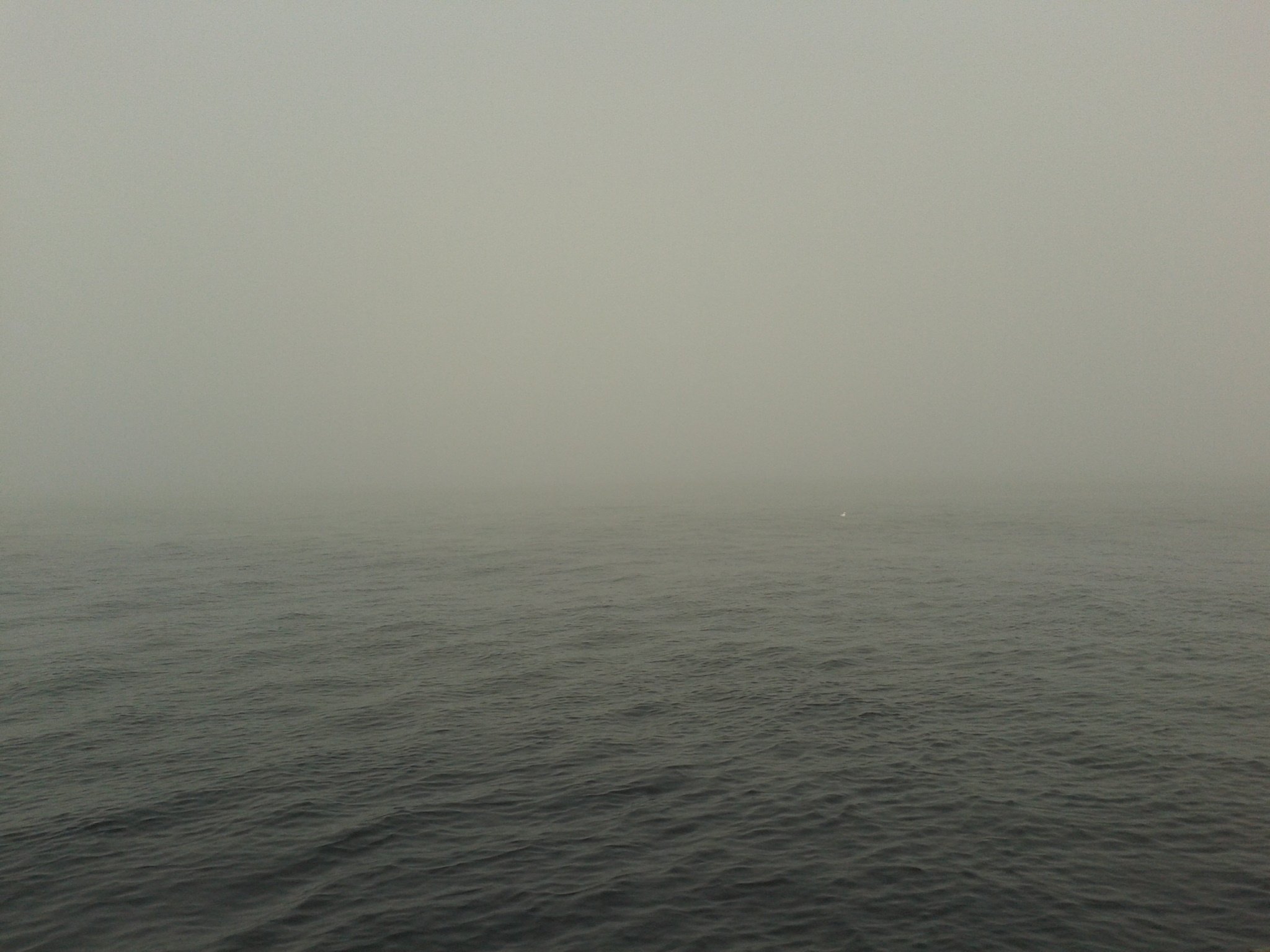
The mist lifts teasingly. The sea brightens, taking on a bluish hue, and above it green-topped cliffs appear, glowing gently in the thin sunshine. They float in the middle distance behind us, tall walls of pale rock which seem to hover in the glistening air. We gaze at them wistfully for a few moments, waiting for the mist to dissipate but instead it coolly closes back in. Once again, its damp vapour envelops us, concealing the sun and any sight of land. All that we can see is the small circle of sea immediately around us and the birds resting upon it: a neat raft of guillemots to port, the odd puffin, a few fulmars sitting placidly astern. Birds fly in from the mist too, like sudden visitations; an occasional gannet gliding low across our bow, a couple of cormorants arrowing along behind. From time to time the burr of an engine approaches and recedes, the low thrumming mingling with the soft roar of surf in the north.
It's a pleasant sonic blend. Usually it's disconcerting to hear things we can't see but we're reassured by the fact that none of the engines have come particularly close. As for the surf, we know we're far enough offshore from its source - the skerry at the mouth of the voe we anchored in last night - to not be in any imminent danger. Indeed, on this quiet sea its sound is quite soothing: a muted white noise rising and subsiding with the sea's slow swell. Nonetheless, its continuing aural presence is a frustrating reminder of our lack of progress. We're trying to sail away from it, to sail west of the skerry and of Papa Stour beyond it, and head north up the Shetland coast, but there must be tidal currents here (not mentioned in our Shetland Islands Pilot), as whichever tack we take we end up travelling some variation of southwards. This wouldn't be an issue if there were any decent wind, but since we cruised out from Papa Stour this morning, it's dwindled so much that even with both sails fully hoisted we can't generate enough momentum to get ourselves out of the current. Instead, we tack uselessly back and forth on faint breaths of air, maintaining some nominal motion but making no headway in the direction we want to go.
I look up to see a lone arctic skua flying overhead. It's heading northwards and I watch its swift passage enviously. I consider the option of turning on the engine, deciding that at this point I'd be willing to put up with the smelly racket it makes, but the skipper's greater patience prevails. "We're out here to sail, not drive," he reminds me, sternly. He's right of course and I respect his commitment to the elements, his determination to harness only natural forces for our propulsion. My drive to keep us moving, however, comes not just from impatience but from a primal desire to avoid seasickness. When we're properly underway I'm fine as in most conditions the boat balances herself against the wind and holds a steady angle, but now that we're losing the wind she's beginning to rock along the axis of her keel, a dull pitching motion which makes me feel heavy and queasy. There's also the noise. With insufficient air flow to hold them steady, the aluminium poles which stiffen our sails - our boat being a junk-rigged schooner - are starting to clank against the masts whose hollow steel conducts the clanking into the cabin below: ta-ka-da-don, ta-ka-da-don. It's quite musical, the same four notes descending in an irregularly repeating rhythm, but I'm getting to the stage where all I want is to lie down and sleep - sleep out the blurry world, sleep off the foggy head, slip away from the growing discomfort for a while. But the mist comes only damper and colder and the battens keep beating: ta-ka-da-don, ta-ka-da-don.
I hug my guernsey close and try to coorie in. It's a chancy thing, going to sea. No matter how settled the forecast, you never quite know what challenges or clemencies you're going to encounter or how you're going to react to them. It's an exercise in ambiguity. Indeed, I've often thought that going to sea is like getting drunk. Casting loose from solidity and sure ground, releasing yourself into a fluid medium where you can no longer maintain the illusion of being completely in control; you're at the full mercy of the world, and of yourself. But being becalmed at sea is more like being hungover: you're not just untethered but adrift, trapped in an uncomfortable lassitude in which your capacity for effective action, indeed, your very motive force, is fatally undermined.
In some ways being befogged takes the edge off it. You can't see that you're going nowhere so the futility of it all is less obvious. On the other hand, the fog increases the sense of disorientation. I think back to our first passage through these waters on our way to Papa Stour a couple of days ago. We got becalmed then too for a while but it was a clear day - the sun was shining and the sea was blue and glossy like billowing silk - and we could see. To the east we could see the pale cliffs of mainland Shetland and to the west, the tall mass of Foula, sitting like a great crown on the horizon. As well as being dramatic to look at, these landmasses provided perceptual structure, visual anchors for our movements, and a sense of perspective. Today there is no horizon. The glassy grey water blends indefinitely into the moist grey air and, with nothing fixed to focus on, it's difficult to keep a clear head. I feel as if the mist is seeping into me. I can neither maintain a continuous train of thought nor dismiss my thoughts which are incomplete and continually dissolving. Even my own body is becoming indistinct, my perceptions and sensations muffled and suppressed. It's as if the four dimensions of spacetime have folded in on themselves leaving only a small porthole of visible certainty. In this shrinking sphere, all I can be sure of is that we are at sea.
That's something, though, and for now it'll have to be enough. In any case the more readily I accept our predicament, the quicker I'll adapt to it. There's no point in resistance - the sea always wears you down in the end, lapping away at you, eroding your edges and defences until only a certain dogged tenderness remains. And like that stage of a severe hangover when you give up trying to do anything and accept your utter inutility, once you succumb to your limitations, you can begin to appreciate what they offer. For all that it's unsettling being at sea in fog, it's also intriguing. We're cocooned from the world, or cocooned within the world, existing in our own private and intimate realm. Inside this realm, everything feels near - the birds seem so close I could reach out and touch them. Yet everything behind the mist seems far away, in another world entirely. I think about our glimpse of the cliffs a few moments ago. Although I can visualise them clearly they have an unreal quality in my mind, as if they're made of a different substrate, a subtler substance than the present reality of the boat; as if they're not a memory of anything real at all but a mirage, a luminous vision, a far paradise just out of reach. I recall our view of Foula a few days ago, an angular silhouette standing proud on the western horizon. Maybe that was an apparition too, its improbable shape a figment of my febrile imagination. Or perhaps a dream-memory, like those dreams of islands I sometimes wake from, full of profound longing for something promised but never entirely understood.
I watch the skipper climb out into the cockpit with two fresh mugs of tea. He's keeping a close eye on our situation, carefully monitoring our position and bearings, and not in the least fazed by the uncanny conditions. I suppose I shouldn't be either: if there's one thing I've learned these last couple of summers' sailing it's that at sea, little is as it seems. Right now, reading our environment is particularly tricky. Not only does the mist obscure all land but it diffuses the light of the sun, producing an even glow which appears to come from all directions at once. And the fickle flurries of wind which come and go make the surface of the sea unreadable for wind direction. Yet even if we had good sailing conditions, the evidence of our senses would not necessarily be consonant with reality.
For a start, where we appear to be heading is not where we're actually going. Our compass shows that we're presently pointing west but our GPS device indicates the direction we're actually travelling over the seabed is south-south-west, a difference of almost seventy degrees. Even if we weren't caught in a current, the compass reading can't be taken at face value since the magnetic north it's calibrated to lies in a slightly different direction to true geographic north, a variation which is itself constantly changing as magnetic north moves around, and which can be further compounded by localised magnetic features.
Assessing our rate of travel can be similarly deceptive. We can gauge our speed through the water by watching how fast the bubbles created by the bow slide past the hull. Yet our speed relative to land, adjacent or beneath, is affected by the movements of the sea - current, waves, swell, tide - all of which may be moving with or against each other, and with or against us. Even the strength and direction of the wind feels different aboard, as the true wind interacts with the wind created by the boat's own movement. What we're actually sailing with is this 'apparent wind' which comes from further forward than the true wind, and depending on the angle we're sailing to it, can be significantly stronger or weaker.
Ach. I sigh at the thought of it all. As I'm discovering, it's one thing to know about these various factors intellectually but another thing entirely to weigh them up and be able to synthesise them into an ever-evolving appraisal of what's going on. The skipper can do it, intuitively grasping whatever's happening and instinctively knowing how to respond. I, on the other hand, flounder. He tells me I just have to give it time. It's a lot to get used to, this tangled web of forces and counter-forces, this drifting pool of elements we inhabit. Yet I suppose being at sea only makes plain what is always true: that we exist only in relation, that we live in flux and flow. Even ashore, the world is on the move. Shorelines rise and sink, beaches get blown away, continents shuffle together and apart, human allegiances continually shift and re-form. There's little we can trust to remain stable. Indeed, at the moment we can barely trust our own perceptions. I sip my cup of tea. But we can trust each other, and I focus on that as we float here in our misted cocoon, on our secret and shoreless sea.
Alison Roe is from Edinburgh and now lives on the north-west Highland coast of Scotland. She’s always been drawn to the sea and the north and is currently writing a book about a sailing trip to Arctic Norway. She has had work published on the Scottish Mountaineering Press Creatives platform and in Northwords Now and Stravaig (the journal of the Scottish Centre for Geopoetics). When not writing, she's usually up a hill, playing taiko (Japanese drums), building dry stone walls or flitting around in her van, a mobile writing studio which doubles up as drum transport. Her musings on all this wash up intermittently at solanoire.com.