
In the Dark, Things Grow — Irpinia
/
By Roberta Cicinskaitė
Irpinia is not on most maps that matter to tourists. It sits inland, in the Campania region of southern Italy, tucked into the folds of the Apennine mountains, far from the Amalfi Coast, far from Naples, far from anywhere that appears on a postcard. Its name comes from hirpus — the ancient Oscan word for wolf. That alone should tell you something about this place.
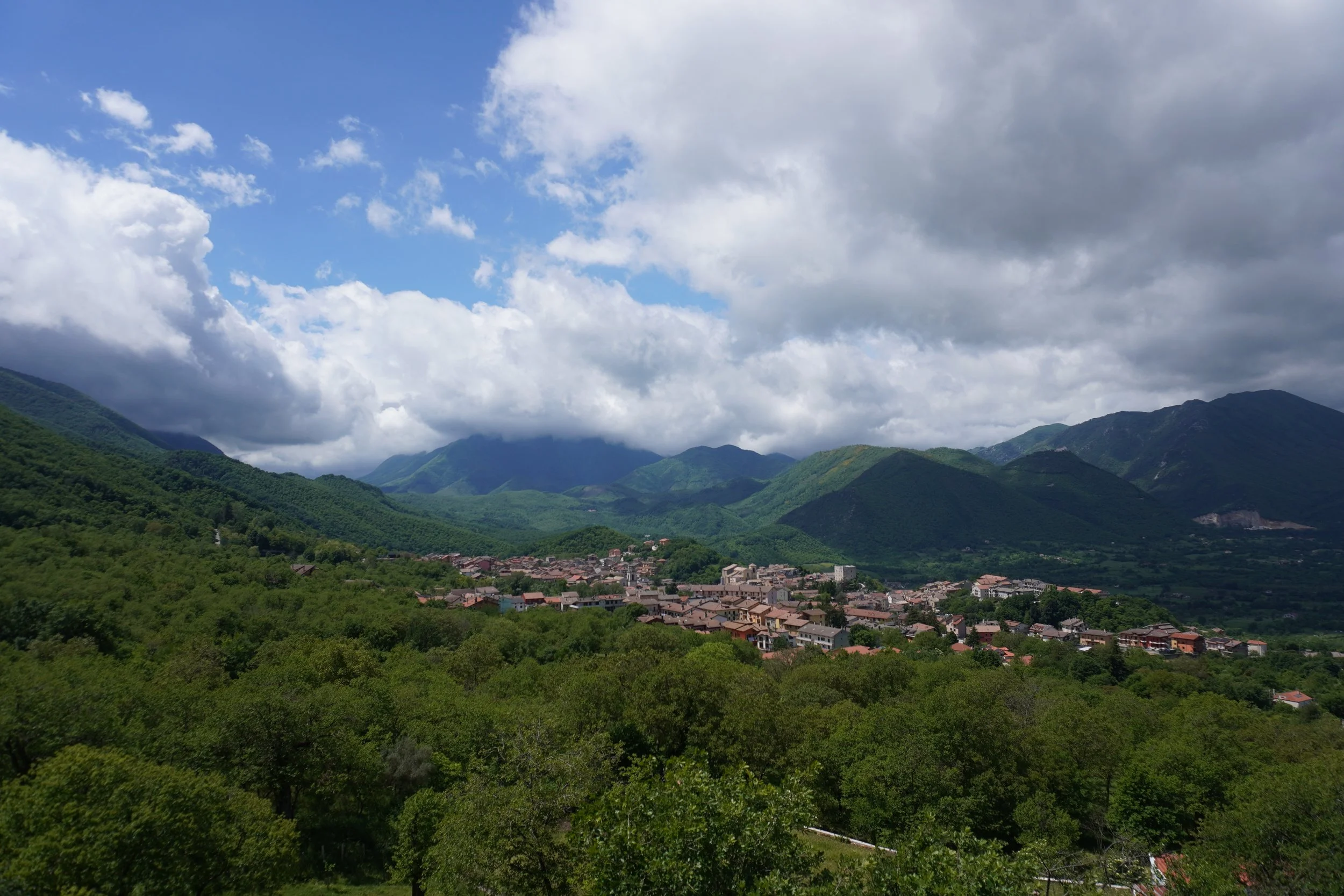
I arrived in May. Not yet summer, warm enough for a denim jacket, the forests still holding the humidity of spring, exhaling it slowly into the afternoon air. The roads wound upward through deep green. The kind of green that feels deliberate.
Irpinia has always known how to hold things in. Including catastrophe.
The region sits on one of southern Italy’s most active seismic zones. Earthquakes have shaped it for centuries — in 1694, 1857, 1930. But the wound that has not fully closed is November 23rd, 1980. At 7:34 in the evening, a magnitude 6.9 earthquake struck — one of the most devastating in modern Italian history. It lasted barely ninety seconds. Nearly three thousand people died. Around three hundred thousand were left homeless. Hundreds of municipalities were damaged, dozens razed entirely. The shaking was felt from Sicily to the Po Valley. And when daylight came, it revealed the full scale of what ninety seconds could do. I kept thinking about that. Ninety seconds.
But Irpinia did not disappear.
* * *
The waterfalls of Montella arrive before you are ready for them.
You hear them first. Then the green parts and there they are — water so clear it almost hurts. Tears from the earth, I think. Kama muta. That wordless welling before language arrives. The same earth that trembled, now touched by murmuring water, as if making peace with itself.
Even the street art here pours. Painted waterfalls on stone walls, spilling into imagined buckets. As if the whole town understood — if the earth can turn its grief into something this clear, so can we.
* * *
On a high hill above Montella, surrounded by ancient chestnut woods, stands Monastero di Santa Maria della Neve — Saint Mary of the Snows. It dates to the 15th century, a period when wars and plague had nearly emptied this part of Irpinia. By 1532, the hillside settlement it overlooked had been abandoned entirely. Six families remained. Then none. The mountain fell silent.
And yet the monastery stayed.
Across the valley, on Monte Sovero, another bell tower rises. You notice it from a distance. Some still climb it — to ring the bell themselves.
You’ll need patience to reach both peaks. A willingness to climb when faith is the only map.
* * *
This is the land of Saint William of Vercelli, who died near Nusco in 1142 and remains its patron saint. The most famous story told about him is simple and strange. A wolf killed the donkey he used for his work. William commanded the wolf to take the donkey’s place. And it did. The wild thing became tame. The predator became a companion.
Irpinia has never forgotten this. It spent centuries proving that wildness, when met with patience, can become something you live alongside.
I came to Irpinia with Klaus — a young Lagotto Romagnolo, the ancient breed used for truffle hunting. He carries the instinct in his blood: to press his nose into the earth, to follow a scent into darkness, to dig, to find what hides beneath. Bringing a Lagotto to Irpinia felt less like coincidence and more like a homecoming.
* * *
A dusty road leads to La Tartufaia. The evening air is thick with perfume before you arrive. Tall bushes of roses in front — different colours, extravagant, unexpected — petals scattered on the ground. It catches you off guard. And here the senses layer: the waterfalls you heard before you saw; these roses you smell before you find them.
At La Tartufaia — an agriturismo, a working farm and table dedicated to the culture of truffle — Klaus immediately found the donkey. They met through the fence, both pressing their noses forward with great seriousness, two creatures following instincts that didn’t need language. I thought of William. I thought of how some things haven’t changed in a thousand years.
The truffle hunters of Irpinia know this bond better than anyone. For centuries they have walked these hills with their dogs, not commanding them but trusting them. The dog nose goes where no human sense can follow, into the dark beneath the roots, finding what is hidden. The human brings the dog home. The dog finds the treasure. Neither can do it alone.
Inside the restaurant, Padre Pio sits quietly on the fireplace mantle.
Not displayed. Not announced. Just — there. Present, as faith is in places like this. Woven in. The fire is burning and the warmth hits your face as you sit down and something in you exhales without deciding to.
The owner moves through the room without ever needing to perform warmth.
He introduces his animals with particular affection, including the donkey, whom he defends with genuine feeling. “People are so wrong,” he says, “to use the donkey as a synonym for stupidity.”
The family hunts truffles. They always have. Here it is the Tuber Mesentericum — known locally as tartufo nero di Bagnoli, the winter black truffle. It grows underground in symbiosis with tree roots — oak, beech, hornbeam, hazel — taking months of precise conditions to reach maturity. Its scent is sharp, almost medicinal. They call them black treasures. And so they are. A mild bitterness on the tongue that opens into something earthen and deep, best enjoyed raw, shaved thin over pasta or eggs so the heat of the dish does the rest. Once you taste one, it carries you somewhere underground. Somewhere that was always there, waiting — in the dark.
* * *
In Bagnoli Irpino, Ristorante Braceria Casa Dell’Angelo.
A grandfather, his sons, and their sons — three generations moving through the same room, the same trade, the same warmth. The grills spit fire and the steaks lean into the heat, their juices meeting the flames in a sound that is itself a kind of welcome. The youngest, nine years old perhaps, brings bread to the table with a seriousness that makes you smile. The meat arrives with funghi porcini, dense and woodsy, with a richness that feels almost meaty on its own, and shavings of tartufo. Angelo and his sons joke about life with such ease that you forget, briefly, that you are a stranger here.
At some point, Angelo looks at us — and Klaus — then laughs, says we should get married, have children. He says it lightly, the way people do when they have never had to question the shape of their life.
We laugh too.
Before we leave, they bring out small glasses, their own digestivo. Something made from what grows here: herbs, roots, time. We stand near the grill a while longer than we meant to, the afternoon stretching without asking anything of us.
It takes a while to leave.
Outside, the sun is still high. The mountains hold it quietly. We step back into the road with warmth still settling somewhere beneath the surface.
Driving back through Bagnoli, I see broken churches. The 1980 earthquake damaged or destroyed hundreds of religious buildings across the region, bell towers, castles, medieval sanctuaries. Some were rebuilt entirely. Others stand half-joined to what remained. Old wall and new wall, side by side, inseparable now.
As long as the bells are not broken, they will call for mass.
* * *
In Nusco — a borgo of around four thousand souls, perched at 914 metres above the Apennines, and one of the Borghi Più Belli d’Italia, Italy’s official register of its most beautiful villages — the coat of arms stops me.
Three hills. And above them, something grows. Rooted. Reaching. A tree shaped like a truffle, a serpent coiled around it.
Prudens sicut serpens.
Wise as a serpent.
Not the wisdom of conquest. The wisdom of those who know their ground. Those who have been shaken from this mountain more than once and chosen, each time, to stay. Those who understand that survival is not loud — that what endures does so quietly, close to the earth.
Irpinia has always known.
The truffles are still maturing in the dark.
The water is still falling.
The bells are still ringing.
Places visited: Montella, Nusco, Bagnoli Irpino.
Roberta Cicinskaite is a Lithuanian writer and musician currently completing an MA in Comparative Cultural Studies. She has lived between Lithuania and southern Italy — movements that left their mark. Her work explores questions of place, memory, and belonging, often following what lingers quietly at the edges.