
River at the Pasture’s Edge
/
By Peter Novokreshchenov
Beacon Card No. 9730
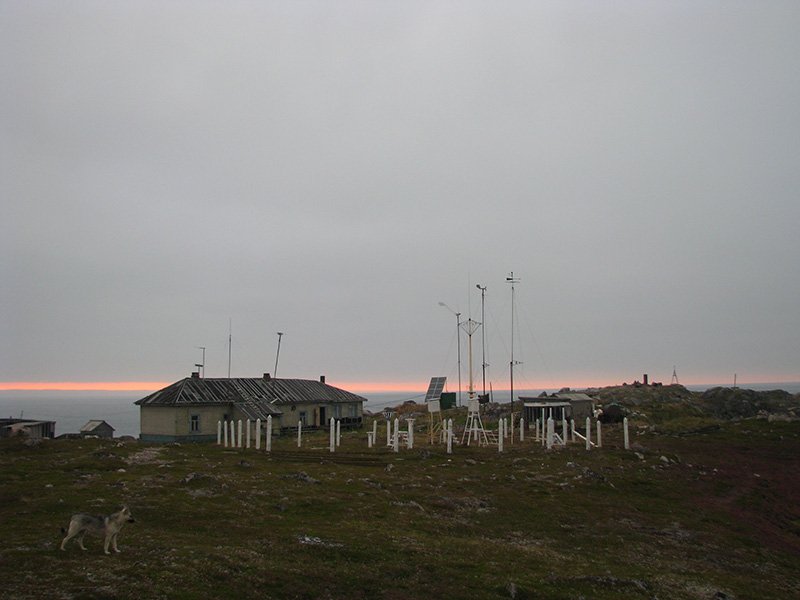
Name: Khodovariha Beacon
Geographical coordinates: 68.93277°N, 53.76278°E
The turquoise glaze of a cold, northern sea had spilled over, flooding the sky, and now white shards of ice were drifting right through the horizon. They peeled away from the surface of the water and sailed above my dwelling, heralding the coming thaw.
Type: Terahertz radio beacon
Broadcast frequency: 215 GHz
I sat on the upper floor, drinking tea and thinking about the dream I had been seeing for several nights now. In this pre-dawn hour the kitchen was still submerged in a thick, viscous gloom. Through it, dimly, emerged the edge of the table with its yellowed cloth, a pot-bellied kettle, pale mugs. And with the light, smells were also waking up: flowers of morning frost bloomed lazily, and beneath the ceiling gathered smells of dried rhododendron leaves, of mushrooms, of berry jam.
For me, these were the smells of boundless eternity, of green, ripe happiness — I closed my eyes and started to reminisce. Mossy tundra carpet under my feet, sand, cold sea, and the utterly inexpressible feeling of sparkling Bengal lights in my chest, which formed the moment I climbed into the dish of the Beacon and cast my gaze across everything around me.
My edge of the world.
I picked the cloudberry jam myself. In summer the little berries hid, merging with the rust- coloured earth and the sand blown in from the sea, playing hide-and-seek with me. Cosmic radio beacons are almost entirely autonomous systems — a human operator is needed only in the event of a critical failure, and in my half-century at the Beacon one never occurred. So there were days on which I just sat in the living room watching for hours as the wind ruffled the sea and the sand behind the window.
Sand. Now it drifts in, now it is carried away. Water follows it. The ground beneath is like a tail of some prehistoric lizard — swaying, retreating further from under my feet with every passing year. From under the Beacon.
After all, it stood on a sandy hill, and deep below it the icy threads of permafrost ran far into the earth, biting into the tender tissue of a mycelium foundation. An octagonal giant, as if hewn from a mammoth’s tusk, had stood for two centuries amid shallow lakes.
I remember how it fell.
Construction notes: Beacon No. 9730 was built using mycelium bricks. This material is characterised by high indices of thermal insulation and fire resistance; however, if the temperature regime is disturbed, it decomposes rapidly.
On that summer night I had climbed once more into the dish that crowned the Beacon. To be inside it was strictly forbidden, but for many kilometres in every direction there was not a single living soul, and so I lay down, settling as close to the centre as I could, and began to take in the briny coolness that had all of a sudden surged up from the sea.
The shape of the dish made the whole structure look like an enormous mushroom — a white porous stalk topped with an inverted parabola of an antenna-cap. The moon rose into the sky. My gaze grew hazy, and I thought about the space ships now moving between the Earth and the Moon, about the invisible thread of radio waves on which they were strung like knots, about the eternal void that begins where my dear Khodovariha ends.
It seemed to me that the mycelium beneath me had taken on the damp, interlaced roots of plants, and that in the sky, in place of stars and satellites, small log cabins and spherical weather stations hung — the kind I had so often passed on my walks along the Kuznetsk Bay.
Then, suddenly, the star-infinite sky tightly hugged Khodovariha, the Beacon, me — my body seized by a strange rush of lightness I had never known. I should have been alarmed, but it was an unusual night.
The next moment the antenna-cap turned, tilted, and began to slide from the stalk. The Beacon was falling.
Under its own weight the rotting mycelium crumbled into damp clumps. Chairs fell, striking the frozen ground with a crack; wardrobes fell; plastic containers of sensors and analysers went scattering; mugs and jars of cloudberry jam shattered.
I got separated from the dish, thrown out into the black ocean of night. And before I had come back to my senses, the parabolic antenna struck the ground and fractured in half.
Transmitter height above sea level: 36 m
Waking up the following morning, I understood that I had seen for the first time what among radio-beacon keepers is called a static dream. The merciless symptom of terahertz radiation exposure. They say that one keeper in five falls victim to them sooner or later. Static dreams are mercilessly constant: the only escape is to leave the beacon. They get stuck, lodged in one’s mind — beating inside it until they seep into reality. As is to be expected of dreams, they do not come true with exactitude, but I knew enough to understand: my giant mushroom was doomed.
From that point on, every night I had the same dream — I fell together with the Beacon.
Repair and restoration: Restoration deemed inexpedient
For several months I was sent to the mainland on assignment. When you live away from a radio beacon the dreams cease. Memories, however, do not. I soon found myself counting the days, languishing as though in a cage, trying to drive away the thought that the Beacon would fall without me near it.
Even the most harmless and everyday things reminded me of it: white velvet-patterned wallpaper, the rustle of dry leaves, the diffuse light of the sun falling patchy through tree crowns.
When I returned to Khodovariha, I began to tend to the Beacon as though it were a gravely ill relative — inspecting it each morning, cutting away the rotting crust at the base, pressing sand into the foundation. My happiness had refracted strangely into a burden.
The awareness that the former carefree life was becoming ever less recoverable came at night, as I wandered in the dark, sheltering in the noise of the sea from the static dreams. Sometimes I went very far out and returned only at dawn, and felt a weary gladness seeing from a distance the mushroom silhouette of the Beacon.
In those days it seemed to me that fate itself had come to grips with me — the wind, as though possessed, scattered the sand with doubled force, and moisture gnawed relentlessly at the foundation.
There were times I was so utterly emptied that I thought of burning the Beacon, putting an end to our suffering.
Maximum broadcast range: 0.0035 AU
Beyond the window it had grown light. I finished my tea, put away the jam, and went to a small table in the corner of the room.
On it, arranged by my own hand, lay memories. In plastic containers of different sizes, moss was growing, along with berries and miniature tundra flowers. And in the centre, in a large container, small yellow mushrooms were unfurling their caps. They rose from a mycelium brick wrapped in film and covered with a faint bloom of condensation.
Their fragrance is delicate, subtle — I would know it among a thousand. A lightning-bolt of memory: I am cutting this brick from the wall of the Beacon while it is still standing, but already condemned as unsafe. It will fall in the night while its keeper suffers, sleepless in the house nearby.
The very house in which the container now stood, with its fragment of the giant mushroom. In the morning I will go out to the sea. The antenna-cap will be resting in the matt water, which looks like lard because of small ice crystals shifting on the surface.
The Beacon that had stood with its shoulders thrown wide, in its full colossal height, remains in the past. Those days are gone, and between the lakes new moss is already growing. And yet the memory, preserved in the small yellow mushrooms, lives on. The Beacon fell, but I am still standing.
Current status: Irretrievably lost beacon
Peter Novokreshchenov (2002) is a Russian writer, filmmaker, and artist. His work, centered around weird fiction, spans several years and includes short films, paintings, stories and novelettes. Being a "contest first" writer, he publishes snippets of his work in various anthologies and on his blog: novoookrr.blogspot.com.