Unanchored things, displaced people
/
By Kat Hill
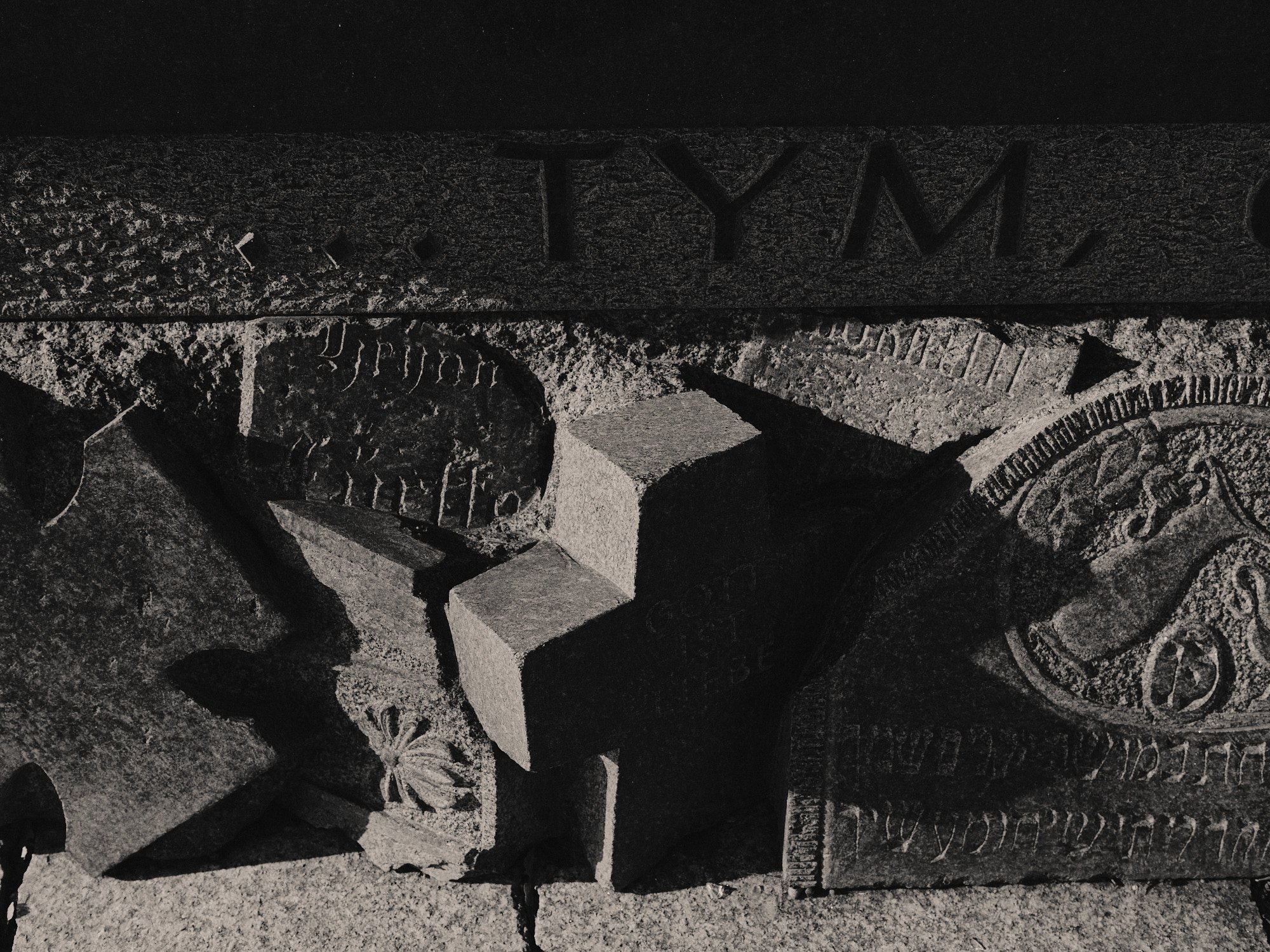
It’s a cold day in early February; the air is still and the sun bright. A pair of metal gates adorned with the tree of life face the road that runs through the city of Gdańsk. Inside are fragments of gravestones and tombs that have been splintered and cracked apart by violence and neglect. They come from the many communities who have called the Vistula Delta home. Polish names, German writing and Hebrew script adorn the marble and the stone which have been placed on the site of the former Corpus Christi and Lazaret Cemetery. This place is now known as the Cemetery of Lost Cemeteries. At the far end is a monument with an inscription of a poem by Wisława Szymborska: ‘They walk out of the untold, return to their names’.
Gdańsk is a place characterised by moving identities and shifting ideas of belonging. It has changed statehood countless times throughout its history and also been a free city. Often caught between powerful political actors, it has been subject to violence, dispute and conflict, as a result of which people have been displaced and ostracised. The destroyed and abandoned cemeteries across this part of northern Poland, cemeteries which once reflected the mixed religious and ethnic belonging of the place, are a poignant reminder of this past. Some were destroyed in the Nazi occupation; others were victims of policies after the war in the Recovered Territories of the USSR. Cemeteries mark settlement and rootedness. To lay the dead in the ground is also to lay down presence that connects the past and the future. Destruction and neglect tell of the material memories of communities that have become severed from those who placed them there.
Here, in this small corner of green land in Gdańsk, material objects that were displaced and unanchored from the ground where they were laid are gathered together once more. It is a decision made (the gates tell us) ‘in unity in the face of the death of all the departed, regardless of religious adherence or nationality.’
Displacement has a material dimension. The flight of refugees, political upheavals and the exile of communities exists in a world of things and objects. I have thought about this often as I have worked on the Mennonites in northern Poland and beyond. It was for their cemeteries, now abandoned, that I first came to the area. They are communities who have moved many times, sometimes through choice, sometimes force, and there is always a materiality to that movement. I remember being particularly struck by death sheets in a museum in rural Kansas, the white robes that all nineteenth-century transatlantic migrants had to bring with them in case they died at sea. They would be thrown overboard, wound only in the sheet, in stark contrast to the solidity of a cemetery in the woods.
It made me think about the material dimension of migration more broadly, particularly forced migration and displacement. The loss of things and material devastation is a reality for any group of people who have to move at moments of violence and conflict. People who are cast from their homes in war and terror, as is happening all over the world, must leave behind the objects that gave their lives joy and meaning. A few years ago, the International Rescue Committee asked refugees what was in their bags. It’s a heartbreaking list. A 6-year-old child with one change of clothes, bandages for scrapes, and marshmallows with sweet cream. A 20-year-old artist with a shirt, guitar picks, and a rosary from his girlfriend. Cast into the world, away from what they know, they take with them a few treasured possessions.
As people leave, their absence is betrayed by the presence of what remains. UNRWA described reaching a school in Khan Younis in Gaza last year, hastily abandoned. ‘There’s shoes on the floor, there’s hairbrushes, toothbrushes, even bits of food just left behind.’ Things are cast aside on journeys or in flight, and everywhere the material remnants of the displaced, the dispossessed and those who are adrift scatter the landscape. There’s another poem by Symborska about the experience of refugees, ‘Some People’:
Some people fleeing some other people.
In some country under the sun
and some clouds.
They leave behind some of their everything,
sown fields, some chickens, dogs,
mirrors in which fire now sees itself reflected.
How can a thing stand for the human experiences of migration, displacement and violence? How might we represent and memorialise this?
I remember visiting the Folk Museum in Vienna once. It’s full of objects which speak to an idea of what culture and nationhood might mean in Austria, a traditional, deeply rooted memory of land and place.
But scattered amongst this was a material memory of a different kind. A smashed phone. Dirty bags. They felt out of place, washed up here by some strange storm, but this was precisely the point. These were the unrooted material things recovered from migrants and refugees who had been fleeing with what little they could. One is a bag accompanied by a label that tells us that 10 to 15kg of luggage is all that remains of most refugees’ possessions. Such objects scattered amongst the permanent exhibitions provide a counternarrative to the main themes of the display.
Other museums have also experimented with exhibitions which have tried to document the fragile archaeological record of migrant lives. An exhibition at the Pitt Rivers, ‘Lande: The Calais ‘Jungle’ and Beyond’, collected material and visual culture from the ‘Jungle’, the temporary migrant and refugee camp as it existed in Calais from March 2015 to the demolitions of 2016. By that time, 10 000 people lived in this place and the material on display was on temporary loan from displaced people, activists and volunteers who lived and worked at the ‘Jungle’ as witnesses of experiences of “human precarity, resistance, creativity, and hope.” A political grouping, the Askavusa Collettivo (Barefoot Collective) in Lampedusa attempted to construct a museum to migrant experiences. Lampedusa is a key entry point for migrants coming across the Mediterranean from Africa, often now on small boats. The exhibition featured everyday objects such as shoes and food coming from these boats. In 2016 Manchester Museum collected a lifejacket from the southeast coast of Lesvos for its new thematic collection examining migration.
The lifejackets are a bitter reminder of how many are lost to the waves as they make dangerous crossings. Anthropologist Jason De León, who has worked on migration across the Mexican border in the Sonoran Desert, explores the scant archaeological and material record of migrant experiences, and the dehumanization of people even in death. The desert here exacts a form of necroviolence, since it not only claims victims, but the physical environment destroys the bodies in ways which leave very few remains and do not allow for proper burials.
These efforts ask how we make a monument to the displaced and the refugees, for those adrift on the currents of the world’s turmoil, and how we memorialise what is always in motion and unstable.
In his poem ‘Unpeopled Eden’, American poet Rigoberto González writes of a scene after an immigration raid. There is the tree who will ‘weep at the pillage’, surrounded by ‘debris:/ straw hats, handkerchief, a basket.’ Below one tree is a red shoe that looks like a strange apple.
Shoes. Always the shoes. Shoes hung from the roof of the museum at Harbour M in Lampedusa. Shoes below a tree. Shoes cast aside on the road.
On one day during the trip to Gdańsk, I make a visit to Stutthof Concentration Camp. As is so often the case in memorials that try to bear the weight of the terror wrought by the Nazi regime, one room has all the shoes, piled up as the irrevocable symbol of the horror of genocide and mass murder. Shoes bereft of their owners who were torn away and who would never again walk the ways of the world with freedom. They are encased in glass, motionless yet somehow cast up like the debris of a terrible shipwreck.
Kat is an author and researcher based on the Isle of Skye. Her work focuses on questions of community, belonging and environment, and explores the nature of our material, creative and collective existence, as well as human and non-human encounters. She is the author of the prize-winning book, Baptism, Brotherhood, and Belief: Anabaptism and Lutheranism, 1525-1585 (Oxford University Press, 2015) and her second book, Bothy: In Search of Simple Shelter was released with William Collins in Spring 2024. It was shortlisted for the 2024 Wainwright Prize for Nature Writing. She is currently working on a book project called Endlings, which is an examination of the meaning of endings, last things and extinctions in an age of crisis.