
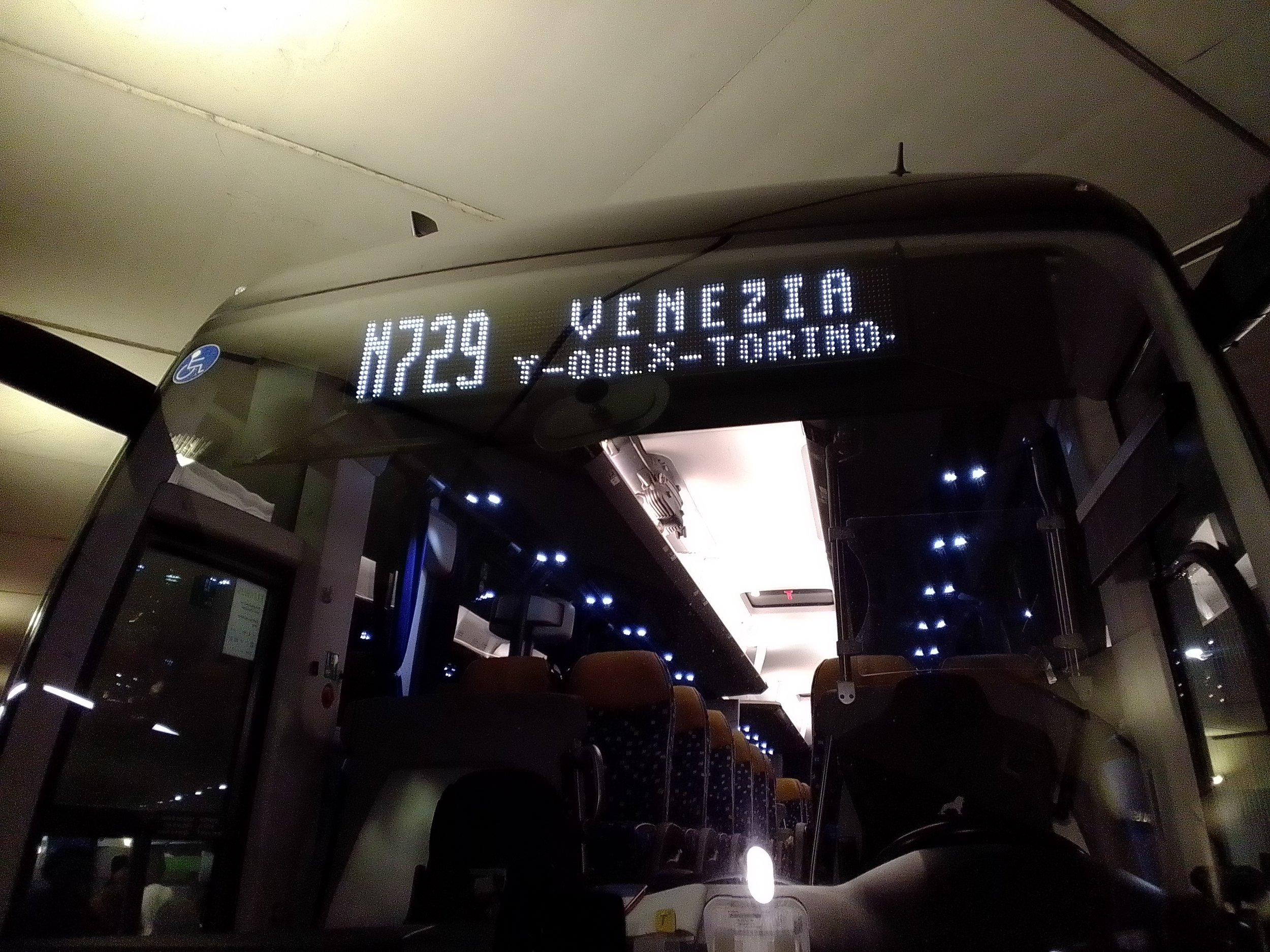
The Flixbus from Paris, Bercy
/
By Ben Morris
I'm back on the bus. I'm a no-flyer, and Paris-Turin trains are still out.
The trains are out because the seasons are all wrong and the mountains are crumbling. A rock slip in August 2023, a dozen or so kilometres on the French side of the Fréjus tunnel, swept away the line. Unlike the autoroute, which runs on the valley floor, the engineers of the great railway age built their line right into the crook of that great rock mass. When something falls, that's where it falls. In daylight, if you go that way, you can see it from the road, the mess it made of the railway line and the sheer, high, straight-up vertical face. You can see them working up there, high-vis vests crawling over the rock face, the puffs of dust as another pin goes in and the steel netting goes up.
I see evidence of the wrecked climate each year in the vineyard; the three years of drought in Italy while France was under water; the increasingly randomised seasons; the summer temperature extremes which used to last a few days but now last for weeks; the extreme weather events. Each London-Turin flight dumps, by my estimate, 24 tonnes or so of CO2 into the high atmosphere and I don't want my name on any part of it.
There are other ways to get to Turin, but if you refuse to fly — unless it's an emergency, unless there really is no other way — it can't be done in a day; no combination of trains and buses will get me from London to Turin in time for the last local train to my house on the hillside, so it's either an overnight somewhere — a hotel and an extra day's travelling — or the overnight bus from Paris.
Looking back through my diary I find I did this trip nine times in 2024. And here I am again. Trains are promised again for April, so maybe this will be my last time. But maybe it won't be.
So Bercy.
It's on the river, on the north side, well out of the fashionable centre, a little way beyond Gare de Lyon. It gets a couple of pages in Eric Hazan's The Invention of Paris. Once it was working quayside — wine wharves and wine warehouses for barrels shipped in on the canals — and the streets, when not named for the heroes of the Cinémathèque, which is on one side of Bercy Park, are named for the crus of France; Champagne and Chablis, the Mâconnais, Saint-Émilion and Saint-Estèphe. Once, there was a grand chateau here which rivalled Versailles in its splendour, built as a riff on the palace and park at Greenwich. But the wine warehouses expanded beyond the riverside and the chateau fell into disrepair and its parklands were swallowed up by the railway. Bercy Park, with its gardens, its parterres, its orangerie, its little vineyard — someone's pruning there today — with its one remaining ruined wall of the Petit Chateau — a parkland folly — is what remains of it.
Paris once had its own vineyards too, as did London (as the street names still attest: Vine Street, Grape Street, Vineyard Walk). Rousseau in The Reveries walks up Rue du Chemin Vert, just a bit above Bercy, to what is now Père Lachaise. Up there between the heights of Ménilmontant and the village of Charonne, in that “delightful countryside” — now urban Paris — he walks the paths through the vineyards and meadows:
A few days earlier the last grapes had been harvested; the walkers from the city had already left; the peasants, too, were leaving the fields, not to return until their winter work began. The countryside, still green and radiant, though some of the leaves had fallen and it was already almost deserted, was the very image of solitude and the onset of winter.
The bus, in winter, can make you feel like that; the evening coming on; the strobing lights of the traffic, the unending rhythm of the road beneath you; the fuzz of snow on the ground at the first rest-stop. I have my own winter work to begin in the vineyard when I finally get where I'm trying to go.
The gare routiere is a concrete bunker on the far side of the park, half buried beneath the riverside expressway. There's an outdoor gym, blasting out French rap, where pumped-up black youth come to work out. Inside it's cavernous, grotty, a haze of diesel fumes. The toilets stink. Muzak from tinny speakers competes with the booming basslines leaking in from the bodybuilders outside. It's all noise and attention deficit; the hissing of air-brakes, slamming shut of baggage-hold doors, starting of engines, shutting off of engines. You're here with the young, the backpackers in ones and twos and sometimes threes; and the indigent and the migrant, and the jobless; with the less well-off and the downright poor and the darker skinned. But watching the departure boards it's hard not to feel the magic in the names of those destinations: Ljubljana, Napoli, Perpignan, Prague, Madrid, Berlin, Amsterdam, Lisbon. From here it seems you can go anywhere, direct.
If you walk down from Gare de Lyon, whichever way you come, the first thing you see is the improbably long span of the Ministry of Finance, one of the grand projects of the Mitterand years, built on stilts and running up from the Quai de Bercy where its feet are planted in the Seine, crossing the riverside expressway, its sideways face meeting the curve of a slab façade and a thousand blank windows across from the Arena stadium. The Ministry moved here from the Louvre in 1989, the double-centenary of the Revolution. Bizarrely, Bercy has become a protagonist by proxy in the life of the nation; you read it in Le Monde: “Bercy thinks”, “Bercy says”, “Bercy will”, “Bercy won't” by which they mean, The Ministry or The Minister; the economists, the powers that be, as if the English were to say “Whitechapel” or “Shadwell” instead of “Threadneedle Street”.
Past the Ministry, past the Arena, past the hotels — a Novotel, an Ibis — past the hire-car offices and the Arena parking, the Franprix and the radiology centre, finally there's the Cinémathèque, and behind it the park. Winter sky, bare trees, it's grey, chilly. But sitting there in the Cinémathèque café — Café Lola; L-O-L-A-Lola — with my bags and a glass of wine, under the watchful gaze of a wall of film posters — a Truffaut season, Antonioni's Blow Up, a Méliès brothers retrospective, a season of Asterix films — I think, I love life. If only I could remember that at all times. Travel makes you feel the romance of other lives. Travelling alone brings on a state of open-ended solitude; you can think, write, read, make your way slowly, at your own pace; you can just be there, absorbed in it, immersed in the surface of others as much as in your own thoughts. Life is immense, its immensity is its whole point; you feel it.
But now it's 5 p.m. and I'll be sitting on a bus for the next ten hours. I have time in hand, so bags over shoulder, I take a long loop through the streets. On Rue de Bercy the library doors are shut and the cafés are filling up. The evening is arriving. There are little gatherings of fathers — Arab French men, the colonised — outside the cafés. They gather for coffee and to smoke, cigarettes not vapes, to pause for ten minutes' friendship between school or after-school and home, while the kids look at each other shyly and cling to their fathers' legs. Bercy is poor. The roads and railway tracks run through it. Most people who come here, come for something else. If I lived in Paris it's almost certain that I wouldn't live in Bercy, because Bercy is not where people like me live, and probably not people like you either.
But France is France, and in these streets you couldn't not know, because you see it everywhere, carved above the doorways of the schools and crèches — carved into the stone above the library door — that this is a Republic — it says so; all are born equal, and live equally, in the eyes of the secular state.
My first time on the bus, the Cinémathèque was closed (there was some event going on). I sat in a café across from the stadium. A couple and a youth, perhaps their son, dragging broken bags with broken wheels and what looked like the rest of their world in two huge plastic laundry bags, stopped and sat down at the pavement tables. The man and the boy brought out Heinekens, watching the door carefully because they hadn't bought their beers here. The three of them seemed to be squabbling about something. Then eventually the other two sent the boy in to buy a lottery ticket. He took it back to the table and presented it to the woman, his mother or so I suppose, in an almost furtive way. And then with great concentration she slowly scratched the card; intense hope, focused for a moment before the bubble bursts and life resumes its broken-wheeled course. It could have been a scene from a Bresson film.
The bus — it's a shiny, new, dark-windowed double-decker — leaves on time, merging into the expressway traffic, heading back towards the Arena and the Bercy bridge. It's not quite dark. Instead of crossing the bridge, where the Metro trains rattle above, the bus loops around and we double back and go out on this side of the embankment, out beyond the end of Bercy park; We Work, the Pullman Hotel, the old Gare Périphérique, abandoned, a place of ghosts; and suddenly eight lanes of traffic coming in all directions; the old peripheral boulevard is somewhere there — its sections named for the marshals of the First French Empire, Napoleon's marshals — and then we're up the ramp and onto the Périphérique proper and the signs flash 9 mn to Porte d'Italie, though surely from here you could almost reach out and touch it. Paris traffic is dire and it's a lousy time to travel, evening rush hour, even if — from a journey point of view — all other times are lousier.
Across the river it's all shabby office blocks and cheap hotels and grey blocks of flats and Fitness signs and a stop-start sea of red brakelights; somewhere through the underpasses and overpasses we pick up the A6 autoroute and begin the journey south. An Ikea, another round of hotels and Fitness, more block after block of flats, the newest blocks built right up to the motorway shoulder as Paris keeps on and on repeating itself. A ribbon of winter trees marks out the road ahead. A shallow basin of new suburban housing opens beyond the trees. No lights on the bus this time, just the glow of the night-light strips. But there's light enough to write, or read. The bus is three-quarters full, there are no free seats to move to. I feel hemmed in already.
An hour in — more than an hour in — and we're stop-starting again. Slip roads feed in and out. Up ahead the lights of a suburban train move slowly across a bridge. The train goes on for a long time. We crawl on into the night.
On the concrete side walls and on the bridge piers are the graffitied slogans of the PCF, the Communist Party; and Mélanchon looking out from the shreds of election posters for La France Insoumise; except that we all are, surely, bowed and beaten. I was there, whenever it was, coming through Paris before the last election. I liked the look of the young people leafleting for the Insoumise. I don't think they thought they could win. I think they thought they could keep the fascists out, collectively, as a popular front, and they did.
Burger King. Chronopost/DPD, acres of lorries and a sea of containers. Suez, more acres of lorries. I think I see the lights of Orly, the lights of runways; did the last sign say Sortie 5 or is that the next one? And then it's busy still, but finally we're moving more of less freely. A sign says Lyon four-hundred-and-something, and then it's the first payage and there's no doubt we're on our way.
Somewhere before the A6-proper begins the skinny man in the seat across from me, who has carefully taken off his shoes, lays a prayer mat out in the aisle and places himself on it, facing forwards, to say his prayers. On the Metro this afternoon I watched someone reading his Koran, mouthing the words, fingers on the page, pocket sized but printed large — I reckon fifteen lines if that, maybe fewer — it seemed rude to count — all arabic swashes on thin bible paper. I thought of those beautiful Gutenberg bibles. I listen to the murmur of the man who's now praying beside me, there on the floor of the bus. He finishes, rolls up his mat, sits back in his seat and plugs himself in to watch the football on his phone.
Me, I travel like the bourgeois I am; I have lardons from the baker just off the canal, a baguette sandwich from the baker on Rue de Lancry, two small white wines I bought on the Eurostar which I'll drink discreetly from a paper cup, later, while the devout around me snooze.
A child gets stuck in the loo. All hands help. The co-driver comes to coax him out, talking him (in Italian, which the boy certainly doesn't speak) through the intricacies of the broken door lock.
And then I doze. I didn't sleep well last night. I never do before I travel. It's a wrench. I hate to leave. I have to leave. I wish I wasn't going alone, but I want to be alone, because that's the precondition for writing. And I have to get back to my house because there's a vineyard to be worked and a garden to be kept and the vegetable garden to be prepared and the year won't wait.
I'm half asleep when we stop for a ten-minute break somewhere after the signs for Beaune. There's a chill in the air, swirls of fog. I know the route, more or less, from the days when I used to drive this way, dawdling on the N-roads, dawdling through the vineyards on the D-roads; Dijon, Gevrey, Nuit-St-Georges. Later through the fog and night I glimpse the church spires of Tournus, lit up behind the treetops, the light bleeding through the fog, and the lights of the Kiriad Hotel off the motorway, where I stayed once with my son when my jeep lights failed on the drive home. I look for the lights of the bridge. The Saône is wide here. Knowing it's there, you sense its presence somewhere out beyond the shadows.
I can't think of Tournus without thinking of Saint-Exupéry. One summer evening, driving back to London, I had stopped there, found a hotel, walked down to the river, sat down at a café table, opened a book, Saint-Exupéry's Letter to a Hostage. And there he was, remembering a carefree day on the banks of the Saône, near Tournus, seated at a simple table, lunching with a friend in a restaurant with a wooden balcony overlooking the river. What he writes is a love letter to France, to friendship, to the shared experiences which bring us together and make us what we are, and to the necessary aloneness in which we experience it all, like the solitude of the desert he loved; written to his friend, Leon Werth, when Saint-Exupéry was kicking his heels in Lisbon, having escaped after the fall of France and waiting to escape again, desperate to join the war and to play his part, wondering if his friend had survived and who would survive; the friend who was lost somewhere in a sea of refugees, separated from his children, separated from his wife, after fleeing Paris as the Germans marched in.
Saint-Exupéry writes:
The essential, most often, has no weight. The essential there, [on that day,] was apparently nothing but a smile. A smile is often the essential. One is paid with a smile. One is rewarded by a smile. And the quality of a smile might make one die.
Lyon at half past midnight. The Rhône was high last time I was here, the Saône churning over its banks. The rhythm changes and the bus plunges down through the maze of concrete which brings it, finally, up into the gare routiere at Perrache. Half the bus gets off and another half gets on in their place.
It's a long dozey ride thereafter. Sometimes you wake in the mountains and see snow. Sometimes you wake in the tunnel — Fréjus, but once, when the bus was diverted, Mont Blanc; sometimes you wake and the bus has stopped and it's Turin and it's a bleary scramble to grab your bags. But not tonight; tonight they have closed something, somewhere, and we crawl in a queue of lorries the last few kilometres up to the tunnel entrance. When I wake again on the Italian side we're on mountain roads for an hour, steep and icy, before picking up the motorway again.
Then it's 4.30 a.m. and we're swinging up Corso Francia; up past the Camplus where I sometimes stay before the journey back; swinging onto Vittorio Emmanuale, my stop. Here I am, a bit stiff and achy and dropped-on-my-head. It'll take me two days to recover. Have a low key day today, I tell myself; don't make any decisions.
The Invention of Paris, Eric Hazan, trans. David Fernbach. Verso, London, 2011.
Reveries of the Solitary Walker, Jean-Jaques Rousseau. I have an Oxford paperback edition, Oxford University Press, 2011.
Letter to a Hostage, Antoine de Saint-Exupéry, trans. Jacqueline Gerst. Pushkin Press, London, 2008.
If you're interested in London's lost vineyards, this is a nice piece by Victor Keegan.
Ben spends half his time in London and half on a wild hillside in Piemonte, where he writes, grows grapes, and makes wine. The crowdfunder for his second novel, Partisan, launches soon. He blogs about writing, reading, books, and publishing, at disintermediated.blog.