Mount Koya: Beware of Bears

KoyaMartin2.jpg

By Pete Martin:

I stop at Karukayado (the Hall of Karukaya). The Karukaya is a story of a boy called Ishidomaru who came to Koya-san in order to meet his father. The boy met a monk, who was in fact his father, but, as the monk had renounced his past life for priesthood, he told the boy that his father had died and sent him back to his mother at one of the inns at the edge of the mountain. (At this time, women were not allowed to enter Koya-san and so seven temples were built on the periphery for women). Ishidomaru found his mother dead at the inn and so returned to study under the monk, never knowing the monk was his father. The hall is now preserved as a hermitage where father and son practiced asceticism together for over forty years. I walk along the corridor of the hall that houses the shrine and follow the paintings on the wall that depict the story.

In the centre of Koya-san is the Kongobuji and Danjo Garan complex. The Kongobuji is the head temple of Koya-san Shingon Buddhism. The temple comprises two temples that were combined together in 1869. It has a feel of history and tradition in its plain, ancient wooden features. It was in the willow room of the Kongobuji that Toyotomi Hidetsugu, the nephew and retainer of the great Toyotomi Hideyoshi, committed seppuku (ritual suicide by disembowelment) after being accused of plotting a coup.

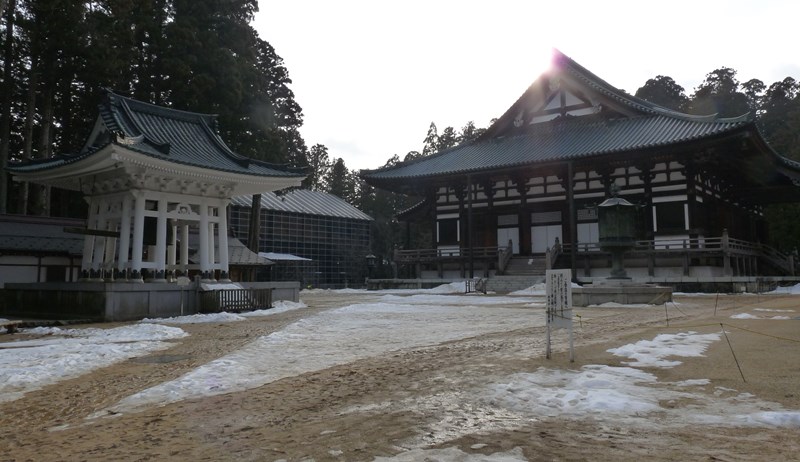
The complex opens up further with the old, dark wooden Fudodo on the left sitting prettily in front of a lake. This is the oldest existent building in Koya-san built in 1197. Opposite is the magnificent towering red Daito (Great Pagoda). Kobo Daishi planned the Daito as the centre of the monastery. The original construction began in 816 and was completed seventy years later. The forty-nine metre high red pagoda that is here now had to be rebuilt in 1937. Inside there is a golden statue of Buddha Mahavairocana.

This area is spectacular. The ground is covered with snow or, where it has melted, with wet orangey-brown gravel. Beyond the Daito are more sacred buildings, including the Meido (Portrait Hall), where it is said that Kobo Daishi had residence. This building is closed to the public and is only opened once a year, on the anniversary of the day Kobo Daishi began his long (and continuing) meditation. Inside is a portrait of Kobo Daishi painted by his disciple Shinnyo.

At Rengendani, it’s a short walk uphill to my shukubo - a temple that provides lodging. The outside of the shukubo looks like an old, traditional temple, with a rock garden and carp pond. Inside, I change into geta and am shown to my room by a monk in full robes. Inside, it’s completely modern except that there is no heating. Later, I change into my kimono and warm outer coat and I’m collected from my room by the monk for dinner. My private dining room is a small room along a cold, glass panelled corridor. The shoji on one side have simple tree paintings on them. The others are bare. The glass doors are closed and in the middle of the floor are a cushion and two red trays with cold food laid out. Beyond the glass doors, I have a view of the rock garden, now lightly lit in the dark of the evening and sprinkled with what remains of the snow. Another tray is brought in with hot food, sake and tea. I take my time to sample it all. It’s one of the best meals I have ever eaten and in one of the most amazing locations. It takes me nearly an hour to finish everything.

Just before seven o'clock in the morning, I’m lead to the older part of the temple, through the cold corridors, to the shrine room. At the back there are cushioned benches on either side of the central aisle. I sit down. Two small side rooms have hundreds of red lanterns on the ground. In the middle of the room, there’s a model of a golden pavilion in front of the altar. From the ceiling, more lanterns and pendants hang. The only light comes from several rows of lit candles. One monk sits directly in front of the altar and one monk to the side. The one to the side begins a slow chant and soon the monk at the altar begins a louder chant.

Both use various bells, chimes and cymbals to wake the Buddhas. Halfway through the chanting, one of the monks comes to me and asks me to drop three grains of rice into a bowl. The monk then returns and they chant in unison again. Without intending to, I find myself falling into a trance. I’ve been given a sheet of paper with the words to the ‘Heart Sutra for the Perfection of Wisdom’ which is written in Japanese and English. The Japanese is also spelt out phonetically in English. Amazingly, I can pick up the sounds and I’m able to chant quietly along with the two monks as they recite the sutra. Time seems to stand still.

After forty minutes or so, the morning ceremony is finished and I’m taken directly to breakfast. The rock garden looks very different in the early morning daylight. Once breakfast is done, sadly I have to leave the inn. At the stop for the bus back to Koya-san station, there’s a sign on the wall which reads: ‘Beware of Bears! Recently bears were seen at each area in Koya-san and there are so many eyewitness reports. When you go out, don't go out alone.’ I now realise why I have had the wonderful sights of Koya-san to myself.

Pete Martin’s book Revolutions: Wandering and wondering on a sabbatical year is a compelling tale of travel and change and is out now. More information can be found at www.wander2wonder.com.

The Library: Travellers in the Third Reich - The Rise of Fascism through the Eyes of Everyday People, by Julia Boyd

ThirdReichTravellers.jpg

Read by Marcel Krueger:

I strayed by mistake into a room full of S.S. officers, Gruppen- and Sturmbannführers, black from their lightning-flash-collars to the forest of tall boots underneath the table. The window embrasure was piled high with their skull-and-crossbones caps.
- Patrick Leigh Fermor, A Time of Gifts

In 1934, 18-year old Patrick Leigh Fermor walked on foot from Holland to Constantinople, which also meant that he had to cross Nazi Germany. But of contemporary political events he records little in his classic work of travel writing, 'A Time of Gifts'. Instead, the youngster is most fascinated by the palpable history in the Gothic old towns of Germany, the still-feudal society structures outside of towns, and the odd tipple. Besides a pub chat about Herr Hitler now and then, no one seems to be interested in engaging the youngster in political talk or even convince him to join their side.

Two years later, in April 1936, a group of English students between 12 and 14 years of age along with their teacher hiked up Schauinsland, a mountain in the Black Forest, a challenging hike even when undertaken in favourable conditions. Just short of the summit, the group - inadequately equipped and clothed - was engulfed in a blizzard, and severely lost. Hours later, some of the boys made it to a nearby village, from where a search party set off to rescue the scattered group from storm and darkness. By that time, four of the group of 27 were already frozen to death or had died from exhaustion. This tragic event became locally known as the Engländerunglück, literally ‘The Englishmen’s calamity’.

The Nazi propaganda machine now went into overdrive. The dead were laid out with all possible honours, the surviving members of the group pampered and feted by the local Hitler Youth, and all reports about the rescue effort suddenly credited the Hitler Youth itself with helping in the rescue. In 1938, in memory of this event, local authorities even erected a memorial for the deceased English students, with the inscription “The youth of Adolf Hitler honours the memory of these English sporting comrades with this memorial.”

These two events, the travails of an unperturbed vagabond and the tail of doomed yet innocent youngsters exploited by Nazi propaganda, are perfect examples of how visitors from the anglophone experienced holidays in Germany between 1933 and 1939. Few specifically came to see how the new Nazi state remodelled society, many came for steins full of beer, castles, deep forests and cheap accommodation. In 'Travellers in the Third Reich', Julia Boyd provides an excellent overview of the types of visitors that came to Nazi Germany before war erupted, by weaving many sources and eyewitness accounts together.

Boyd's travelogues do not begin with Hitler's rise to power, but instead record views and statements of tourists and visitors right from the end of World War 1 and the birth complications of the Weimar Republic. From there on it chronologically follows the developments in Germany up until August 1939. The 21 chapters are arrayed both chronologically and topically - there is 'Old Soldiers' about visiting veterans, 'Hitler's Games' about the Olympic Games 1936, and visitors being increasingly confronted with the growing anti-semitism in '"Peace" and Shattered Glass' in the wake of the Munich Agreement and the Kristallnacht 1938.

From an impressive array of sources, Boyd summons professional soldiers, diplomats, school children, Chinese students, pilots, nurses and 'it' girls from London that recorded their personal impression of Germany under Hitler. Among these witnessed we increasingly find resistance fighters (and those to become one), English families faced with Jewish refugees for the first time, and also Nazi sympathizers like Unity Valkyrie Mitford, of whom Boyd writes:

The story of Unity - the fifth of Lord and Lady Redesdale's famous brood of seven - is that of an unhappy, not particularly bright young woman finding glamour and purpose in a cult religion. She might have become prey to any number of eccentric beliefs or deities but unfortunately for her, and those around her, she fell for the Führer.

Whereas often the view towards Nazi Germany pre-1939 is dominated by the events playing out and being recorded in Berlin, Boyd's book is nicely balanced, presenting quotes from all over the German Reich and Austria. Student Joan Wakefield, for example, recorded an encounter from Upper Silesia on the border with Czechoslovakia in 1938:

On the road back to Rauden, they met 'hundreds' of tanks and lorries filled with soldiers. 'All a bit terrifying,' commented Joan. But anxiety melted away as she was absorbed once again into the daily pattern of riding, swimming in cold forest pools, parties, practical jokes and the inevitable tennis.

'Travellers in the Third Reich' is a hefty tome in hardcover, and surely nothing for the beach. But all the different sources and viewpoints are neatly weaved together and I almost devoured the book, eager to learn more about the many protagonists - and if the reader gets lost in all those fellow travelers, there's a handy dramatis personae at the end of the book; which also comes with a fine cover imitating a 1930s tourists add by kid-ethic.com, as well as maps and black-and-white images.  

Two things stand out: the widespread anti-semitism that prevailed also in the anglophone world before the 2nd World War, and how naive many of the visitors are when faced with obvious propaganda or even criminal machinations they witnessed. This is an important and nuanced book, one that shows that not all the people from future Allied countries perceived Nazi Germany as dangerous, and that a feeling of goodwill was quite strong especially in Britain in those years. And it shows that something we, in hindsight, might call dark tourism was not so dark for those undertaking it, as long as the streets were clean and the beer was flowing.  

Paddy Fermor made it to Istanbul, and spent the remainder of the 30s in southern Europe and Greece; only to be called back to England to join the army in 1939. Because of his knowledge of the area he became a Special Operations Executive and parachuted into Crete, where he became one of the few Englishmen aiding the local resistance fighters, famously capturing German general Kreipe in 1944.

The pupils from Strand School never returned to Germany; the father of one of the victims, Jack Eaton, led a futile legal battle against the failings of their guardian teacher, and in the end erected a private memorial to his lost child, one that was not utilised by the Hitler Youth - maybe because the story behind it was too personal, unusable for any propaganda effort.

Nazi Germany affected them all, in one or another. In her afterword, Boyd underlines the fact that the 12 years of Nazi Germany are not only still an endlessly fascinating period of time; but that these days it is imperative to look at the reasons for the rise of the Nazis and what it means for us today, still.

More than eight decades after Hitler became chancellor we are still haunted by the Nazis. It is right that we should be.

About the book:
Travellers in the Third Reich: The Rise of Fascism Through the Eyes of Everyday People (2017) by Julia Boyd is published by Elliott & Thompson. Support your local bookshop!

About the reviewer:
Marcel is the books editor of Elsewhere: A Journal of Place and author of Babushka’s Journey: The Dark Road to Stalin’s Wartime Camps. This November, Marcel is launching the books with a series of events in Berlin, Dublin, Belfast, Dundalk and Solingen. You can find details of Marcel’s book tour here.

Letter to a Stranger

Shawna.jpg

By Shawna Bethell:

The thing I didn’t tell you was that I met your brother on the ferry. He was looking for you. Your father wanted you home. To this moment, I’ve never told anyone that I met either of you. I felt it would be a betrayal of sorts, though I didn’t even know your names. But I knew your stories, two parts of a whole, none of us expecting I would cross both your paths. Yet I did, within a half-dozen hours or so. Harris is a small island, after all.

I was sitting alone on deck watching grey waters when your brother approached and asked to sit. Together we watched sleek arch-backed porpoises rise and fall as they swam alongside the ferry. We watched a low sweep of rock appear in the distance, growing until it became an island large enough for a port, a village and a road up the coast that would cross a narrow isthmus to another stretch of gneiss known as the Isle of Lewis.

Eventually, he started talking. Told me more than he probably should have about your family, but he spoke with earnestness, and I couldn’t help but listen. He had tracked you to that slab of stone sprawling in the distance and hoped you were still there. In time, we disembarked and as I walked away, he asked me to dinner. I declined and wound my way up the hill, unknowingly, to you.

It was later that evening, in a hostel full of travelers, when our paths crossed. I was rummaging in the kitchen when you came in and I asked you where to find a knife for my vegetables. You were a large man, with long blonde hair bound back by a leather cord and gold wire-rimmed glasses that framed blue eyes. From the leather sheath on your hip you pulled that gracefully thin filet blade with a round wooden handle and passed it to me. I still remember how caught I was by its elegance. Casually, you also opened the cupboard and offered spices from your cache saying I’d likely not find anything but salt and pepper in the communal kitchen. Then you quietly paced the cramped space, crowded with washer and dryer and Formica table, while I sliced in silence. When I returned the knife, you left.

That night, as a woman from Skye cranked open the window above our bunk and slept comforted by familiar cold air blowing in from the sea, I was left sleepless by the same damp chill, so I took my laundry back to the warm kitchen, made a cup of tea and sat down with my journal.

I hadn’t realized any one else was around when you walked in from the TV room and spoke. As before, you paced the perimeter of the room past the washer and dryer, along the counter and back before pulling out the chair across from me to sit.

You said you were from Finland and had worked a lucrative desk job as expected by your father until a few months before. Then, with no word to anyone, you left. You landed on the island and hired on at a fish cannery off the rocky shore. You said you liked the physical labor, liked the men you worked with. You said you weren’t planning to stay on the island, but had no plans to go back either. 

We talked a lot about family and expectations. I told you about the Midwestern United States, where people were rooted by generations of family loyalty, a pull so strong that I felt my choices in life were abdicated before I was old enough to know I had choices to make. I loved my family, but when I finally left the Midwest, it was with a sense of escape. I landed in a mountain town in the western U.S. populated with out-of-work miners, scientists, artists and travelers. It was a place where people accepted you as the person you presented yourself to be, and it was where I gained the freedom to be the writer I wanted to become.

In the dark early hours of morning, you put on your jacket and went outside, cigarette in hand, and through the window I watched the orange tip burn as you paced the walk out front. Shortly you returned, explaining you had to catch the ferry for work in only a few hours and needed to get some sleep. I don’t remember that we even shared a ‘good-bye.’ You just walked away through the drafty, concrete-block hallway, and I was left to pull my clothes from the dryer and stuff them into my pack. Then I followed the hallway to my own side of the dorm where I fell easily and unexpectedly to sleep.

By daylight you were gone and I caught a ride north, jotting a quick ‘thank you’ and tucking it into your spice cache before I left. We never did exchange names. It didn’t seem necessary, I guess. But I still think of you, and I wonder if your brother ever found you. I wonder if you ever went home. I did, eventually. For better or for worse. Sometimes, I’m still not certain. But that strange triumvirate of love, loyalty and obligation will call even the most wayward of us back.

Wherever you ended up, I hope you went there by choice and without regret. I hope you found the life you wanted. I wonder, though, if you ever knew, if either of you ever knew, if you ever talked about that woman you both happened upon, who carried two men’s stories back out to sea.

Shawna Bethell lives in the central Midwest of the US. Her work has appeared in the Denver Post, The Mountain Gazette, High Desert Journal, and This Land Magazine among other publications.

Standing on a windy corner of Ku'damm in Autumn

Emily.jpg

By Emily Richards:

It is six o'clock in the evening and I am waiting for a bus because I chose to miss the last one. Here at Olivaer Platz in Berlin, as the people run out of their offices to jump on buses, speed across lanes in their shiny black BMWs, or swerve on their bikes through traffic in their anxiety to be home, I am unable to move, mesmerised by this autumn evening.  I have passed through this place, one of the busiest in Berlin, at different times and for different reasons for twenty-five years now. Once it was strange to me. Then, it was home. Now it is strange again.

It is not yet dark but there is a haze upon the air, and some of the street-lamps are already glowing silvery-bright. The autumn light turns from gold to a translucent pallor, tinged with the colours of the red, gold and brown leaves swirling in the wind. The flowers on the corner of the Platz, planted in a gesture of beauty amidst noisy traffic, still grow in green profusion, though a dimness is settling over them as evening falls. They are the first to lose their outlines in the twilight; the first to be overlooked as our faces turn towards clocks, mobile phones, LED displays to see if it's hometime yet, so that the longing which has built in us all day can be released like the tension on a trigger.

But I won't be going home just yet. I'm kept here almost against my will by the fading light, by the faces of Berlin that pass me by one by one and look at me for longer than English faces would, on this evening, two days after the general election. In the election, a radical right-wing party gained over a quarter of the vote in parts of Germany, and thirteen percent overall. I look at each person who walks, ambles or hurries past, and their faces look different to me.

I never noticed how misshapen and worn a human face can look. Sagging skin, stooped shoulders, a grimacing mouth; orange blusher scarring the too-pale face of a middle-aged woman who plunges in uncomfortably high shoes to her next appointment. Her head's skewed around awkwardly to pin her mobile phone to her shoulder as she talks into it, gesturing vaguely, staring at nothing. A tall, elderly woman with thinning brown hair and feet too plump for her old black shoes walks as stiffly as if on stilts, slowly raising each foot high above the pavement before grinding it back down. A younger woman with half-shaved head, dressed entirely in black with wide Cossack-style trousers and Russian boots, walks boldly past, but her clothes are dusty, nearly grey in places. A young man ambles in front of me, dark hair closely gelled to his scalp, eyes glued on the tightly-clad bottom of the young, hard-faced woman ahead of him, whose heavy gait is disconcertingly masculine for someone with such a bleached-blonde ponytail and such conventional make-up. Her double chin sags and the lines around her eyes crease as she swings her head round, shouting into her phone. An old man – but surely he's not much older than I am! – with a loose mouth, a white fringe of hair and a red nose stands for minutes in front of a rubbish bin, staring into it, looking for bottles he can take away and turn into money; then he looks around swiftly, bends to the ground and snatches up a fag-end before swinging away, arms flopping wide and uncontrolled in his badly-fitting beige jacket.

There is a sense of dissolution in the air.

The summer dissolves; the outline of the Ku'damm, of its buildings, buses, lamp-posts and cars, seems to dissolve in the haze of this autumn evening, in the rustle and whisper of the leaves moved by the wind. Before my eyes, the safety I once found here dissolves too. The reassuring, orderly security of these middle-class Germans loses its outline in the dusk, their aspirational Wirtschaftswunderland revealing itself as the illusion I should have known it to be. I did know it, really. But the shared illusion was a comfort, and, as such, transcended its own illusory nature to demonstrate its greater truth: that security, beauty and order all matter, and that those who are denied them or have lost them or mistrust them will turn to more dangerous illusions of their own; for example, that rejecting everything outside your own culture and experience will keep you safe. In this way they remove safety for everyone, not least themselves. For what if one day their fellow voters turn to them and say, "But you had a foreign grandparent did you not? You were once kind to a refugee, we hear." Then you too will be cast out. This is what happens. But by then you'll have done your damage, and it will be too late to be sorry.

Yet nonetheless, on this autumn evening, the wind whispers to me that something is stirring, something is afoot, something is changing. And I prefer this in the end. I prefer it, though I don't know what it is, what it will demand of me, what it will do to me.

And now here is my bus. And like all Berliners I might be foolish enough to miss a bus once, but I won't miss it twice. For who knows when the next one will arrive? Who knows when I'll be home.

You can read more from Emily on her blogs The Castle Captures Me and Boring in Berlin.

Printed Matters: The Line Between Two Towns

Laura.jpg

We are really excited about this place-related project from our friend and Elsewhere contributor Laura HarkerThe Line Between Two Towns is a new zine that explored the Esk Valley line between Middlesborough and Whitby in northern England, bringing together writers, poets, artists and photographers who have all been inspired by the different destinations on the line between the two towns. Here is Laura's introduction to the zine, and you can order your copy online here.

The idea behind this zine came from wanting to explore the differences between Whitby and Middlesbrough, and all the unique nuances and cultures that set them apart from one another. Though there are such stark differences between the two towns, there is still one thing that brings them together: the Esk Valley Railway.

It clocks in at only 36 miles long, but the Middlesbrough and Whitby line was once part of a larger network of railways that covered the area until many lines were closed after Dr. Beeching’s cuts. Thankfully, the line remained open due to its popularity. Originally intended to serve the mines and quarries across the region, the Esk Valley line quickly became a hit with Teessiders who realised that it placed the North Yorkshire seaside just over an hour away.

Over the past few decades, the area’s industry has disappeared, Brits have set their sights on sunny European beaches, and the line is now rarely busy except for Bank Holiday weekends. But it continues to be an important lifeline for many in the villages it passes through, connecting them to Middlesbrough and Whitby.

I was born in Middlesbrough but we moved to Glaisdale, just outside Whitby, when I was 11. Carefully picked up from my urban childhood, I was transplanted to the countryside where most other kids were members of the Young Farmers and thought my Boro accent came from Ireland. Even though my childhood so far had been spent less than 30 miles from Whitby, I realised there was a large gulf between these two locations – industrially, culturally and aesthetically.

This isn’t something that bothered me that much until I moved to Berlin and I was constantly asked the same question: Where are you from? When Germans and other non-Brits asked, the answer was easy – I went with North Yorkshire. But when Brits asked, expecting a more specific pinpoint for their mental map, I couldn’t bring myself to give just one answer.

I couldn’t just say Whitby and ignore Middlesbrough or that would be turning my back on my first decade, family ties, and roots as a Teessider. But I couldn’t simply say Middlesbrough, as I’d spent 15 years on the moors by this point. My Boro accent is long gone and my Middlesbrough geography gets hazy whenever I step off Linthorpe Road in the centre of town – I can’t quite stomach saying I’m a true Teessider. And so I thought about writing a personal essay on this identity crisis and the towns that sparked it, using the Esk Valley Railway to bind it all together. When I realised there was just too much for me to say, I decided to make this zine and open it up to submissions to try and create something of a printed tapestry of the area.

The zine includes works from local writers, poets, artists and photographers, all of which have been inspired by stops along the line. Threading together their work along the context of the Esk Valley Line, I wanted the zine to explore the cultural and landscape shifts that can be found taking this particular train journey, from starting in Middlesbrough surrounded by tired factories and ending in Whitby just steps from the beach. And it might actually help me figure out what to say whenever someone asks me where I’m from.

The shingle beach, Crosby

All Images: Chris Hughes

All Images: Chris Hughes

About a month ago we published the essay The War Memorial in the Sea by David Lewis. As always, we love to hear what people think about the work we publish both here on the blog and in the print journal, and we are especially pleased when it inspires as moving a response as this, from a long-time friend of Elsewhere, Chris Hughes:

Following on from David Lewis’s fascinating piece about the architectural rubble spread on the beach north of Crosby promenade after the clearance of bomb damaged houses and major public buildings in Liverpool and Bootle at the end of the Second World War I send you these photographs taken a couple of years ago on the beach just south of the shingle. Like David I have tramped across the shingle to find the remnants of the large buildings of Liverpool destroyed in the bombing and once found wonder in imagining which of the buildings a remnant comes from. Looking at the photographs from the time, and to see the sheer scale of the destruction, it is doubtful that even the most brilliant architectural historian could identify the pieces; it’s enough to find them and marvel that their presence is still here.

Chris_Skyline.jpg

But what of the bricks, thousands, probably millions of bricks, half bricks and the grainy rubble that was once a brick that lie scattered along the beach, some still resembling the cuboid they once were, others pummelled by the tide over and over again to become a rounded pebble? What a range of colour and texture is here considering that all were created from the clay of the local area and the North Wales brick works.

Chris_Bricks_1.jpg
Chris_Bricks_2.jpg

Following the death of a good friend who was also a lover of stones, shells and drift wood, we were asked to bring a stone to the funeral from our own area and a cairn would be built of these stones as a symbol of our love and friendship. There are no natural pebble beaches on the Sefton coast; it’s all sand, so it was here, to Crosby shingle beach I came to select two very different rounded remnants of bricks to add to the cairn. And very good they looked too, bright red and orange among the predominantly grey and white stones from other parts of the country that were piled up along with them.

Chris_2Stones_1.jpg
Chris_2Stones_2.jpg

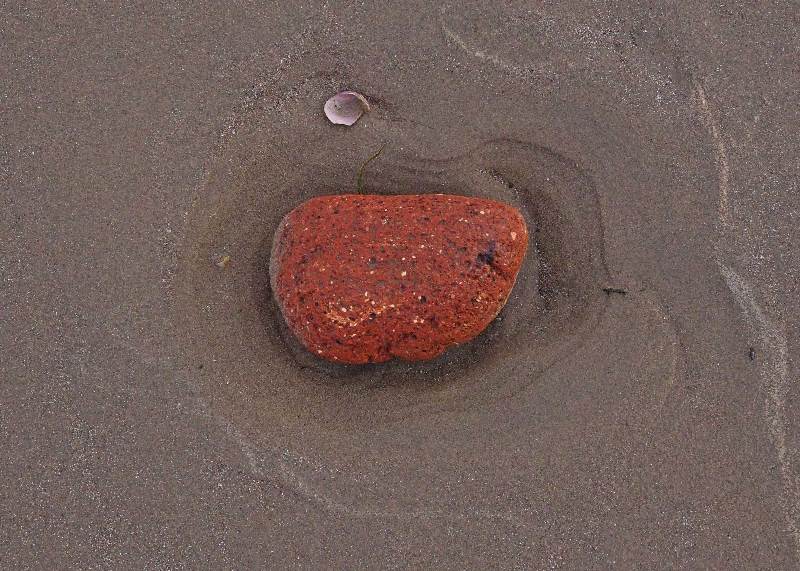
On a very windy day in February 2015 we went to walk among Anthony Gormley’s cast iron men on Crosby beach and I saw the way that the wind had carved out the patterns on the sand, blowing away the smaller grains, leaving the heavier stones and shells each with a tail of sand in the lee of the gale. The larger pieces, almost whole bricks, ended up isolated in little pools of water; a tiny moat around the brick castle. I started to look for the different colours in the bricks, the reds and browns, oranges and yellows, but also the blue and black. Was this a different band of clay? Was it crushed shale or even clinker from the iron furnaces of the day? I’ll probably never know but the colours will always remain in the bricks of the Crosby shingle beach.

Chris_Gormley.jpg

Moor-haunting

ElizabethMoor.jpeg

By Elizabeth Wainwright:

I moved back to a place that I know; it tugged me in my sleep, seeped into my blood like wine and desire. Suddenly I am on Dartmoor, feeling myself dissolve into its shifting mist and separate from my body – like long ago when I was someone I am not, and being under the influence, I drifted away from myself when I hadn’t chosen to. But this time I choose to wander away from myself: not sure whether I am an individual or part of the churning mass of life.

I have become fixated by hares, those mythical and elusive creatures. Search them in spring, and if you’re lucky (I haven’t been so far), you’ll witness the ‘mad march hare’ boxing antics; elegant creatures transformed into tall, aggressive dancers; each one Odette and Odile, black and white swan, fighting for courtship rights. This time I hear them snorting nearby, calling the approaching solstice into being like a spell.

I’ve taken shortcuts that were the long way round. I’ve opted for easy routes that were the boggy, marshy, slow routes. I should know better. But Dartmoor is an ancient cauldron of reason and desire; and I am learning that I gain less from a level-headed caution than I do from imagination and intuition (whilst all the while feeling the edge of my compass in my pocket, safe in the knowledge that someone knows where I am). A stones-throw away in Exeter, where I live, I enjoy wandering and observing life in the city – as Virginia Woolf called it, ‘Street Haunting’. On Dartmoor, I do the altogether more consuming, wide-open-space version; I become a moor-haunter, a Gore-Texed Artemis, roaming; sometimes searching, sometimes found.

Joseph Campbell said, “What the myths are for is to bring us into a level of consciousness that is spiritual.” Dartmoor is a place in Devon, but more than that, it is a myth. It strips me of any role, any context, any time, and takes me into the place behind the pause button. It is here I have heard God and myself. Where I’ve reacted to and interacted with nature. It’s here I’ve doubted myself, and then felt the most ecstatic, frenzied, deep but momentary understanding of absolutely everything. And also where I’ve simply watched a sunrise with a quieted mind and mug of tea.

Once, I saw the carcass of a dead moor pony and I stopped to look. It clutched a foal, half-born. Half in the world and half hidden. Dead before it was alive. The foal wouldn’t get to stagger on lanky legs; hunker down in winter snow; doze in a summer haze to the amusement of passing tourists. Dartmoor is barren, heartbreaking. But it is not cruel. It would rise up to meet the death with soft grazed pale grass, and with it, feed worms, ravens, plants. Nothing mourned, but nothing wasted either. Suffering without cruelty. We’re terrified of our own mortality – especially in the age of the self. But perhaps that pony had no sense of itself as a separate being. It was always connected to all the other creatures on the moor.  “The tygers of wrath are wiser than the horses of instruction”, but these are not horses of instruction – they are wild and free, hardy and intuitive. Theirs is a third way inbetween Blake’s aphorism; inbetween wrath and instruction, desire and reason. I see myself there, feel it on Dartmoor – theirs is the here and now, the mysterious kingdom come, on Earth. Not fierce uncultivated energy, and not mindless robotic being either. Rather, free to roam and to congregate, to sense and respond.  

I flinch when someone asks a question to which I must respond by saying ‘I like walking on the moor’. It feels like Peter’s denial before the rooster crows, claiming I never knew it. I feel Dartmoor glance at me, granite eyebrow raised, hurt. I do like walking on the moor, but that’s the method, not the purpose. For me it is no hobby. It is essential, like touch, and I like to think it is essential for Dartmoor too. Because we need people who are happy to get lost and get found again; to sit on a rock and all-at-once smile and weep at the grandeur and beauty of a sight that contains scale and possibility; colour and tiny miracles; music. Not a ‘nice view’ that we do not really see, but rather a roaring, existence-shaking singularity where all that ever has and ever will exist is here in this one moment, and it’s all the more heightened because for some reason we get to experience it but the dead foal never will. We need to tap into the soul-aligned ecstasy of being out in non-human nature (rather than mind-aligned ‘pleasure’) because when that joy takes root and turns into astonishment, deep connection, essence, and understanding, it becomes so infinite that one person can’t possibly contain it and so all we’re able to do is give it away, maybe to a neighbour or a child, or to the world. We become protective of it; we lovingly work in a garden, or furiously work on the global sustainability agenda (knowing that ‘sustain’ is a pale shadow of what we really feel or want).

But it all starts with a place, a call of the wild, a call of the divine. And for me that place is Dartmoor – its purple heather that fills lines of folk songs; its yellow summer gorse that in winter, yellowless, shelters sheep; its gentle springs that swell into churning white water; its storied tors and ancient bronze-age traces; its space and howling peace; its smells and shape-shifting light and weather and mood.

Dartmoor is a grazed, razed, bleak and beautiful place. No, it’s more than a place – it’s an experience. But it reclaims the idea of ‘experience’ from those companies that two-dimensionally offer ‘great customer experience’ or a ‘really wild experience’. Dartmoor owns the real meaning of the experience – ‘to feel or undergo; observe as a source of knowledge; an event which has affected one’.

Dartmoor affects me; it reveals knowledge and wisdom that – in my broad travels –  has not disclosed itself elsewhere in quite the same way. So I will keep on moor-haunting. And if we meet, and we talk about pastimes – please know that Dartmoor is more to me than that. It is stopped time; truth-telling time; wonder-full, wild, sensual, transformative time. It is never just passed time.

About the author:

Elizabeth Wainwright is The Ecologist’s nature editor, and she co-leads the community development charity Arukah Network. She has lived, worked and travelled around the world but is now back in Devon, UK, where she is from. @LizWainwright www.elizabethjaynewainwright.com

Names of the Wind

 Photo: the Bora in full spate on the slopes of Mount Mosor, near Split, Croatia, by Nick Hunt

 Photo: the Bora in full spate on the slopes of Mount Mosor, near Split, Croatia, by Nick Hunt

We are extremely pleased and proud to welcome Nick Hunt back to the Elsewhere blog. Nick wrote a piece for us about ‘walking into the world’ in Albania a couple of years ago, and he has returned to reflect on the names of the wind… or the names of the specific winds that inspired his journeys across Europe for his new book Where the Wild Winds Are, published this month:

Every traveller knows the thrill of falling in love with a name. Some might be stirred by the name of a city: Odessa, Buenos Aires, Timbuktu. For others it may be a route through a landscape: the Silk Road, the Via Francigena, the Camino de Santiago. For me it was the names of Europe’s great seasonal winds – the Mistral, the Tramontana, the Bora, the Meltemi, the Kosava, the Foehn, the Bise, the Sirocco, the Levanter – which I saw on a map one day, invisible pathways threading across the continent, connecting regions and cultures that seemed quite separate in my mind. They sounded like things from a fairytale, invitations to a quest.

Why are some winds given names, while others remain nameless? What distinguishes one current of air molecules from another? I set out to follow four, which seemed an appropriate number for winds, drawn by the romance of their names but also intrigued by their effects; Europe’s great aeolian forces are said to influence everything from architecture to mythology to psychology. The Helm – Britain’s only named wind – blows down the western slopes of Cross Fell, the highest point of the Pennines, with enough force to destroy stone barns in the nearby Eden Valley. According to local legend the summit was formerly known as Fiends Fell, until the air-dwelling demons – whose howling caused such terror in the parishes below – were exorcised by a wandering holy man. The Helm itself takes its name from a long white cloud called the Helm Bar (a helmet for the mountain’s head) which acts as a harbinger of this freezing north-easterly. I camped for four days and nights up there, scanning the desolate moorland and waiting for the cloud to form; when it did, the demons returned to haunt me with a vengeance.

My second wind was the Bora, which led me down the Adriatic coast from Trieste in north-east Italy through Slovenia and Croatia. Fierce enough to sink ships and hurl fish from the sea, the Bora is also credited with helping defeat the last major pagan army to oppose the Christianisation of Rome – turning the arrows of the troops back towards them in the air – despite the fact that it takes its name from the pagan god Boreas, ancient Greek avatar of the cold north wind. It is celebrated for bringing good health, in stark opposition to the southerly Jugo, which muddies the sky with a yellow haze (taking its name from the Slavic word for ‘south’, this is the local variant of the many-named Sirocco, whose other appellations include the Khamsin, the Ghibli, the Sharav, the Marin, the Leveche and the Xaloc). During my three-week walk I found myself in a tug-of-war between Jugo and Bora, north and south, clear skies and humid haze. At last I met my quarry on a snow-covered mountainside above the Croatian city of Split; appropriately enough for a god, Boreas froze the blood in my veins and knocked me off my feet.

The etymology of the Foehn, which I chased across the Swiss Alps, perhaps also stems from the divine – it may derive from Favonius, the Roman god of the west wind – but locally it has earthier names: Schneefresser, ‘Snow-eater’, Maisvergolder, ‘Corn-goldener’, and Traubenkocher, ‘Grape-cooker’, in tribute to its warming effects. Associated with clear skies, sunshine and the coming of spring, it is also blamed for causing headaches, nosebleeds, insomnia, anxiety, depression and a host of other ailments; antique maps depict the Foehn as a puff-cheeked face blowing out not air, but showers of human skulls. I tracked this ill-omened force for a fortnight from one deep valley to another, acting on meteorological tip-offs and snatches of local lore, until eventually catching it in the heart of Haslital. After experiencing three days of relentless roaring heat – incongrously thundering from snow-capped summits and glaciers – I woke one morning so depressed that I could hardly move. It felt as if everything in my life had gone disastrously wrong, and it took me most of the day to understand the cause and effect. The legends and old wives’ tales were true: I had fallen victim to Föhnkrankheit, the notorious Foehn-sickness. As soon as I escaped that valley, the symptoms disappeared.

My final wind was perhaps the best-known, being something of a household name far beyond its native range: the bitter breath of the Mistral, which blows, according to superstition, for three, five, seven or nine days southwards down the Rhone Valley from Valence to the Gulf of Lion. Its name comes from the Latin magistralis, which means ‘masterly’, and it certainly dominates the land; the farmhouses in its path are built with windowless north-facing walls to protect against its blast, and lines of closely-packed cypress trees are planted as living windbreaks from east to west. Like the Bora and the Foehn, the Mistral makes a clean sweep of the sky and helps create the vibrant light that has attracted generations of painters to the south of France. But there is a price to beauty; this ‘wind of madness’ is notorious for driving people crazy. Vincent Van Gogh, who lived in its path for two years in the town of Arles – during which time he cut off his ear and committed himself to the local asylum – referred to it in his letters as ‘a nagging malice’, ‘pestering’, ‘merciless’ and ‘the devil’, even as the conditions it brought inspired some of his greatest works. I followed its trail for ten days down an ancient pilgrims’ path on the western bank of the Rhone, ending my travels on the Plain of Crau, a little-known and desolate region classified as western Europe’s only steppe. Two thousand years ago the geographer Strabo travelled there, describing ‘an impetuous and terrible wind which displaces rocks, hurls men from their chariots, breaks their limbs and strips them of their clothes and weapons’. Apart from the chariots, nothing much has changed.

NickCover.jpg

Nick Hunt’s Where the Wild Winds Are (Nicholas Brealey Publishing) was published in September 2017. Nick’s website can be found here.