Beacon Bound, Part III: Infalling

Monument.jpg

In memory of his grandfather, Nicholas Herrmann walks the length of The Ridgeway: an ancient road stretching for eighty-seven miles across chalk downland, from Overton Hill to Ivinghoe Beacon. We will be following Nicholas’ journey here on the Elsewhere blog over the next couple of months.

There he sleeps, immeasurable: the fire-drake. Somewhere under the earth, in some hill or nameless barrow. His lair is dim and airless, his breast the only glow. His hide is painted in royal reds, scales edged in gold as if gilded with sticky treasures. Coiled around his mass: a tail tipped with a fleur-de-lis. His wings are folded at his sides, bat-like, all skin and sinew. Horns peek from a fog of smoke that spreads with every breath. Claws, blood-muddied, dig into countless piles of precious things.

He could rise at any moment and burn the world away.

*

The Ridgeway smells of dead grass and chapped earth. The fields creak with crickets, and Cabbage Whites drift on the breeze like ash. Our bags are heavy on our bare shoulders as we step into summer. We’ve unpacked our raincoats and drybags, filled the space with water and sun cream. It’s already hot as we pass the Memorial of Lord Wantage – a striking column rising from the ridge, proclaiming aphorisms in Latin across the valley: Peace in passing away. Salvation after death. Light after darkness. Hope in light. Somewhere, we cross into Berkshire, my home county. Soon, we’ll be wading into the Thames and resting in the Chilterns’ beechwood shade, but first we must traverse ten miles of parched and dying downland.

A terrifying alchemy has taken place: the ‘precious stone set in the silver sea’ turned to dust.

Haystacks.jpg

They’re calling it a heatwave. In the coming days, The Washington Post will run stories about the all-time records being set around the world: Africa and Japan witnessing their hottest ever temperatures, people dying in Canada, roads and roofs melting across the UK. The Jet Stream has buckled and the Gulf Stream is grinding to a halt, causing surface temperatures to rise. Whole sections of rivers vanish. Wildfires rage in the Arctic Circle. In Scotland, dogs die from lapping blooms of toxic algae. In Ireland and Wales, the drought causes crop marks to appear: outlines of ancient sites and settlements, unknown or long-lost, like marks from a magnifying glass burning through time. It’s Britain’s driest summer since modern records began. The heat is unnatural, the world uncomfortably warm.

On the path, flies cluster and chase, attracted by our gathering sweat. We push through tall, tick-threatening grass, guessing at the names of the wildflowers that colour the verge. I can only identify the obvious ones: cow parsley, buttercups, thistles. A hiker heading for Overton Hill points out others: ragwort, scabius, vetch. Names like ancient ailments.

My father has been clearing out John’s house in Wales, and there have been discussions about what to do with the dragons. They lurk on bookshelves beside Richard Mabey’s Flora Britannica, squat on side tables above leather walking boots. There’s a dragon cast in iron, low and long; one made of plastic, a children’s toy elevated to ornament; one carved into a wooden stamp. The centrepiece is ceramic, hand painted in green and gold, clutching a crystal ball. It was a love born of studying biology and archeology, reading Pratchett and Tolkien. Even the house was part of the collection in a way – a bolt hole in the land of the dragon.

There’s no hiding from the heat. We’re stalked for miles by Didcot’s smoking towers. It’s a strange section of the trail, unremarkable and vast, the antithesis of Uffington, a place busy with history. We pass under the A34, connecting Newbury and Oxford like a steel pin forced through the bone of the land. The roaring underpass provides a few seconds of relief before we’re once again bombarded by UV rays.

After another stretch, the landscape relaxes into a valley, the power station falling out of sight. At the bottom, a little brick bridge arches over a trench of nettles: the skeleton of the Didcot, Newbury and Southampton Railway, opened at the end of the nineteenth century, closed in the 1960s due to lack of traffic. The DN&SR became important in World War Two, when it was used to transport supplies to the coast in preparations for the Normandy landings. Our presence flusters a couple of wood pigeons that blunder into the trees. I lean on the wall and gaze into the green abyss, imagining the wildlife tucked into the weeds, the insects nesting in cracks, the creatures suspended in shadow. I wonder when the A34 will go this way – sink back into nature, burst open and bloom. Return to barbarism.

Wheat.jpg

The buzz of a Cessna interrupts the heavy quiet of the afternoon. The breeze is thick and warm, dragon’s breath blowing in from the barley. Orchids rise from the bank. Heat haze ribbons on every edge. As we trudge the last few miles, the chalk of the Ridgeway glows white-hot, angling the sun at us, cooking us evenly. I squint, chalkblind.

Finally, we find shelter. A wood materialises on the lip of the Goring Gap as we descend the ridge. It’s a sign we’re moving through a new morphology now, that the windy, sweeping stretches of the North Wessex Downs are behind us. It also means we’re reaching the end of our first ancient highway, the Thames marking the start of the Icknield Way. We walk to the edge of Streatley, where a sign tells us we’ve been infalling for forty-one miles – almost half the distance to the Beacon. We see out the day at Aldworth, a village home to medieval giants, a one-thousand-year-old yew, and The Bell – the Platonic Form of a pub, housed in a building from the fifteenth century. We collapse onto rain-warped benches to savour local ciders beneath the falling sun.

*

The temperature rises by one degree.

Our skin a little pinker, we walk the final mile to Streatley. The town feels like a threshold, a red-brick terminal busy with early-risers leaving for the hills. There’s a book exchange in a telephone box, filled mostly with travel authors left by Ridgeway ramblers: Eric Newby, Paul Theroux, Patrick Leigh Fermor. We pass blue plaques announcing the famous feet that have graced the town: Turner did some sketches here, parts of The Wind in the Willows are set in the surrounds.

Signposts ferry us over the Thames, into Goring, and through a system of alleyways and driveways that cut between castles: riverside mansions that block our view of the water. On the map, the path appears to follow the river closely, but in reality we’re funnelled between eight-foot-high fences, with signs warning: private, keep out, the river doesn’t belong to us.

We emerge from the residential warren into a meadow of yellow wildflowers, ones I now have the power to name: ragwort. A train barrels past on its way to Reading. As we approach the perimeter of the village, church bells ringing the end of Sunday service, I’m put in mind of J.L. Carr’s A Month in the Country. This approach through no man’s land feels foreign, like we’re strolling into the early 1900s – the meadow hasn’t been cultivated, built upon, or swallowed up by Goring. It feels rare to find such a clear delineation, a place not being put to use.

Bridge.jpg

At last, we reach the river, sleepy and wide. Dogs stand in the shallows snapping at phantoms, people wave from paddleboards. We wander alongside, coming to a four-arched Victorian railway bridge I later learn was designed by Isambard Kingdom Brunel. The brickwork shows its age – wrinkled and weathered, bleached by efflorescence, mottled and soiled with moss and soot. Two centuries absorbed in its pores: every storm that’s ever fallen, every boat that’s passed underneath. The bridge crosses the river aslant, the bricks arranged into complex diagonal structures. I linger to photograph an arch, mesmerised by its patterns and tones, the leaves and roots that sprout from the mortar. The years have given the bridge the same plumage as a kite.
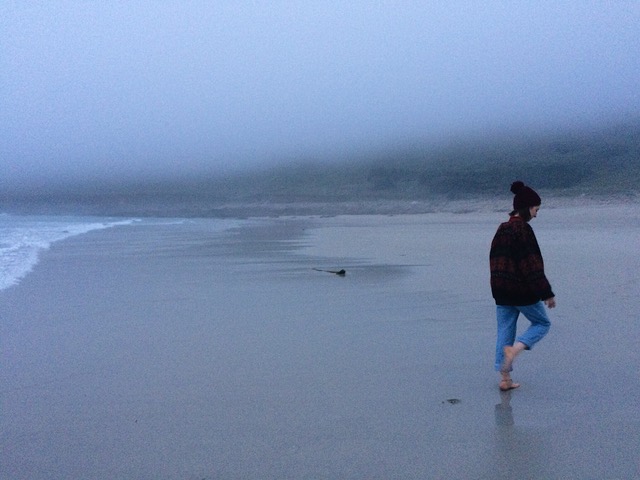
Beach.jpg

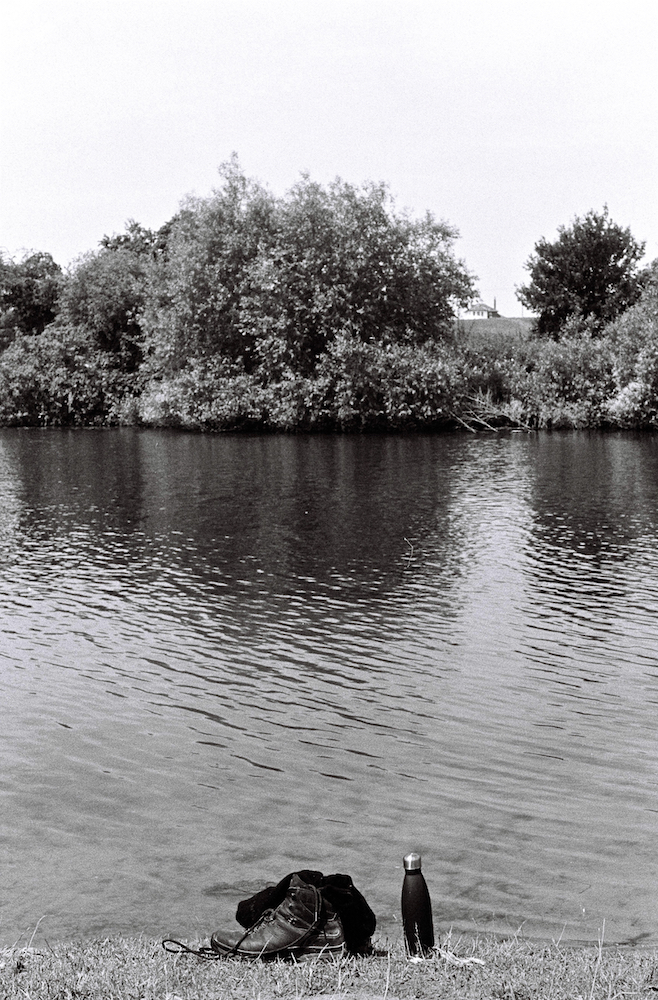
We follow the water north. It’s hazy, humid, the sun at its zenith. We are desperate to find a place to swim. Soon, we find it: the perfect beach just off the towpath. I take off my hat and shirt, and immediately begin to burn. We wade in. My toes sink into the silt, my blood starts to cool. We stand and listen to the buzz of insects and distant shouts down the river. A laugh from my father – fish are nibbling at his feet. When the sun becomes too much, I bend my knees and launch myself, washing the heat from my skin in an instant. I dive to wipe the sweat from my brow. The relief is profound. My limbs feel apart from me. Like eels, they slip and slither in the shadows of the river. I swim into the middle and float among the dragonflies. I breathe in the fishy smell of willow, weed and water.

Like mudskippers, we climb out awkwardly, finding our feet on the sun-baked bank. I submerge my shirt before putting it on again, to carry the river with me a while. Then we head back into the long grass towards North Stoke.

The path takes us past a ‘Type 22’ pillbox in a riverside garden, its embrasures still narrowed at the Thames as if no one told it the war was over. We enter the graveyard of St. Mary the Virgin, a modest church of flint and beam founded in the eleventh century. Inside, medieval paintings of bible scenes adorn the walls, the figures cartoonish and flat. The thick walls fortify me, my sweat dried by the musty air. It smells subterranean, of a cave or sett, and I am returned to Wayland’s Smithy. My father’s voice reverberates in the empty building – he is reciting a section of his favourite poem:

You are not here to verify,
Instruct yourself, or inform curiosity
Or carry report. You are here to kneel
Where prayer has been valid.

Lines from ‘Little Gidding’, the final part of T.S. Eliot’s Four Quartets. I stand in the nave clutching my notes, Eliot’s words ricocheting around my skull. Outside, the shadow of a kite orbits the churchyard, folding from stone to stone.

Wagtails wash by the old mill, the path growing more secluded on the approach to Crowmarsh, a name perfectly suited to this terrain. We are travelling through edgeland now, a place not quite nature, not yet town: boggy, littered and overgrown. The scent of poplar and lime mix with car fumes that linger above the A4074 – a road that acts as a final boundary before we’re once again climbing into the hills.
Beechwood.jpg

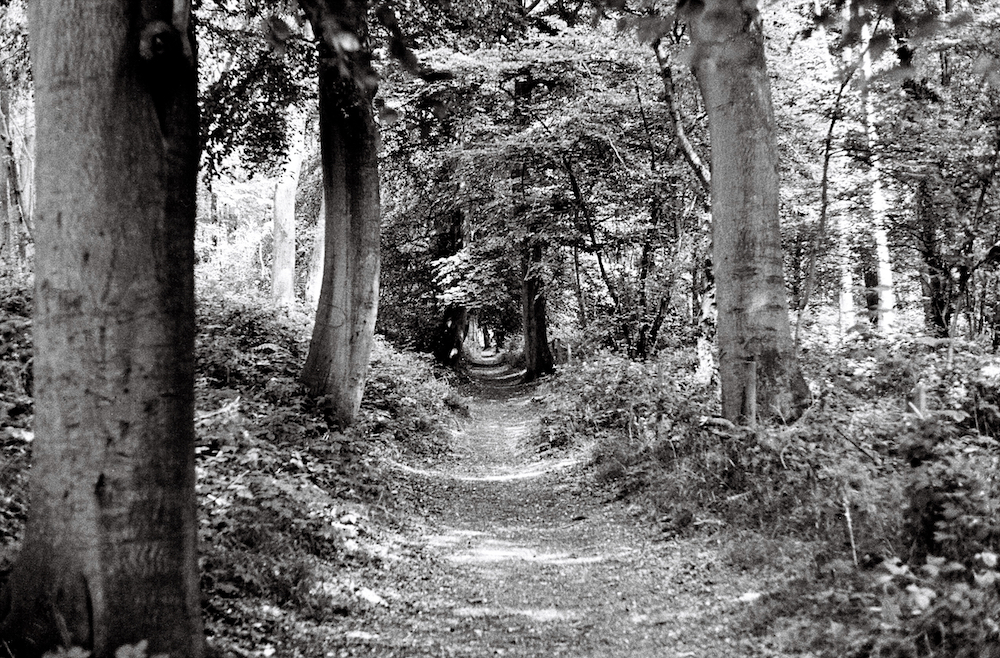
This is where we run out of water. My skin wrings out the last few drops as I snake down narrow, nettle-lined paths that wind between wheat fields belonging to Lonesome Farm. We pause on the edge of our first proper beech forest where the ferns are thick, the birdsong exotic and loud. The topography has shifted: shady, verdant, animate.

Grim’s Ditch, a series of mysterious ancient earthworks we’ve been following for miles, grows deeper as we near Nuffield, like a dried up riverbed from some distant climatic tragedy. A red kite raises the alarm as we emerge from the trees: dragon-like, a lookout on the edge of its kingdom. The Church of the Holy Trinity, practiced in aiding walkers, supplies us with a bench and a tap. We fill our flasks and stomachs, water dripping from our chins. The kite whirls above us in the low light, sounding its battle cry: weee-ooh, ee oo ee oo ee oo.

All the colours of heat.

Nicholas Herrmann is a writer and photographer based in Bath. His work has appeared in journals and online, and his writing has been shortlisted for the Bath Novel Award and Janklow and Nesbit Prize. He is a graduate of the Creative Writing MA at Bath Spa University. He is currently working on his first novel. You can find him on Twitter: @NickPSH.

Island

Artwork: Untitled, by Jase Falk

Artwork: Untitled, by Jase Falk

By Kell Xavier:

The house is at the top of a long driveway, paved years ago and strewn with gravel. On this hill, one can see the blue mountains, rain like steam in a different city. There are candy cane lilies in the front yard, and delicate yellow flowers hang from a twist of a tree. There is green grass by the campfire, the mint plant, the badminton net, the orange trees with their waxy leaves. I climb for tangerines, my fingers digging into orange skin on a fresh-plucked fruit.

I touch my hip bones before I sleep, a reminder of physicality and the thought of beauty. Lately, when I touch my body to the floor to roll in trials of choreographic magic, I find bruising peeking through my skin. I massage fingers into the looseness of their purple pain, calling it into me and alive, like an incantation. I hold my hip bones like knobs or handles, to propel me on.

He is king of everything the ocean touches. He says so. Once or twice a year, I beg the blues, the waves— spaces he believed in— to keep his spirit alive. Every now and then, I beg something— what do I believe in?— to keep my spirit warm to him.

In a poem, years ago, I compared my father to a candle flame. What I mean is: my fragile energy is a candle flame, I don't want to think about my father.

The warm silver of a siren calling, death with desire; the cold iron of a banshee, death with petrification.

About:
Kell makes meaning with words and movement. He is non-binary, likes film and dandelions, and resides on Treaty One territory. Kell is on Twitter: @icebox_clouds

Hiraeth

Photo: jessica sealey

Photo: jessica sealey

By Aoife Inman:

It’s late but the evening light lingers at the peripheries of the ocean making the day stretch long into the night. Time seems to stretch here, the minutes distorted by the quiet swell of the ocean.

The air is full of mist; it pads out the twilight zone between the last dregs of evening and the soft beginnings of the morning. I’ve always thought this is an almost mythical piece of the day, when it’s neither light nor dark and the sky is damp and thick with salt, brushed in off the incoming tide. You can hold the mist between your teeth, wads of it pressed against the insides of your cheeks like cotton.

There aren’t many who bother to come down to the sea front at this hour, with the weather, as it is, temperamental and unforgiving. The wind bites and scratches at any scrap of skin left bare to the element and my thighs are lined with small red welts and scratches – the claws of the ocean have dug their way into me, right to the bone. Today, however, there are a few faces who peer palely over in my direction as I trail down the hill – van dwellers, keen surfers and fishermen, who are all, themselves, half brine and barely human, at least in the city sense of the word.

This was always the place I felt most at home, not here specifically but this ocean, this crack of coastline that juts out obstinately, defiant and secluded. It feels a million mile away from the industrial powerhouse cities I’ve made my home now.

Home. It’s a strange word whose weight has always felt uncomfortable in my mouth, hard and bitter. I was born on the road, moving between a collection of cardboard houses, each one like the last and yet lacking something. I resided in houses, habitats, a series of rooms, plaster, mortar and board – safe and comfortable but never permanent. To belong to just one place strikes me as an exhausting concept.

I thought when I had grown up that I’d settle somewhere; that I’d stop moving and plant some roots, or whatever the metaphor is, but I’ve realised that those moments, those years spent on the road, they get into your bones over time. Slowly, you barely feel it at first, but I can’t stay still now. I’ve tried, time and time again, found a place I love and settled there with a job and a plan and a circle of friends and then I feel that itch, again, against the soles of my feet. It’s like a disease, that itch, that want for change, it’s exhausting sometimes.

I walk along the cliff path, away from the cove, to the world’s edge where the grassy slope seems to fall away into the deafening blue. It’s a steep rocky path carved right into the grit and soil of the cliff, the sort that has been etched by many pairs of feet, worn over many years. When the tide eventually comes in it will cut off this path completely, a void of cold, blue Atlantic filling the space where my feet have trod. Nothing about the breadth or surface of this terrain is easily digestible. It’s a wholegrain, bran and fibre sort of landscape – some find it lonely, harsh, and unforgiving – I find myself falling in love with the rough corners of it every time I return.

When I was a child we were taught to spot currents on cliffs like this, our hands tracing the motions of the sea, trailing the lines of white foam that spread across the ocean like a film. I reach out my hand to lay it on the horizon, palm obscuring the bulb of the grey sun.

If you follow the cliff path round the curling edge of the peninsula you reach a town, a knot of tangled streets that overlap one another like old strings, every one gnarled with potholes and cobbles. I follow it now, zigzagging through kissing gates and through fields of thick grass. Everything is further apart here, houses and gardens stretch along the street, sand banks drag the beaches way out into the bay and the years seem to trickle by – I do not have to measure time so carefully here, there are months to spare.

The town is simple, a harbour filled with thin fishing boats and crab pots, a lifeboat house, a shop selling spades and 99 cones. It’s fixed in another time, another era where people worked with their hands, in the earth and the water.

This place is filled with mysticism, steeped in folklore, luck bound in rhymes and patterns of three. It’s everywhere you look, tucked in corners of woodland and thin waterfalls where faerie stacks topple. Down in the town the boats that jut out into the cove are named after mythical lands and magical creatures, suspicion has wormed its way amongst the men who tend the land and drag the sea.

“Look down there.” The mother leans into the clove of her son’s ear as she speaks. “Look down at that boat there, see the lions on its side?”

Sure enough, on its flanks are painted two yellow lions, their manes dipping and rising out of the green waters.

“They’re named after the legend of Lyonnesse…legend says there used to be a beautiful isle just set above Seven Stones reef that is halfway out to the Scillies. The city of lions and the land of Lyonesse, built with 140 churches atop it and a castle they say, all swallowed up in a single night by the ocean.”

The boy’s eyes widens as he listens, his hands gripping the handrails with his chubby palms.

His mother crouches down by his side, “look now do you see the top of the steeple there, just jutting out of the waves?”

He nods, eyes fixed on the grey sea.

The light is fading now, obscuring the edges of the day. Home, it’s a strange thing I think again, I wrap my tongue around it, a lump in the hollow of my mouth. It’s everywhere here and yet it feels distant. It’s in the lilt of the mother’s curling accent, the one I have lost over so many years spent away. It’s in each vowel, full bodied and warm, the crackle of pebbles under rubber boots in the evening tide, the low thud of water turning cliff to rubble.

I collect them in my palms as I count them, feel the weight of the love I hold for this place, and close my eyes as the day melts.

About the author:
Aoife Inman is a writer and historian based between Cornwall and Manchester. Her short stories have been published in Electric Reads’ Young Writers Anthology 2017 and New Binary Press’ 2018 Autonomy collection, as well as being long-listed for the 2016 Royal Academy Short Story Award. 

Postcard from… Szent Mihály, Balaton

Photo: Katrin Schönig

Photo: Katrin Schönig

By Paul Scraton:

From the bike path that was leading us around Lake Balaton, a small track led up through the trees, winding its way around a couple of tight hairpins until it reached the top. There were picnic tables up there and a clearing in the woods that clung to the hillside, offering views across the curve of the lake’s western shore, back to Keszthely where we had started out that morning and across to Fonyód where, the previous day, we stopped to watch a congregation of egrets as they stalked along the pebbled shore.

Photo: Katrin Schönig

Photo: Katrin Schönig

Also atop the hill was a white chapel, bright against the blue sky, and a series of crucified figures, carved out of wood and looking sorrowfully down towards the picnic tables and the views belong. The chapel was dedicated to Szent Mihály, and St Michael’s chapel had been built on this promontory above the lake for a very specific reason. The chapel was there to remember a day almost three hundred years before; a day very different to the one we experienced beneath a hot, June sun.

Over the winter of 1739, a group of fishermen walked out onto the ice on the edge of the partially frozen lake. As they worked, lifting fish from the cold waters, the ice they were standing on broke free and began to float off into the lake. The waters were so cold it was impossible for them to swim for safety. Six died, from the cold or from falling into the water. The other forty were left, floating on the lake, waiting to meet a similar fate.

That the forty fishermen survived was thanks to a shift in the wind, which began to move the ice floe back towards the shore. Once back on dry land the fisherman decided to build a chapel in thanks to their miraculous survival, and they built it on the hill that looked down on where they had returned to shore, so that it could continue to watch over the fishermen of the Balaton from that point on.

It was hard to imagine the lake frozen as we sat there on the picnic table beneath Christ on the cross and the tower of St Michael’s chapel. There seemed little movement on the lake as the sun rose higher in the late morning sky. But the church on the hill stood there as a reminder, not only of those who survived that winter’s day, but those that hadn’t been so lucky to be saved by the changing wind.

About the author:
Paul Scraton is the editor in chief of Elsewhere: A Journal of Place. Paul’s book Ghosts on the Shore: Travels along Germany’s Baltic coast is out now, published by Influx Press.

Like Home

In our home town of Berlin, Catherine Marshall visits an exhibition that explores notions of place and home through the work of different artists:

In a grand corner apartment block in Berlin’s Mitte near Friedrichstraße, eleven artists with a connection to South America and Berlin have set up temporary home, or ‘Like Home” as the exhibition is titled. It is organised by the project Loop Raum, and the focus of the work is on abstraction, patterning, repetition and colour. Visiting it transported me back to the time of abundant unrenovated spaces in Berlin, where you might come across pop-up exhibitions in unusual places and have the pleasure of discovering the unexpected. Stepping into the the first-floor apartment where the exhibition is held, the space exudes the former grandeur of its Grunderzeit architecture with its high ceilings, intricate stucco and beautiful parquet flooring. At the same time, the rooms are damp and cold in places, the corridors are quite spooky and maze-like and plaster lies exposed with remnants of wallpaper from bygone years. We start to explore.

Carla Guagliardi / "O Lugar do ar" (The place of air)

Carla Guagliardi / "O Lugar do ar" (The place of air)

In the first room, we see a delicate kinetic sculpture of iron rods supported by rubber bands that crisscross the entire room by the Brazilian artist Carla Guagliardi.  A piece called "O Lugar do ar" (The place of air), its structure imposes a new language over the room with its potential to shift and change shape. It's material and formal abstraction is incongruous to the historicist style of the room, yet it reinvents it. It is not solid and fixed, yet it has a strong presence. When we endeavour to make a new city feel like home, we wish to carve out a space for ourselves, both physically and mentally. Due to economic necessity, a transient way of life can also become a permanent state.

We turn the corner down a long corridor where a small drawing by Columbian artist Carlos Silva from his ‘Mazy Drawing’ series hangs. Its overlapping squares of blue ink appear to have been made with a scraping technique. The wall it hangs on carries its own marks: Swathes of white filler on plywood and torn wallpaper edges. The work draws attention to the layers of workmanship and materials of the flat itself. In this show, many of the artworks resonate with the apartment itself, its ghosts and history, making us question who might have lived here. It reminds us also that home is never static, is not just located in place but also in time. 

Carlos Silva / "Mazy Drawing II"

Carlos Silva / "Mazy Drawing II"

Leaving the corridor, Chilean artistGonzalo Reyes Araos’ grid-like “RGB Painting” revels in glitches that might appear on a computer screen, except that this is reproduced here meticulously in paint. It’s as if the romantic landscape genre of the eighteenth century practiced by artists such as Caneletto has been updated. Instead of architectural ruins we have crumbling technology. Have we passed the threshold where our home screens feel more like home than our actual home?

Other works in the show play with optical illusion, geometric forms and seem to want to reach beyond the boundaries possible between four walls or even within the limits of their own frames. Carla Bertone’s colourful painting ‘Turgoxid’ looks as if origami paper has been folded and refolded in a quest to reach the limits imposed by the square, if there are any. Maria Muroz’s “Lemniscata” is a play on the mathematical symbol of an infinity loop. Close up, however the progression of colour through the figure of eight is not so straightforward. New angles and colours become apparent, questioning our own logic.

When you move city or country or live between places then perhaps there is ‘no place like home’. Instead it is something better, a plurality of homes, experiences, memories, friends and origins. We have moved on from Dorothy’s trance-line repetitions of “there is no place like home” as she returns to her Kansas’ origin. We prefer the uncertainty of Oz, and its new possibilities. In ‘Like Home’ I felt these artists might enjoy that notion too.

The exhibition ‘Like Home’ has been extended to July 21 and has been expanded to include an additional fifteen more artists. It can be seen at GLINT, Glinkastraße 17, 10117. The show was originally paired with another project called ‘No Place’ with the joint title ‘No place/ Like Home’

From Travail to Travel

By Ian C Smith:

On Saturday mornings in post-war London he thrills to the idea of escape.  For sixpence he sees a hero, dressed more like a movie star than a cowboy, elude a dull-witted gang, sidling from a spot tighter than his belt and boots, while the juvenile audience, escaped from grey boredom, jeers hoarsely.

Freedom: scheming prisoner motivation, the door left unlocked, exit road snaking away to the hills, or shaking off hounds by crossing streams, or the fairground life, always moving on, appeals, his hourglass almost done, parents edging closer to learning of his shoplifting, their emigration to Australia offering him an escape tunnel.

Vanished people intrigue: a car stranded under a tree, keys no longer swaying, silence, the stars, restless wind, the only witnesses; fresh starts, no difficult goodbyes, off to find Utopias gloved in dreams.  Isolated Australians’ penchant for flying overseas triggers his idealised self as a secretive drifter who makes unscheduled stops.

Travelling light to New Zealand where the South Pacific, Tahiti, await, island hopping the Dateline, splendour beckoning beyond dock lights, then hitch-hiked highways, youth hostels somewhere in America, this yearning for other lives, his homing instinct, exempts him from worn out love, income addiction, the fetid weight of a wasted life.     

About the author:
Ian C Smith’s work has appeared in, Antipodes, Australian Book Review, Australian Poetry Journal,  Critical Survey,  Prole,  The Stony Thursday Book, & Two-Thirds North.  His seventh book is wonder sadness madness joy, Ginninderra (Port Adelaide).  He writes in the Gippsland Lakes area of Victoria, and on Flinders Island, Tasmania.

Late of Kings Turning

IMG_2333.jpg

By David Lewis:

One grey day in early summer I found myself unexpectedly alone, so I stole a long day to go walking and exploring.  The town was quiet and warm, and the air was scented with the rich musk of lilac and a soft suggestion of wisteria.  Great pale purple bunches hung over the road and curved gently across the faces of old houses.  The country lanes were bordered by long grasses and frothy, gentle wild flowers - cow parsley, herb Robert, buttercups.  The hedge thickened around an overgrown brick step and a sturdy white iron gate, as the ground rose into the cemetery.

We all have cemetery stories, ancestor tales.  My maternal grandparents and great grandparents are buried in a sloping graveyard overlooking the Welsh town of Llangollen, but my Lewis ancestors were either cremated or lie in an unmarked grave in Toxteth Cemetery, Liverpool.  There is a poetry in these places, the poetry of time and loss and hope, stories told in grass or written on stone pages.  Far from being depressing places, cemeteries are full of wildflowers and a rich meditative silence broken only by the birds.

IMG_2326.jpg

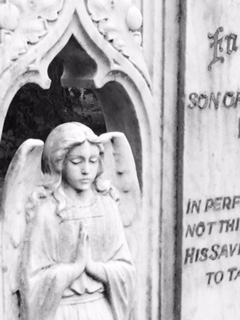
This was a very Protestant cemetery and I saw only one Catholic crucifix on my slow walk.  Carved from the local grey-brown stone, the heavy Victorian headstones were sombrely decorated with calligraphy and curlicues rather than angels, although many headstones wore small panels of spring flowers, symbolic of Easter and the Resurrection, an eternal stone garden mirroring the lush greenery in the hedgerows outside.  The headstones’ crisp edges had been softened by a hundred Welsh winters, and names and dates were fading beneath lichens and mosses.  As a landscape it was defined by giant yew trees, dark and gloomy, beneath which the grave plots were widely spaced, a lawn sprinkled with tombs.  Gothic ironwork disappeared into thick ivy; older tombs were smothered by wild undergrowth.  There were more Celtic crosses than in an English cemetery, but very few Welsh inscriptions.

Yet the stories reached back through time to the landscape around the town.  Older graves were often carved with the names of large houses, hill farms and town houses, places I passed daily.  Bridge House, Stapleton Court, Tan House.  Late of Kings Turning, read one.  In this border cemetery the names were Welsh and English – Hatfield, Davies, Jones and Roberts – and I found many Thomas Lewises, my paternal great grandfather in that unmarked Liverpool grave.  Many families were haunted by infant mortality, the children’s lives cut short which sadden all visitors to a nineteenth-century graveyard.

IMG_2310.jpg

But in rural Wales, the dead are part of the stories of the living and old stories fade slowly.  King’s Turning is a bend in the road, a field, a footpath on the outskirts of town, named for a fleeting visit by Charles 1st, so the story goes.  Welsh family storytelling creates a weave of story unconnected to chronological time, in which the dead are present through story and anecdote.  In Wales, as in William Faulkner’s Deep South, the past isn’t dead, it’s not even the past.

David Lewis has written five books of history/landscape/psychogeography about his native Liverpool and Merseyside.  He posts urban/rural images on Instagram - davidlewis4168 and mutters about the world on Twitter - @dlewiswriter

Postcard from... Cafe Leopold, Mumbai

Marcel Mumbai.jpg

By Marcel Krueger:

In the sweaty humid madness of the cyberpunk city that is Mumbai, where 60-storey skyscrapers rise into the night sky behind crumbling British colonial buildings and where men with typewriters and computers sit in little wooden booths offering letter writing and translation services on the streets, Café Leopold has been haunted by generations of foreigners. Lonely Planet calls it a ‘clichéd Mumbai travellers’ institution’, and it features heavily in Gregory David Roberts’ 2003 novel ‘Shantaram’, about an Australian hiding from the authorities in Mumbai and a staple in the literary diet of backpackers coming to India – they even sell it at the counter in the café.

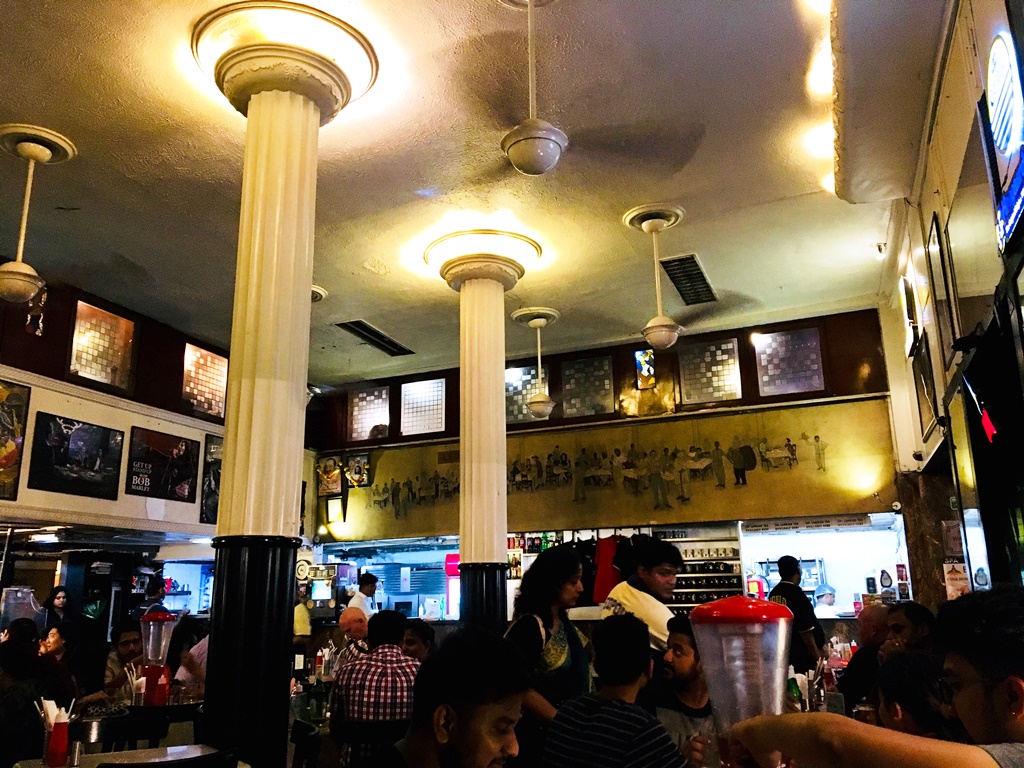
The café itself however does not seem to live up to its reputation. Its small entrance is almost completely immersed in the tourist infrastructure of the equally touristy Colaba Causeway, the main street of this southern Mumbai neighbourhood. It’s flanked by small stalls and shops selling trinkets, fake jewellery, smart phone covers and T-shirts, and only the two security guards wearing ‘Leopold’-T-shirts at the entrance give it away (and check your bags for dangerous items). What I like about the place is its matter-of-factness. Despite being in business since 1871, there is no European café grandeur amidst the languid air pushed around by the many ceiling fans on the ground floor, only Indians and foreigners, backpackers and businessmen who come here for cheap food, cakes and cold beer.

Maybe it is this matter-of-factness that made it one of the targets in the 2008 Mumbai terror attacks, when the attackers sprayed the café with bullets from their AK-47s, killing ten guests and injuring many more. Some of the bullet holes can still be seen in the walls, between old beer advertisements and Pulp Fiction posters. Café Leopold defiantly re-opened only four days after the attack, and I for one believe that cold beer and cake will always beat terrorists and their bullets.