
Four Poems
/
By Clare Bryden
Us English
Us English are a country
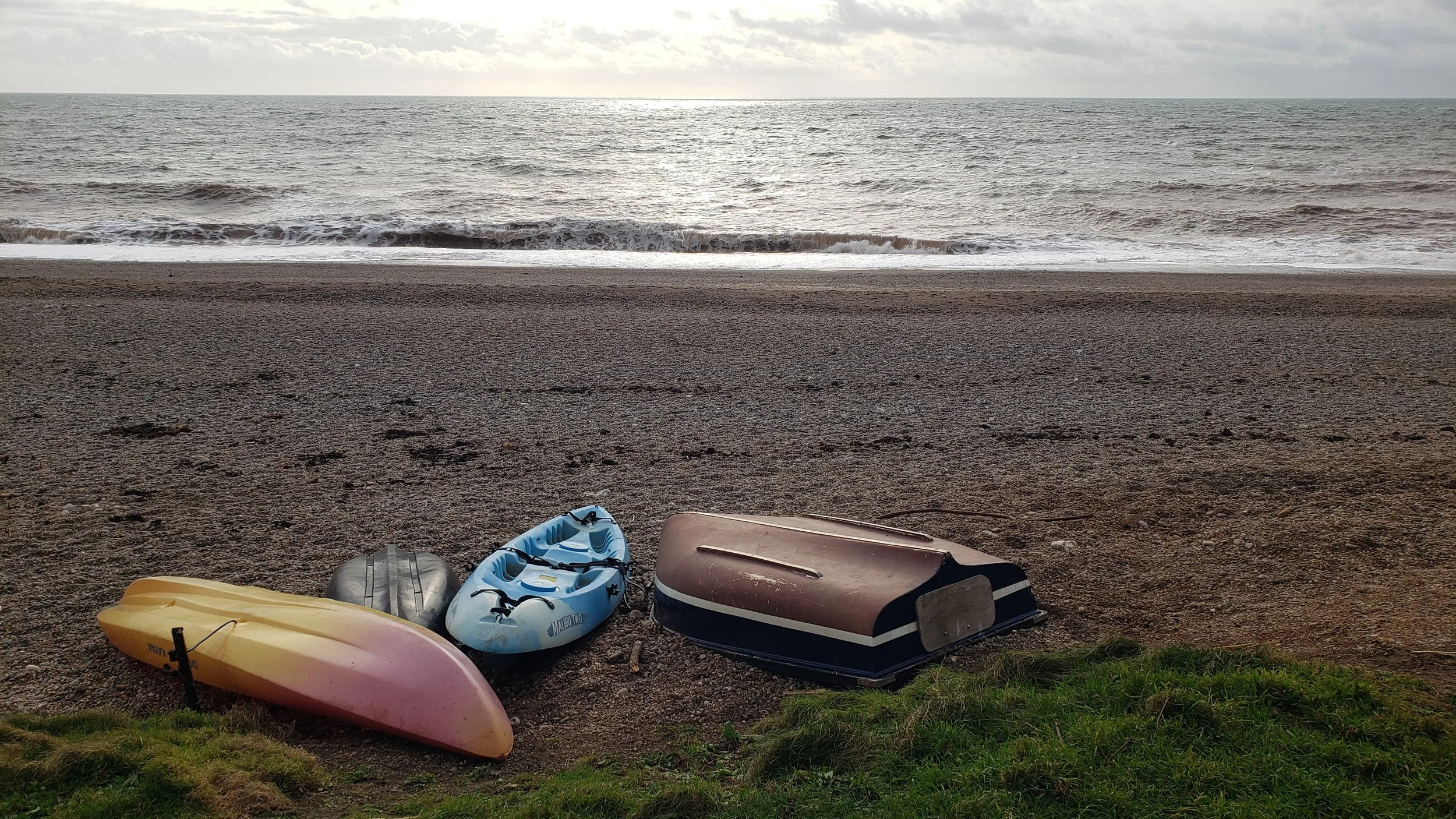
of boat people.
Waves washed in the craft of Neolithic, Beaker folk, Celts,
before ever the Romans
came and saw and conquered.
And which of us have not settled
in the settlements of Angles, Saxons,
Jutes, Frisians, Franks?
Or swayed on the tube and tram as
Danes and Vikings
on the aft decks of their dragonships?
Us Normans rub along with traders, troubadours,
seekers after life and the curiously off the map.
William of Orange is old news.
The Moho Discontinuity is exposed
You would walk Coverack shore on the ebb
from the far north end to the harbour wall—
would plunge miles beneath the sea bed
where the Lizard bulldozed into Cornwall.
From the far north end to the harbour wall
lie minefields of smooth-sharp intrusions.
Where the Lizard bulldozed into Cornwall
you would stumble over cool basalt wounds
and minefields of smooth-sharp intrusions
among crust crumbled gabbro boulders.
The moon rubbing rubbing salt in wounds—
what secrets has this place been holding
among crust crumbled gabbro boulders
and upheaved mantle covered at high tide?
The secrets of this place have been folding
weaving red green veins of serpentine
in upheaved mantle uncovered at low tide.
You would understand what happened here—
reading the red green veins of serpentine
exposed to light and the world’s weather.
You would understand what happened here
once plunged miles beneath the sea bed
exposed to light and the world’s weather
while walking Coverack shore on the ebb.
Ars prosaica
We are marked / by the place we call home / ... by the land. //
I am the daughter / of the mother of mountains —Bonnie Thurston
They mean well, the poets of place and landscape,
but in their pages I observe I am the offspring of flat.
Only Didcot’s distant cooling towers and the Clumps
punctuated the sentences of my early geography,
my horizon a temperature inversion under high pressure
hazing my days with pollen, crop dust and coal-fired power.
Clay clods broken into fields unbroken for miles around
and a river tamed by weir and lock were my raw materials.
Here was I formed, child of an economy of head knowledge
commuting to research blocks erected on former airfields.
Yes, I admire these poets rooted in place and landscape—
their apogees and depths—but I fail to trace the poetry in flat.
Gaza 365
Dartmoor covers 365 square miles,
one for every day in the year.
So we play Dartmoor 3-6-5, a game
tracking down features of interest,
one target in each square mile:
evidence of bygone industry,
strip farming, stone walling,
circles, rows and standing
stones of sacred import,
and graves, yes, Grim’s Grave,
Jay’s Grave and Stephen’s Grave,
Childe’s Tomb and The Coffin Stone,
yes, and Hangman’s Pit, Gibbet Hill,
Boundary Crosses, Bloody Pool,
Target Railway, Shell Top,
New Waste, Bleak House,
Look And Weep.
Our company of seekers
have dedicated books and maps,
reference sites and a Facebook Group
where we ask each other questions:
Are they practising live firing today?
What were these ruined buildings?
Who used to occupy them?
Where exactly is the target?
How do we get from A to B?
Gaza covers 365 square kilometres,
one for every day in the year.
“In 1991 Dartmoor National Park had an official area of 365 square miles” — from the Introduction to “Dartmoor 365” by John Hayward. Dartmoor 365 Facebook Group https://www.facebook.com/groups/296555273885240. https://en.wikipedia.org/wiki/Gaza_Strip#Geography gives the area of Gaza as 365 square kilometers.
Clare Bryden is a writer and web developer based in Exeter, UK. Her interests are wide-ranging, but primarily the place of humanity within the natural world of which we are part, and the related theology and psychology of connectedness. Her poetry has recently been published in Dream Catcher, The Christian Century, ionosphere.