
The Ideal Gardener
/
By Knut Birkholz
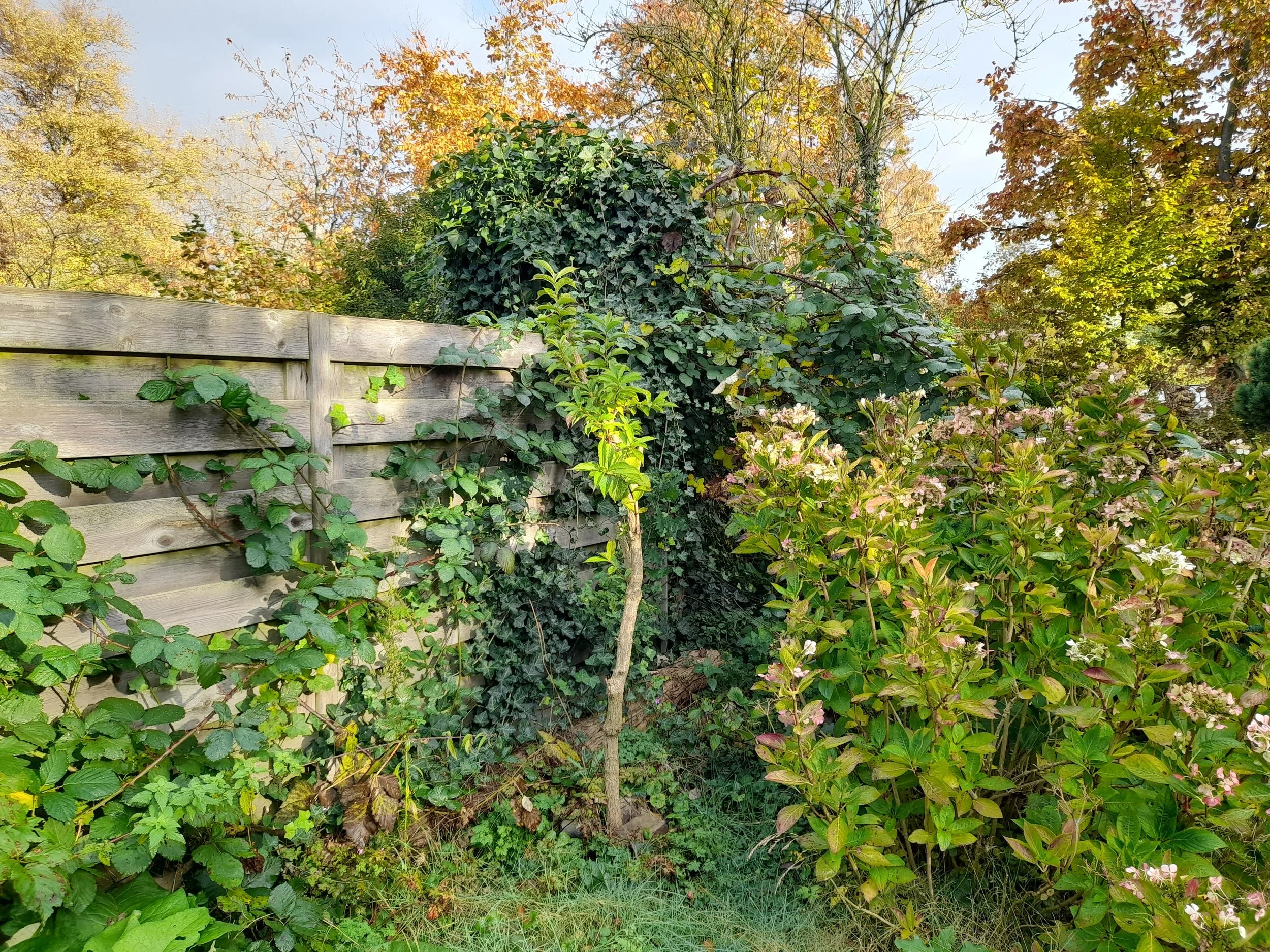
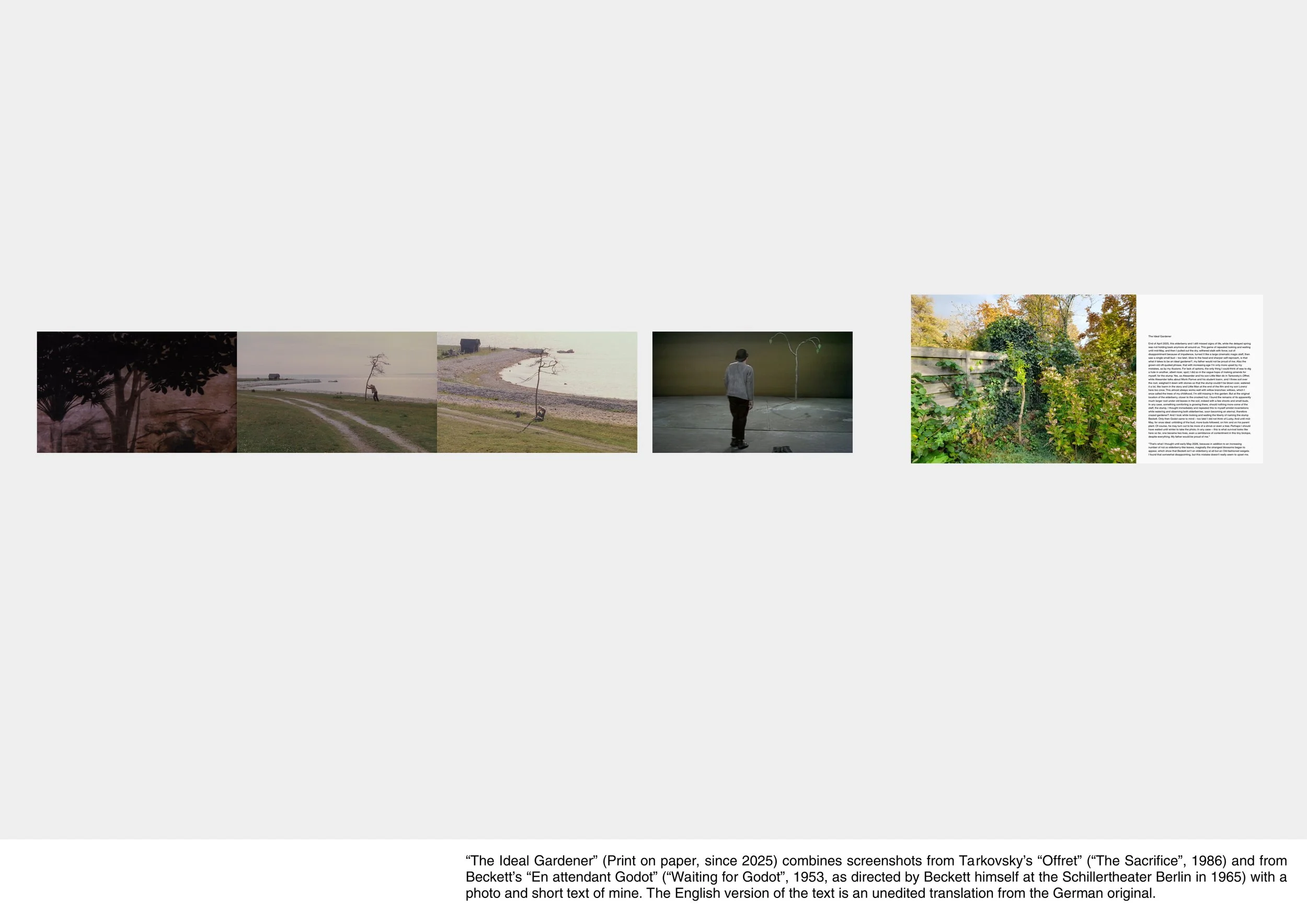
End of April 2025, this elderberry and I still missed signs of life, while the delayed spring was not holding back anymore all around us. This game of repeated looking and waiting until mid-May, and then I pulled out the dry, withered stalk with force; out of disappointment because of impatience, turned it like a large cinematic magic staff, then saw a single small bud – too late!, blow to the head and sharper self-reproach, is that what it takes to be an ideal gardener?, my father would not be proud of me. Also the grown-old oft-quoted phrase, that with increasing age I’m only more upset by my mistakes, as by my illusions. For lack of options, the only thing I could think of was to dig a hole in another, albeit nicer, spot; I did so in the vague hope of making amends for myself, for the stump. Yes, as Alexander and his son Little Man do in Tarkovsky's Offret, while Alexander talks about Monk Pamve and his student Ioann, and I threw soil over the root, weighed it down with stones so that the stump couldn't be blown over, watered it a lot, like Ioann in the story and Little Man at the end of the film and my son Lorenz here too once. This almost always works well with willow branches: willows, which I once called the trees of my childhood, I’m still missing in this garden. But at the original location of the elderberry, closer to the crooked hut, I found the remains of its apparently much larger root under old leaves in the soil, indeed with a few shoots and small buds. In any case, something comforting is growing there, should nothing more come of the staff, the stump, I thought immediately and repeated this to myself amidst incantations while watering and observing both elderberries, soon becoming an eternal, therefore crazed gardener? And I took while looking and waiting the liberty of naming the stump Beckett. Only then Godot came to mind – too late! I did not think of Lucky. And until midMay, for once ideal: unfolding of the bud, more buds followed, on him and on his parent plant. Of course, he may turn out to be more of a shrub or even a tree. Perhaps I should have waited until winter to take the photo. In any case – this is what survival looks like here so far, one became two lives, even a semblance of contentment in this tiny biotope, despite everything. My father would be proud of me.*
*That’s what I thought until early May 2026, because in addition to an increasing number of not so elderberry-like leaves, magically the strangest blossoms began to appear, which show that Beckett isn’t an elderberry at all but an Old-fashioned weigela. I found that somewhat disappointing, but this mistake doesn't really seem to upset me.
Knut Birkholz has mostly worked as a curator, critic and writer. His non-literary texts were published in exhibition catalogs, architectural magazines, and art exhibitions. In 2007, he was nominated for the prestigious German literature prize Open Mike. He has published literary work in art exhibitions, the Internet, anthologies, and literary magazines. Since 2018, he is program manager of the International Studio Program of the ACC Galerie and the City of Weimar (Germany). In 2020, the German publisher parasitenpresse published his translation of the poetry collection Wavelengths of Your Song by Canadian writer Eleonore Schönmaier. Knut received a grant from Deutscher Übersetzerfonds (Germany) to initiate the translation of the poetry collection Groenboek by Dutch writer Herman Hendrik ter Balkt. He is increasingly making minimal installations combining texts with drawings, maps, images and books. Being influenced especially by conceptual and documentary artists – such as Allan Sekula and Sophie Calle – he prefers long-term research and archival work leading to material collections centering around his biography, family history, transgenerational re-enactment and larger socio-historical contexts in East Germany and the Netherlands. His first bundle of prose-poems, Robinson des Braunkohlereviers (‘Robinson of the brown coal mining area’), is set to be published in 2026 by publisher edition offenes feld, Germany.