
Concrete Phantoms: Photography at the Edge of Presence
/
By Ema Lančaričová
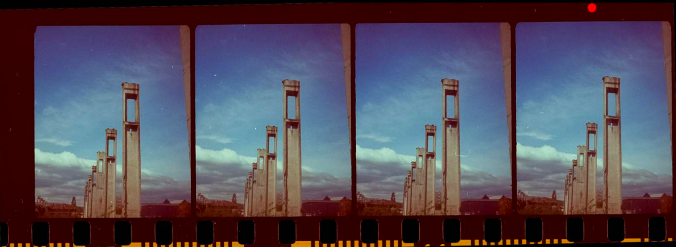
I first encountered the colonnade in 2016, as part of a landscape that did not ask to be noticed. It appeared along a railway line—glimpsed repeatedly, always in passing—until its persistence began to exceed coincidence. I returned in 2018. What followed was not a decision, but a gradual attachment: a repeated movement toward a place that seemed to exist outside of ordinary time.
The structure itself — a fragment of a former industrial complex — had already passed its moment of function. What remained were concrete columns, stripped of purpose yet not entirely abandoned. They stood as if suspended between states: neither fully present nor entirely gone. It was within this unstable condition that the project Concrete Phantoms began to take form.
The ruins do not signify an end in the sense of finality. Rather, they indicate a threshold — a zone where different temporalities overlap. These sites are not simply remnants of the past; they are active surfaces where the past continues to sediment into the present, and where possible futures begin to emerge. They resist linear history. Instead, they demand a mode of attention attuned to discontinuity, repetition, and delay. Each return to the colonnade was marked by a persistent sense of déjà-vu. The structure appeared familiar, yet never identical. Light shifted, surfaces eroded, fragments disappeared. Time did not progress forward; it accumulated in layers. What I encountered was not the same place, but a series of variations — each visit producing a slightly altered configuration of the visible.
This experience revealed the ruins as what I came to call concrete phantoms: entities that remain materially grounded yet behave as if partially withdrawn. They are present, but their presence is incomplete. Something has already left them, yet something continues to insist. Photography, within this context, does not function as a tool of documentation in the conventional sense. It becomes a method of approaching this unstable presence. Rather than fixing the image, it exposes the impossibility of fixing it. Each photograph operates as a threshold in itself — a surface where visibility and invisibility intersect.
The photographic image is often understood as evidence of what has been. But in these encounters, that understanding begins to falter. What is recorded is not a stable object, but a condition of transition. The photograph captures not the ruin itself, but its ongoing transformation. It records a presence that is already dissolving. This becomes particularly evident when working with analogue processes. In Polaroid photography, the image emerges as a chemical event. It appears gradually, forming itself in real time. Yet even after its development, it remains unstable. Light continues to act upon it; temperature alters its colours; time shifts its material composition. The image is never fully fixed.
In Concrete Phantoms, this instability is not corrected but foregrounded. Some images are exposed to conditions that accelerate their transformation. Others are physically altered — stripped of their protective layers, leaving the sensitive emulsion vulnerable. In one instance, the photographic layer is placed in water, where it begins to dissolve, slowly losing its coherence. These processes do not destroy the image; they reveal its temporal dimension. The photograph becomes an event rather than an object — something that unfolds, changes, and eventually disappears. It exists at the edge of presence.
At the same time, the project constructs an archive. Over years of repeated visits, images accumulate, forming a layered record of the site. But this archive does not stabilise the place. Instead, it multiplies its possible readings. Each photograph enters into relation with others, creating constellations that shift over time. The ruin thus exists across multiple registers: as a physical structure, as a photographic trace, as a memory, and as an imagined projection. None of these layers fully coincide. Their misalignment generates a space of speculation.
This speculative dimension is central to the project’s engagement with utopia and dystopia. The industrial site itself is a residue of a utopian impulse — a belief in progress, production, and collective future. Yet its current state reflects the collapse or transformation of that vision. The ruin becomes a site where utopia turns into dystopia, but also where new forms of imagining become possible.
The columns, as the central motif, embody this tension. They are structural elements, yet they no longer support anything. Their repetition suggests order, but their isolation disrupts it. They appear monumental, yet fragile. Through repeated photographing, the columns become both subjects and frameworks — organising the visual field while simultaneously dissolving within it. In some instances, the boundary between documentation and construction is deliberately blurred. A 3D model of a column is created and photographed within a controlled environment, introducing a parallel layer of fiction. The resulting images cannot be easily distinguished from those taken on site. This gesture does not simulate reality; it destabilises the assumption that photography can guarantee it.
The question that emerges is not whether the place exists, but how it exists — and in what form.
This question became particularly urgent during a return to the site in 2025. The factory building that had once accompanied the colonnade was gone, demolished sometime between visits. What remained was an emptier space, marked by absence but still saturated with traces. The act of returning shifted from observation to excavation. The site became an archaeological field, but not only in a material sense. It required a reconstruction of memory. I attempted to recall the proportions of the building, the texture of its interior, the way light moved through it. But these recollections were unstable.
They blended with photographs, with imagined reconstructions, with fragments of previous experiences. Memory revealed itself as another form of ruin — subject to erosion, distortion, and reinterpretation. In this sense, the archaeology of the place extends beyond the physical site. It becomes an archaeology of perception, of memory, of the image itself. Photography does not simply record these layers; it participates in their transformation. The ruins thus function as temporal thresholds. They hold within them what has been, what could have been, and what might still emerge.
This condition resonates with the broader context of image culture today. As images become increasingly dematerialised — circulating within digital networks, detached from physical substrates — the question of what persists becomes more urgent. The material photograph, with its vulnerability and finitude, stands in contrast to the apparent endlessness of digital reproduction. In this project, materiality is not a nostalgic return, but a critical position. The analogue image insists on its own limits. It can fade, degrade, disappear. It cannot be infinitely replicated without loss. This fragility becomes a form of resistance against the illusion of permanence.
At the same time, the analogue image is not immune to mediation. It carries its own aesthetics, its own distortions. The Polaroid, for instance, introduces a specific colour palette that evokes a sense of nostalgia. This is not an inherent quality of the past, but a property of the medium itself. The image produces its own temporal atmosphere. Thus, even as the work engages with material reality, it remains aware of the constructed nature of every image. The ruins are not simply there to be captured; they are continuously reconfigured through the act of photographing. What emerges from this process is not a definitive representation, but a field of relations. The project unfolds as a series of encounters—between site and image, between presence and absence, between memory and speculation.
The title Concrete Phantoms reflects this dual condition. The structures are concrete — material, physical, grounded. Yet they behave like phantoms — elusive, shifting, partially inaccessible. They occupy a space at the edge of presence. To work at this edge is to accept uncertainty. The photograph cannot fully grasp its subject; the archive cannot fully preserve it; memory cannot fully reconstruct it. What remains is a continuous process of negotiation.
The ruins do not offer closure. They remain open — waiting for new interpretations, new projections, new forms of engagement. Perhaps this is where their significance lies. Not in what they represent, but in what they enable: a rethinking of time, of presence, of the image itself. At the edge of presence, the world does not end. It transforms into something less stable, less certain, but perhaps more attentive to what persists in fragments.
And within those fragments, the possibility of another beginning remains — not as a return to what was, but as a reconfiguration of what can still be imagined.
Born in 1993, Ema Lančaričová works at the intersection of instant photography, experimental practice, and critical theory. Using Polaroid and other analog processes as her primary tools, she investigates the photograph’s fluid character today—its oscillation between presence and disappearance, material trace and ephemeral information.
Her practice consistently returns to themes of visibility and invisibility, image instability, and the temporal fragility of photographic materials. She approaches each work as a small archaeology of the medium, probing how images emerge, erode, and persist. Questions of authorship, material agency, and the limits of photographic evidence run through her projects, shaping an artistic research that blends tactile experiment with conceptual reflection.
Lančaričová completed her doctorate at the Academy of Fine Arts and Design in Bratislava, where she now teaches and contributes to contemporary debates on photography’s shifting ontology. Her work has been exhibited internationally in solo and group shows, including Fotohof (Salzburg), Rotlicht Festival (Vienna), Photon Gallery (Ljubljana), Fotografic Gallery (Prague), and Gandy Gallery (Bratislava).