

The End of the World, a syllabus
/
By Ian Breidenbach
Year Zero - present
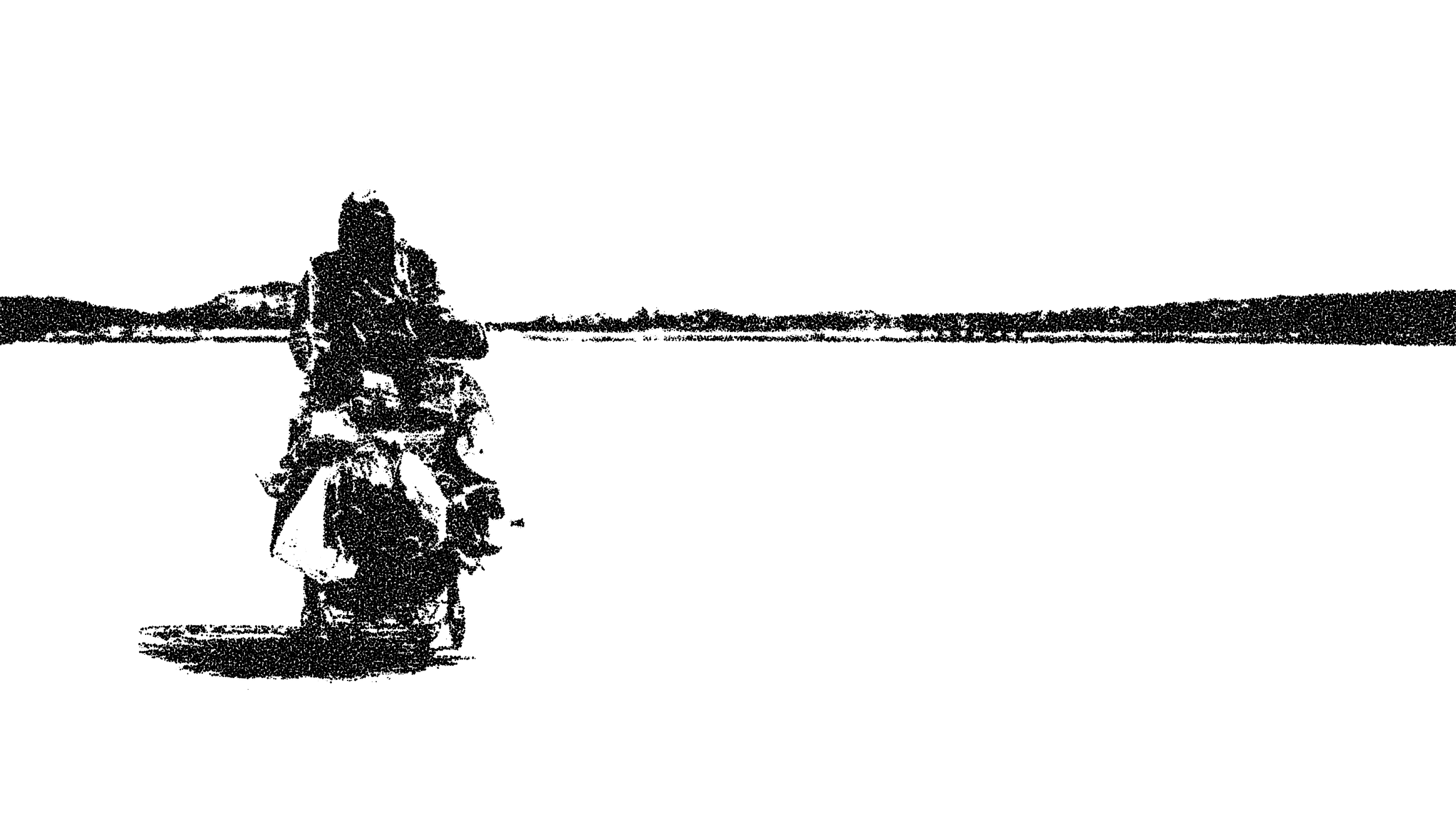
Instructor: The Ferryman
Meeting Times: Weekly service to take place on _______, lessons will begin at dusk.
Cost of Admission: One hot meal (upon arrival) plus (+) 2 assorted canned goods (1) will provide payment for one evenings lesson (one film and one reading) for an unlimited number of members of your community.
Means of communication: To schedule an appointment, raise a black flag from the highest remaining building. Meeting point will be set in advance, and meeting will take place at dawn the next morning. Communications initiated under darkness will not be acknowledged.
Disclaimer: The ferry will only run for the instructor (the Ferryman). Any violence upon the instructor will result in termination of services. There are no strikes, and service is at the discretion of the Ferryman. Any attempts to follow the Ferryman upon completion of service will terminate service. The Ferryman is not your friend, he is your teacher.
Catalog Description (2)
So, the world is moving on (3) ...
Have you noticed?
Since the detonation of the first atomic bomb at The Trinity Site in New Mexico on July 16, 1945 (4) , the world has lived in constant fear of nuclear war; the collectively agreed upon mutually assured destruction of the world in a matter of minutes. (5) But what if the end of the world wasn’t instantaneous? (6) What if it was long and drawn out, over months or years, or a lifetime? (7)
Would you notice? (8)
How would we know? (9) Are there signs? (10) What does the end of the world even mean and to whom? Are we the only species with a concept of “the end”? (11) How fragile is the balance between order and chaos (12), and who holds the scale? (13)
This course looks at the world ending through a very broad lens. It will look at the aesthetics of Late Stage Capitalism (14), at the stillness of Slow Cinema (15) . It will take into consideration ideological shifts as the ends of particular worlds; it will explore the end as both a subjective and objective experience. It will cover all manner of ends, from theological eschatology, to flesh eating Zombies; from world killing devices to worlds that kill themselves. It will propose the manner in which an understanding of various speculative dystopian futures can guide us towards working on a more utopian present.
By studying the media, not all of it fictional, of an anxious world, perhaps we will discover methods of alleviating our own anxieties as the world burns, or freezes, or is overrun by giant ants. This course will inform you on strategies to survive and thrive in the world to come. (16) It will link entertainment and real-world events, blurring the line between realities into a new history, with the hopes of answering the question “did the world end already, and if so, when?” (17) And if it did end, will we have learned from our mistakes and be equipped to replace it?
Format of Course
This course will be provided once per week, on your community’s scheduled day at dusk. A proper forum will be scouted upon remittance of service. This will be an exercise included in the first lesson. (18) It is here that, henceforth all subsequent lessons will take place, unless the forum should become unstable and be deemed a risk to participants and instructor. Alternate arenas should be proposed at the outset, lots cast for the best option. Assuming that payment has been made, the Ferry will project one film, to be followed by a supplemental reading with a Question and Answer session to follow.
Supplemental clause: In the event of prolonged cloud cover due to nuclear winter or unexpected weather event, community is responsible for the supply of petroleum for the Ferry’s generator.
Overview and Course Topics
Our history is littered with missteps (19) , ignorance (20) and conflict. We are masters of our universe, its resources at our disposal. In doing so, our culture has moved from a place of “survival” to a position of “quality of life”;. But we are depleting those resources with no plan for renewal. There is no sustainability built into the system. Even progress has progressed to a point of no return, a snake that eats its own tale. Humanity’s death drive (21) has led us to the brink of extinction.
America’s main export of the last century has been its entertainment. Instead of living our own lives, we are fed directionless unending narratives. We were educated by fictions. Are these narratives capturing our existence? Or creating it? For humanity to contemplate its destruction, have we also provided and glorified the road map to that destruction? (22)
It is here that this course finds meaning.
As we stand before the temple in ruins, can we learn to consciously direct humanity through these fictions, and incorporate them into our new ideologies? Can we identify systemic flaws without a system in place? From the ashes, can we use these stories to build a better more equitable world? The only way out of the maelstrom is to stop fighting and let it take you. From the visions of our world’s destruction can we birth a new society, codifying these fictions as part of our history in the form of theoretical thought experiments. We have seen how humans have acted in these circumstances in our entertainments of the old way and they have allowed us to teach a new way.
Course Texts
(see Time Enough At Last Bibliography)
Learning Outcomes and Assessments
Outcomes
The lessons and course materials will allow you to:
1. Traverse the landscape in a new manner. (23) Meekly, cautiously, and aware of the many dangers. There is no hospital and the medicines are limited; there is no safety net here.
2. Re-acquaint humanity to the world it destroyed; welcome to the post-apocalyptic Garden of Eden. You will explore your surroundings and create an inventory. You will re-evaluate your position to objects, finding new uses for old things, and old uses for new things.
3. Redefine who you are? What is it that you have to contribute? What is your name now that you are not a number in a system? (24) Who are the members of your new family? (25) You will determine your role and profession in this new society based on both the lessons and the skills that you have transferred from the old society.
4. Reassess your value to your community. What is the value of human life in this new world? Now that we know that entire worlds can perish, there is nothing to fear in the death of the individual.
5. Answer the question - What is the end goal of civilization? You will learn to work together on a group project to determine this new society. How does this society function? How does it handle what it means to be human in this new world? You will decide how your civilization will interact with other civilizations; how your society will view conflict. There will be others. You are an ambassador.
6. Confront the Question – Does Humanity deserve to continue?
Assessments
The community will determine the level of forgiveness available in this new world. This may result in the expulsion from the community (26) , but the instructor will have no determining voice in these discussions.
I do not expect you to succeed. But there is also no failure. You will learn to adapt, or you will perish. (27)
*For Independent Study – See Means of Communication*
**Rubric and Institutional Policies Forthcoming**
***Syllabus is subject to Change***
—————————————————————————————————————--
1 Please, please try to mix things up. 1 Fruit + 1 Vegetable or 1 Fruit + 1 Canned Protein. I do not want two cans of Kidney beans for lunch every day. Cannibalism will not be tolerated, and will result in end of service.
2 (it’s the end of the world) The precedent for short, structured and succinct Catalog Descriptions died with the bureaucrats who found that when it came to survival, they were unable to cover their ass with a paper trail.
3 Term used by Roland Deschain in Stephen King’s The Dark Tower Series. “The World has moved on” describes a mixture of what would be remnants of the old world: trains, cities, technology and their place within this new world of dust and mutation.
4 Which according to David Lynch’s Twin Peaks: The Return (2017), opened up a trans-dimensional rift allowing the being Judy to vomit Garmonbozia (pain and suffering) into our world.
5 The Doomsday machine in Stanley Kubrick’s Dr. Strangelove or: How I Learned to Stop Worrying and Love the Bomb (1964)
6 As in Douglas Adam’s The Hitchhiker’s Guide to the Galaxy, when the world is blinked out of existence by the Vogon Constructor Fleet to make room for a hyper-spatial express route.
7 The only indication that the world has ended in the first film of George Miller’s Mad Max saga is an area of the Australian landscape that is “off limits”; there are still picnics on the beach, ice cream, and some semblance of law and order.
8 Or would it take you a while, like Shaun (Simon Pegg) in Edgar Wright’s Shaun of the Dead (2004), as we follow him on his daily morning trek to the convenience store.
9 Nicholas Cage would try to inform us after deciphering the code from a child’s drawings found in a time capsule, for sure.
10 Will the bells of heaven ring as in Kevin Smith’s Red State (2011)? Or would we be visited by our personified past sins as in Clint Eastwood’s Pale Rider (1985)? Or will we all just be carrying around phones with the mark of the beast (the bite from the apple)? — An early conspiracy theory about Steve Jobs being the antichrist because he sold the first Apple computers for $666.
11 Elephants have funerals, dogs guard resources during times of scarcity...perhaps certain jellyfish have no concept of an end as they have been shown to revert to polyps in response to damage or starvation in a process similar to immortality. Also, Vampires, but this is perhaps longevity as opposed to immortality, if a slayer is concerned.
12 Why is Alexander wearing a Yin/Yang robe in Tarkovsky’s The Sacrifice (1986)?
13 Is Beyonce actually in the Illuminati? When searching “Who Runs the World” the top results are all for her song Who Run the World...is she providing a smokescreen for the Rothschilds? The Bilderberg Group? Jeff Bezos? The Weyland Corporation?
14 I always hated artists who use trash and recycled objects in their work, but I get it now. I still hate it, but I get it.
15 What will you do when you don’t have the internet? You might stare out the window for 30 minutes at time (The Turin Horse, Bela Tarr, 2011) or try on new roles, such as prostitute or nun (Melancholia, Lav Diaz, 2008). These are all acceptable responses to the trauma you have suffered.
16 Unless it is a truly planet ending event, memorialized in the words of Bill Paxton’s Pvt. Hudson in Aliens (1986) “Game over, Man”
17 Fingers crossed, we live long enough to invent time travel.
18 On Guy Debord’s Theory of the Dérive (1958), please wear or locate active wear and proper footwear.
19 Innumerable to recount, many lost to time. Henceforth there should be a ledger.
20 At the end of the film Idiocracy, Luke Wilson proposes that one day the world will once again care about who’s butt it is that is farting, and why. Until that day arrives we are doomed.
21 This wording is so good: “the task of which is to lead organic life back into the inanimate state” — Freud
22 Where we’re going we don’t need roads.
23 Like an insect or a rodent, though not like the rats of Bruno Mattei’s Rats: Night of Terror (1984), but eventually (hopefully) you may learn to scavenge in a manner similar to parkour.
24 Though, it will be easy to think of yourself as a Prisoner.
25 The answer is everyone.
26 So sayeth the Christian Bible, the world began with an expulsion.
27 “Life always finds a way.” — Ian Malcolm, Jurassic Park (1993)
Ian Breidenbach (b. 1984) is a conceptual artist, curator, and educator based in Findlay, Ohio. He has exhibited and curated nationally and internationally. In 2012, he founded The Neon Heater Art Gallery, an artist-run space servicing community of Findlay, Ohio and surroundings, providing access to contemporary art in a rural setting. His artistic practice explores the connective quality of narrative in the creation of worlds and possible futures. His current research focus is The Utopian Megaproject, a collective of artists, writers and philosophers exploring speculative mechanisms for collaborative difference. He holds a BFA from Wright State University in Selected Studies: Video Art (2009) and an MFA in Studio Art from Texas Tech University (2022). He is currently a Visiting Assistant Professor at The Ohio State University at Lima, OH teaching Art and curating The Farmer Gallery.