
Jurkalne, Latvia’s Baltic Coast
/
By Morelle Smith
It was Francesca’s idea to go to Jurkalne. Someone she met in Riga at the film festival had travelled round Latvia’s western coastline on his motorbike and the best place, he said, was not a town or village but a stretch of beach below a high sand dune, like an overlooking cliff, held in place by a pine forest. Between Liepaja and Ventspils, it wasn’t on any bus route and so Laura suggested to Ojars that we have a group outing there, in the car. He will think about it, Laura says to us later. He is Libra, so he will think of both sides, of yes and no, and often when I want to do something, I’ll suggest it when I see he is in a positive, optimistic mood. Ojars thought about it and decided that we could go the day after the performance, he could make time that day.
The sky was clear blue and cloudless that morning. We had got used to this extravagant sunshine and now expected nothing less. On the way to the beach we visited Edole Castle, a grand manor building dating back to the thirteenth century and rebuilt in the sixteenth. From then until 1920 it was the home of the German Baron von Behr and his descendents. Sunlight threw tree shadows onto the front of the building. The coat of arms depicts a bear and the motto, still clearly visible on the building’s facade Fortiter pergo roughly translated as – I proceed, I press on, even stronger.
To be in possession of a coat of arms was probably routine for many of the Baltic Germans, whose families had owned land here for centuries. But time and history have a way or eroding even the staunchest of declarations, overturning mottos as easily as trestle tables, turning moats into ditches (like the grassy trench that runs around this building) with just one summer of drought and neglect. Repeated wars and invasions cleared all the Baltic Germans from the area, and now these large houses or castles are either renovated and put to other uses, or are abandoned and derelict, sometimes in ruins.
Ojars says the building was now a hotel but there didn’t seem to be any guests. Only one SUV parked in front. The stonework of the facade was covered with a bright wash and the grounds were fastidiously tended. Perhaps guests would arrive later in the summer.
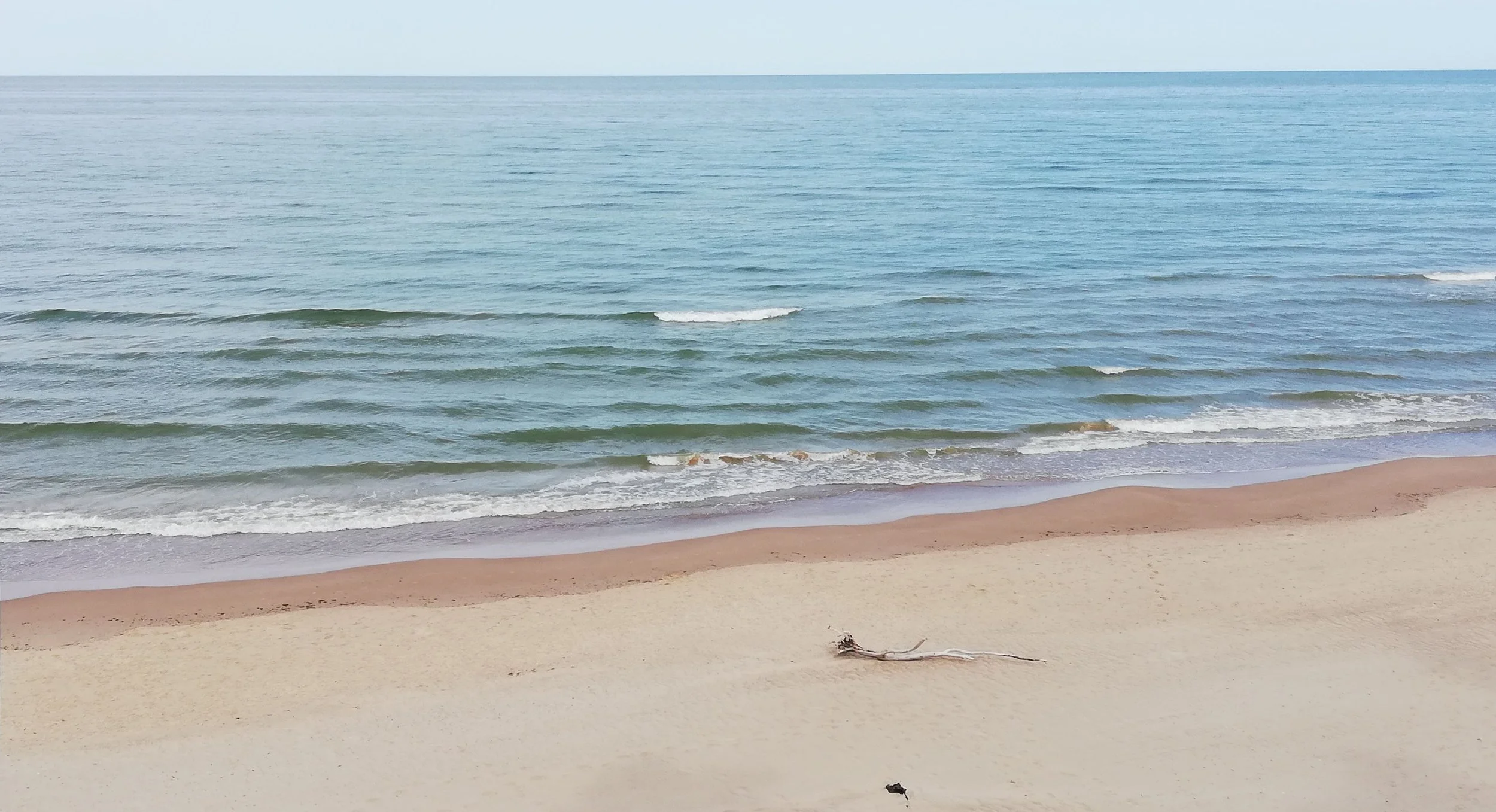
Leaving the lonely castle behind, we drove on to Jurkalne following a track through the pine forest, to a small parking area. Wooden steps go down from the top of the sandy cliff, to the beach. The sand was spotless, only a few shell fragments, some stones and the occasional bleached skeleton of a pine tree, dislodged from the clifftop, severed from the forest, and remaining here, white and sea smooth, polished by the wandering waves.
*
It has to do with the sea, with how it changes you. I know this, from looking at Francesca, as we sit outside the restaurant, shaded by the umbrellas from the hot sun. We have strolled along the beach at Jurkalne, and while I took off my shoes and waded through the shallow water, Francesca stripped down to her swim suit and walked into the sea.
The dishes are spread on the table, the bright red and green colours of the salads, it all mixes with the sunlight, which slices across the table, and Francesca’s hair is still damp from the sea. And just as she was immersed in the ocean, completely, every inch of her body wrapped in it, so the ocean is within her now as well, as if she has wrapped herself around the ocean. Her eyes are even darker, her wet hair, closer to her head. Though the sun will soon dry it. Sometimes, she seems briefly sunk in herself, as if she is reliving that moment when she put one hand over her nose, bent her knees, and disappeared below the surface of the sea. As if she is returning to those few seconds when she hesitated on the borderland between air and water, before she willed her body to sink into the water.
Unless it was her body itself that made the decision. Sometimes it is hard to tell. Perhaps she is remembering that moment when there was no will, no decision, the purity of the connection with the water, the obliteration of all boundaries between her and ocean, that moment when she became one with it. Like the pause between breaths, it did not last long, but it was like a microcosm of what time does to us, what our relationship with it is, which is really one of vanishing, of there being no separation whatsoever between us, but because we are so busy thinking or watching, speaking or listening, because we are so busy acting and thinking ahead to the result of our actions, because we are, in short, so caught up in our relationships with space and buildings, with walking and laughing, with digging down into the depths of thoughts, or catching the highest, flitting about in summer air like green or gold or blue or iridescent insects, well, we focus on that and do not realise that we are one with this element. It changes temperature in winter and summer, just like the earth, we see our breath in front of us on frosty days, we seek the shade of trees in hot sunshine, but it is always with us. Only at times of such poise, as between breaths or before falling asleep yet we are still conscious, do we register this element that holds us, always. So it might have been with that moment when Francesca became one with the ocean. It was so brief she can hardly remember it really. But she wants to go back there. Again and again, as we ate salads and drank beer at the table outside the restaurant surrounded by forests, and our movements made the sunlight dance across plates, cutlery, the basket with bread as we passed it to each other, across hands or arms or memories, she would slip into a sea reverie, her eyes would darken and her hands went still.
Laura tells the story of midsummer at Jurkalne. She shows us a video she has on her phone. People make a wheel, a firewheel, and roll it from the top of the cliff we visited, and the fiery wheel rolls down to the bottom, then it rolls across the sand towards the sea and even watching the video I was holding my breath, willing the wheel on into the water, and people were shouting and I assumed they were shouting what I was feeling, go on, go on, keep going, gorgeous wheel of fire, take your fire into the sea, be blessed by sea. It is not the sea putting out the fire, it is the sun, in its burning, its embodied possession of the wooden wheel, which takes its fire into the sea.
I always enjoy listening to Laura’s stories, because of the way she talks. She has the storyteller’s ability to hold your attention, the storyteller’s authority, to weave a spell.
It isn’t just the best beach, but it has a history of ancient ritual, as relevant today as ever. It isn’t just a good beer, it is excellent because of the quality of the water in Užava, the village where it is brewed.
The deep history of her country is related in personal stories, with humour, irony, affection. Yes, she says, I come from the village which occupies the highest point in all of Latvia. My grandparents were in Siberia (deported there along with many others when Latvia was taken over by the Soviet Union) and when they heard that they would be allowed to return to Latvia they were so happy that they made my mother, and that is where she was born. But later they were able to return here, with my mother of course, and that’s how I came to be here too.
*
If you want to lose tight definitions, go to the sea. Even for a few minutes, for a few moments even, especially if the sea touches part of your body, more if it’s your whole body – the sea will obligingly wash over your perceptions, erase your boundaries, tug, pull, push, and your walls and bricks, your stones and borders will lose solidity, colours will flow into each other, this sea energy will clear you, clean you, and revive your perception – that distant horizon, that water that moves and tugs and splashes endlessly, that never stops, ever...
At Jurkalne I saw a long beach stretching in front of me until the next headland, with pale sand unperturbed by humankind. You could say this beach was empty but really it was brimfull – a landscape of sand with just a few shells or stones, a branch of seaweed, a few pieces of bone that once were tree, white and stripped bare of everything except hardness, angularity, branches like the fringes of sea anemones, petrified, and scaly as a dragon’s foot.
The sand and the sea came together, moved apart, this was their territory, their conversation, their continuous connecting, there is the sense of being lucky to be part of this, to witness it. The sea is vigorous here, not wild, but in possession of its own strength. A flick of its curious tail could mark you forever with a blush of blue, a pattern of its passing, a rolling wave, a thrusting undercurrent, shellprint on your forearm, proof of your encounter with the sea. So there is solitude and strength, the sunlight reaching over the tops of the pines – so tall their feather-tips touch the foothills of the sky – then cascading onto the sand. And onto the surface of the water. Here we are, the sun and sea are saying, climb into our boat and come with us.
Morelle Smith has been writing for many years now, poetry, fiction, non-fiction, essays. Travel memoirs are Every Shade of Blue, travel with a musician across the USA and Europe, (which is having a second edition printing in March this year) and Tirana Papers, a memoir about Albania. She writes a lot about place, and had pieces published in The Nasiona, Scottish Review, & Stepaway Magazine. She writes regularly in her blog: https://rivertrain.blogspot.co.uk