
Memories of the Forest
/
By Giselle Bader
Forests are thick places. They are suffused with history and folklore, their denseness and darkness absorbing the memories and experiences of all those who have moved through it. There is within them a heightened awareness of the past, and the footsteps of those we follow in. Forest paths often have a far older history than we realise. They were pilgrimage trails, trading routes, and roads utilised by shepherds, farmers, traders, and travellers. Their collective footsteps have carved these paths into existence and our own footsteps maintain them. These are the places I go to remember the past.
Walking in these places is an innately liminal act. Our feet always poised between one place and another, here and there, then and now, before and after. We assign these spaces meaning but meaning can be slippery. We move towards and away, backwards and forwards, objects move in and out of view. The sky above is sacred, the ground below profane. There is, most profoundly, the innate understanding that what is before us is the future, and what is behind us, is the past. And yet, in the forest, I often find myself disoriented, unsure of which direction I am moving in. Landmarks shift, shadows lengthen, and distances stretch and contract. The past presses close, the present recedes.
Like Orpheus looking back at Eurydice in the underworld, I am eternally looking behind me as I walk through the forest. As if almost expecting to see my father there. He began each day with a run in the forest. My mother told me that watching my father on a run once, she was struck with the sight of him having de-aged several decades. He was as he had been, a young man running in the forests of his childhood. She felt like she had seen something she was not supposed to, as though she were trespassing. She took a quick step back, out of sight, almost hiding. Let the forest swallow that image of her husband back up.
That landscapes are haunted means that the past is never really past. Places become stained and marked not only by great events or structures but also by memory. The ghosts of these places give them their mood and tenor. I sense my father walking beside me, and behind him, a long line of our ancestors. Sometimes I even speak aloud to him. Words trickling through that thinnest of veils. To enter the forest is to issue an invitation for the long dead to awaken from their green and tangled graves and walk beside you. Past and present occupants of the forest walking in tandem. I am never entirely at ease in a forest. I am haunted by an ever-present sense of foreboding, prescience of my future status as one of the forest’s ghosts.
The earth is haunted by its own ghosts. That of long dead forests. The earliest humans navigated a world coated in thick primeval forests. Plants are among the first colonisers of earth. It was not until the Devonian period that our planet began to resemble itself as it appears today. The first trees evolved from moss, algae, and herbs. They grew taller, their leaves reaching higher and higher in competition for sunlight, slowly blanketing the planet with forests. At the start of the Devonian period, plants crept to only a few centimetres high. Thirty million years later, a blink of an eye in evolutionary time, they were some ten metres high. The earth had been colonised. Gone was a rocky planetary desert wasteland, the earth was green and wet, and roots wrapped their way around its heart, embedding themselves in deep time. The forests of this period are known as coal forests because their decaying deposits would over millions of years convert into coal. The birth of the industrial revolution some four hundred million years ago.
As humans we evolved by learning to wield the forest as a means to our survival. We gathered deadwood and felled trees to make fire — a skill that set us apart from other animals. Fire kept us warm in cooler climates and allowed us to cook food, fuelling the brain growth that shaped modern humans. It was the catalyst for our migration from Africa, the rise of agriculture, and the technological advancements that followed. Perhaps there is something within us that recognises this partnership. The great debt we owe to forests. For there is something unassailably primal about lighting a fire in the outdoors. The ritual sparks something ancient and longing within us. The smell, the intoxicating sensations of shadows, light and dark, all darting together and apart again. The fire flickers and for a moment we are no longer ourselves but some nameless ancestors, whispering in a language newly formed and child-like. Learning to tell stories about the world we live in. We whisper, afraid of being overheard by the forest gods we prayed into existence. We emerged from wild forests, learned to talk and to walk, learned to both fear and revere the place we came from.
When we spend time in natural spaces like forests, environments we evolved in, we experience time in a different way. We witness the patterns and cycles of nature, but we also experience first-hand the disruptions to these cycles, the ways forests regenerate and renew, and the means by which we have the power to destroy but also to repair. Looking at regeneration and rewilding requires us to look backwards, to examine how things were, how things are, and how they can be again. Time spools itself over and over until it does not. Moving between forests and civilisation reveals the fatal fault line in these forests: us.
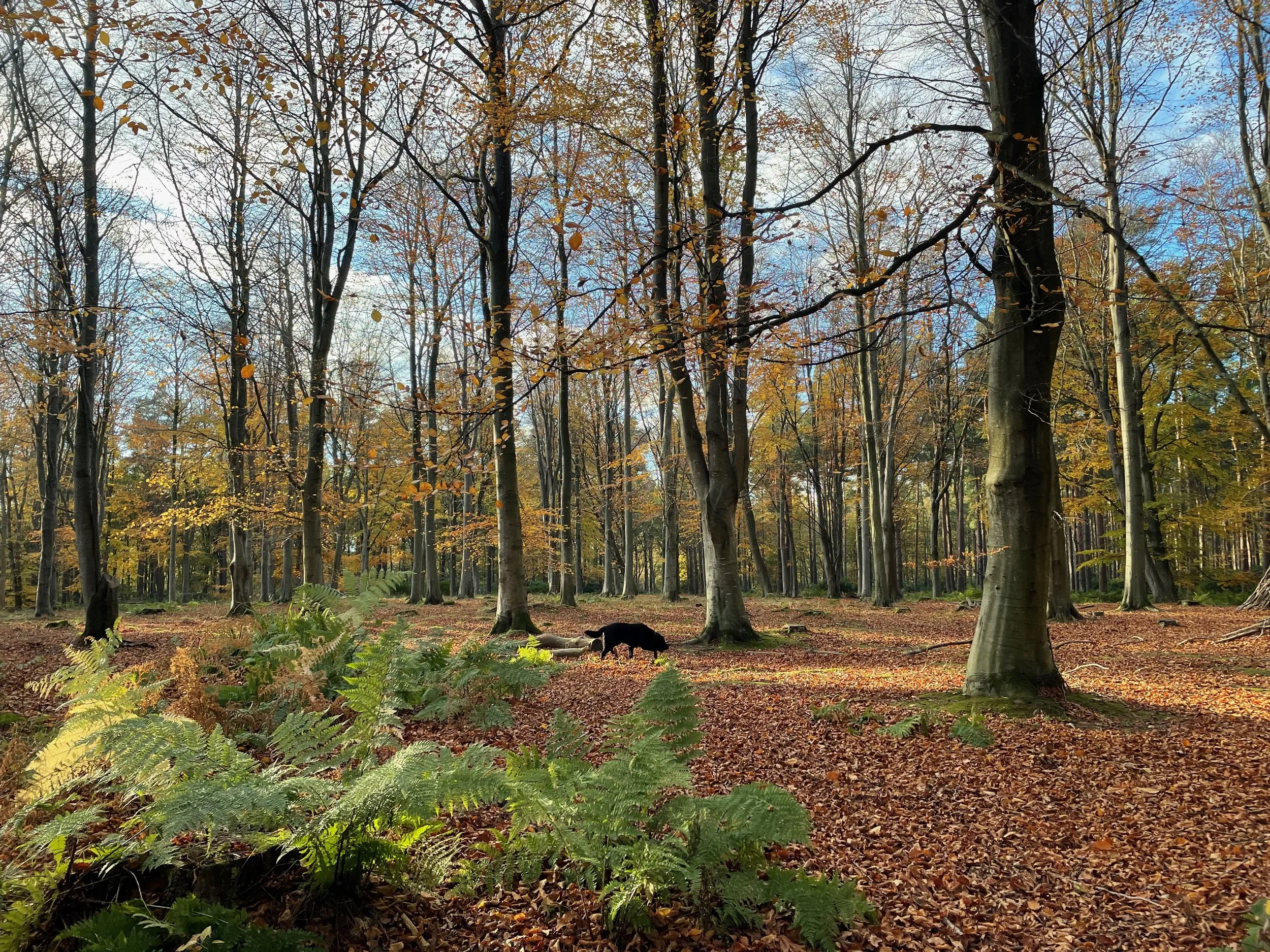
As I grow older, and the years widen between when my father was alive and when he was not, I feel painfully the chasm grow between myself and the forests of my childhood. I have developed an intimacy with the Scottish forests I now live amongst. The deciduous oaks and beech, and the evergreen Scots Pine. I watch my father’s dog in the forests. He told me this would probably be his last dog. He was only one when his master died. When I moved to Scotland, he came with me. I watch him weave his way between trees, emerge triumphant with a stick clutched tightly in his jaw, his joy as he leaps over logs and darts beneath branches. I live a life that is intimate and close to trees and yet there is a deep understanding that these are not the trees of my people. I will not find him here. There will be no barely caught glimpse of his silhouette as he jogs on the path ahead, half ghost, half memory.
There is one forest we visit often that is full of ghosts. Binning Wood, a three-hundred-acre forest, was originally planted in the eighteenth century and then cut down for wood in the Second World War for fighter planes. There is no old growth here, but it is indelibly linked to life and death for many local residents. A part of the forest is dedicated to a green burial site, where those seeking an environmentally friendly afterlife are buried using only natural and sustainable materials. Only a small parcel of the forest is reserved for the dead but there are no external markers separating it. One simply stumbles upon it; the only signs of mourning are slightly raised mounds of earth and the occasional bundle of flowers.
We visit these woods often and despite its use as a burial site, it is a light place. There is no one seeking me here in these woods. I come alone and leave alone. But perhaps someday this is where my children will come to seek me out. For these are the woods where my partner and I get engaged. On a rainy January walk with my father’s dog. In a place meant for both the living and the dead.
Giselle Bader is a writer and historian living in Scotland. Her research and writing are focused on the history of pilgrimage, walking rituals, and our spiritual connection to place.