
Syria, May 2024
/
Aleppo: Faded glory of the Baron hotel, where Agatha Christie stayed many times and TS Lawrence has an unpaid bar bill.
By Janet MacDonald
Syria: civil war, ISIS, refugees, earthquake, these are the words that come to mind. The accompanying images of destruction and displacement served up in the mainstream media are seared into our psyche. Visiting last May - while the country was still under the grip of Assad - I felt a certain quandary, travelling to a country run by a dictator.
Syria has a history which stretches back to and beyond biblical times. Occupied since the Neolithic period (10,000 BC), it has been conquered by the Crusaders, the Mongols, the Greek, the Romans and in1916, as part of the Sykes-Picot agreement regarding the division of the Ottoman empire, it was given to the French, along with Lebanon, Kurdistan, and parts of Southeast Turkey.
Leaving Damascus, as far as the eye can see, are piles of rubble and destroyed buildings. Reinforced concrete protrudes from buildings, like pipe cleaners. These are remnants of the battle to keep ISIS out. Thousands of small black protrusions emerge from the ground in some sort of macabre dead tree growth. Wasim the guide tells me:
“As ISIS advanced towards Damascus they cut down and then burnt all the trees to ensure there was no cover for the Syrian soldiers holding them at bay. This is why we have these charcoal stubs.”
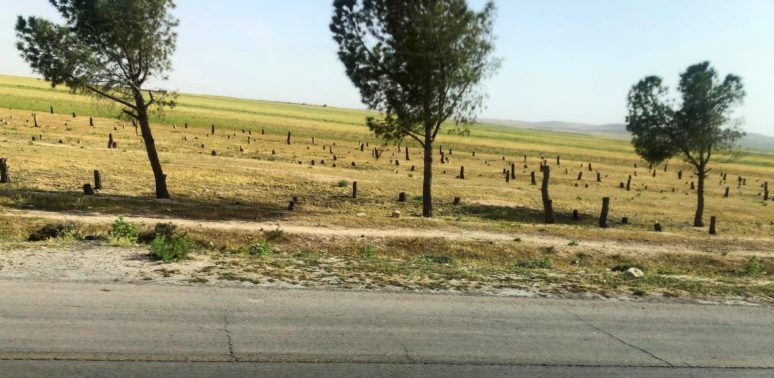
Damascus: on the road out , charred stumps are the result of ISIS fighters cutting and burning down trees as they advanced on Damascus in 2015 and 2017.
Syria, a country with a 22 million, mainly Sunni population, has a Mediterranean coastline to the west and shares borders - and complex geopolitical relations - with: Turkey, Iraq, Jordan, Israel, and Lebanon. The First Syrian Republic was formed in 1930 but full independence from France was not granted till 1946. Political instability has followed with multiple military coups, the establishment of a one-party state and a totalitarian regime. The 2011 Arab Spring uprising provoked a government crackdown and a refugee crisis ensued. Then came ISIS, in 2015 and again in 2017.
Known as the Pearl of the Desert, Palmyra – lies a further 200 km north. This is, or was ISIS country and the extent of the devastation they wrecked is clear; the museum was looted, Roman ruins in Old Palmyra were destroyed with tonnes of explosives and the Director Khaled Mohamad al-Asaad publicly beheaded in 2015, at the age of 83, after refusing to reveal the location of hidden antiquities. I visited an extensive underground tomb which was turned into an underground prison by ISIS. Many of the graves were disturbed and looted with the multi-coloured Arabic fresco at the entrance badly damaged. Extensive ISIS graffiti penned on the walls translates as “Tidy up after yourself. Wash the dishes.” I was expecting something more profound but even jihadi terrorists must keep on top of the mundane chores of life.
The UNESCO-listed ruins of Old Palmyra date back to the Neolithic times. ISIS nearly destroyed the famous Temple of Bel, with 5 tonnes of explosives. A displaced block in a 20 metre high column, shunted right by a rocket, leaves the column now balancing precariously like a giant jenga game. Merchants, brothels, money exchange, tax collectors; the entire gamut of commercial activities was here. I get a sense of the grandeur of this spot which was a nexus on the silk road trading routes.
The famous Norias’ water wheels of Hama are a feat of engineering. Traditionally made from hard wood such as walnut, the water is forced into a narrow channel which pushes it against wooden paddles which drive the larger wheel round and move the containers attached to the paddles up, transporting the water upwards.
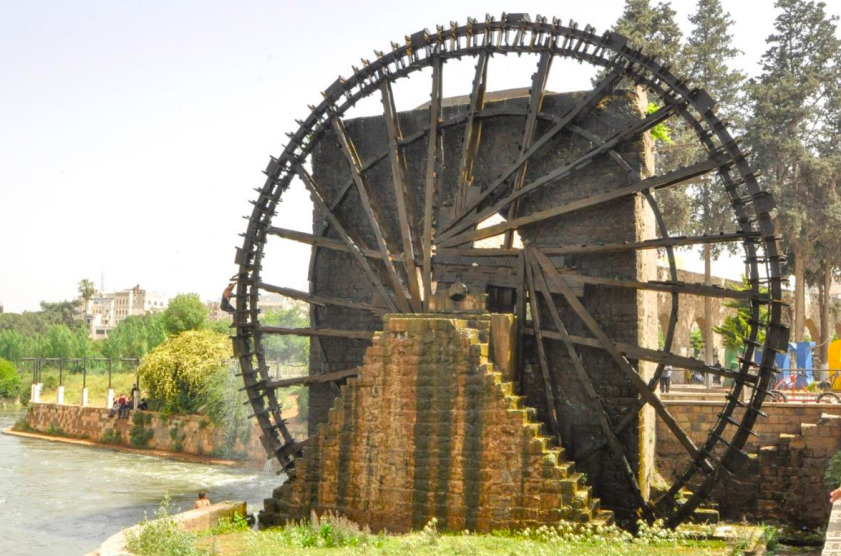
Hama: The Norias of Hama are a series of 17 historic water wheels, developed and used for irrigation. A feat of engineering, they were for 500 years the largest water wheels in the world. Boys often jump off them now. In the conservative town, girls standby and watch the fun.
The first stop in Aleppo is the museum. The few artefacts on display tell a story of a long, and at times tragic history. There is 3000 year old pottery - still intact. An indent of a child’s foot from 2000BC; four children to be taken as payment for a debt. A lamp with 5000 year old burn marks, a complicated and intricate headdress and a complicated scale and compass to identify mecca. Flintstones which are over a million years old all remind us of how ancient this country’s history really is.
The Barron Hotel in Aleppo has seen many famous residents; TS Lawrence has an unpaid bar bill and Agatha Christie stayed here many times. It has an abandoned air, as if the party was suddenly broken up; bottles left standing on the bar and paperwork scattered. I rummage through cases of old bills and receipts and look at the abandoned piano, imaging the parties and singalongs that it would have sustained.
The Al-Madina Souq is a sobering experience. The largest covered historic market in the world, with about 13 kilometers of stores, some dating back to the 14th century, it has almost been destroyed; each doorway of rubble representing a destroyed business, income and family. One shopkeep selling jewellery tells me, “I come here every day as this is my life. I have been selling out of this shop for 25 years. I don’t know what else I would do with my life.”
Aleppo’s strategic trading position attracted many settlers who wanted to take advantage of the commercial roads that met in Aleppo: China, Mesopotamia to the east, Europe to the west, and Egypt to the south.
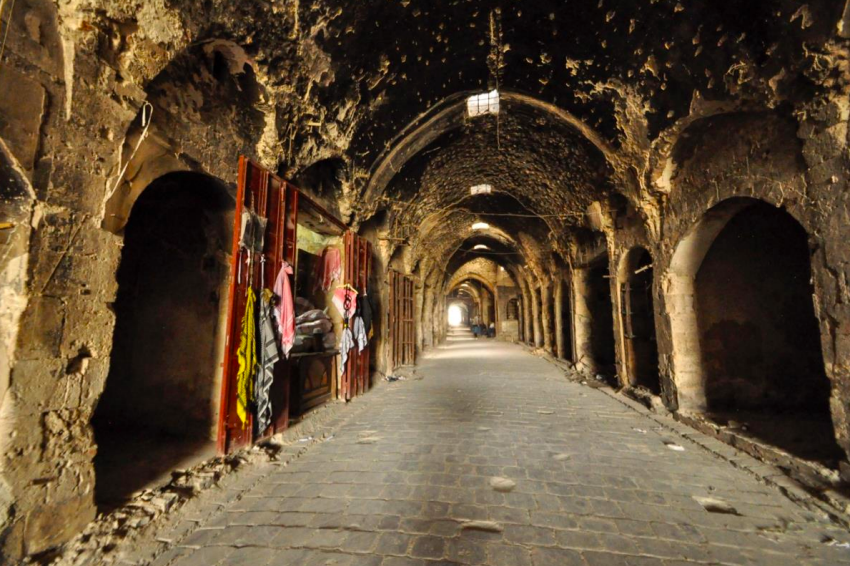
Aleppo: The al-Madina Souq is the largest covered historic market in the world, with an approximate length of 13 kilometres. Much of it was destroyed in the civil war.
I sit in a cafe beside the Aleppo Citadel on my own, people watching. A group of teenagers are at the next table. As they sit with coffees, cakes and milkshakes they have not a care in the world as they sit in the evening sun with their mates.
A new arrival with a confident air scans the environment and spots me and shouts in English. “Where are you from?”
“Scotland.”
“Oh. Take me there with you. Please. I will come with you to Scotland.” “Do you have a husband?” he continues.
I laugh at his confidence and exuberance but before I can clarify my marital status, his question has incurred the wrath of one of the staff who comes over and gives him a loud and extensive telling off in Arabic. Clearly concerned that I am offended, the staff member apologies.
“It’s ok. I don’t mind. He’s just being friendly and a bit cheeky.”
That night our group eats at a cafe, where they butcher their own meat, with one outdoor table, in a lane, under a car park and it is amazing. We visit a rooftop bar where the staff are surprised to have any guests and watch a super moon high over Aleppo.
The next day we drive to Maaloula, an historic Christian town where ancient Aramaic is still spoken. In the underground church we find a woman singing in Aramaic - the language Christ spoke and a wizened nun, over 90 years old, who was kidnapped by ISIS, selling souvenirs.
By contrast, in the carpark, in one of the few shops, there is a lively man with a general store. He greets us excitedly. His hospitality greeting is vodka shots, which would seem rude to decline. Portraits of Assad and Putin hang behind him.
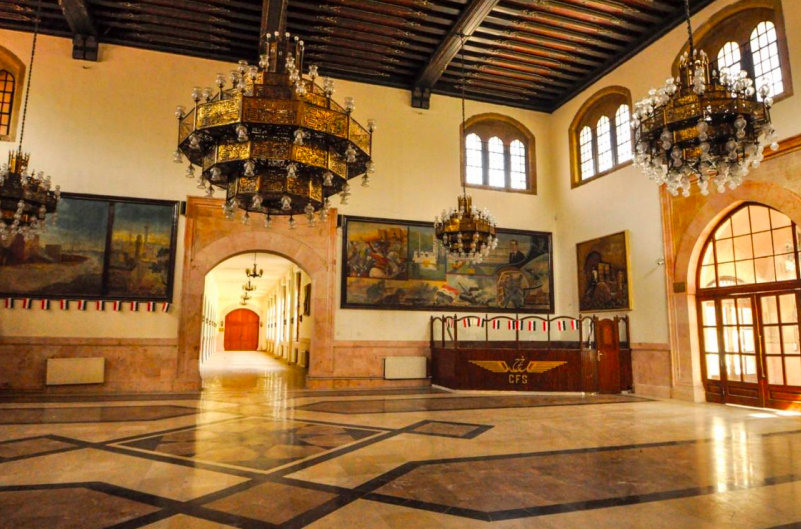
Aleppo railway station: Faded glory from the era of great rail transport
Janet MacDonald is a Scottish writer, photographer and director.
About her visit to Syria before the fall of the Assad regime, Janet says: “My travel in Syria was reasonably free. I went with a guide who had previously lived in Syria and, as was required, worked with a Syrian tour company who organised visa and logistics and provided a Syrian guide. There were only four of us, because really in April/May last year no one was going to Syria. We didn’t have an allocated Assad man but all the tour companies need to be government licensed and we needed to preapply for our visas. In Damascus and Aleppo I was able to wander freely on my own during the day and at night we often socialised freely in old Damascus.”
Janet returned to Scotland three years ago, after living in New Zealand for 20 years, to be nearer family. Unfortunately, her parents’ died within 15 months of each other. Janet decided life was short and now spends (most of) her time travelling, researching and writing. She has travelled to some of the world's supposed 'trouble spots': Mexico, Colombia, Iraq, Syria, Lebanon, Russia and Afghanistan, where she seeks to understand and articulate historical manoeuvrings and geo-political influences. Combining these with interviews and insights gathered from locals, she writes, to help both herself, and her readers, better understand the world. Some of her writing can be viewed at https://medium.com/@janet_40220