
Visiting the Venus Flytraps
/
By Hope Yancey
A couple approached us as we lingered at the trailhead in the park. “Are you here to see the Venus flytraps?” the man asked my husband and me, eager to share his excitement with someone else. He was earnest as he tried to point out on a paper map, as precisely as possible, where to find these plants. His companion waited politely. Not only were we there to view the flytraps, Brian and I had just driven four hours on a day trip from Charlotte specifically for this purpose. Through no fault of this stranger’s, I struggled to commit to memory his detailed directions, the stifling summer heat working against my concentration.
We made several turns down a long boardwalk in search of the elusive plants. It was an extremely humid and uncomfortable start to August during the pandemic. Our clothes stuck to us. The weather tempered our enthusiasm, but could not extinguish it. We were at loose ends and had to find our enjoyment where we could in those times. Something outdoors in the open air seemed relatively safe.
Stern signs near the trail cautioned that the site was being videotaped. Removing the flytraps is a felony offense. Though Venus flytraps are cultivated and sold elsewhere, North Carolina’s Carolina Beach State Park, south of Wilmington, and nearby areas are among the few places these plants grow native in the wild, so the stark warning for visitors did not seem excessive.
Parts of the forest appeared charred, as though park rangers had carried out a prescribed burn. There was a forest restoration project in progress.
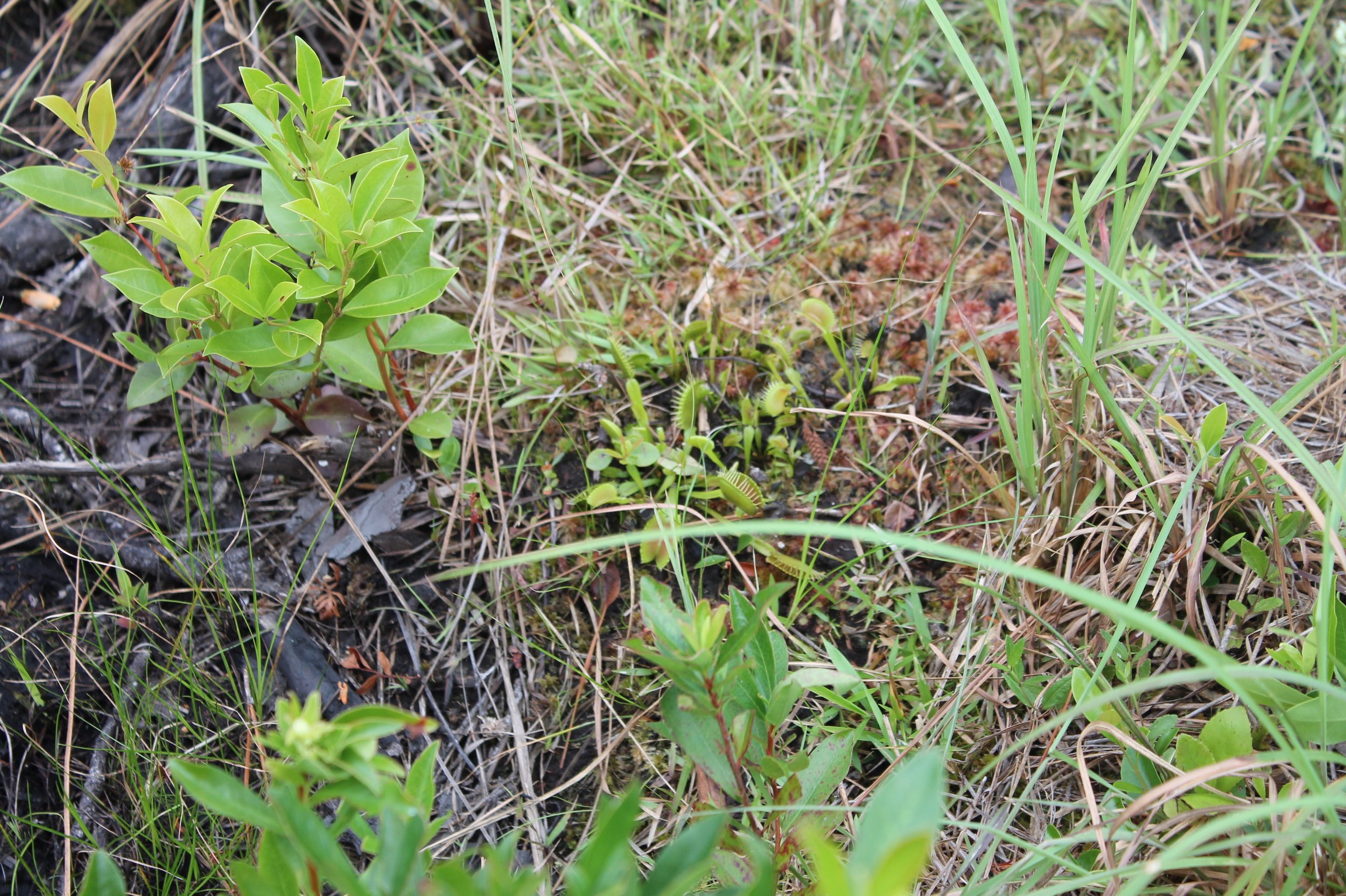
I’ve heard the adage, “Patience is a virtue.” This is true when it comes to spotting a Venus flytrap. You may have to really look. And look. And then look some more, close to the ground.
Peak season for the Venus flytrap (scientific name Dionaea muscipula) is May and June. Since we were there later, perhaps our difficulty finding the plants was attributable to timing.
We spotted our first one about 3 feet to the left of a skinny pine. Ultimately, I think we saw more than a dozen “mouths” of varying sizes: some open, some partially open and some closed. One was bigger than the rest and wide-open, agape in a toothy smile, accentuated by a rosy pink inside and lime green outside – the colors of a ripe watermelon.
The park’s website describes the shape of the leaves that trap insects as being like a clam’s shell, which is accurate. But, with a little imagination, it’s also a tiny jack-o’-lantern’s grin, a comparison I find more personally compelling as a lover of Halloween. The site notes these plants are diminishing in number where they’re found in the wild, a combination of poaching and habitat loss. I wonder to what extent coastal development is encroaching on their habitat.
I didn’t know this at the time, but the Venus flytrap intersects with North Carolina history. According to the N.C. Department of Natural and Cultural Resources, Gov. Arthur Dobbs, a royal governor of North Carolina who was keenly interested in the natural world, identified the plant growing in the state (then a British colony) in 1759. There’s even a license plate designating North Carolina as the home of the Venus flytrap, I learned only recently.
I was so taken by the sight of these plants, and relieved to have finally found them, that I braved the abundant insects to sit down at the end of the walkway. I’d never seen a flytrap in nature, only for sale in stores. Before this pursuit, the extent of my knowledge about carnivorous plants was a hazy recollection of watching the 1980s movie “Little Shop of Horrors” when I was growing up. Perhaps that wasn’t a sufficient primer.
As a vegetarian, it seems like a contradiction that I would find myself preoccupied with an insect-devouring plant. But I’m not embarrassed to say I talked to those Venus flytraps. Communed with them. Got to know them. There was a stillness at times, with no other company but the birds and bugs.
Growing in tall clusters, the pitcher plants – another carnivorous plant – were easier to spot. I spied their yellow blooms with red veins.
The sounds of fauna cut through our thoughts, vying for attention with the sight of flora. We heard animal noises we couldn’t locate. Frog? Cicada? Lots of clicking going on! Meanwhile, thunder rumbled in the distance, threatening a coastal storm.
Afterward, we celebrated our pilgrimage with cold desserts at an Irish ice cream shop at Carolina Beach. Irish Butter Pecan helped me overcome the heat. I think Gov. Dobbs, who had strong ties to Ireland, would’ve approved.
We also paused for a short visit to the beach and ocean. But honestly, I probably would have been satisfied if we’d stopped with the coastal vegetation.
Since that time, I’ve come across little Venus flytraps for sale at a garden center and in the floral department of a grocery store. Nothing compared, though, with seeing them growing in the ground.
One day, my travels may take me to find the rare Oconee bells, a spring-blooming wildflower at Devils Fork State Park in South Carolina. I’ll have to be prepared to encounter crowds for that one, but I know it will be worthwhile.
Sometimes, going on a quest, even a small one, helps me regain a sense of purpose. According to Merriam-Webster, one of the definitions of the noun “quest” is “an act or instance of seeking.” As quests go, this was not a big one. That’s not important. At a time when I needed it – needed them – I’m glad the Venus flytraps were there. I hope they’ll be there for you.
Hope Yancey is a writer in Charlotte, North Carolina. Her work has been published in Deep South Magazine, HeartWood Literary Magazine and many other places. She loves plants.