Printed Matters - hidden europe magazine

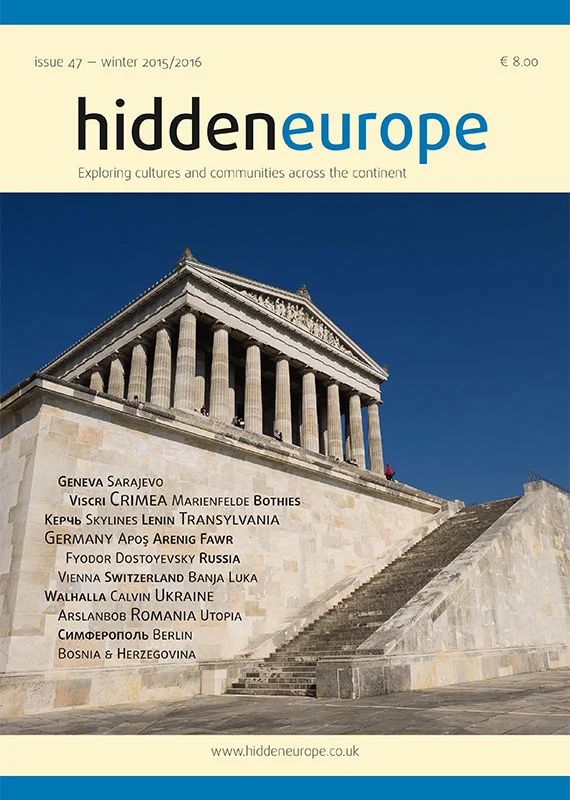
HE-47-cover.jpg

On the 28th November we are hosting Printed Matters #1 - a celebration of Berlin’s indie publishing scene that we are very proud to be a part of. We are also very much aware than many of our readers are not in Berlin, and so we want to use the opportunity to present some of our friends here on the website. First up, hidden europe magazine:

It is not really surprising that we are fans of hidden europe. Not only is this magazine an inspiration - published three times a year they have just released their 47th edition - but the editors Nicky Gardner and Susanne Kries have been a great source of support over the past year as we have tried to get Elsewhere off the ground. And beyond that, there is a philosophical link as well, for the writing contained within the pages of hidden europe is intended to conjure a sense of place as they probe “the curiosities of the continent’s diverse cultures.”

The current edition, released last week, is no exception. As you might be able to guess from the name, hidden europe is a travel magazine in the best sense, taking the reader to the corners of Europe that perhaps you have never heard of. In issue 47 this includes the Saxon villages of Transylvania and the mountain bothies of Scotland, but they also delve into the secrets of more familiar haunts, such as a Berlin suburb or a Vienna train station. What this means is that hidden europe is a journey of discovery each time it arrives in your letterbox, thanks to the editors and their small band of contributors.
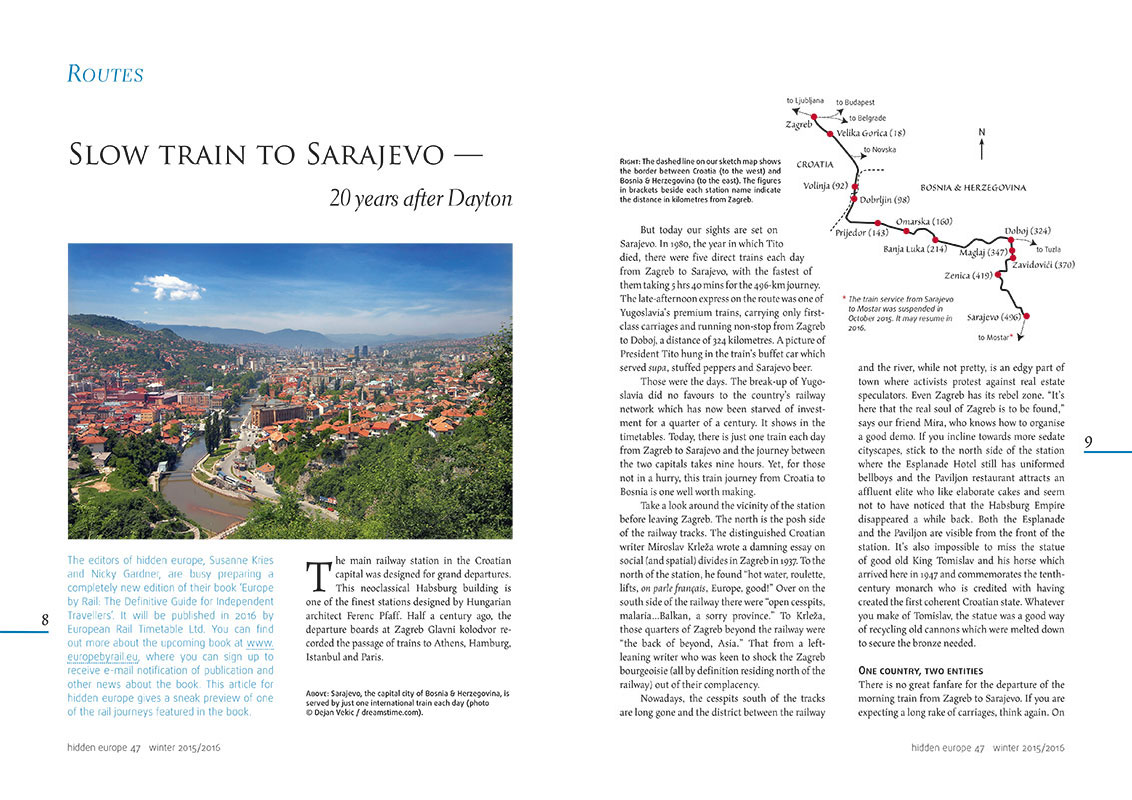
Sometimes it is possible to spot a thread running through the articles of any given issue, although this is not always made explicit. For issue 47 however, the editorial gently points us in the right direction, and it could not be more timely:

Displacement is the word of the moment. And the refugees who have moved in their thousands across Europe these past months compel us to reflect on the experience of the displaced. The most compelling images of migrants on the move have actually been devoid of movement: the remarkable patience of refugees trapped at Budapest Keleti station in late summer, and more recently the hapless situation of refugees stranded in driving rain on the border between Croatia and Slovenia.

Exile and displacement feature in various ways in this new issue of hidden europe. We consider Geneva, a classic city of refuge. We examine a suburb of Berlin which has, over the years, received refugees in tens of thousands. And we explore villages in Transylvania to discover what happens to these places when everyone leaves. We also explore the question of links severed through past or present strife and conflict. What happened to all those trains which once ran between Zagreb and Sarajevo? And why has it now become impossible to take a train across the Perekopsky Isthmus to Crimea?

And this is the key to hidden europe, and why they are proud to claim to be “more than just a travel magazine.” This is writing that informs, entertains but also leads you to ask questions. Questions about specific places or moments in time, but also about our own relationships with place and their stories. This is similar to what we are trying to do in the pages of Elsewhere, and it is no wonder then that not only has Paul written for hidden europe and will do again soon, but Nicky Gardner’s short essay on Mitrovica appeared in Elsewhere No.01.

This exchange of ideas exists not only in the pages of our respective journals, but on a personal level as well, at a favourite table in Berlin’s Joseph-Roth-Diele. We are looking forward to more conversations on the 28th at Printed Matters, and many more future editions of hidden europe.

hidden europe 47 is available now through the online shop on the hidden europe website. Make sure you sign up on the website for their regular Letters from Europe email newsletter that, like the magazine itself, is always worth a read.

If you are in Berlin, you can get a copy of Hidden Europe, Elsewhere, or one of the other wonderful indie publishing projects in the city at our Printed Matters event.
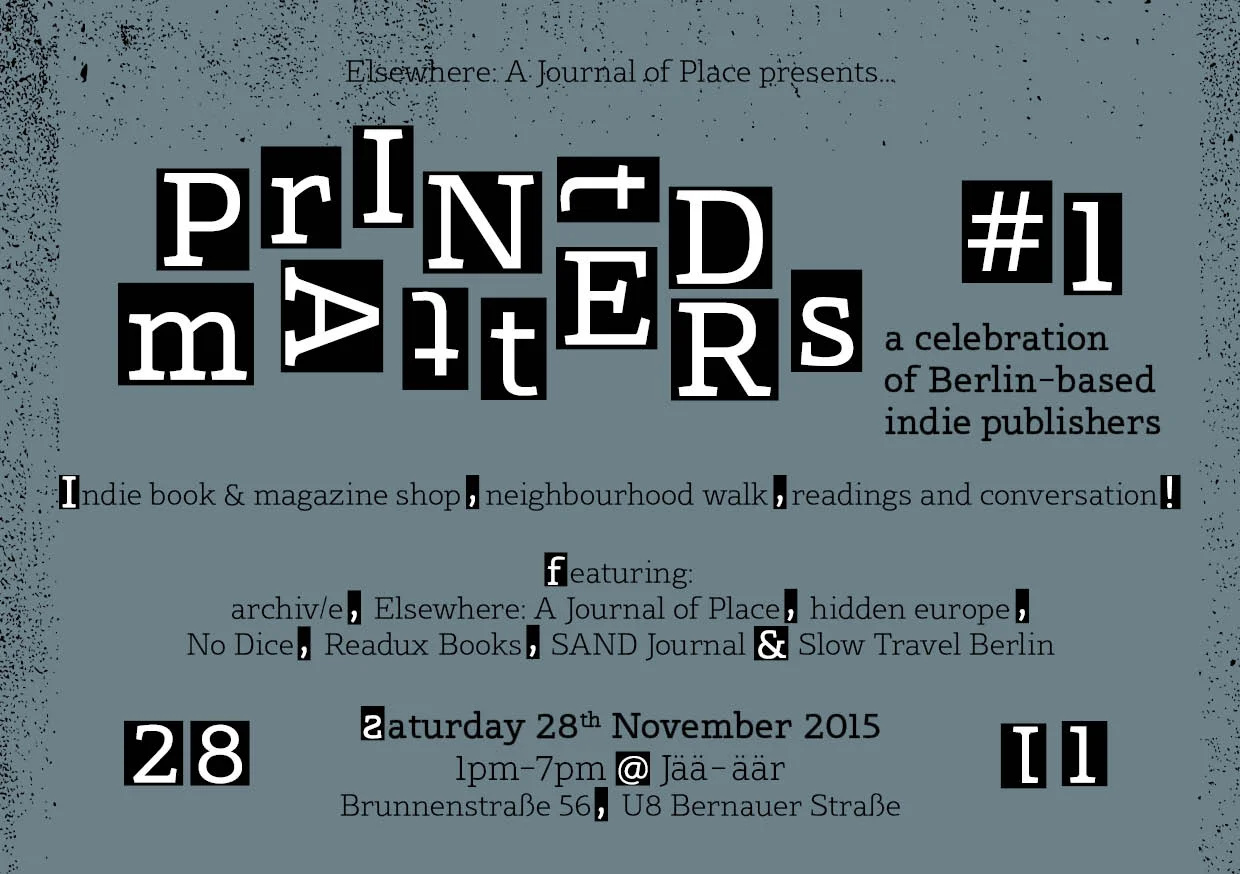
Printed Matters #1 at Jää-äär - Saturday 28th November 2015

At the end of the summer we were in Hamburg for the indiemagday Free Trade Zone in an old harbour warehouse. It was a great day, meeting lots of fellow magazine-makers and readers, and as we packed away our things ready for the journey back across the northern plains to Berlin, we wondered to ourselves whether or not we could do something similar in Berlin.

We batted some ideas back and forth and decided that we would like to create a relaxed and friendly event in a nice place, where people could come and get their hands on copies of independent magazines and books and listen to some readings and conversations from those writers and editors behind the publications. And as we already knew a number of people involved in such projects in Berlin, our idea for Printed Matters (as we decided to call it) developed fairly quickly from there.

So on the 28th November 2015 we will be gathering for an afternoon at the wonderful Jää-äär cafe and creative space in Berlin-Gesundbrunnen, where you can enjoy Estonian treats a handful of steps from where the Berlin Wall once divided the city. We will have a book stall in operation all afternoon so you can buy copies for yourself or perhaps Christmas presents, and Elsewhere editor in chief Paul Scraton will also take those interested on a cultural-historical exploration of the neighbourhood, on both sides of the former dividing line, inspired by the walks he does for Slow Travel Berlin. Jää-äär will also be hosting an exhibition from the London-based Estonian artist Anu Samarüütelfirst.

The final schedule for the reading has not been confirmed yet, but we will be announcing who will be talking and reading in the coming days on the Facebook event page. And most importantly, we will be presenting our fellow magazine and book publishers that will be joining us at Jää-äär here on the Elsewhere blog in the run-up to the event… at the time of writing, the roll of honour includes archiv/e, hidden europe, No Dice,  Readux, SAND and Slow Travel Berlin… and if any other Berlin-based independent publishers or magazines would like to join the fun, then they can get in touch with paul@elsewhere-journal.com.

We are really looking forward to the event and if you happen to be in or around Berlin on the last weekend of November, we would love to see you there.

The Shard and the Winchester Geese - The Cross Bones Cemetery, London

By Jeanette Farrell:

To walk along the river Thames from London Bridge, east towards Vauxhall is to walk in the shadow of tall, misshapen skyscrapers that have a habit of suffocating us minions who lurk below. As Londoners we’re given to kowtowing to the inevitable as another patch of sky is taken away and yet we admonish our city when beauty gives way with increasing ferocity to the financial services sector. ‘That’s life’, they say, and so it is.

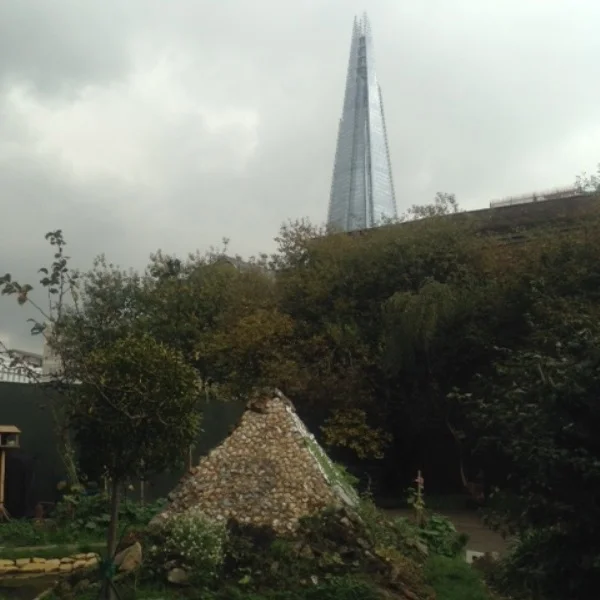
The Shard is a strange spectacle; so obvious it hardly seems noticeable. It was the first proper skyscraper to land on the south side of the city, tenuous though this postcode is within shouting distance of its brethren at Bishopsgate. Borough, where the Shard is located is an artery in the heart of London’s folk lore and there’s still the odd hint of what took place there before all the money moved in.

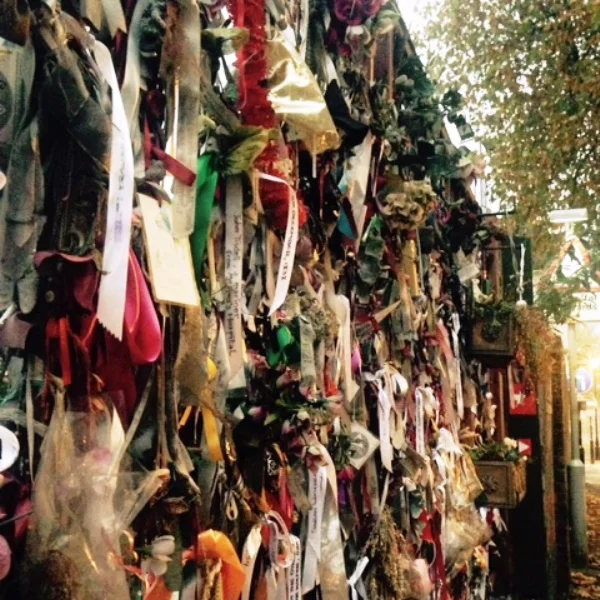
Amongst these residues is the Cross Bones Cemetery on Redcross Way. If casually wandering back to the tube from Tate Modern on the Southbank, the cemetery is startling to happen across. Attached to iron gates, perhaps six metres long and three high, are hundreds if not thousands of colourful ribbons, love hearts, teddy bears, poems, dream catchers, letters and flowers. Billowing in the wind at dusk, it’s spine-tinglingly unexpected, uncanny even. The land behind the gates belongs to TFL or Transport for London. In 1990 whilst building a substation for the city’s Jubilee Line extension, the bodies of approx 150 women and children were found, thought to be an estimated 1% of the number of bodies subsumed into the ground.  

The site, you see, is what’s known as a pauper’s burial ground and before that an unconsecrated burial ground for the city’s sex workers. Medieval prostitution was licensed by the Bishop of Winchester to work within the Liberty of the Clink, as Southwark, home to Borough, was known. Taxable in life yet dishonourable in death the women, known as the ‘Winchester Geese’, were forbidden a religious funeral and were buried in this pagan ground where they lay, undisturbed. Eventually the graveyard was home to the bodies of children and finally paupers until it was closed in 1858, ‘completely over-charged with dead’ and forgotten about.

The Cross Bones Cemetery, now a memorial garden, is, according to one care- taker I spoke with, a feminine place with a female spirit sitting as it does beneath the great phallus of the Shard. John Constable, a druid who has lived in Borough for almost 30 years, took charge of the Winchester Geese and, finally, fought their corner. On the 23rd of each month he gathers with a group, sometimes 10, sometimes 40, to honour the outcast, dead and alive. Well kept and ever growing, the garden, on temporary lease from TFL for the next three years, is a sanctuary. Trees play host colourful mementos, a mound covered in shells sits at the centre surrounded by two freshly built raised flower beds. A shelter, build by a local architect and enthusiast, gathers rain water to feed the pond.

The Cross Bones Cemetery is important to many people, for many reasons and is subject to continued lobby by local residents to maintain the space as it is, safe from the hands of the developers. It’s eerie to sit there amongst the dead, right by a power station, opposite a wine bar looking over to the city. And it’s a little bit strange these mounds and small shrines, separate as they are from any explanation. But it’s also gentle and indeed, female, and really quite beautiful. It is, somehow, the London we come looking for but can never quite find. 

Send Elsewhere for Christmas this year

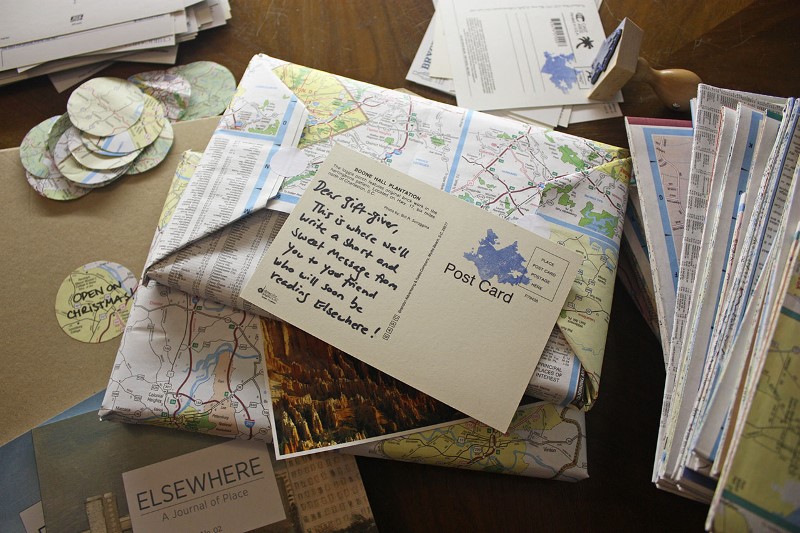
If you have read and enjoyed our journal over the last year, why not send a special someone a copy or two for Christmas this year. We have put together a special Christmas Gift Offer, including unique wrapping and a personalised message, and we will be sending them out on December 7th.

There are a couple of options to choose from, and you can find out more by following the link below:

ELSEWHERE CHRISTMAS SPECIAL

Five Questions for... Nick Gadd

The next in our series of interviews about home and place with the editors and contributors to Elsewhere is with Nick Gadd. Nick’s article Ways of looking at a ghost explores the ghostsigns of Melbourne and appears in the current edition of the journal.

What does home mean to you?

The western suburbs of Melbourne, in particular Yarraville, have been our home for the last 20 years. It’s a place with a fascinating industrial history, interesting architecture and the other stuff that you want like bookshops, cafes, pubs and cinemas. What makes it home, though, is the fact that this is where we’ve worked, studied, where our kids have gone to school, we’ve made friends, all the simple experiences of life. Gradually we’ve learned about the history of the place, and we’ve woven our own stories into it. Most of my writing is about Melbourne in some way, especially the west. I can’t imagine feeling at home anywhere else, although I came here fairly late, when I was already in my late 20s.

Where is your favourite place?

I’m very happy wandering the inner suburbs of my city, especially if it’s a part of town I don’t know, somewhere with bluestone laneways and red brick factories, ghostsigns, old shops, maybe a bit of street art, and intriguing stories to discover. Roving further afield, I visited San Francisco last year and was immediately smitten. Like Melbourne it’s a former Gold Rush town that grew very fast and has experienced a lot of immigration – you get the sense of diverse stories on top of each other, great creativity and energy, and natural beauty as well.  

What is beyond your front door?

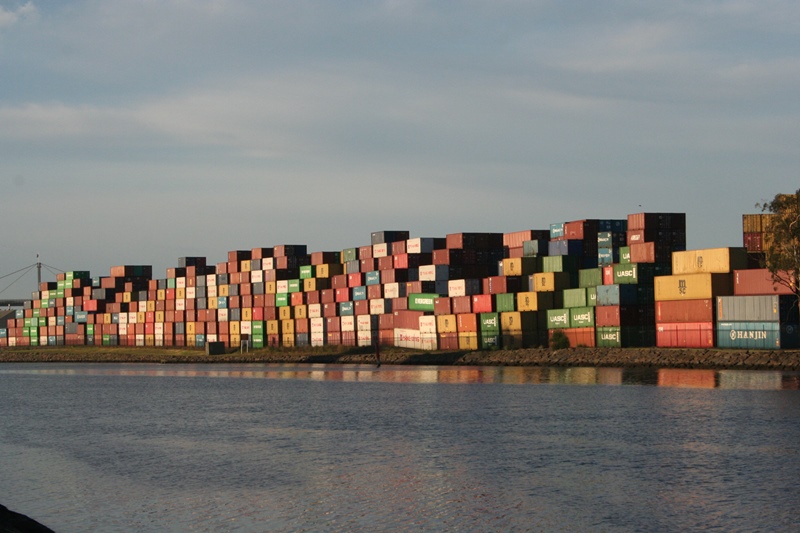
A street of small weatherboard houses like ours, a creek, a primary school, and the distant West Gate Bridge which carries traffic across the river Yarra from west to east and back – it’s a great sight, especially at night, when it’s lit up like an illuminated ribbon. Underneath it there’s a nature reserve, where land reclaimed from a former quarry has been replanted with native species, and there are mangroves growing in the water right below the bridge. And not far off there are oil refineries, and beyond them the docks. It’s a weird mixture of heavy industry with little pockets of nature quietly thriving amongst it all.

What place would you most like to visit?

I actually have a wish list of destinations which I made about 15 years ago. They include Frida Kahlo’s house in Mexico City, the Ideal Palace of the Postman Cheval in Hauterives, which is a surrealist icon, and Easter Island. Needless to say I haven’t been to any of them. But maybe this will inspire me to revisit the project. These days, thanks to Google Earth, it’s pretty easy to visit almost anywhere virtually, which may make us lazier, or may inspire us – I can’t decide.

What are you reading?

I’ve been working my way through the complete works of Robert MacFarlane, as I’m sure is compulsory for all readers of Elsewhere, and have just finished Mountains of the Mind. It’s a history of the relationship between people and mountains from the 17th century to the present, along with MacFarlane’s account of his own mountaineering experiences. I’m also reading Anson Cameron’s new novel The Last Pulse which is about a man who blows up a dam to liberate the water that the Queenslanders have ‘stolen’ from the southern states. You would think it’s hard to write a comic novel about eco-terrorism but Cameron manages it. He’s just sent the Minister for the Environment floating down the river trapped in a portable toilet, which is not something I’ve encountered before in literature.

You can order Elsewhere No.02 featuring Nick’s article on the ghostsigns of Melbourne via our online shop

Postcard from... Beelitz

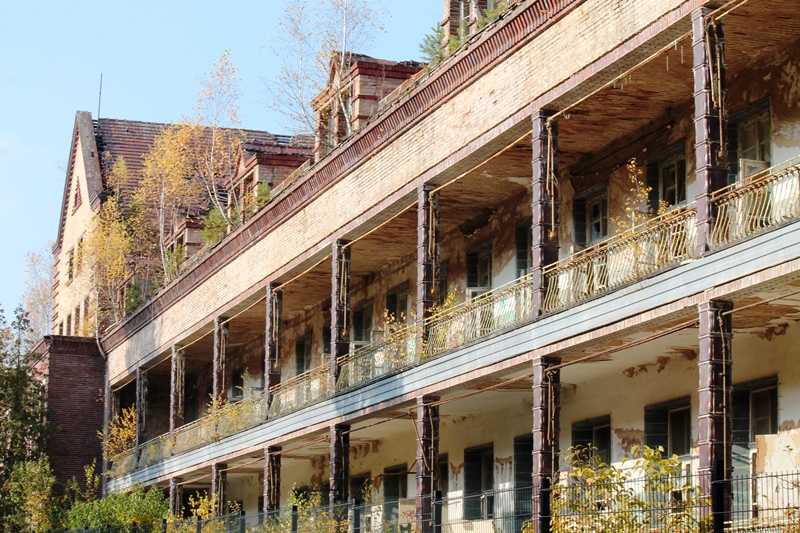
Photograph: Katrin Schönig

Behind the fences the buildings stand in their beautiful decay. Plants grow between the crumbling brickwork. Trees have taken root where there once was a roof. Cyrillic signs are painted on the door in memory of former occupiers, and more recent artwork decorates windowless rooms from more recent explorers. The Beelitz Heilstätten, south of Berlin, was a sanatorium and hospital complex for less than a hundred years, from its opening in 1898 to the retreat of the Soviet military, who had occupied the site after WW2, in the mid-1990s. Now, as you walk between the buildings you get the feeling it will be visited as a ruin for far longer than it was used to cure the sick and injured.

It is because of our attraction for such abandoned places that there is a newer structure in the forest, a walkway of steel and wood that lifts the visitor high above the treetops. On a sunny weekday in October there are hundreds of people up there, turning their cameras and phones from the views across the top of the autumnal forest to the decaying buildings below and the fascinating glimpse into the rooms and hallways carpeted in rubble. Back on the ground, standing in the shadow of the walkway next to the frame of a building where women once took ‘air baths’ as a treatment against tuberculosis, it really is as if the ruins have been subsumed, very much part of the forest and somehow as natural as the trees, the bushes, and the mushrooms sticking up between falling leaves.

Read more about the Beelitz Heilstätten from our friends at Slow Travel Berlin

Elsewhere No.02 is out now - order your copy here from our online shop

The Library: Lost and Found in Johannesburg, by Mark Gevisser

City of Gold and Empty Spaces

Review: Paul Scraton

After a brief prologue that sets the scene for a brutal and frightening home invasion in Johannesburg, 2012 - a story which will be told in harrowing detail later in the book - Mark Gevisser starts his story with a childhood map-reading game called ‘Dispatcher’ played on the pages of the family’s Holmden’s street atlas of the South African city. The young Gevisser would take addresses from the phone book and attempt plot the course of an imaginary dispatcher moving through the city… Only, it was not that simple and his dispatcher would sometimes come up short due to the seemingly illogical nature of the layout of the maps:

“Sets of neighboring suburbs were grouped - in admittedly pleasing designs - as if they were discrete countries, often with nothing around the edges to show that there was actually settlement on the other side of the thick red line.”

Some of the maps are recreated in the book, showing little islands of streets surrounded by empty spaces, the compass arrow marking north pointing this way and that. And sometimes those settlements on the other side of the red line were not to be discovered anywhere in the book, not even on a different page. For the Holmden’s Register of Johannesburg not only presented the city on the whim of a creative designer, but also erased entire black townships or else presented them as if on another planet. Attempting to dispatch a courier from his home to an address in the black township of Alexandra, Gevisser came up against uncrossable white space. The destinations may have been only two pages apart in Holmdens, but there was no route between them:

“The key plan might have connected the two pages, but on the evidence of the maps themselves, there was simply no way through.”

It might have been geographically inaccurate, but the atomisation of the city through these maps did reflect the divisions between black and white, rich and poor. Through this game played on the pages of Holmden’s in the back of his father’s Mercedes, the young Mark Gevisser begin to come to terms with the reality of life in his home country. It was, he writes, the start of the development of his political consciousness.

This rediscovery of his childhood cartographic games leads Gevisser to take a step further back, to explore the first commercial street guide to Johannesburg published by W. Tompkins in 1890, just a couple of years after the discovery of gold in Witwatersrand. This map was as much a fantasy as it was a reflection of the facts on the ground… many of the neighbourhoods laid out their in neat rows on the map were speculations, and some of them would never even be built. But the most meaningful discovery for Gevisser is the two small patches of land plotted out south of the railway tracks. Like islands in the open veld, one portion was allocated to “coolies” (workers of Asian descent) and one to “kaffirs” (black labourers).

This speaks to the viewer in two ways. Firstly, that “apartheid was embedded in the development of Johannesburg from the very start”. And the second was that all the workforce that would be needed to build this new city could be contained in twelve city blocks. “Here, then, represented by the Tompkins map, is the folly of apartheid capitalism and the reason why it was destined to fail, even if it took a century to do so.”

From this point on Gevisser, not only through his words but also through maps, photographs, newspaper reports and other documentary evidence, tells the story of the city and of his own family, who came from Lithuania as Orthodox Jews and ended up in a rich white suburban neighbourhood in South Africa. He tells the story of his own personal political development, in the bohemian corners of bookshops and bars, of his own sexuality and the lives of gay men under apartheid, and the many, myriad ways in which people were kept apart - and not only through the white spaces on a map.

The writing is gentle and fluid, leading you through the pages like he once led his imaginary dispatcher through the city streets, only with no dead ends along the way. Gevisser is excellent in its descriptive powers and with a creativity that can conjure entire imaged scenes from a single photograph.

In parts it is a gripping tale, especially when we get to the story of an attack on the apartment of his friends whom he was visiting at the time. It is brutal but could, in Gevisser’s own reflections, been worse (and what does that say?), whilst the aftermath paints a less than positive impression of the South African judicial system and the investigatory powers of the police. And while this is going on, Gevisser is self-aware enough to consider the classic reactions of guilty white liberals when faced with such a crime.

In this he is reflecting on contemporary South Africa, contemporary Johannesburg, and how the present - especially the new boundaries that have developed in the city, those new spaces between people that have been thrown up in the twenty years since the euphoria of those first democratic elections - are still being shaped by the divisions of the past. And yet he finds hope for his hometown, despite the continued difficulties and the challenging realities of everyday life, in one of the world’s most complex and fascinating cities.

Mark Gevisser's website

Elsewhere No.02 is out now, featuring great writing on place, reviews, photography, illustration and interviews. You can find out more information and order your copy online here.

Postcard from... Saint-Hubert

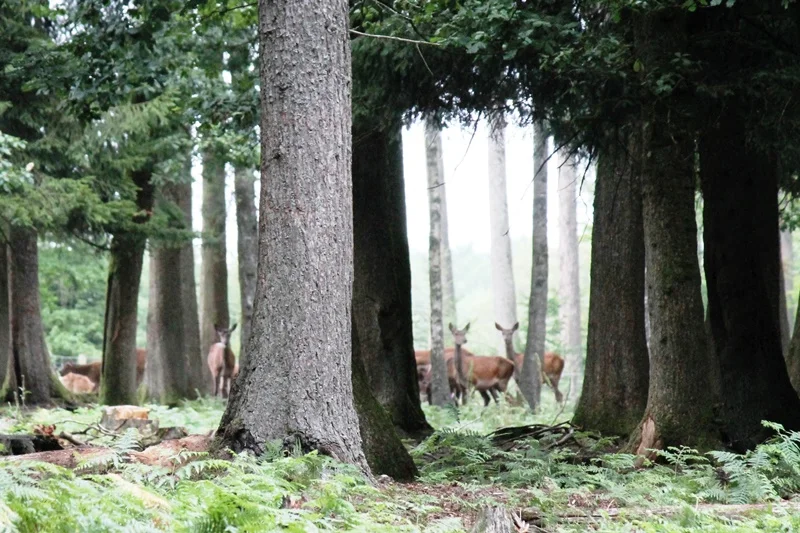
In the rain we walked Saint-Hubert’s gritty and gloomy streets. The water ran in streams from the awnings of cafes, hammered against the church roof. All we wanted was a portion of frites, preferably smothered in thick, warming cheese sauce. It was not to be. The chip-shop was closed. We stood outside its locked door and stared at it awhile, the rain creeping in beneath our waterproofs via our sleeves and our necks. We ran for the woods.

Saint-Hubert in the Ardennes is a hunters' town, its roundabouts and bistro walls decorated with stags and wild boar, a town named for the patron saint of hunters (alongside mathematicians, opticians and metalworkers) whose status depended on a vision whereby, at the end of it, he spared the stag. Some hunter. Under the shelter of the forest we explored a game reserve on the edge of town, spying wild boar and deer in a place of protection and celebration yet where we paid our admission in a cafe beneath a pair of antlers, a collection of old guns, and other symbols of the hunt.

We did not look at the menu. Saint Hubertus may have spared the stag, but this was still a hunters' town.

By Paul Scraton
Photo by Katrin Schönig