This Far East: Beckton and Barking

By Gary Budden:

We pull up into a deserted carpark by the Showcase cinema, by the saddest Frankie & Bennys I’ve ever seen. Star Wars, The Hateful Eight and Bollywood films I don’t know are screening.

We head onto the path, flanking the Beckton sewage treatment works on our right. There’s the smell of damp concrete, something sour, flowing water. Not a soul to be seen, yet here we are, in London. Even the walls here show no human life, free of graffiti and tags.

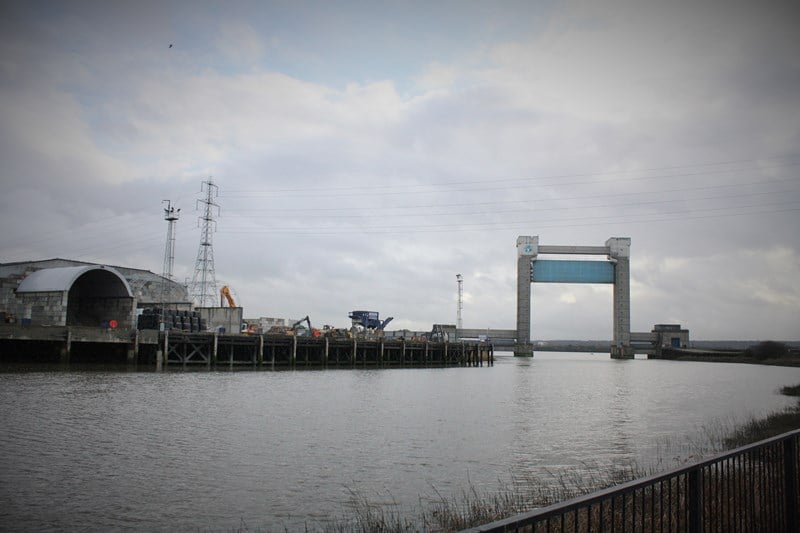
The flood barrier comes into view, by a refuse-disposal site where black-headed gulls flock and machines roar. It’s a sci-fi edifice, little known and colossal. I wonder if it’s been use with the recent rains, or has ever been in use. It looks like the gate to a sunken and forgotten city.

Where Barking Creek meets the Thames I wish I’d bought my binoculars. The river never fails to inspire and this far east it can take the breath away with its sheer size.  The opposite shore is a world away.

Twenty turnstones or more skim over the water. Demonic cormorants pose like black statues on the concrete. Gulls bob on the river surrounding tugs weighed down with the city’s waste. I’m amazed to see a black tailed godwit take flight perhaps a hundred metres from where we stand and I start to take photos. Then an orange-jacket man walks up to the fence of the treatment works, look at us and walk back. I imagine he’s bored.

We have to double back. There’s a hoppable padlocked gate into the tiny nature reserve. We hop it and walk through sibilant reeds watching rabbits break cover at our approach. Still no other walkers seen. A new tree-planting scheme has begun, and I wonder if this is why the gates for this public space are locked.

We hop the other gate and head along the River Roding into Barking. FUCK OFF TO ALL FORIGNERS screams the graffiti. New developments, the wooden remains of a boat half-submerged. I read the signs on the window of a new empty block. Creative arts spaces for rent provided by Bow Arts. You can feel which way the tide is going.

The Roding is muddy water and the familiar detritus of crumpled beer cans, discarded underwear and puddled shit. But I’m happy to see gorse bushes, still in bright-yellow flower, a plant I associate with the flatlands of East Anglia.

We visit the ruins of Barking Abbey and the newer church. The abbey has Anglo-Saxon origin (names like Ethelburga in the information signs). It was dissolved come Henry VIII. Carved skulls adorn certain graves, mossy and weather-beaten. In the distance are red buses and pound shops, London going about its business.

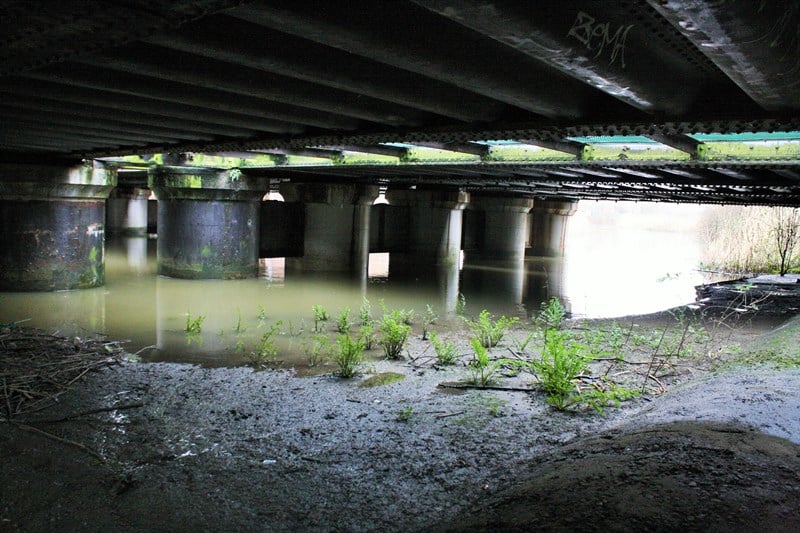
Back to the river. We follow a dead-end path, over a wall into a mess of bramble and trampled razor wire, crawl under the railway bridge to where the river is breaking its banks and green plants grow in the murky half-light.

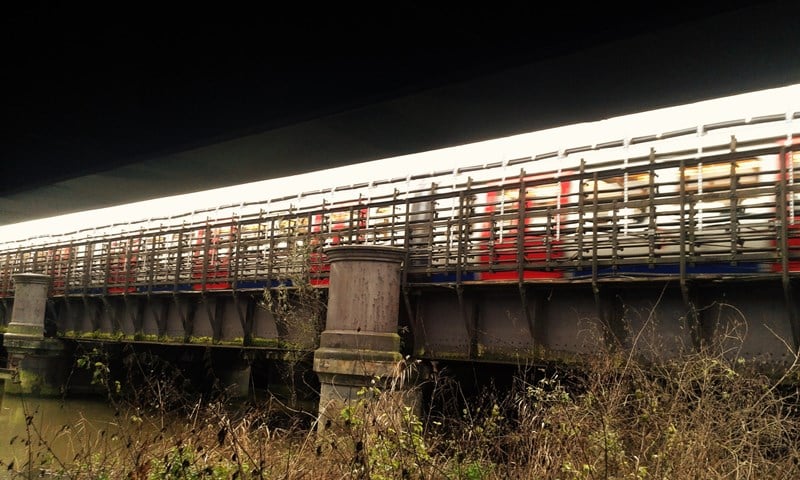
Like trolls, we wait, filming the trains as they pass. What would the passing traveller think if they saw us?

Walking back the way we came, a bird of prey breaks cover from the trees above but I can’t identify it in this weak January light.

We come across a Tesco with a Costa attached. Coffee break.

As we sip in the carpark, I think how unknowable this city is and after over a decade here, I’m still just beginning.

Gary Budden is the co-director of Influx Press and editorial assistant at Unsung Stories. His work has appeared in Structo, Unthology, The Lonely Crowd, Gorse, Galley Beggar Press and many more. He writes regularly for Unofficial Britain and blogs about landscape punk at New Lexicons. Gary’s essay on Romney Marsh appeared in Elsewhere No.01.

Watch a film of this journey, and beyond to Gallion's Reach, by Martin Fuller.

The Library: The Island that Never Was, by Robert Alcock

Review: Paul Scraton

As stories go, the building of the Zorrozaurre peninsula in Bilbao is a fascinating one. In the 1950s and 1960s a canal was dug to improve access to the Euskalduna shipyard as part of Franco’s policy of industrial expansion. Many of the residents of the area had already been rehoused when the plans changed and the project ground to a halt. The canal, that would have created an island, never reached its destination. And as Robert Alcock explains in his short but fascinating The Island that Never Was:

Instead of an island, after the economic collapse of the early eighties the peninsula had become a lost world, forgotten by the rest of the city. Most people had no idea that four hundred residents still clung on.”

It was into this forgotten neighbourhood that Alcock moved in 1999 with his partner, and overthe course of the nine chapters that make up this book he creates a portrait of a community, of his neighbours and their worries and concerns, of the graffiti and where it came from, of its plant- and wildlife, and crucially how different people – some important and listened to, others not – had plans for Zorrozaurre that would completely transform the peninsula and by definition the lives of those people who called it home. Faced with a development master plan that would see many of them evicted, the locals were finally roused into action, including forming a residents association and taking to a bit of street-art themselves to paint a mural depicting life in the neighbourhood:

“It was a reminder that the neighbourhood existed – a fact of which, even now, most people in Bilbao remained ignorant – and a collective nose-thumbing at the authorities. It wasn’t only the squatters who could paint walls.”

It is not simply the story of an anonymous neighbourhood and its struggle for recognition and self-determination that makes this book interesting, although it most certainly does. It is the fact that it reminds us once again that everywhere – every district, every estate, every village, every town – has its story and there is a value to listening to what it is. It is the fact that it reminds us once again that communities develop on what seem, on the face of it, unlikely and perhaps even unappealing locations. And that what makes a community is worth fighting to protect.

Although it is not explicitly stated, the fact the The Island that Never Was has been published in a tri-lingual edition – English, Spanish and Basque – would suggest that Alcock’s intention was to make sure his neighbours in Zorrozaurre have access to this telling of their story. I am sure that they would be very proud.

Robert Alcock is a writer and ecological designer who moved to Bilbao in 1999 to undertake fieldwork for a PhD in marine ecology. He and his partner lived in Zorrozaurre for several years and were founder members of the Forum for a Sustainable Zorrozaurre. They still keep active ties with the neighbourhood. You can order The Island that Never Was via the Abrazo House website, where it is also possible to purchase an Ebook version.

Looking Back. Looking Forward.

So as the dust settles on New Year’s Eve here in Berlin, the pavements strewn with the debris of a million fireworks and the first of the abandoned Christmas trees, I thought it was about time we had a little look back on the first year of Elsewhere as well as a look forward to what is to come in 2016. It is just over a year since Julia and I first announced the project and then we began the process of working on the successful crowdfunding campaign that took place during April and May, Elsewhere No.01 which we published in June, and Elsewhere No.02 that came out in September.

These are the cornerstones of the year but they tell nothing of the story. We learned so much over the past twelve months, not only when it comes to journal production but also marketing, distribution and all those elements that you need to get a project like this off the ground. We had issues with printers, worked with lovely (and professional) writers, illustrators and photographers, and added some people to our team. Tim has been invaluable when it comes to editing; Marcel as our Books Editor; Corinne working on sponsorship to help move the project forward; and Katrin, helping us out with the events.

We need to especially thank those people as up to now all of us who have worked on Elsewhere during the first year have done so for love of the project. Although we made a commitment to pay our contributors from the beginning and have done so, we have not been able yet to pay the rest of us… which makes their commitment all the more impressive and our gratitude for their hard work all the greater!

As for contributors, it has been our great privilege to publish some wonderful writers, artists, photographers and musicians over the past twelve months. In the pages of Elsewhere No.01 and No.02 you can see the work of the following fantastic, talented people:

Elsewhere No.01

Kavita Bedford, Gary Budden, Stephen Cracknell, Nicky Gardner, Julian Hoffman, Chandler O’Leary, Eve Richens and Paul Sullivan

Elsewhere No.02

Alejandro Cartagena, Nick Gadd, Stuart Fowkes, Satya Gummuluri, Paula Kirby, Amy Liptrot, Laurence Mitchell and the good folks from the Uckermarker Project

You can find many of our contributors on our Twitter list here

What else? Beyond the physical journal that is, and remains, the centrepiece of the project, we have also been publishing interviews and short writings on place on our blog. There we have also established the Library series of book reviews from work that has inspired and interested us, and the Printed Matters series of posts about other print projects that we feel worthy of support. Tied to the latter was our first Printed Matters event, held in December, and we hope to take the Printed Matters idea beyond our home city during the coming year. Another event we hosted was our launch event in June, and again, we are hoping to host more events in Berlin and beyond in the coming twelve months.

We would also love to return to #IndieMagDay, which we attended in Hamburg at the end of the summer, and build our connections with other journals, magazines and independent publishers out there. Although there is much doom and gloom about print, we are convinced that there has never been a better time to launch a project such as ours. The internet means we can reach readers and contributors quickly and directly, and people can support the projects they like from their own home. The challenge, as ever, is to make it sustainable and that will be the major focus of 2016 alongside producing two more editions of the journal.

The next edition of Elsewhere: A Journal of Place will come out in March, with the contents already finalised as follows:

Places…
Black Mountain, Northern Ireland by Feargal Mac Ionnrachtaigh
Berlin, Germany by Paul Scraton
Faversham Creek, England by Caroline Miller
Iqualuit, Canada by Knut Tjensvoll Kitching
Kumano Kodo, Japan by Laurence Mitchell
Lappland, Sweden by Saskia Vogel
Trieste, Italy by Paul Scraton
Yangon, Myanmar by Alex Cochrane

Plus…
An interview with Darran Anderson, author of Imaginary Cities
Endbahnhof: The photography of Kate Seabrook
...and more illustrations and reviews

We will begin pre-orders closer to the publication date, but you can of course take out a 4-issue subscription to guarantee your copy. We are also looking for patrons for the third edition, so if you are interested in supporting the journal and seeing your name on the inside cover, please follow the link for more information.

Finally, and most importantly, both Julia and I would really like to thank all the readers who have supported the journal, whether via the crowdfunding, buying individual editions, reading the blog or newsletter, or sharing our posts and links on social media… it all helps and we really wouldn’t have got this far without you.

Have a great 2016, and here’s to more adventures in Elsewhere,

Paul Scraton
Editor in Chief
January 2016

Follow us on Facebook or Twitter
Photo by Patricia Haas (post@patpat-studio.com)

Postcard from... The Morning After

(On the Berlin S-Bahn, between Humboldthain and Nordbahnhof)

Man 1: Did you have a good New Year’s Eve?
Man 2: Not bad. With the family. How about you?
Man 1: I was in bed by eleven. Couldn’t sleep though. Not with all the fireworks…
Man 2: How come you went to bed early? I thought you were meeting the others?
Man 1: (shakes head) I wasn’t in the mood.

(Pause while Man 2 looks in his bag for a second or two before returning to the conversation empty handed)

Man 1: I mean. There’s not much to look forward to, is there?
Man 2: No?
Man 1: The things you read.
Man 2: You mean crime. Things like that. Yesterday, in the paper, there was this story…
Man 1: No. Not crime. The weather. Look at the weather.

(They both look out of the window, but in the meantime the train has entered a tunnel)

Man 1: Time was, winter in Europe was winter. Not this shit. And then they wonder why the ice caps are melting. Floods in England. And for what? So we can have more, more, more…? 
Man 2: You do think that. Christmas-time especially.
Man 1: Yep. Just so those fellas… Microsoft, Amazon, Google… just so they can buy a fifth house. A sixth. Makes you sick.
Man 2: No one needs that many houses… Two, maybe. For the weekend…
Man 1: And the floods. They have them in England now. But we will get them soon. Half of Meck-Pomm under water. Half of Belgium. France. We don’t learn. The water has to go somewhere. Has to.
Man 2: I suppose you are right.

(Recorded voice announces the train’s imminent arrival at Nordbahnhof station)

Man 2: You at work tomorrow? Shall we watch the football after? 
Man 1: Who’s playing?
Man 2: (shrugs) They’re still playing in England.
Man 1: Water polo.
Man 2: (laughs)
Man 1: OK. I’ll see you there.
Man 2: Till then.
Man 1: Till then.

(They both leave the train at Nordbahnhof and walk down the platform in opposite directions)

A Christmas card from... Crawfordsburn

By Paul Scraton:

Dusk at Crawfordsburn beach. In Belfast traffic waits at entrances to shopping centres, buses are backed up along the main roads and shoppers dodge each other, a chaotic choreography, as they make the final preparations for Christmas. At Crawfordsburn the beach is empty, except for the oystercatchers wading in the shadows, the cormorants diving for their tea and the crows and starlings occupy the sky above the trees, preparing for the onset of darkness. A Stena Line ferry leaves Belfast Lough and across the water the lights of Carrickfergus come on one by one.

Around a headland and Helen’s Bay beach is as deserted as the one we left behind. No, through the gloom it is possible to make out a cyclist on the path and a couple walking on the sands. It is hard, a few days before Christmas, to imagine the summer crowds, let alone the 12,000 that would throng the beach in the village’s 1930s heyday. The moon is bright in the sky and the stress and chaos of the city centre feels a long way away. It is peaceful here, the wind has dropped with the sun and waves are gentle. It is difficult to imagine a better spot to pause, to stare out across the water and consider the events of the last twelve months. It has been a good year.

Merry Christmas everyone.

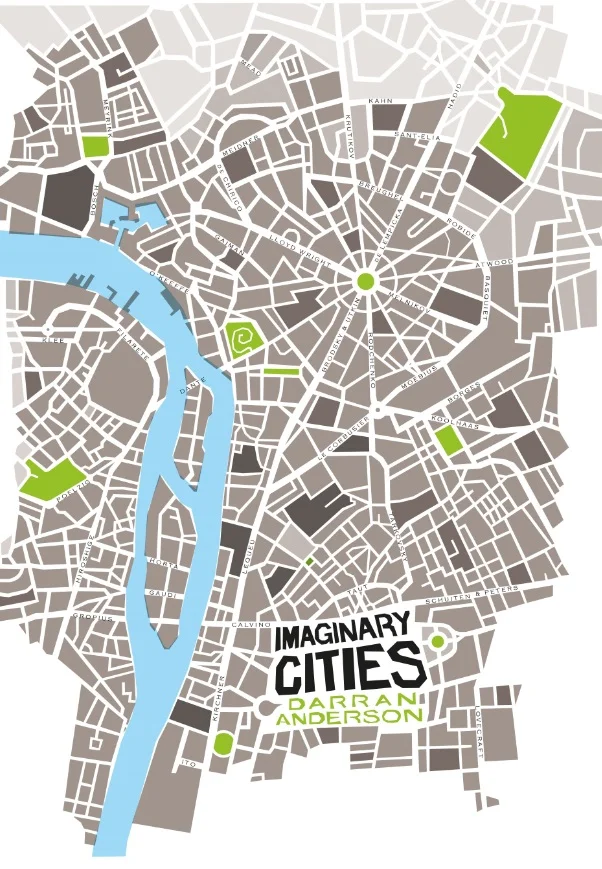
The Library: Imaginary Cities by Darran Anderson

Review: Paul Scraton

I began to read Imaginary Cities in a bar on a pretend High Street of a make-believe village that was actually an out-of-season holiday camp on the German Baltic coast. From the bar you looked out onto the (indoor) street scene, complete with pretend houses, mock gas lamps and the chairs and tables of cafes and restaurants spilling out onto the “pavement”. The holiday camp was an imagined city of sorts, a self-contained world built in the 1970s for escape by the seaside. And such was the depth of the research and the scale of the ambition of Darran Anderson’s book, I half-expected to turn the page at one point and find a description of this particular imaginary city waiting for me on the other side.

It is a remarkable book, as Anderson takes the reader through and to almost every conceivable city of the human imagination, from the plans for actual cities realised or not, real cities in fictional settings, cities of myth and cities of legend, cities that we can walk through (and some that we could have done, had we lived in another time or place) and cities that have only ever existed in the mind, as a film set, or in the pages of a book. The scholarship involved in such an undertaking is apparent from the very first page, and it is how Anderson that marshals his material that makes the book work. Like a city itself, the book is fractured, with plenty of distractions along the way, and although sometimes you feel like Anderson might have taken you down a dead-end-street, you realise it was actually a diversion that took you to the intended destination by a more creative and interesting route.

As I read, both in the candlelight of the bar and the next day, rain and Baltic winds rattling the window of the apartment, each section of the book brought more to think about and more scribbles in my notebook. I left to go for a walk or a run and found that the book came with me as I attempted to process what I had been reading. And it is a feature of the book, and the quality of the writing, that I found myself writing out (and repeating to myself) direct quote after direct quote. Here are just a few, directly from the pages of my notebook:

On the bias of cartography and the stories maps can tell us… “decisions which haunt us to this day.”

On the law of unforeseen consequences and how pollution helped give birth to impressionism… “the future not only has side effects, it is side effects.”

On historical cities that although we know existed remain imaginary… “we know the dimensions of rooms… but we can only make educated guesses at what transpired within them.”

On the Tower of Babel… “every age built it again according to their own methods and pulled it down for their own sins.”

The book moves ever forwards, towards the next story, the theory, the next city of the imagination. We visit stories of the past told through stone and ruins. We learn about how cities are branded by their cinematic depictions or in books and art. We consider how buildings that once existed “exist little more than the planned buildings that were never built.” We think about the cost of cities, whether the workers who built the Pyramids all those centuries ago or those that built the new cities in the gulf (and are building the stadiums for a football World Cup). We question the politics of cities, and the morality play of meritocracy, where everyone gets the city they “deserve”, whether a villa in a gated community or the favela on the other side of the wall.  And we are forced to confront those places that were born out of the darkest corner of the human imagination to become the worst cities on earth. Places that were never supposed to be known about but whose names resonated through the second half of the 20th century and beyond. Auschwitz. Treblinka. Stalag.

By the time I returned to Berlin from the holiday camp by the sea I had finished the 500+ pages of the book. But it was not the scale of the ambition and the knowledge exhibited in the book that impressed me the most, although impress it did. It was that – like the best writing on place (or the idea of place) – Imaginary Cities influenced how I looked at my own city as I caught the S-Bahn from the main train station and then walked the handful of oh-so-familiar blocks from the station to my apartment building. Any book that provokes us into new ways of understanding our surroundings and moreover leads us to ask questions, about not only how we do live but how we should live is worthy of inclusion in any library of place, whether imaginary or not.

Imaginary Cities by Darran Anderson is published by Influx Press.

Follow the twitter feed @Oniropolis for Imaginary Cities updates, debate and musings.

You can read an interview with Darran Anderson in Elsewhere No.03 - available via our online shop here.

Postcard from... Dubrovnik

The terrace of the house looked down across the bay towards the narrow streets of the old town. Orange, lemon and kiwi fruit trees provided shade, as did the line of laundry flapping in the breeze blowing in from the sea. Standing at the fence, I was ware of a presence at my shoulder. My host nodded at the fence.

“The hole. This was made by a shell,” he said softly. “You can still see shrapnel holes in the drainpipes over there. I had to completely re-do the terrace.”

“Were you here at the time?” I said, and he nodded.

“Upstairs, in the house. I was deaf for a week afterwards. The house next door…” he paused for a second. “There were five of them eating their dinner when the bombardment started. All of them died.”

I didn’t know what to say. It seemed impossible that this beautiful place had housed such horrors in the not-too-distant past. But the signs were there; in the traces of damage to houses; in the brighter roof tiles where there had once been smoking holes; in the city map that guides you from one direct hit to the next; in the memories of my host, of his neighbours, and my own of the nightly news.

Dubrovnik is possibly Europe’s most picture-perfect city, and there are likely to be many visitors today who don’t think of those days of war in the final years of the 20th century. But knowledge of events, never mind direct experience, cannot but shape our interpretation of the place. From the moment the first shells were fired the city was changed, regardless of how successful the rebuilding and many traces have since been removed. So long as we remember, the ghosts will remain.

Michael Lange's FLUSS

(above: Michael Lange, "#8953" from the series FLUSS)

We have long been fans of the photography of Michael Lange, ever since we saw his exhibition WALD (Forest) at a gallery on Auguststraße in Berlin, back in 2012. Now he has a new series, titled FLUSS (River) which is being shown at an exhibition at the Robert Morat Galerie in Hamburg until the 9th January 2016.

In many ways you can see the new collection as an extension of the photographs from the WALD series as once again the characteristic element in the photographs is the stillness and beauty of the natural world. The FLUSS series has also been published as a book by Hatje Cantz, and the press text from the release earlier in the year gives something of a flavour of the photographs contained within its pages:

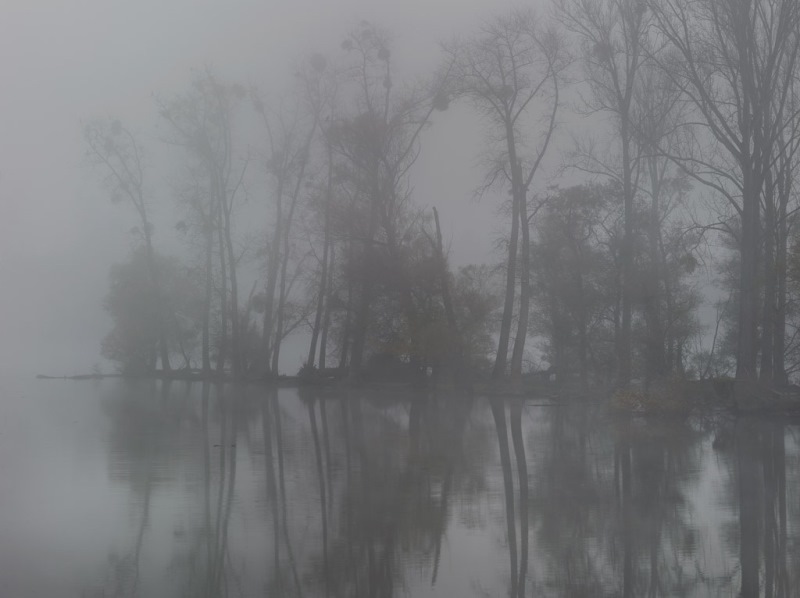
With its scenic beauty and myth-enshrouded past, the Rhine has always been a popular subject in art and literature. One of the longest rivers in Europe, it inspired the masters of medieval panel painting as well as the Romanticists and the representatives of the classic modern era and contemporary art. Between 2012 and 2014, the photographer Michael Lange (*1953 in Heidelberg) devoted his attention to the waters of the Upper Rhine. Taken with a large-format camera, his photographs tell of the longing for tranquility and the desire to lose oneself: they present secluded places, areas of water veiled in fog and traversed by mysterious reflections, at dusk. Subtle shading and color gradation give rise to compositions of atmospheric density and intense clarity.

From the forest to the river, Michael Lange’s photography captures that moment that any wanderer through the trees or along the embankment can recognise. The soft mist above a still, glassy surface. The footpath after the rain, as drops continue to fall from the trees even as the sky begins to clear. A walk through the gloaming in what your city-battered ears think at first is silence but then, as you stand as still in the scene as if you had been captured by Lange’s camera, you realise that there are many, many sounds to be heard.

Just looking at the images of FLUSS or WALD makes you want to catch the train to the edge of the city and go for a walk. And in our world, that is the best compliment we can give to a writer, an artist or a photographer.

Michael Lange’s FLUSS is showing at the Robert Morat Galerie in Hamburg until 09.01.16. The book, with text in English and German, is published by Hatje Cantz and is out now.

Elsewhere editor Paul Scraton wrote about the previous collection - WALD - in December 2012 on his blog Under a Grey Sky.