Crossing the fence: The Trespass app and oral history

PHOTO: Sarah Sparkes

PHOTO: Sarah Sparkes

Freeman’s Wood is an urban edgeland on the outskirts of Lancaster, northern England. For decades local people have been using the wood for recreation, until it was recently closed off by its owners. The offshore private property company erected a metal fence, barring locals from entering, and threatening those that attempted to gain access to the wood with trespass laws.

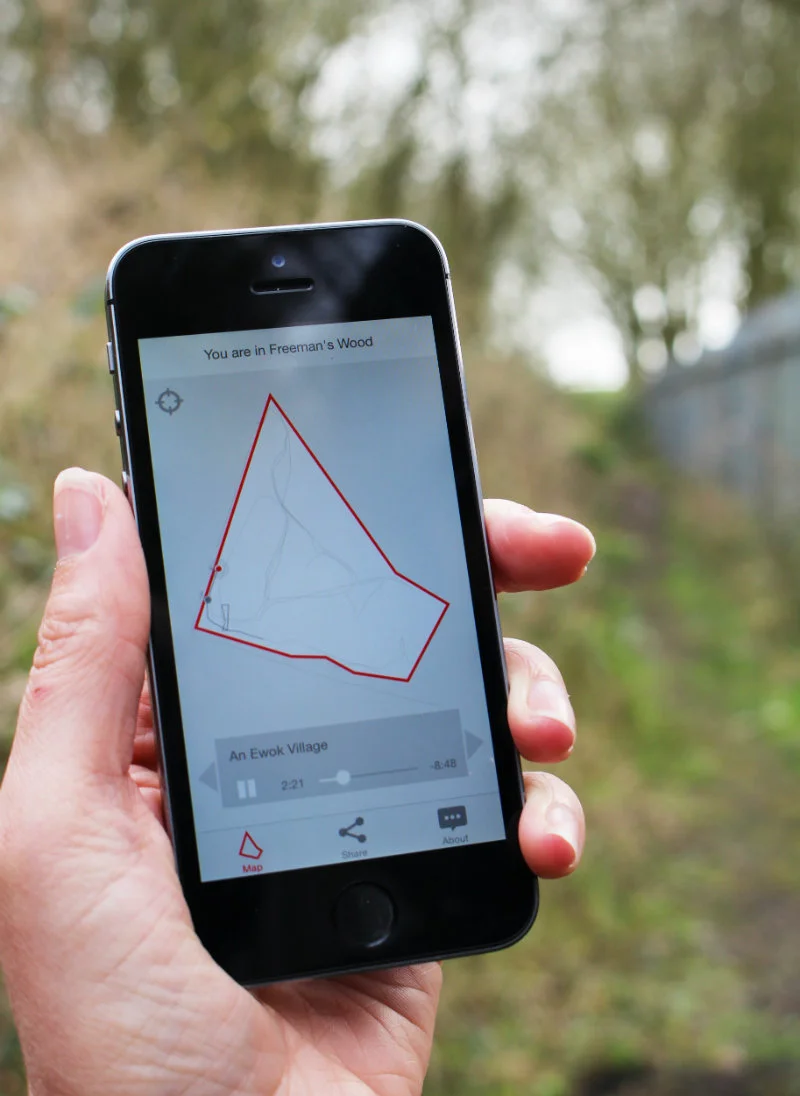
In reaction to this, the artists Layla Curtis has developed an iPhone app that provides users with an oral history of Freeman’s Wood, via a series of interviews with members of the local community that she recorded whilst walking inside and outside of the wood. The interviews reflect on the impact and importance of this place on their lives, as well as speculations as to what the future holds, and the memories and insights create a series of moving narratives about boundaries and the shifting meaning of ownership and common land.

The key to the app is, however, that you need to be on those walking routes to access the stories. Once you are nearby the app uses geo-location to identify where you are in relation to the boundaries of the wood, and indicates the starting points for the thirteen walking routes. Crucially, to access all thirteen, you need to choose to trespass… across the fence and into Freeman’s Wood. We caught up with Layla to find out more about this fascinating project.

Listen to a sample from the app:

Can you tell us a little more about the origins of the idea?

I was invited by John Angus of StoreyG2 to visit Freeman’s Wood shortly after the steel security fence was erected around the site in 2012 by the current landowner (a property investment company registered in Bermuda who had recently begun the process of gaining planning permission to build on the plot). Members of the local community were investigating ways in which they could continue to legally use the land, protect it from potential development and bring it into public ownership. An application to register the land as a Town Green had been submitted to the local council, along with requests for three of the footpaths that crossed the space, to be officially recognised as Public Rights of Way.  John had begun a research project about landownership and its effects on local people inspired by the situation at Freeman’s Wood and invited me to be part of it.

Freeman’s Wood is industrial wasteland, now partly overgrown with mature trees, gorse bushes and scrubland; it is a semi-rural, semi-suburban edgeland situated on the outskirts of Lancaster. I found the surrounding fence and the threatening ‘Keep Out‘ signs intimidating, however once inside I quickly warmed to the site itself. It was clear to me that this land was well used by local people, despite the restrictive intensions of the fence. At the time of my first visit a rope swing hung from a tree just inside the perimeter fence, elsewhere a den was visible deep in the undergrowth and there were BMX tyre tracks in the hardened mud of well-worn footpaths. I followed discreet arrows drawn on reflective ribbons tied to trees leading to a fire pit strewn with discarded empty beer cans and I imagined this place as an adventure playground where local children (and adults alike) could make and live by their own rules, escape and feel free.  

It was evident that someone was fighting back against the installation of the fence – I noticed several of the palings had been removed creating gaps and allowing access. Many of the warning signs had been graffitied with political slogans about landownership – some had been cleverly manipulated to subvert their intended meaning; ‘WARNING: Keep Out – Private Property – No Trespassing’ became ‘NARNIA: Kop Out – Prat Proper – Try pissing’.  This is a place of territorial tensions where the interests of a local community are colliding with those of global capital.

How did you find the stories?

The app contains thirteen audio tracks compiled from interviews I carried out with seventeen local people. The interviews took place in Freeman’s Wood, mostly inside the fenced off area. We discussed the land as we walked across it – the local people reflected on the impact the wood has had on their lives, and shared memories and personal accounts of how they have used the space for all kinds of recreational activities – bird-watching, foraging, cycling, dog-walking, den building and BMX biking are just a few examples. Some interviewees remember when the nearby linoleum factory was in use, and when the now-dismantled railway line, which cuts through the site, was still in operation. They discussed the landowner’s recent erection of the steel security fence and accompanying ‘Keep Out, No Trespassing’ signs, the emotional impact this had on the community, and how this has affected the way the space is now used and accessed. We talked about wider issues of landownership, trespass, territory, common land and activism, and speculated as to what the Wood’s future might be.

I mapped our walking routes through the Wood using GPS and plotted them onto the map in the app. Users of the app are invited to walk these same routes while listening to users of the Wood recount their experiences.

Why the limitation? What was the motivation for making the user commit the act of trespass in order to access the stories?

Trespass invites users to come to Freeman’s Wood in order that they can experience for themselves the place that is the focus of this work. Three of the app’s audio tracks can be listened to by anyone who has downloaded the app, however to unlock access to the other conversations, users must cross into the now fenced off area of Freeman’s Wood. On approaching the site users of the app are directly confronted by the physical presence of the fence and are therefore forced to consider the act of trespass. They must decide for themselves whether they will trespass the boundary to fully access the audio content (in the same way that local users are forced to decide whether they will trespass to access the land.)

While the presence of the fence and signs deter some long-term users of the Wood from crossing its threshold, there are several breaks in the fence and it is therefore a very easy boundary to cross. Despite the restrictions, well-worn footpaths still weave across the space.

Can you say something about the importance of place, or perhaps better space, to your work?

My practice focuses on the ways we perceive, navigate and make use of physical space and I am particularly concerned with how we map borders and boundaries, how we define territories and establish a sense of ‘place’. I was curious to meet the people who were suddenly labeled ‘trespassers’ for accessing land they had enjoyed for decades, and set out to investigate the impact the fence, and the actions of a property developer situated on the opposite side of the globe, was having on the local community.

Tell us a bit more about yourself? What are your main motivations as an artist?

My work has a focus on landscape, mapping, and the ways we locate ourselves, represent terrain and our movements through space. I am interested in the attempts we make to order the world, to chart it and the security that this brings; or rather the insecurity that results when we are unable to do so. Often I am seeking to understand place by examining its relationships with elsewhere - observing and revealing connections between locations which may not otherwise appear to have any obvious reason to be associated, such as two antipodal points on earth or those with shared place names.

So it is about the spaces we inhabit, how we define and map them, and differing cultural approaches to issues of land ownership, territory and access. I am interested in how architecture, space and the city can be subverted, re-claimed, re-imagined and re-experienced through practices such as psycho-geography, skateboarding, parkour and urban exploration /place-hacking - and how these practices (consciously or not) challenge the official demarcation of public verses private space.

I work with a variety of media: collaging maps to create fictional cartographical works; creating drawings compiled of text taken from atlases; and employing technologies such as thermal imaging cameras, mobile phone apps, Global Positioning Systems (GPS) and video to create drawings and trace journeys.

My research explores how contemporary navigational, tracking or surveillance technologies such as GPS, drones, geo-location, hidden cameras, and infra-red might be borrowed from use in military, recreational or scientific contexts and appropriated to seek alternative artistic solutions for representing terrain, our journeys across it and our interactions with it. Through this I am attempting to push the limitations of these technologies, exploring how they might be hijacked and used as tools for drawing.

Trespass was conceived and designed by Layla Curtis. The app was programmed by Ron Herrema. Trespass is available as a download via the Apple Store

For more from Layla - visit her website

Trespass was commissioned by StoreyG2 and is part of the project LANDED (Freeman's Wood), an exploration of the issue of land  ownership, and its effects on people and places. Other commissioned artists are Goldin & Senneby, and Sans Façon. Find out more about the project on the StoreyG2 website.

Postcard from... the Elbe

Torgau.jpg

By Paul Scraton:

At Torgau we stood by the river and watched as a group of soldiers in camouflage uniforms pulled the bright pink life jackets over their heads and climbed gingerly onto the inflatable rafts. The Elbe was passing quickly beneath the road bridge, the waters of Bohemia pushing on downstream, forward, ever forward, towards Hamburg and the North Sea. We watched as someone important in a motorised launch called out instructions through a loudhailer and a chilly-looking civilian snapped a few photographs and then they were off, the currents taking them around the bend and out of sight before they could even break the surface with their paddles.

We walked back up the quiet street, towards the castle and the sleepy town centre. It was Saturday but in small German towns the shops only make a token gesture at opening on the weekend before closing in order that their owners and staff can do something more civilised instead. In front of the castle a terrace looked out over the river. It was all that remained of the old bridge, the one that used to cross the river before the Second World War.  By the time Soviet forces approached the river from the east on April 25th 1945 the bridge was collapsed, half sunk in the high spring waters of the Elbe as it rushed through war-ravaged Europe. On the other bank they were greeted by American troops who had been pushing west. And so this spot, in the shadow of the castle, was where the Allied forces met for the first time as they squeezed Nazi Germany from either side. In Berlin, down in the bunker, the endgame was in sight.

As we watched the river and tried to imagine those scenes 71 years ago, as kids played on the steps of the memorial the Soviets erected to mark the spot. With texts in Russian, German and English, the Hammer-and-Sickle flag “flew” next the Stars-and-Stripes, both chiselled out of stone, for the entirety of the Cold War and beyond. Torgau would, after the famous meeting, find itself in the Soviet zone and thus the German Democratic Republic, to become infamous as a place political prisoners were sent. And throughout it all, the Elbe kept flowing. Now the tales of war and the divided country are told on information boards and in an exhibition at the castle. Meanwhile, in the town centre and with the shops closed, the locals warmed up in the coffee shop on the main market square. We took one last look at the river, and headed into town to join them.

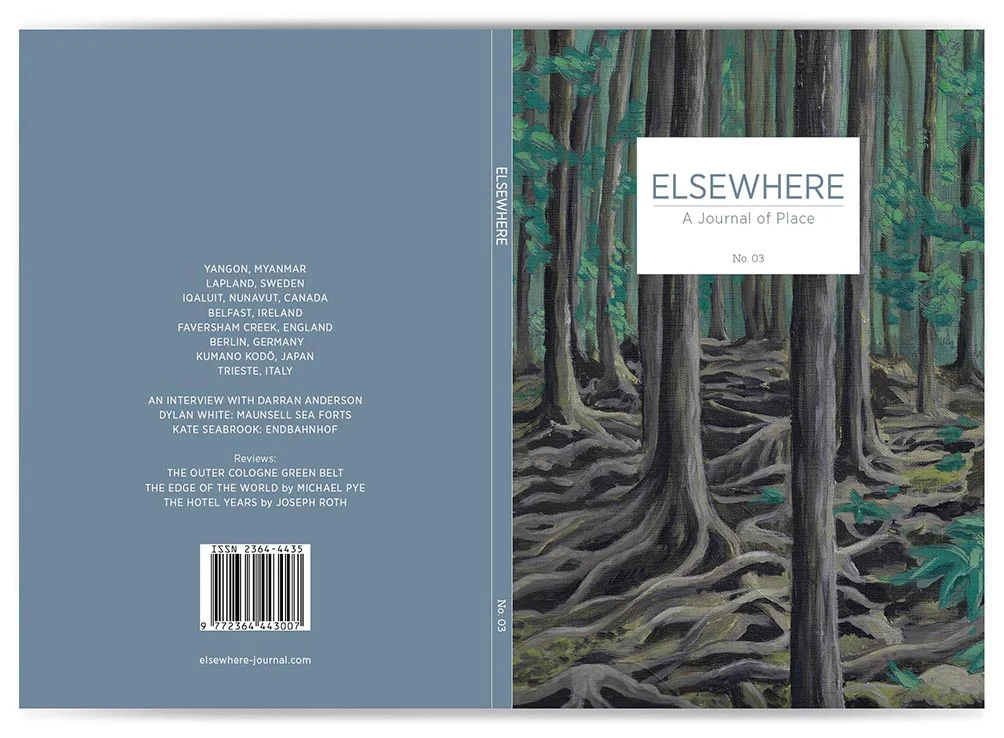
The new edition of Elsewhere: A Journal of Place, is out now. You can find out more and order your copy of Elsewhere No.03 via our online shop.

On Music and Place - The Magnetic North: Prospect of Skelmersdale

Review: Paul Scraton

As a young person growing up in West Lancashire, Skelmersdale always felt like an “other” place. With no railway station and no reason to go there unless you were visiting friends or family in the town, it was never on our radar of escape destinations on a Saturday from our own small town. We would go to Ormskirk or Southport, Preston or Liverpool. The train could take us to all these places. Or to Wigan or to Manchester. But not to Skem. So it was a place unknown and unknowable, and therefore a place where stories could be hung on it, whether true or not, and Skelmersdale could develop a reputation for people who had only ever passed by on the M58 at 70 miles per hour. A rough town of scallies. A place of roundabouts that offered no escape once you were trapped in those estates. An unfinished town, that never became what it was supposed to be. Poor. Rough. What else? Nothing else. In the surrounding towns, that was all you needed to know. The prospect of Skelmersdale was grim.

Skelmersdale is a town of nearly 40,000 people that was designated a new town in the early 1960s, where industry was lured with breaks and benefits that that did not last and by the late 1970s most of the big employers had gone, leaving behind a planned town that was never really finished. Failing was the word that was stuck to Skelmersdale into the 1980s, at exactly the time an influx of newcomers to the town arrived. The Transcendental Meditation (TM) movement had been looking for a place to build a Maharishi Village and Skelmersdale, at the heart of the country, was deemed the ideal place. And so a community was established, complete with a Golden Dome for Yogic Flying, school and health centre. A failing new town and the largest TM community in Europe… perhaps we should have shown more interest in our near neighbours.

Simon Tong, one third of the band the Magnetic North, moved to Skelmersdale with his parents in 1984. “My dad wanted to be part of the TM movement in the town,” he says, “he wasn’t ever a hippie; he’d been more of a beatnik in the ‘60s. Growing up in Skem as a teenager, I hated the whole TM thing. When I got to 16 and started practising it for few years, it worked. I became a lot less miserable and angry.”

Tong and his bandmates Erland Cooper and Hannah Peel turned their songwriting focus on Skelmersdale following their first album Orkney: Symphony of the Magnetic North which was inspired by the landscape of the islands and released in 2013. Cooper is from Orkney, and when it came time to think about a follow-up, it was Peel that suggested taking a look at Skelmersdale. The album Prospect of Skelmersdale is then, like Orkney, a sonic exploration of place, exploring the dual modern histories of the town in twelve songs, described by the band as “a dozen tales of hope and hopelessness.”

Now, I am not a music writer. I find it hard to describe albums, songs or live shows in a way that does justice to my experience of listening to music, especially when it is positive and there has been a strong emotional reaction. But I was intrigued by the idea of an album about a town that I had grown up near but not really known, and so I took it with me on a walk through northern Berlin, sleet driving down from the sky at dusk, aiming for a doctor’s surgery by the railway tracks, across the street from a shopping centre. The Schönhauser Allee Arkaden is not the Conny (for those who know Skelmersdale) but as I walked and as I listened I found myself transported back; to memories of my own West Lancashire childhood, and a snapshot of images of Skem, most of which viewed through a car window or the school minibus on the way to a football match.

The first track is titled ‘Jai Gurudev’ after the original guru to the Maharishi and features archive recordings from a speech welcoming visitors and new residents to the opening of the Golden Dome. In what follows the album takes us to the woods and through the estates, the dreams of both the planners of a new town and the builders of a new, alternative community. The music is often melodic, at times dreamlike and yet with moments of sharp focus. Ken Loach meets George Harrison. Some tracks, such as ‘Little Jerusalem’ and the final ‘Run Of The Mill’ are hauntingly beautiful.

Ultimately my reaction to the album is completely shaped by my own knowledge (or lack of) of Skelmersdale. I can picture the boy in ‘Death in the Woods’ going, in the words of Erland Cooper “to meet his mates on a crappy bus on his way to a crappy location, just being a kid,” because if I was perhaps not that boy, maybe I knew him. Sometimes with art it connects with us because of something that is already there inside of us when we come to it, as we view the painting, read the book or listen to the album for the first time. As ‘Run Of The Mill’ came to an end as I reached the door of the doctor’s surgery it felt like I had not only walked through the cold and soggy streets of Berlin, but I had been back home again.

On subsequent listens to the album I tried to remove my own experiences from my attempt to judge the music. Impossible, of course, but the more I listened, the more I heard the lyrics and built a picture of those twelve stories in my head (rather than it being a soundtrack to my own childhood memories). It became increasingly clear that this was music - great music - that had been put to the purpose of creating a true portrait of a place, its memories and its community. People often say that an album or music in general can take the listener “on a journey”. With Prospect of Skelmersdale, the Magnetic North allow us to explore the town, having created a genuine album of place, filled with story-telling, reporting, memory, myth, (re-)imaginings and descriptive beauty that the best writing on place contains, whether done with a pen, a piano, a guitar or a voice.

The Magnetic North online – website / Facebook / Twitter. Prospect of Skelmersdale is released on the 18 March 2016 and is available for pre-order here.

Film: Secretly sharing the landscape with the living

Secretly sharing the landscape with the living: A film by Martin A. Smith

Filmed on The Icknield Way, The Chiltern Hills, Buckinghamshire

Following in the footsteps of Edward Thomas

In 1911 Edward Thomas walked The Icknield Way, an ancient pathway that he called “a shining serpent in the wet”. It runs from the Dorset coast to Norfolk, although as Thomas declared “I could not find a beginning or an ending to The Icknield Way. It is thus a symbol of mortal things with their beginnings and ends always in immortal darkness.”

This film shows a stretch of The Icknield Way that runs through the Chiltern Hills, near Princes Risborough. It is an area I know well, the path passes by a village where I used to live, and was filmed in the Winter of 2016.

Martin A. Smith is a composer, artist and curator whose work is concerned with the spirit of place and the creation and reflection of atmosphere. He creates immersive, multi-layered pieces that reinterpret or enhance our emotional response to the nature of place, memory and environment. He has created gallery installations and has written music for film, television, theatre and contemporary dance and is currently working on an audio/visual study of a small village in the South of France and a sound exhibition reflecting the English countryside.

Martin's website

Elsewhere No.03 - Release Date 16 March 2016

We are extremely happy and proud to announce the release of Elsewhere: A Journal of Place No.03. We will be launching the journal at an event in our hometown of Berlin on that very day (Facebook event page here) but if you are unable to join us, you can pre-order the journal from today to make sure you are among the first people to get your hands on it. 

Here is what you can expect to find inside:

Places...
Yangon, Myanmar by Alex Cochrane
Lapland, Sweden by Saskia Vogel
Berlin, Germany by Paul Scraton
Iqaluit, Nunavut, Canada by Knut Tjensvoll Kirching
Belfast, Ireland by Feargal Mac Ionnrachtaigh
Faversham Creek, England by Caroline Millar
Honshū, Japan by Laurence Mitchell
Trieste, Italy by Paul Scraton

Plus…
An interview with Darran Anderson on Imaginary Cities
Photographer Kate Seabrook on her Endbahnhof project
Illustration from Dylan White and the Maunsell Sea Forts

and Reviews…
he Outer Cologne Green Belt
The Edge of the World by Michael Pye
The Hotel Years by Joseph Roth

So head on over to the Elsewhere No.03 page on our online shop, where you can see some spreads from inside the new edition, read some quotes from the articles, and of course, order a copy of your own! Once again, thanks to all our subscribers and patrons who have made this edition possible... and we hope you enjoy it!

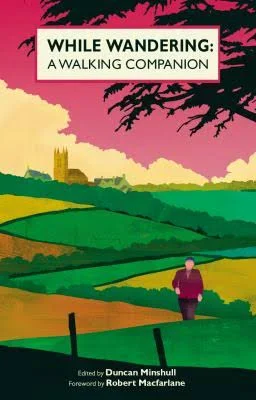
The Library: While Wandering, edited by Duncan Minshull

Review: Marcel Krueger

Next day I rose early, cut myself a stick, and went off beyond the town gate. Perhaps a walk would dissipate my sorrows.
Ivan Turgenew, First Love (1860)

When it comes to physical activity, I am hardly ever fazed by the fact that sweating and cursing on, say, a football pitch or in a gym smelling of old socks could be beneficial for my health. I prefer to exercise in an armchair, holding a book with one hand and occasionally raising a tea cup to my mouth with the other. The only exception I make is when it comes to walking. The reason for that may be that I come from a family of walkers: my grandmother, after growing up on a farm in the 1930s and crossing half of Europe after World War II, always spurned cars, buses and trains and preferred to walk, taking me on long hikes to chapels in the middle of nowhere when I was six or seven; my father and stepmother share a love for hiking the Alps, while my mother runs forest walks for the German Nature and Biodiversity Conservation Union.

So, I was raised a walker and have always walked since. I was also raised a book lover, and soon started reading what others thought about my favourite  - and only - physical activity. I read Fontane and about his ramblings in Brandenburg, followed Josef Martin Bauer through Russia in As Far as My Feet Will Carry Me, and escaped over the Himalaya with Sławomir Rawicz in The Long Walk. Over the years, two books on walking have stayed with me, my copies now dog-eared and mud-crusted from many days on the trail: one is Rebecca Solnit’s Wanderlust, the other Duncan Minshull’s beautiful anthology While Wandering.

In this 400-page book Minshull has summoned 200 writers past and present from around the globe, all who have written about the act of walking. In here are novelists, poets, film directors; among them the Brontë Sisters on the heath, well-known flâneurs Charles Baudelaire and Walter Benjamin, hiking veterans Robert Louis Stevenson and Bruce Chatwin, and psychogeographer Ian Sinclair. Some writers are represented in excerpts from longer works, some with poems, others with whole short stories like Edgar Allan Poe’s The Man of the Crowd (1841) or Daniel Boulanger’s The Shoebreaker (1963). Minshull has sorted all these excerpts topically, with chapters named “Why Walk”, “In The City”, “Tough Tracks”, or even “March Parade Procession” - all chapters posing questions to the walker that Minshull himself has answered in giving the excerpts new titles. Here an example from “Why Walk”:

WARDING OFF MADNESS

I am told that when confronted by a lunatic or one who under the influence of some great grief or shock contemplates suicide, you should take the man out-of-doors and walk him about: Nature will do the rest.
Apsley Cherry-Garrard, The Worst Journey in the World, 1922    

There are a thousand and one reasons for setting out, be they physical, psychological or spiritual. And that, for me, is the beauty of this collection (which, despite being in hardcover, has the perfect size for rucksack and duffel bags) - everyone who walks will find himself reflected in here, with all the positive and negative aspects the activity brings with it: setting out early on an autumn morning, the mountain trails waiting; the hundreds of impressions that even the shortest city stroll will convey; the misery of rain, blisters, and exhaustion. Even though I’ve read it over and over again, I know that whenever I open it anew will find something in here that connects me with other writer-walkers, reminding me that walking gives rise to thought, which in turn might lead to expression. Or sometimes just cursing on a hillside - which I prefer to cursing on a treadmill.  

As Robert MacFarlane writes in his introduction, “What I mean in sum to say is that this is the best anthology I know about an activity I cannot live without.” I do thoroughly concur.

While Wandering on the publisher’s website. Support your local bookshop!

Elsewhere No.03 - Launch Event in Berlin on 16 March

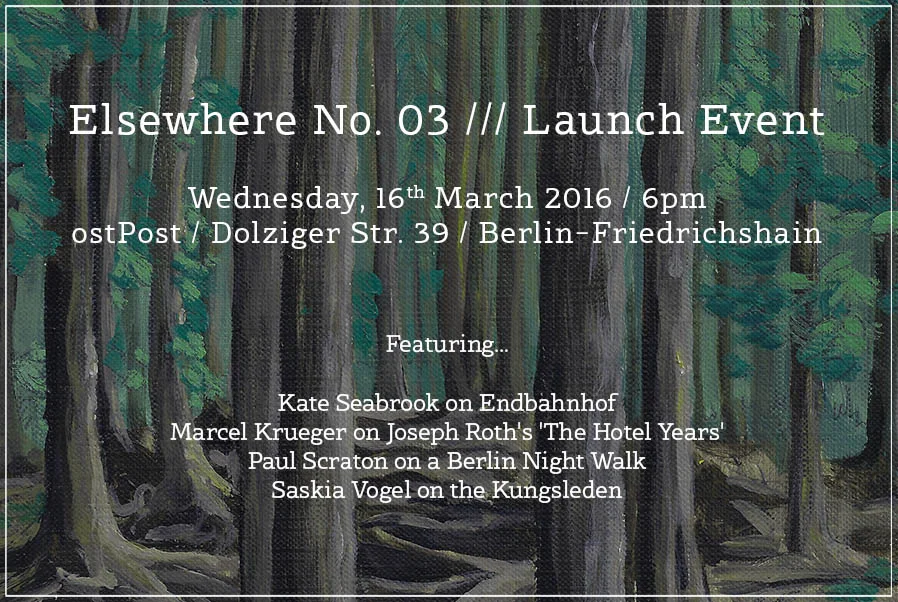
If you are in or near to Berlin in the middle of next month we would love to see you at our launch event. All the details are in the flyer above, and we are really looking forward to being at ostPost in Friedrichshain for an evening of reading and conversation. For those of your a little further away, never fear... we will have pre-order information about the third edition of Elsewhere in a week or so, in order that we can get all subscriber and pre-order copies out into the world by the time we are gathering together in Berlin... so you can enjoy it with us in spirit!

If you want to tell us you are coming, you can do so via our facebook event page, and otherwise it would be great if you could help us spread the word. Cheers!

Postcard from... The Cafe Slavia

By Paul Scraton:

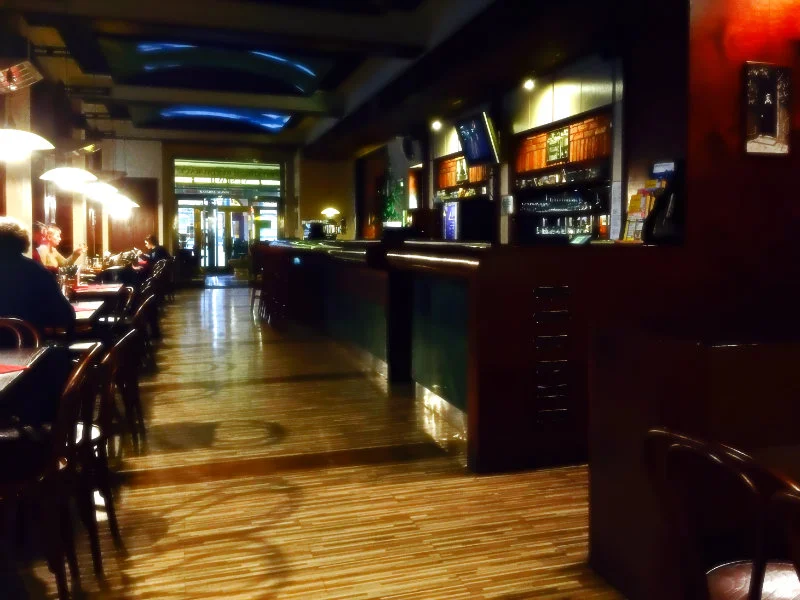
On the banks of the river we take a last look downstream, towards the Charles Bridge and the castle on the hill, before we retreat from the cold into the warm embrace of the Cafe Slavia. A chalkboard tells us we will be more comfortable, and they will be better able to serve us, if we leave our jackets with the friendly cloakroom attendant, who passes us a numbered raffle ticket in exchange for 5Kc and our things. The main room of the cafe is packed, as waiters in starched, white shirts and black bowties move between the occupied tables, the air filled with conversation, the hiss of the coffee machine, and a thick fug of cigarette smoke. The Cafe Slavia has been a meeting point opposite the National Theatre for over 130 years and today appears to be no different, and with no play on tonight across the street, no-one is in a hurry to leave.

We retreat to the room next-door, smoke-free and thus emptier. We find a table and order beers. Soon we will have placed in front of us plates of food – rabbit with thyme and cream, poached chicken, breaded schnitzel – that have probably been on the menu for thirteen decades. But like the waiters’ uniform and the cloakroom, if it has worked for all this time it still works now, so why change? We relax amidst the pot-plants and the polished wood, art nouveau theatre posters and black and white photography. The only nods to modernity are the wi-fi signals linking the laptops of 21st century poets to the outside world and a flat-screen television, hanging above the bar. But although it is tuned to music television the sound is down, and main thing we can hear is the low-level conversations at the next tables.

Two men are talking in Czech, and because of the place and the fact that I cannot understand them, I like to imagine them as the next in a long line of literary visitors to the Slavia, discussing their work or the politics of the streets outside. There is of course every chance that they are talking about the Macklemore video now being silently screened above the whiskey bottles behind the bar but linguistic ignorance allows me to pretend they are a modern-day Kafka and Rilke, with Havel looking approvingly on… although the reality is, they would probably be next-door in the main room, filled with life and smoke. Where the action is.

At another table a mother and daughter cast their eyes over the menu – recommended side dishes NOT included – as a large beer (mum) and a diet coke (daughter) are delivered to the table. The napkins that stand in a rack between them, next to the cutlery, proclaim a Cafe Slavia since 1881, although the internet claims 1884. No matter, it is long enough, and I think of the different Pragues that have existed beyond the high windows and the awnings that frame the view. The Habsburgs and the Czech national revival. Independence as Czechoslavakia with Prague as its capital. Nazi Germany and Communism. The Prague Spring and the Velvet Revolution. NATO. EU. Schengen. And what next… I could ask the young men at the next table but they have already gone, collected their coats and stepped out into the Prague night. Time, then, for another beer. We can spend a little while longer in this cafe by the river.