Push The Red Button: Film-making in Malawi

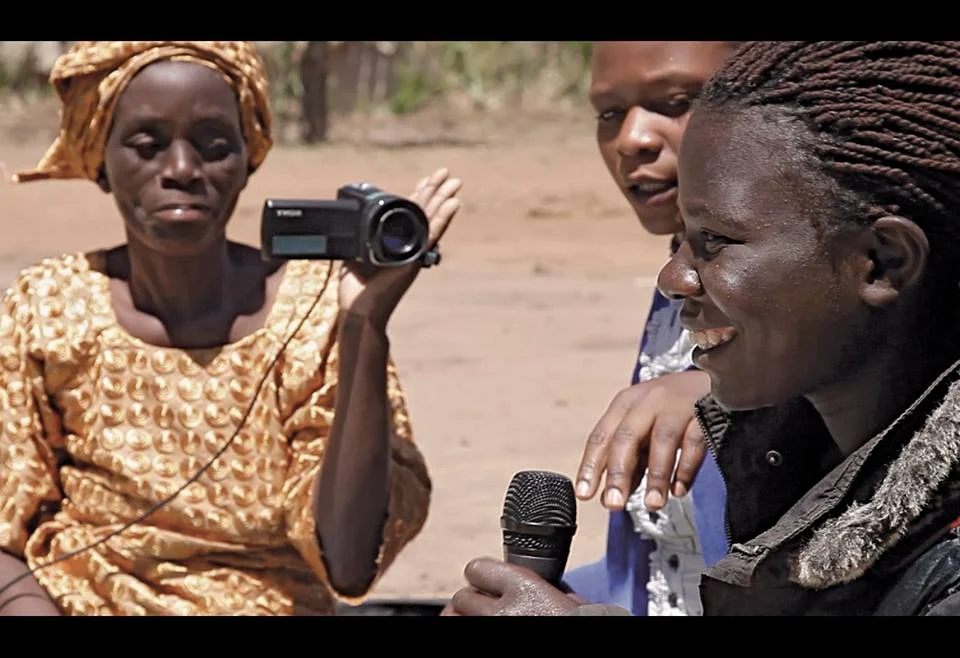
Our friend Sabine Hellmann was featured in our digital-only zero edition of Elsewhere: A Journal of Place, with her photographs from the Namumba Trading Post in Malawi. Now Sabine wants to return to the country as part of a film-making project titled Push The Red Button. Sabine and the team are currently crowdfunding the project via Indiegogo, and we wanted to use this chance to speak to her about what they are trying to achieve in the hope that some of our lovely Elsewhere readers will give them some support.

So Sabine, can you tell us a little bit about the motivation behind the project?

When I first started to train a group of farmers from rural Malawi to use video cameras, inspired by how they used the technology to tell their stories. With hands-on exercises and games, all part of a 'participatory video' workshop, the farmers understood quickly how storytelling in film works and the results were great. It was also a fun way to work together.  With Push The Red Button I hope to capture those wonderful moments when technology that is perhaps new for a particular group of people is embraced and used to tell their stories. Added to this, it was important for me to focus on women's stories, as these are so rarely heard.

Why Malawi? Is it a personal connection?

The connection came through my work and the observations I made when facilitating the video workshops. In Malawi where there is no electricity in the vast rural areas, it is nearly impossible to see moving images and so film and television remains something very special. This spring the sustainable farming project that I work for is coming to an end and it is the last time I will have the chance to visit Malawi and make a film about the magic that film-making brings for those who have had little opportunity to tell their stories, but have ample stories to tell!

Who are the women you are working with in Malawi and how did you choose them?

The five women who will appear in the film are Agnes, Sofeleti, Eunice, Judith and Emily. They live in Dzoole and Nthuzi villages in the district where we work. Two of them are grandmothers and the other three are in their twenties, some with children. Our project coordinators met them in the farming clubs and we chose them because they have not yet had a chance to be part of the video workshops that were held there. Each of them has a story to tell and issues like old traditions vs. modern influences will be explored during the filmmaking.

You are raising funds for the project via Indiegogo. How much money do you need and what will you be using it for?

We are hoping to raise a fairly basic production sum that will enable us to cover a number of expenses for the two weeks of shooting in Malawi. From car hire, decent wages for our colleagues in Malawi who will help with the production and translation, as well as international travel and local expenses for food and lodging. Part of the budget will also enable us to get an editor on board to create a rough cut and approach for more funding after the trip.

Aside from raising the money - what are the main challenges for a project like this?

There are a number of challenges - first of all we are shooting in Malawi and despite it being a peaceful and beautiful country, the infrastructure is not the best. We will face challenges like getting around in remote areas, working in sweltering heat and having to adapt to a much more relaxed e.g. slow way of doing things. I'm used to it through my work and I have gathered a great team on the ground that I can rely on. We'll be able to face those challenges and with Malawi being one of the friendliest countries in Africa, there is always a way around a problem.

Once the film is completed, what is the plan?

Once Push The Red Button sees the light of day, we hope to get it out and into film festivals. We are also looking into educational distribution possibilities, perhaps in conjunction with school screenings. This universal story is reflecting on the challenges of women from rural Malawi in a unique way, by observing them embrace the technology totally new to them and telling their stories. In return, I imagine it will also cause us to reflect on our own use of media and how it dominates our lives.  

Thanks Sabine… and best of luck for the project!

To see the pitch film and more about the project, visit the crowdfunding page on Indiegogo, and follow the project (and share!) on Facebook here.
A Dance of Memory - Sant Pere de Ribes, Catalonia

By Alan Nance:

An overcast Monday, a quarter strike from noon. At the edge of town I leave the road and start along the dirt track, and it is there I spot the pack of devils up ahead. Their hessian capes are emblazoned on the back with tongues of fire and dragon scales, while from their hoods two red horns protrude. The leader is carrying a long staff with a metal head split into six prongs, each threaded with an unspent gerb, a fountain firework. I watch him flick a cigarette end to the ground, and I think of the smoke that will soon fill the air.

Sant Pere de Ribes lies some 40 kilometres to the south of Barcelona and five kilometres inland from the coastal resort of Sitges. A town with its own quiet history, it is a place where people live and work rather than somewhere that draws the visitors. There are two days of the year, however, when a visit is worthwhile. In keeping with its name, Sant Pere de Ribes celebrates its annual festival on the Feast of St Peter, 29 June. But a year without festivities would be too much for any self-respecting Catalan to bear, so come midwinter – on 25 January – the townspeople take to the streets once more, this time in celebration of St Paul and his conversion on the road to Damascus. That, at least, is the official motive.

I walk this track almost every week, following its arc through the vineyards and scrubby groves of almond and carob that border the west of town. Today, however, I’m only going as far as the first fork, to where a path leads up to the Chapel of St Paul. On my weekly walks I rarely see a soul here, but today the crowd is thick and I’ve lost sight of the pack of devils, who by now must be gathering with the other demonic troupes in front of the chapel, the starting point for a procession that will make its way down the track and through the streets to the town’s main square.

Looking back I see the way lined with expectant families, many of them showing off their generations. The elders have seen it all before, and you can sense their delight as they wait to share the moment with their children and grandchildren. For a while at least, the thread of blood ties is taut and tangle free.

The neat stonework of the restored Chapel of St Paul belies the fact that this has been a place of worship for over five centuries. Festivities to mark the saint’s conversion are documented as being held here as far back as 1740, and for many years they consisted mostly of traditional dances rooted in Catalan folklore, followed by a communal outdoor meal. Afterwards, the townsfolk would return en masse to their homes, accompanied along the way by groups of dancers. Over time, the dancing descent from the chapel became a parade in its own right, and by the early twentieth century other folkloric elements had been added: drummers, devils and, most notably, a three-headed dragon that is now the main protagonist of every feast day in the town.

From the direction of the main square I hear the sound of four quarter bells followed by a toll of twelve, and shortly afterwards the faithful few who have been attending a special mass inside the chapel begin to make their way down the path to where I am standing. The stragglers barely have time to take their place among the waiting crowd before the drumming begins and the leading devil, his six-pronged staff aloft, starts to make his way along the track.

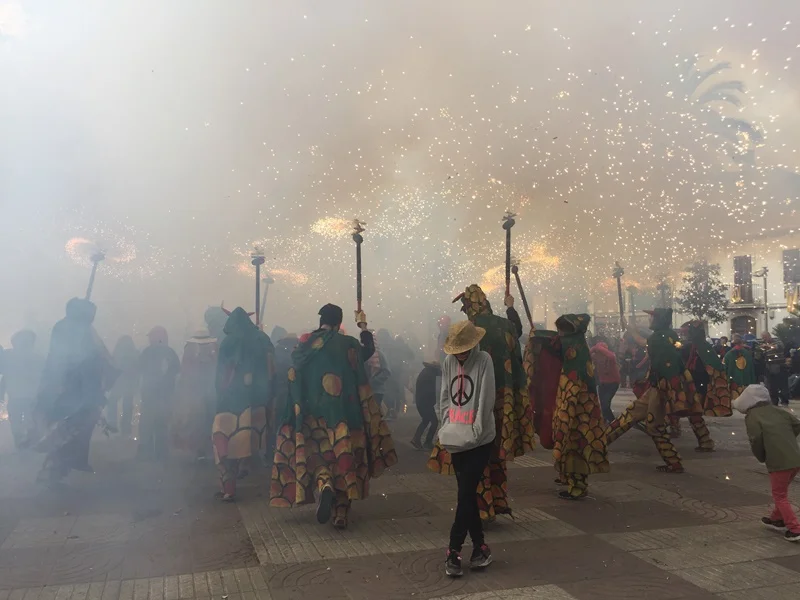
At the first bend he stops and is encircled by his henchmen, each of whom carries a shorter staff topped by a single fresh gerb. Someone throws a flare to the ground, and each of the devils lowers the head of his staff towards the flame. Contact is made, sparks fizz and fly, and the devils leap back and begin dancing in a circle, their raised staffs raining fire and delight over the onlookers.

Stepping back out of range I watch as hoodied teenagers wearing kids’ sunglasses lurch forward and start bobbing around at the heart of the whistling fountain. It’s not about getting hurt, but it might not be bad to go home with a singed jacket or a mark on hand or cheek, a badge of honour to be shown off at school tomorrow.

Once the fireworks are spent the band of devils moves off again, only to be replaced by a similar troupe of drummers and demons who have been following along behind, and who are now letting fly – with more directional malice – their own screaming shower.

Not far behind them I see the star of the show come into view. The dragon, some three metres tall, is scaly green with a red-plate backbone and four human feet, the only sign of the two carriers who are lodged inside its fibre-glass body. From its three mouths, long red tongues protrude, while around each of its necks it wears a pair of much larger gerbs that when ignited will make the devils’ rain seem like drizzle. As the fuses are lit, smartphones and cameras are held up before the beast, and I think of crucifixes and vampires and of how our talismans have changed. The dragon belches light and heat into the winter sky, and people cheer.

The parade will carry on like this all the way to the main square, and I decide to head there for the finale. The ground is strewn with carton tubes, discards from when the devils reload their staffs, and there is now a definite hint of sulphur in the air. So as to avoid the crowds I cut down a side road that will bring me out on the other side of the square from where the procession will enter, and it is then, tucked away in a back street away from the action, that I see something which makes me think of the man in whose name the festivities are officially being held.

It is too much for me to imagine that someone might walk the road to Damascus today and come away with anything resembling faith. Yet here beneath a makeshift banner that someone has strung between two trees in an ordinary Catalan town that few have heard of, I do at least feel that all is not lost. In one corner of the white rectangular sheet, someone has painted the stylised figures of a family in flight, two adults and a child who seem to be running towards the simple message, written in English, that the banner displays: Refugees Welcome.

In the square the terraces of the two bars and two cafes are filling up as people look to secure a spot from where to watch the finale, or simply to settle down to an afternoon’s eating and, above all, drinking. I linger until the procession makes its entrance, but decide then that I’ve had enough for today. It is as I’m leaving the square that I notice, strung between two plane trees on the far side, another banner, one whose message seems to capture two faces of this community, of this town that has become my home. Written in Catalan the banner calls on people to fight for a Republic and for social justice, but it is the hashtagged message at the bottom that most catches my eye. #FestasiLluitatambé – enjoy the party, but don’t forget the fight.

Alan Nance is a writer and translator based in Catalonia. He blogs at www.walkinginmind.com  and tweets @alanjnance

Postcard from... Prora

By Paul Scraton:

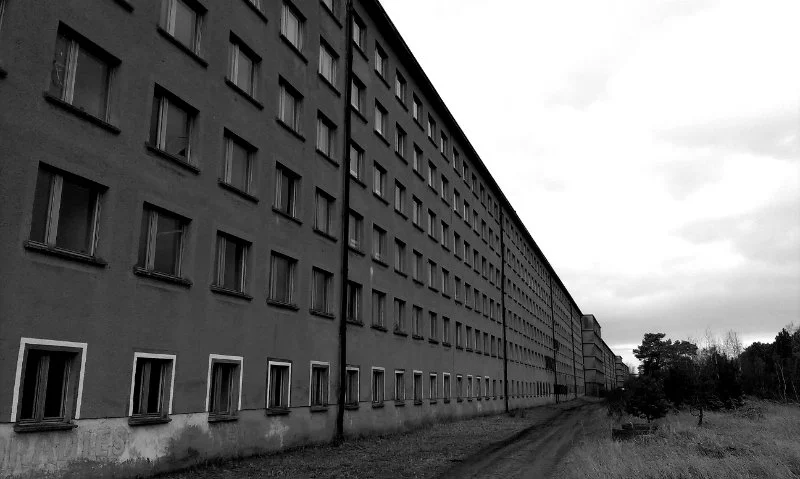
At Prora it is the scale of the place that first impresses. Built in the late 1930s by the Nazi’s leisure organisation ‘Strength through Joy’ it was one of the largest building projects undertaken during the Third Reich, a holiday camp for 20,000 visitors at a time who would be housed in colossal residential blocks that stretched for over three miles between the pine forest and the sands of one of Rügen island’s most beautiful beaches. The German workers never made it to Prora for a holiday, as war interrupted before the building work was complete, although most of the residential blocks were standing by the time the Red Army arrived on the island in 1945.

During the German Democratic Republic the site was controlled by the NVA – the East German Army – and it would remain a military zone until after reunification when the Federal armed forces handed over the largest standing example of Nazi architecture to the state and the long process began to decide what to do with it. In the beginning there were many plans and many were rejected. During the first decade or so of limbo the site became home to a number of projects and small businesses – Rügen’s largest disco, the honey manufacturer, numerous artists and art projects, a youth hostel and museums and exhibitions dedicated to the history of the site.

At the Documentation Centre, which stands in a side wing of House 3 beside the disco and across the cracked paving stones of the car park from a tree climbing park in the pine forest, a film about the history of the site reflects on what happened next. In 2004, around the time I first visited Prora, the state began to sell off the blocks one by one – “thus washing their hands of the site.” Most of the small and quirky businesses and projects have since been moved out, as private investors have begun the process of turning the site into luxury hotels and holiday apartments.

Leaving the Documentation Centre, which is itself under threat from a potential sale of its own building, I walked down to House 2, most of which has already been renovated and is in the process of being sold on to investors and second-home owners. In the show-apartment the literature extolled the virtues of the location, the investment opportunity, and the chance to to invest in a landmark protected property without ever really explaining why that protection existed. Somehow the entire history of Prora was told without ever once mentioning the words ‘National’ or ‘Socialist’, without ever explaining who had built this colossus and why. The salesman talked through the particulars with an interested couple. They needed to hurry… 80% of the apartments had already been sold.

In the local newspaper I read an article about the last remaining buildings under state ownership, which houses the youth hostel and the Documentation Centre. There was doubt that there would be space for the exhibition in the site under the proposals on the table, that once the sales and renovations have been completed there may be nowhere in Prora that explains how this all came to be. The possibility is there that Prora’s past will be covered-up by new external balconies and a whitewashed paint job. In one of Germany’s largest buildings, it seems that the intention is to hide the past in plain sight. 

The Library: The Moor, by William Atkins

Review: Paul Scraton

What do we read when we look at a landscape? What do we see, and perhaps as importantly, what do we feel? I have lived in Berlin for a decade and half, a move eastwards from my childhood home in West Lancashire first to Leeds and then to the German capital. Until I left England the landscapes of my imagination were always raised ones – the sea cliffs of Anglesey or the mountains of Snowdonia – and in Germany I had to learn to love the different and distinct attractions of the flatlands, the forests and lakes of Brandenburg or the big skies and low dunes of the Baltic.

Alongside the mountains and cliffs of North Wales, the other landscape of my imagination and the one that I would think of when I thought of “home”, was the moors. Living in Leeds for four years and returning ever since to visit family and friends, moorland spotted through a car window on the drive from Liverpool or Manchester airport gives me that first feeling of a sense of return… to land at Leeds Bradford is to play “spot the rocks”, searching through that tiny cabin window for a glimpse of the Cow & Calf above Ilkley and the brooding expanse of moors squatting above the towns and villages of Wharfedale below.

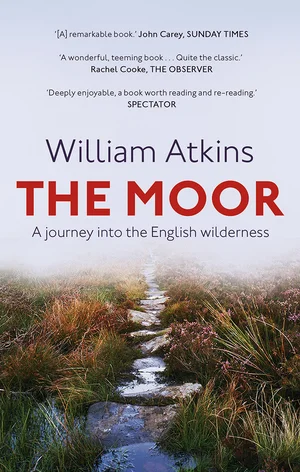
So it was not surprising that, standing in an English-language bookshop in Berlin, I was drawn to William Atkins’ The Moor and its cover image of boggy ground and tough grass. Subtitled A journey into the English wilderness I reached for the book as a salve to a bout of homesickness that comes every so often. What I found when I opened the pages was a captivating journey from south to north, from Bodmin Moor to the White Lands of the Otterburn Training Area, and a book that combines travelogue, history, ecology, literature, folklore and reportage in the way of the very best writing on place.

There is much that is thought-provoking about Atkins’ book, not least the fact this very “English wilderness” has been, for thousands of years, shaped by humans. From the Mesolithic tribes to the Romans, humans cleared and burned the uplands that would grow ever more hostile as global temperatures cooled. And so the people moved ever lower, felling more trees and clearing more land as they did so, the moors following them ever deeper into the valley.

It was man, then – man, with the climate, but not ‘nature’ alone – that made the moors. And it was man who continued to shape them: sheep grazing under the abbeys discouraged the resurgence of all but the least palatable vegetation: mat-grass, purple moor-grass, cotton-grass.

In recent centuries the moorland streams were dammed to create reservoirs to provide water for the ever-expanding cities of the industrial age, and heather was encouraged for the raising of grouse to be shot by guns of the great and the good. Indeed, it is only in exploring a restricted zone that had been declared around a military base over halfway through his journey that Atkins finds an expanse of moorland that has not been burned, grazed or afforested.

If man was to be eradicated, here was what would happen.

The other big question that The Moor inspires the reader to ask is that of land ownership and the impact of this human influence, not just on the moorland itself but for the communities below. I read The Moor as much of northern England was under water, as those “hundred-year floods” returned for the second or third time in recent memory, and the book explains exactly how burning and land management above, in order that a few rich folks can shoot a Land Rover’s boot-full of birds, can have catastrophic impacts on the people living below.

These are just a couple of aspects of what makes The Moor such a fascinating read. There is also plenty of literature, for one of the great gifts of the English moorland has been its inspiration for writers and poets. Atkins is no different, and as he describes the wildlife or the people he encounters, tells the stories and legends of the moors, or reflects on the politics of land and its uses, he does so with lyrical writing that certainly does justice to the melancholy and mysterious nature of these places that are, to my mind at least, both forbidding and appealing all at the same time.

William Atkins’ website

Cry of Despair - 71 Years after the liberation of Auschwitz-Birkenau

Today is International Holocaust Remembrance Day, the 27th January, which was the day Auschwitz-Birkenau was liberated in 1945. One year ago it was the 70th anniversary of the liberation and Elsewhere editor in chief Paul Scraton wrote the following post on his personal website Under a Grey Sky

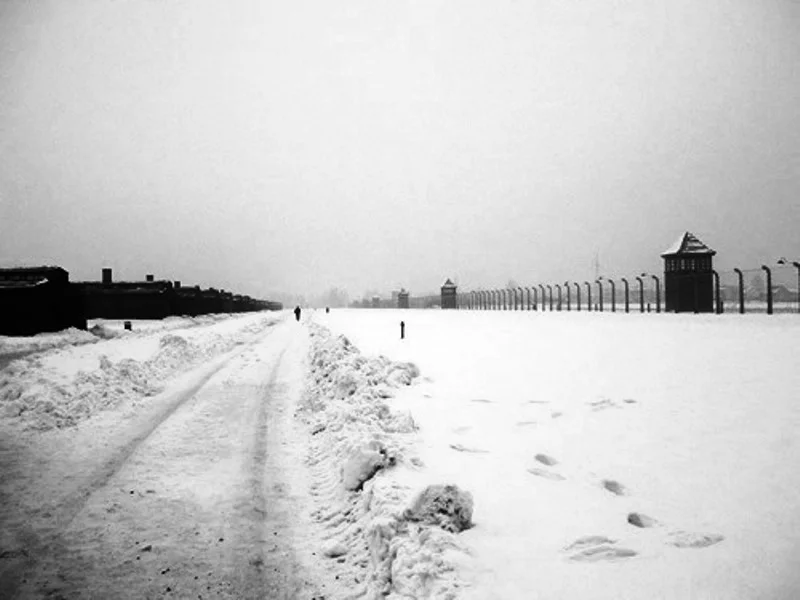
Today is the seventieth anniversary of the liberation of the Auschwitz-Birkenau extermination camp in German-occupied Poland. As events are held across the world to commemorate the anniversary, I dug out an article I wrote based on a visit to Krakow in the early months of 2006. Katrin was pregnant, and we had travelled to the Polish city to scout locations for an international hostel conference she was organising. A few months later, when the conference took place, we had to travel overland as Katrin was no longer allowed to fly, but on the first visit we landed at the airport and were driven into town through socialist-era suburbs that reminded us of Berlin to the beauty of the old city centre:

On a clear winter’s day, with a light mist hanging overhead, weak sunshine bathes the Old Town of Krakow in a gentle, almost dream-like light. It softens the cobbled streets, the towers and spires, the market square – a more beautiful city in Europe is hard to imagine. In the bone-chilling cold people move at a brisk pace. Young women students scurry between university buildings wrapped in heavy scarves and jackets, hats pulled low, their round, pretty faces open to the elements. Only tourists loiter – that’s what tourists do – framing the city through digital lenses. But in January they are few in number. As the city ebbs and flows, people go about their daily business. For them beautiful Krakow is commonplace; while visitors gaze in wonder, local eyes rarely rise above street level.

We had plenty of time to explore in those first few days, our appointments few and far between. But as much as we enjoyed wandering the streets, ducking into basement bars and cafes, searching out the youthful side of this old city there was always something lingering in the back of your mind. We had planned a day later in the week to travel out to Auschwitz-Birkenau, but it was of course the old Jewish quarter of the city that we discovered first:

For over five hundred years the focal point of Krakow’s Jewish life was the Kazimierz neighbourhood, south of Wawel Castle. Today, alongside renovated synagogues, cemeteries, museums and cultural centres documenting the City’s Jewish life are bohemian cafes and bars, regular haunts of the city’s artists, students and intellectuals. Before the Nazis an estimated 68,000 Jews lived in Krakow, now there are only 5,000 in Poland, just 100 of which live in Kazimierz…

A day later we caught a ride in a minibus out of the city. The mood inside was pensive, the landscape outside the window bleak. The driver did not speak the whole way, concentrating instead on the road and the radio, on which cheerful presenters chatted away between songs by Tina Turner and Prince. Ours was not the only minibus to arrive:

Each day scores of minibuses and taxis take visitors from Krakow to Auschwitz-Birkenau. Drivers gather in the snow-covered car park, smoking and waiting under a steel grey sky. It’s just another routine working day. Yet etched in the faces of those arriving at the gates for the first time is horror, shock and pain.  Here, at Auschwitz and the larger Birkenau camp close by one and a half million Jews, gypsies, homosexuals, political prisoners, Poles, and many others were exterminated by gunfire, gassing, starvation or the wretched conditions.

Despite their familiarity, the magnitude of the Holocaust overwhelms the capacity to reflect. What captures the imagination, tragically, are small things: the pair of glasses in a case with thousands of others, somehow apart from the rest, or the suitcase with a Berlin address just two streets from your own, or the photograph of two young guards standing on a train platform, sharing a joke in the aftermath of the murderous selection. Stark moments, frozen in time, feeling like hammer-blows to the chest.

It is difficult to describe now the mood in the minibus as we drove back to Krakow, but I can still feel it. There we headed for our (by now) favourite cellar bar, filled with loud and cheerful students, smiling staff bringing vodka and beer to the table, conversations swirling all around us in a language we could not understand. Katrin was not drinking of course, but I can remember leaving the bar with a fuzzy head, the journey of the day turned into a strange and horrific dream. But of course it wasn’t.

I have been to many sites of memory over the past twenty years. I live in a city that has perhaps more than most. I have visited the District Six museum in Cape Town and the murals of Belfast, the Hillsborough Memorial outside Liverpool’s Anfield Stadium and walked the length of the hundred mile Berlin Wall Trail. In all these places and more I am constantly struck not only by the emotional impact such sites of memory have, but their importance as well. The International Memorial at Auschwitz-Birkenau is inscribed with the following words:

For ever let this place be
a cry of despair
and a warning to humanity,
where the Nazis murdered
about one and a half
million
men, women, and children,
mostly Jews
from various countries
of Europe.

We need this cry of despair, and we need to experience it. Sadly, we cannot as a society make the promise of “never again.” I don’t think it is in our power. But if we can manage “never forget”, then there is always the chance we might make it.

Postcard from... Reykjavik

By Marcel Krueger:

Leif Erikson ignores me. As I walk past his statue in the shadow of rocket thrower-shaped Hallgrímskirkja he stares at the horizon, at Greenland maybe or at the planes tumbling through the wind towards Keflavik airport. The two ravens sitting on Leif's shoulders, however, croak mockery down at me. Maybe they’re not used to see a hungover tourist without colorful plastic jacket and selfie stick. Would it not have been for the appointment with a friend I would have not left my hotel bed, but we had a hot dog and a coffee and I feel good. It is 4.30 in the afternoon, and the sun is setting. 

Iceland has changed since I’ve been here the last time, four years ago. I’m thinking of Harpa, the impressive concert hall by the harbor, and how I once watched Björk making music with Tesla coils there, on an equally cold and dark day. But there are no Tesla coils now, only American tourists buying overpriced t-shirts and magma rocks that someone labelled as jewelry. The city center is as busy as the Berlin one, cranes and building sites everywhere, new hotels rising skywards where skate parks and public spaces used to be before. In 2015, the tourism industry contributed over 5% to the Icelandic GDP, and the number of foreign visitors exceeded 1,000,000; you can now purchase a special ticket for the bus from the airport: where in the past tourists had to make their own way from the main bus terminal BSÍ now there's an armada of smaller buses waiting, ferrying tourists directly to their hotels so no one has to walk through the bitter cold, as if it was a nuisance and not a feature of the land and the season. 

Before I got drunk in Kaffibarinn yesterday, I took the bus to the Seltjanarnes neighbourhood and walked along the coastal trail, towards the tip of the peninsula and the lighthouse on Grótta Island. Icelandic artist Ólöf Nordal has created a basalt sculpture named Kvika here, a hot water foot bath I planned to use, aiming to sit in the icy cold with my feet in hot thermal water, looking out over the bay and snow-covered Mount Esja rising behind it. I walked along the rocks on the seafront, while ravens sat on the street lamps along the trail. Other pedestrians I did not see. The sun was sinking fast, but the light over Reykjavik and the mountains had the outstanding clarity that only the winter sun up here in the north has. When I arrived at the foot bath it was occupied by a tall Norseman with long blonde hair, who had immersed himself completely in the small bath, his naked upper torso and legs out in the cold and his midriff covered with the hot water. I did not mind, and instead watched the ravens, playing over the water.

Image: Joseph Carr Photography

The language of the land is water – the Lake District

By Ellie Broughton:

On Boxing  Day I walked up Brockle Beck, a little stream outside Keswick. At the bottom of the path sits Spring Farm. A heap of sodden toys, carpets and chairs lay outside next to a silver Rolls Royce that gleamed in the sun.

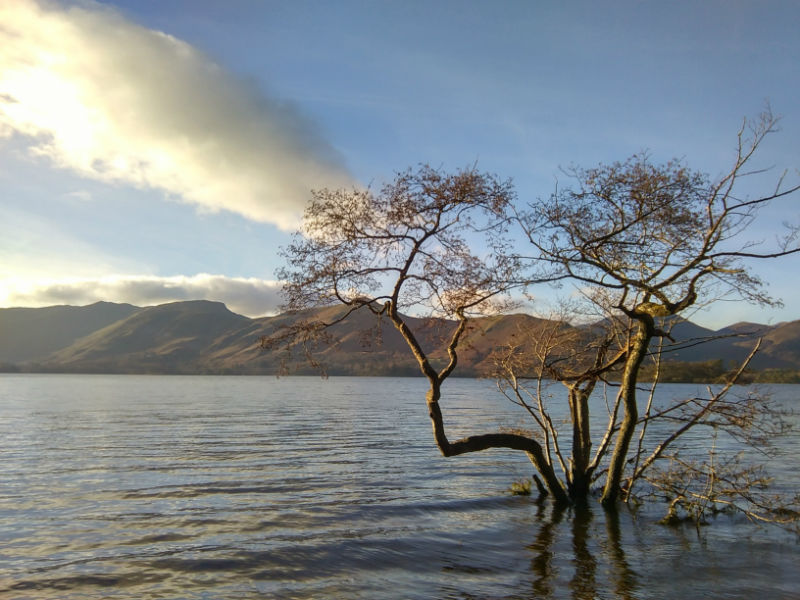
Marks from the floods, which had happened two weeks ago, were still present. From the mounds of soil by the roadside to the still-wet floodplains around the Derwent, the water's draughtsmanship was everywhere.

The footpath led up Brockle Beck through the woods. There were still sweeping traces down the lane of leaves and gravel, marks made by the overflow.

A 30-foot oak lay on its side in the riverbed, redesigned by the force of the floods.

Snapped branches and washed-up bushes framed the now-tiny stream, a picture of a disaster described through ruins.

Further up the track, a bridge had tumbled into the water, as if a subject of a primary school art class on perspective. It had been decorated with yellow tape advising ‘do not cross’.

I visit the Lakes every Christmas to see with my parents, who moved here ten years ago. Their house is hundreds of feet above sea level, thank God, but every year now the rest of the county faces what used to be ‘freak’ flooding.

The signs are everywhere. Even as the Virgin Pendolino climbs Shap, you can see how swollen the river has become, how much spray churned up on the M6.

This year, the storm came two weeks before Christmas. I knew things were bad when my mum uncharacteristically texted to tell me 'not to worry'.

A quick Twitter image search revealed the road to Thirlmere washed away in a starburst of gravel. In Keswick, murky river water lapped over the tops of the town's four-year-old defences.

Cockermouth has seen some of the worst of it, hit three times in the last 11 years. In 2005 the town saw its worst flood since 1822; in 2009 residents faced what was called a once-in-a-thousand-year event. Last month the town flooded again, with an estimated 400-700 homes and businesses inundated.

Many businesses in Cockermouth were back up on their feet by Christmas, just as York went under and Tadcaster evacuated. But any shop by the river had to be gutted, and now lay empty. Winter sun fell through the shop windows onto bare plaster walls. Dehumidifiers stood alone, humming to no-one. A thigh-high watermark still stained the brickwork outside.

The language of the land here is water. Windermere was named for its lake, Cockermouth for the river Cocker, Morecambe for the ‘crooked sea’ (more came).

Cumbria has been the spring for so many words for water courses. Meres, gills, becks, holms, tarns and forces existed long before the south had rivers and super-mares.

But as we drive back to the Northwestern Fells over the Honister Pass it is clear that ‘draughtsmanship’ is not a good metaphor for flood damage. The damage is violent.

Chunks of earth have been bitten from the banks of the stream running down Honister Pass. The waterfall at Buttermere, usually just a silvery scratch in the dark woods, is today thick as a keloid scar. New weather patterns fluctuate and jag; the land suffers.

Ellie Broughton is a writer from London and will appear in Elsewhere No.04, to be published in September 2016. On Twitter she's @__ellie


Five Questions for... Laurence Mitchell

The next in our series of interviews about home and place with the editors and contributors to Elsewhere is with Laurence Mitchell. Laurence’s article on Tamchy in Krygyzstan appeared in Elsewhere No.02, and he has an essay on walking in Japan appearing in the upcoming edition of the journal, to be published in March (Image: WWII pillbox, Horsey Gap, Norfolk):

What does home mean to you?

I have always experienced two strong conflicting urges: that of the home-bird and that of the nomad. Both are equally important to me, so I am part farmer, part pastoralist I suppose. Actually, to continue this analogy I am probably more of a latter-day hunter gatherer – someone who likes to go on hunting expeditions (I am speaking figuratively here) yet wants a secure home base to return to. As any anthropologist will tell you, a lot more time is usually spent digging roots and gathering nuts and berries than catching game to eat.

I have been based in Norfolk, mostly Norwich, for forty years or so now, and am as much at home here as I am anywhere. I grew up in the West Midlands greenbelt and that still exerts a strong pull and, even after decades away, still feels to be as much ‘home’ as East Anglia does. In many ways I feel at home almost anywhere I go; I have never failed to be amazed by the universality of people around the world – we all share much the same hopes, dreams, fears and aspirations. Essentially, we carry home within us wherever we go.

Where is your favourite place?

This partly depends on how ‘favourite’ is defined. If I were asked what is the most beautiful place I have ever visited I would have no hesitation in saying the Hunza region of the far north of Pakistan, where enormous glaciers come right down to the Karakoram Highway and the improbably jagged mountains – 7,000 metres high or more – resemble the sort of things you see in children’s fairytale books. South American cloud forest – the mossy, misty, orchid-dripped terrain that lies between high altitude altiplano and lowland jungle – is also pretty hard to beat for sheer beauty. Central Asia, particularly mountainous Kyrgyzstan and Tajikistan, is also scenically gorgeous in a lonely, slightly desolate sort of way.

But I also love more modest landscapes closer to home – the marshes, dunes and estuaries of the Norfolk and Suffolk coast; the velvety green valleys of the Lake District; Peak District moorland. Coming from hillier terrain in the English Midlands there was a time when I didn’t really appreciate the low horizons of East Anglia but things have changed now. I particularly like evocative coastal landscapes that have a bit of an edge to them, a sense of dark history – Orford Ness on the Suffolk coast springs to mind here.

What is beyond your front door?

I live in a Victorian house on a Victorian Street that was created in the mid-19th century when Norwich built its third railway station, Victoria Station, now long gone. The territory that was once covered by the station buildings and marshalling yard is now a Sainsbury’s supermarket; the course of the old railway line, a cycle path and walking thoroughfare. Much of the street is much as it was 150 years ago, although the Luftwaffe did quite a bit of remodelling one fateful night back in 1942 – a so-called Baedeker raid. The gaps that were created have since been filled with 1950s semis.

Immediately beyond my door are three pollarded lime trees that shield us from the street beyond. If I turn right out of the gate I am soon at one of the main roads into the city, actually the very end of the A11 as it meets the southern city gate, now extant in name only. More or less directly across the main road are the gentrified red brick buildings of the old Norwich and Norfolk Hospital complex – the site now redeveloped with smart new housing. Nearby, within less than two minute’s walk, are three pubs, two cafes, two florists, a Turkish restaurant and an Indian takeaway. There is also a physiotherapist, a dentists’ practice and a huge Brutalist-style concrete office block where suited workers gather to smoke outside its entrance.

The area is virtually inner city – there are flinty fragments of the old city walls next to the inner ring-road just a minute’s walk away; traffic noise is fairly constant. If I lean out of my attic/workroom window I can just about see the cathedral spire and the Norman castle – well I could if I were a giraffe.

As with anywhere in the city, the whole area is layered with history – a palimpsest in which traces of modern, 1960s planned redevelopment, Victorian, medieval and Norman overlap one another. But Norwich is even older still, it was already well established when the Normans came and expanded it for their own purposes. Plus ca change...

What place would you most like to visit?

The short answer is probably northern Greenland, closely followed by Haiti, Paraguay, Madagascar and Ethiopia. The long answer? Well... like almost anybody who has read Atlas of Remote Islands: Fifty Islands I Have Not Visited and Never Will by Judith Schalansky I am intrigued by the remote islands she describes, all of which are very difficult or impossible to visit for the average traveller. I am lucky to have visited just one of these briefly, Hirta in the St Kilda archipelago, a group of islands that has always held a strong presence in my imagination and continues to do so. If I could choose another from the book then – call me greedy – I would go to Deception Island, an uninhabited former whaling station in Antarctica.

Having said all of this, I far less compelled to travel far afield these days and am more content to discover new territories closer to home. Overall I am probably currently more interested in walking routes and ancient ways than places per se – the journey itself rather than the arrival.

What are you reading?

Lately I have been reading Alan Garner again, reading or re-reading some of his stories and have especially got a lot out of The Voice that Thunders, a collection of talks, lectures and presentations that explain his approach to writing. Having recently visited the John Clare museum at Helpston, Cambridgeshire, and also having seen Andrew Kötting’s film By Our Selves, I have been re-reading Iain Sinclair’s Edge of the Orison. In this, the writer recreates the poet’s painful solitary journey back to his birth village near Peterborough after escaping from a mental hospital in Epping Forest. I’ve also recently finished another enjoyable book with Orison in the title – Horatio Clare’s Orison for a Curlew – which documents an unsuccessful search for a very rare bird that may already be extinct.

You can read more from Laurence on his blog East of Elveden.