Postcard from... Koh Kret

By Julia Stone:

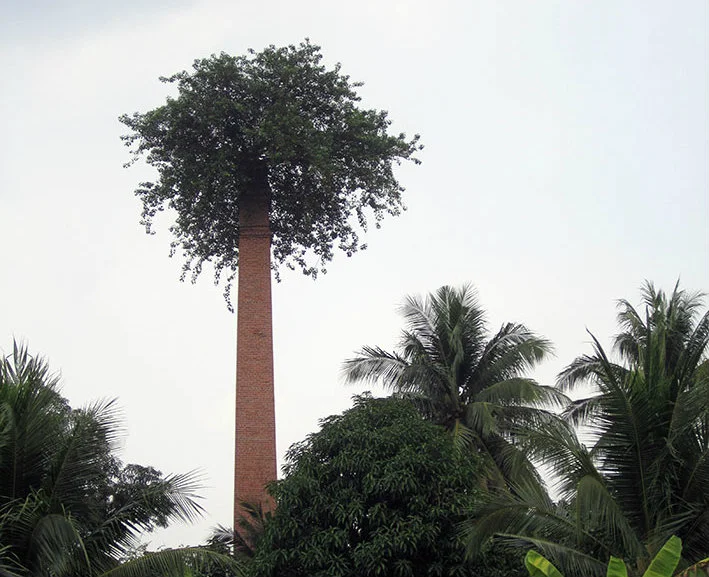
As we approach the island by boat, the chimney has the appearance of a ginormous tree, sprouting high above the coconut palms and temple rooftops. Out of the mouth of the chimney a bush of some sort is growing, like a head of curly hair.

Koh Kret became an island in 1722, when a canal was constructed to create a shortcut in the Chaophraya river. To this day there is no bridge connecting the two by two kilometre island from the mainland, and only bicycles and motorbikes travel the path that runs around it. You will find Koh Kret to the north of Bangkok, in the district of Nonthaburi, where I my dad lives. I love coming to Koh Kret for the rural atmosphere and absolute contrast to the bustle and noise of the mainland, just a two Baht ferry ride away, although not on the wekend, when hordes of Bangkokians arrive to eat, buy pottery souvenirs or visit the Mon temples on the island.

Mon immigrants settled Koh Kret after the destruction of Ayutthaya in 1767, during the Siamese-Burmese war. Today the majority of Koh Kret's population is still Mon, with their own distinct version of Buddhism and a traditional style of Mon pottery called kwan aman, for which Nonthaburi and especially the island are famous.

The chimney is the remnant of a pottery village, I can see some of the brick kilns still standing below as I approach it via an elevated path between crops growing in water, but it looks like it hasn't been used in quite a while. As a kid, my mom used to take me to the Koh Kret and sometimes one of the potters would let me have a go at forming the clay on the rotating wheel, but now I wonder about this inactivity. As the visitors pick over the choice of pottery souvenirs in the village shops I have to question whether they are even made here any more. 

The Joy of Old Maps

By Paul Scraton:

A love of maps is something that all of us share here at Elsewhere, and I suspect that goes for a good many of our readers as well. On a personal level, there is nothing I like more than sitting down with a collection of maps to plan a route or a journey. If is a place I have never been to before, it is a moment where imagination takes over as I attempt to picture the lie of the land or the streetscape I will soon be passing through. If it is a place I known well, the map will stimulate memories of previous travels and trips, or the everyday journeys from here to there when it was a different place, the place on the map, which I called home.

Something of a traditionalist, I prefer my maps on paper, although Amy Liptrot’s essay in Elsewhere No.02 that featured Google Maps as a stimulus to memory and imagination persuaded me that there can also be much value in exploration via a glowing screen. If it is a map of the here and now, I think it is the possibility that they represent that most appeals: Is that a footpath along that abandoned railway embankment? Is that a river in my neighbourhood, one that had somehow passed me by? What is in that patch of grey space in the edgelands of the city, between the residential districts and first of the farmed fields in the surrounding countryside? Maybe I should go and find out…

There is another subset of maps that have long fascinated me, and they are maps from the past. Whether found in second hand bookshops or reproduced and reprinted, old maps are a great starting point for anyone interested in understanding the history of a place. In Elsewhere No.04 we highlighted two projects that have old maps at their heart: the reproductions of city maps by Pharus here in Germany, and the London Trails walking tours by Ken Titmuss, using old maps as guiding documents. Inspired, we decided to launch the fourth edition of Elsewhere by taking a walk, following a route from Friedrichstraße station in the centre of Berlin to the Vagabund brewery in the old industrial district of Wedding. Using a Pharus map of the city from 1902, we attempted to bridge the gap between the Berlin on paper and what we could see with our own eyes.

The map offered us clues to the history of the city. The location of synagogues on the map suggested where the centre of the Jewish community in the early 20th century Berlin could be found. The market halls and bathhouses, theatres and factories, all diligently marked down, spoke to the everyday reality of life in the rapidly industrialising city in 1902. The destinations indicated for each of the main-line railway stations hinted at very different borders for the Germany of then and the Germany of now. Where the Vagabund brewery now stands, the streets are marked but not yet named, and in between them only an empty space. The map of 1902, with a good number of these planned but unbuilt neighbourhoods circling the city centre, showed us that the expansion of Berlin, laid out by James Hobrecht in 1861, was still very much a work in progress. 

As we walked a steady rain fell and the water on the ground shimmered under the streetlamps and headlights of the cars as darkness swallowed the city. In the half-light of an autumn evening we searched out the links between 1902 and now. The theatre still standing. The railway station. The market hall (now a supermarket). And we spotted what was missing: some of the synagogues, the bathhouses and a department store, huge factory complexes and a circus tent. As we walked we could also trace other moments in Berlin’s history, things that in 1902 were still to come. We walked by open spaces levelled by bombs that fell over 70 years ago. We crossed the path of the Berlin Wall. We finished up on a street that now had a name and was now lined with houses.

Old maps will only ever tell part of a story, but they offer up clues that help lead us to some of the fascinating tales of the city. They help us understand what was here before and provide us with a guiding document to imagine what has been lost. Indeed, all maps are – to some extent – “old”. From the moment they are finished they are immediately out of date. A new building erected here. An old one gone there. Streets re-routed and renamed. But in their inaccuracy, maps whatever their age are invaluable for those of us interested in the story of a place. 

Elsewhere No.04, with our map special featuring essays and interviews can be found on our online shop here. Elsewhere No.02, featuring Amy Liptrot’s essay ‘A (near future) Google Maps tour of the heart’ can be found here. For the historic map tours in London, offered by Ken Titmuss, visit London Trails website. You can search the archive of reprinted maps from Pharus via their online shop here. 

Memory, Place and Personal Narratives: High Street Stories

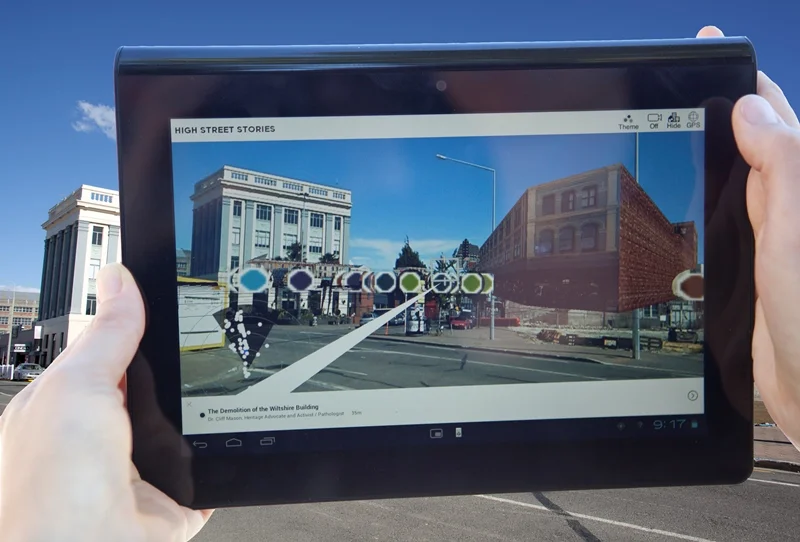
The High Street Stories Augmented Reality app. showing the geo-tagged stories. Credit: Heritage New Zealand. Photo: Guy Frederick

The High Street Stories Augmented Reality app. showing the geo-tagged stories. Credit: Heritage New Zealand. Photo: Guy Frederick

By Paul Scraton:

The question of how we tell the stories of a place becomes all the more urgent when the physical reminders of a city, a town or a village have been destroyed. With the Canterbury earthquakes of 2010/2011, the High Street precinct of Christchurch, New Zealand was irrevocably destroyed. Many of the historic buildings of the neighbourhood were reduced to rubble, and the streetscapes altered forever.

With a background in oral history and documentary film and radio, Zoe Roland in her role as public programmes developer at Heritage New Zealand instigated a project designed to capture the stories of the High Street, “from early days as a bustling commercial centre through its decline in the 1970s and ‘80s, and later regeneration.” With both a website and an augmented reality app for android, High Street Stories brings together 90 histories, anecdotes and other stories from the architectural heritage of the neighbourhood to sordid memories of the red light district.

In her essay ‘There’s nothing to See Here’: Rebuilding Memories of Place through Personal Narratives Zoe Roland reflects on how, after the earthquake “the city’s communities were left disconnected and disaffected, and their mental well-being compromised.” But through projects such as High Street Stories, the use of personal narratives - their collection and presentation - “is a powerful tool to creative collective agency, sense of place and to ameliorate historical amnesia.”

Exploring and listening to the stories of Christchurch, I am reminded of other projects in other, very different places, that also attempt to use this “powerful tool.” In Cape Town in 2010 I explored the District Six Museum, located in what was once a mixed community of “freed slaves, merchants, artisans, labourers and immigrants,” that was declared a white area in 1966 by the Apartheid government. Over 60,000 people were forced to leave and their houses destroyed by bulldozers.

In 1994 the District Six Museum was established to bring together memories of the once-vibrant, now-destroyed neighbourhood, not only to preserve the stories of those who once lived there, but also to tell the story of the forced removals in South Africa in general and their impact on communities and the wider society. Exploring the District Six Museum was a moving experience, and as with High Street Stories, it suggested to me the power of individual testimony and personal anecdote in our understanding of the past.

Here in Berlin, in my previous job at the Circus Hotel, I was involved in a series of Eyewitness History Talks (which are still ongoing) organised through the Zeitzeugenbörse; the Centre for Witness to Contemporary History. In those talks we heard all kinds of different people tell us their stories of Berlin, whether it was growing up in the city during the Nazi era, student days in the GDR, or living with the Wall at the end of the street in West Berlin. Some of the stories were dramatic but it was the observations and memories of the everyday that were often the most powerful, as they all help us build a picture in our minds and offer a backdrop and a context when we are trying to understand the past.

Back on the High Street in Christchurch I continue to listen to the stories and flick through the images that stand now, on my screen, as a reminder of what was lost. I learn about a murderous assault in the 1870s at Barretts Hotel and what it was like to be a kid in the city in the 1960s; I hear about butcher’s shops and departments stores, and learn what as china jerry is and how it explodes into a thousand pieces when fired at with an air gun. 

I have never been to New Zealand, and even if I was to visit tomorrow, the High Street of these stories is no longer there as it was. But it exists in memory, both individual and collective, and through projects like High Street Stories it is there for others to discover.

Links:
High Street Stories website and augmented reality app
District Six Museum, Cape Town
Zeitzeugenbörse Berlin (For the next history talk at the Circus, check out the events page on their blog)

Postcard from... the Eternal Sea

By Julia Stone:

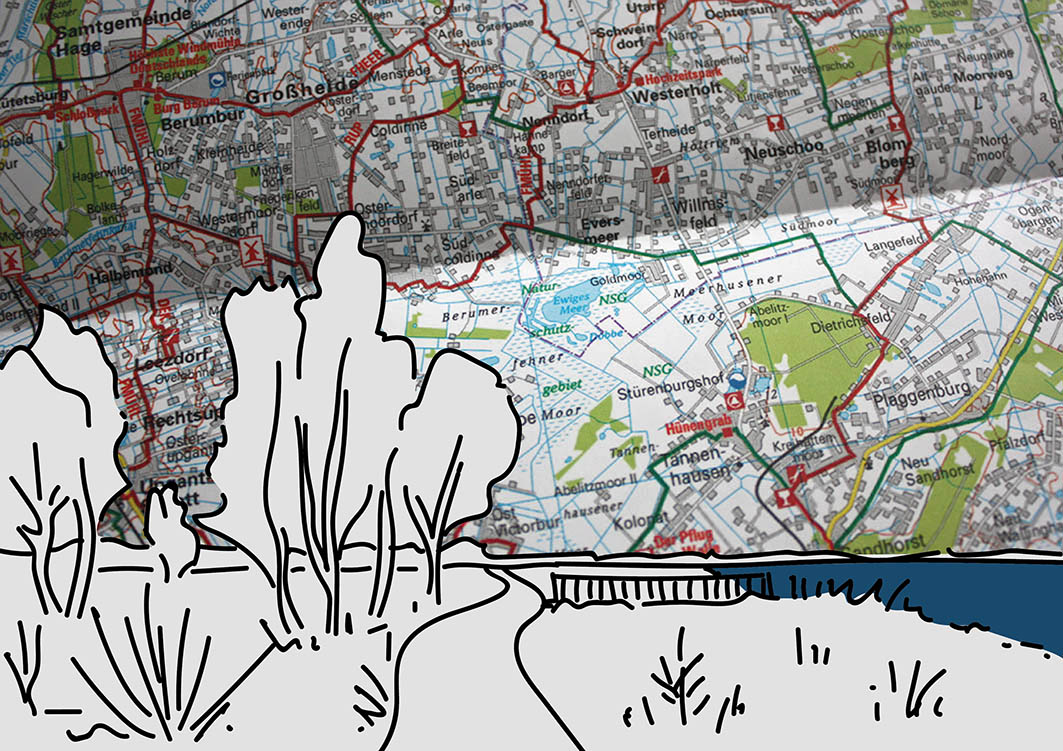
It was the name on the map that intrigued us. Scanning through the places and landmarks of Ostfriesland the name jumped up off the page. Ewiges Meer – the Eternal Sea. We knew nothing else but the name was enough. We took a detour and followed a wooden path above the marshy moor for two kilometres, all the while watching the sky warily for the onset of a promised thunder storm.

We found the lake and immediately noticed there was none of the usual reeds and other plantlife growing in the shallower waters along the shore, and from the information boards by the path we learned that this was a result of the nutrient poverty of the moorland waters. The Eternal Sea is a Hochmoorsee (high moor lake), around which peat was long extracted until it was declared a nature reserve in 1939. It may be only three metres deep but it is 1.8 kilometres long and almost a kilometre wide.

Under darkening skies the waters were choppy, and although the information boards promised a variety of birds and other wildlife there was none to be seen. No people either, and standing out there with no chance of shelter from the cloudburst, feeling rather disconnected from civilisation, our surroundings felt strangely timeless... you might even say: Eternal.

Elsewhere No.04, featuring illustrations and artwork from Julia Stone, is out now. You can order your copy directly with us via the online shop.

Elsewhere No.04 - Launch Event in Berlin

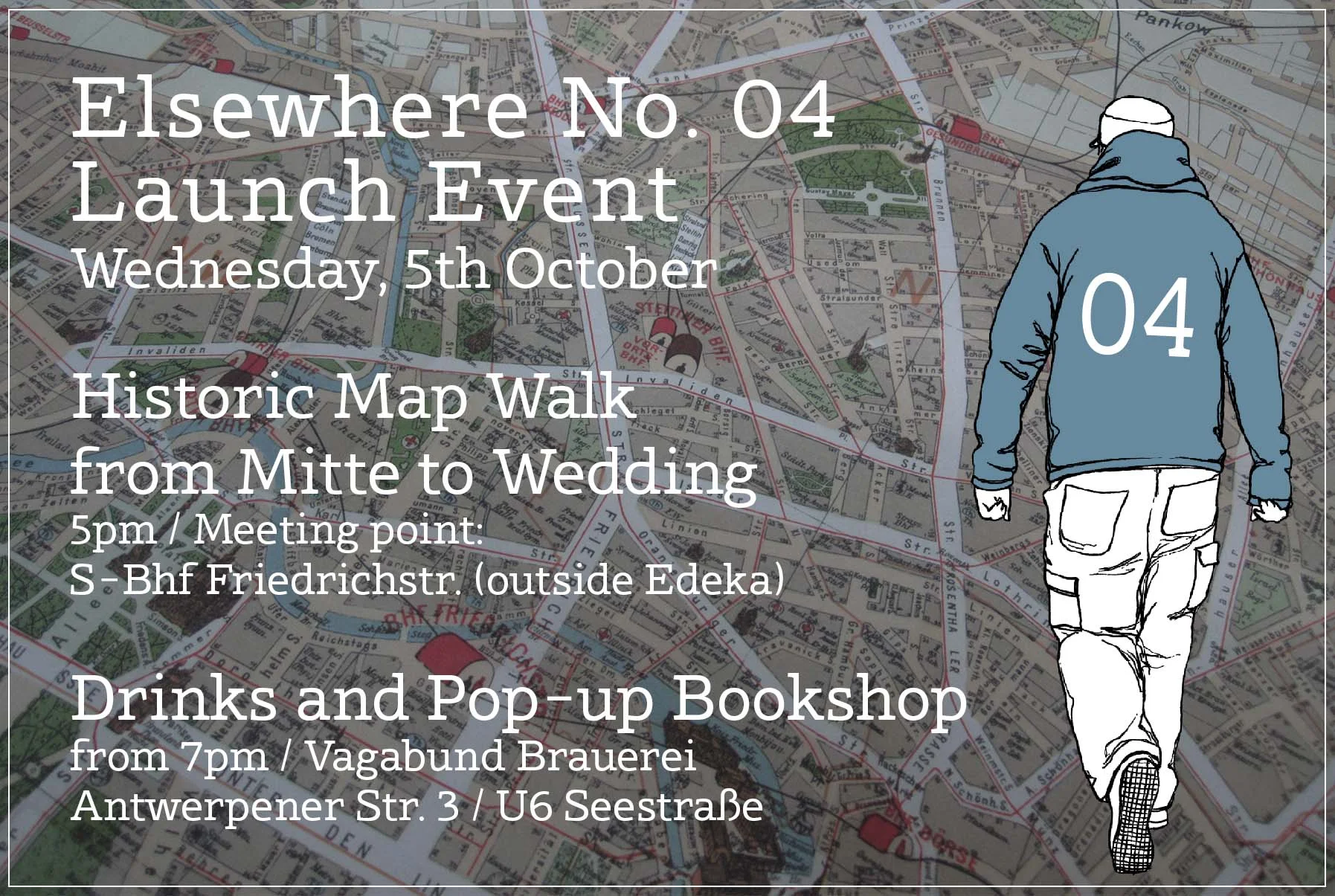
We are really excited to publish Elsewhere No.04 next week and to celebrate, we have organised an event in our hometown of Berlin for Wednesday 5 October. We decided to do something a little different for Elsewhere No.04, in keeping with the loose theme of cartography and maps that can be found within the pages of the journal. One of the map-related projects we highlight in Elsewhere No.04 is the series of tours known as London Trails. These are guided walks using old maps, and inspired by the idea we decided to do a historic map walk of our own.

The walk takes place at 5pm on 5 October, is free to join and open to anyone. We will be meeting inside Berlin Friedrichstraße station outside the Edeka supermarket, and from there we will make our way through the streets of north Mitte and into Wedding using a streetplan from 1902. Along the way we will pass traces of Berlin's cultural, industrial and political history, talk about the dramatic growth of the city in the second half of the 19th century, and specifically about the political, social and economic stories of Wedding. We will end the tour at one of our favourite breweries in Berlin, Vagabund, where we will have copies of the journal on sale. So even if you won't make the walk, come down to Vagabund where there will be a gathering of Elsewhere editors, contributors and readers... it would be great to see you.

Help us spread the word by sharing this post or heading over to the event page on Facebook and sharing that as well.

And if you can't be with us in Berlin, you can still be among the first to get your hands on the journal by ordering your copy directly from us now and we will send it out on the 28 September.


Printed Matters: On the Grass When I Arrive

Read by Paul Scraton:

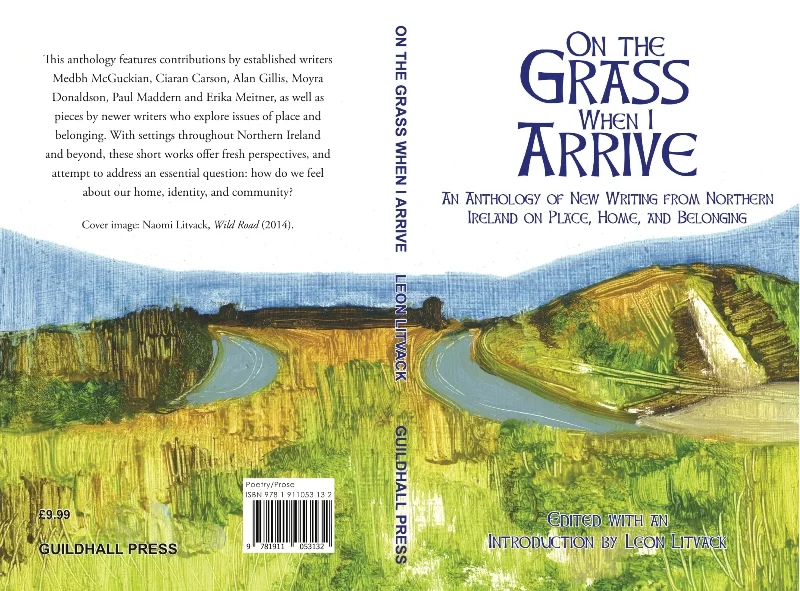
We were extremely pleased to recently receive a copy of the fascinating collection of new writing from Northern Ireland On the Grass When I Arrive. Edited by Leon Litvack, this new book published by Guildhall Press is an anthology of poetry and prose that deals with ideas of place, home and belonging. The introduction by Litvack is a fascinating essay on place and literature that would be worth the cover price alone, and what follows is a diverse but always interesting collection by writers both new and established.

Having discussed in his introduction a number of ideas and theoretical approaches to the literature of place, Litvack turns his attention to how they link with the works collected in the anthology and specifically the place and places about which those works are written:

“Many pieces are set in Belfast: a place which has been… difficult to characterize effectively, because it is a complex, multi-layered, multi-classed space with a burgeoning and diverse population… The range of places treated in this collection extends far beyond Northern Ireland to include the United States, the Caribbean, South Africa, the European continent, and even (albeit tangentially) outer space. We may search in vain for an all-encompassing definition of place which will suit everyone’s needs; but the fact that the writing has moved from the local towards the global is in itself significant.”

I have family living in Northern Ireland and have spent a lot of time in Belfast over the past decade. What strikes me often both before and after each trip is the extremely one-dimensional view of the place many outsiders still have. Despite the many changes in Northern Ireland over the past couple of decades, many still see the place through the prism of what went before. The power of this collection is that in a variety of voices and a variety of styles, the multi-faceted nature of the place and each individuals understanding of their own place in it shines through in the writing. On the Grass When I Arrive is not only a valuable addition to the literature of Northern Ireland but to the literature of place in general.

PRIDE
Laura Cameron

I stand firm on Royal Avenue
to witness the parade.
Meanwhile, at the City Hall gates,
two women
in Union Jack wellies
kick against the erosion
of their cultural identity.

Infectious music,
thousands of spectators
smiling,
swaying to the beat;
two grannies in the front row
jiggle toddlers in buggies.
I let rainbow waves
wash over me.

I can't believe we've got here!
Belfast, twenty-thirteen.
My mind wanders...
In years to come
when school peers ask,
'Are your parents a mixed marriage?'
will a child respond,
'Yeah. My Da's a man
and my Ma's a woman'?

On the Grass When I Arrive, edited with an introduction by Leon Litvack, is published by Guildhall Press and is available now.

Elsewhere No.04 will be published on the 28 September 2016 – Click here for more information and to order your copy.

Citrus Country: Mildura, Australia

By Nick Gadd:

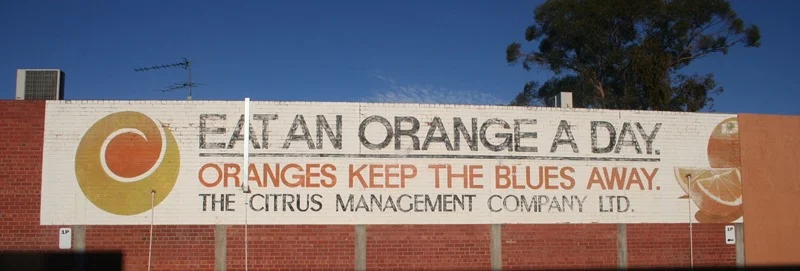
Eat an orange a day. Oranges keep the blues away, reads the large painted sign on the north wall of the former Sunraysia Citrus Management Company. On the right, the signwriter added a bunch of segmented oranges, like a Dutch still life. On the south side is a matching sign for lemons, reading Lemons add to life. Be in it! There’s no doubt about it: you are in citrus country.

Mildura is a regional city on the Murray River, which marks the border between Victoria and New South Wales, and without the river the city would not be here at all. In the late 1880s, two Canadian brothers, the Chaffeys, irrigation experts, moved to Victoria from California, where they had established successful fruit-growing colonies. They persuaded the Victorian government - after much political shenanigans - to allocate them 250,000 acres for a similar colony on the Murray.

The creation of Mildura was a remarkable feat of public relations. How else to explain the fact that droves of people from Britain, Europe and elsewhere threw up everything to travel to this non-existent settlement in a remote part of Australia? They were responding to an international advertising campaign that made shameless promises about the profitability and fertility of the land. Victoria had experienced a gold rush a few decades before: this was a fruit rush. 

Many would be disappointed. The Chaffeys were not as well capitalised as they claimed; their irrigation works were incapable of delivering as much water as was needed. Settlers had to clear their blocks of huge, stubborn mallee roots. There was no railway, making it impossible to transport the fruit to markets. And then, of course, there was the river, which proved an unreliable partner. In some years the Murray shrugged its mighty shoulders, swelled and flooded over the orchards and vineyards. In other years it turned its back, shrank to almost nothing, became a dusty gutter. 

The Chaffeys went bankrupt, resulting in a sensational public inquiry at which settlers accused the brothers of conning them. In spite of all that, the settlement survived. And through the extraordinary efforts of the remaining pioneers and their descendants, along with government support, a successful city based on irrigation did indeed develop.

I’m here in citrus season, and everywhere I go people press fruit on me: oranges, lemons, mandarins from their own trees. It’s not all citrus: today, farms producing grapes and almonds swallow vast amounts from the river.  Now the debate is: How much irrigation is too much?  “We’re OK for now, but when another drought comes, we’re stuffed,” a local greenie told me. Here, as in many parts of the world, how well the water is managed is the critical question for the future. 

Nick Gadd was writer in residence at the Mildura Writers Festival in July 2016. You can read more from Nick on his website Melbourne Circle: Stories from the Suburbs and follow him on Twitter. Nick was a contributor to Elsewhere No.02 where he wrote an essay on the ghost signs of Melbourne.

Elsewhere No.04 is published on 28 September 2016 – Order your copy here.    

From the Essex and Kent shorelines: Estuary 2016

PHOTO: SIMON FOWLER / ESTUARY 2016

PHOTO: SIMON FOWLER / ESTUARY 2016

Here is something that is right up our street – or perhaps better, right along our coastline. Estuary 2016, which begins this coming weekend on the 17 September is a new biennial arts festival curated in response to the Thames Estuary. In Elsewhere No.03 we featured illustrations of the Maunsell Sea Forts by Dylan White, so this is certainly a place and a landscape that is interesting to us, and the festival that is hosted by venues along the Essex and Kent shorelines looks to be a brilliant mix of visual art, literature, film and music.

The programme of the festival is designed as a response to the stunning geography of the region and of the Essex and Kent communities that border the Thames Estuary itself. It will tell the stories of those who have travelled the water and the land, of the people who migrated and emigrated from the Tilbury Cruise terminal and the music borne out of South Essex. Estuary 2016 will explore the cultural significance of the Thames Estuary as a gateway to the world… it all sounds fascinating and our only regret is that we can’t be there!

Here is some more from the organisers about Estuary 2016, and some of the highlights to look out for:

The Thames Estuary is an ‘edgeland’. It is a place of transition – one of arrivals and departures – a gateway that connects the UK to the rest of the world. It has been the front line for the defence of the realm as well as the first port of welcome for migrants and visitors from around the world. Industrial heartland and logistics sit alongside wild habitats, ancient monuments and concrete commuter towns.

Echoes from the birthplace of early punk, noisy seaside fun, brent geese, fog horns and cargo ships create an unmistakable soundscape. It has long provided an endless source of fascination, inspiration and mystery for both artists and audiences.

Some highlights of Estuary 2016:

Points of Departure: 
17 - 30 September
28 contemporary artists present new and existing works in the astonishing Grade II* listed Tilbury Cruise Terminal and venues in Gravesend

Shorelines Literature Festival: 
17 & 18 September
Writers, artists film-makers and performers explore the Estuary and related themes, alongside tours of Tilbury Port, Family Activities and Riverside Walks.

Sound of Thames Delta: 
1 & 2 October
Musicians, writers, artists, film-makers and broadcasters examine the relationship between place and music, at the end of the world's longest pier in Southend-on-Sea.

Infinity (1980-2015): 
17 September - 2 October
Iain McKell's extraordinary photographs of the music and street culture of Southend in the 1970's and 80's punctuates the mile long walk into the heart of the Estuary on Southend Pier

Wish You Were Here: 
17 September - 2 October
Ten artist-designed Beach Huts on Southend Pier take you on an artist-led, nostalgic journey through the heyday of the classic British Seaside experience to the present day.

This is of course just a selection of all the amazing events, exhibitions, performances and more that are taking place at Estuary 2016 from the 17 September to the 2 October. Head over to the Estuary festival website to get the full information and we wish the organisers all success for this inaugural event.