[25] Pockets of [Swansea], [Cardiff] and [London]

[25] Pockets of [Swansea]

[25] Pockets of [Swansea]

We were sent an email recently about a fascinating project called [25] Pockets of [...]. The idea is to create framed object assemblages through gifts, referrals and random encounters within cities. 

Participants give away to the assemblage an object possession and then write on a picture frame, directions for the next location and person, or 'pocket' to be visited in a particular city. The trail of referrals from person to person continues in any particular city until 25 objects from 25 referrals have been collected. The objects are then incorporated into a final collage.

[25] Pockets of [Cardiff]

[25] Pockets of [Cardiff]

Positioning of the assembled objects on the montage correlates to the locations at which these were obtained so that there is a relationship between the object's placements to these locations.
 
Instead of mapping out and arriving at a fixed definition of the identity and substance of a place, it is hoped that [25] Pockets of […] allows viewers to glimpse a city as a dynamic variation of living relations and discover a sense of a place via one of many possible open-ended, overlapping series of interconnections and encounters.

[25] Pockets of [London]

[25] Pockets of [London]

[25] Pockets of [...] is the brainchild of Victor Buehring, who drifts around cities, makes assemblages and enjoys writing. You can see accounts of his wanderings on his Artrospektive website, or take a look at the following video that explains a bit more about the project:

Uploaded by [25] Pockets of [...] on 2015-02-28.

Event: Disappear Here Launch in Coventry, 16 March

We have recently discovered a fascinating project in which a collaboration of 18 artists have produced 27 films about the Coventry ring road as an inner city superstructure that crosses the boundary between Modernist and Brutalist architecture. Sounds interesting? Well, on the 16 March the work of the last few months will be launched at The Box - Fargo in Coventry where there will be a screening as well as a Q & A session with the artists and the organisers of the project.

Here are a few words from Adam Steiner, the Project Lead of Disappear Here:

“It’s been a great experience to work alongside emerging and established artists from Coventry and beyond to reimagine the ringroad through a series of poetry films. Coventry ringroad is one of the city’s most iconic (and notorious) physical landmarks , acting as both city wall, orbital conduit and dividing line. 

I feel the ringroad deserves to be celebrated as well as criticized – it is the duty of artists and citizens to engage with issues of public space, control of architecture and the human experience of our built environment – to shine a light on the fantastic, the boring and the universal in the everyday. Coventry has always been underrated as a place to live, work and create – so I hope the films will encourage people to visit and seek inspiration where they can to read, write and attend more poetry events!”

You can watch the trailer here and all important links are below:

TRAILER - DH will launch in Coventry - 16/3/2017 - 7pm - @The Box, Fargo - CV1 5ED 18 Artists - 27 poetry films exploring the Modernist/Brutalist superstructure of Coventry ringroad. FLUX/BARRICADE/SPEED/FUTURE/SCULPTURE/ENERGY/HISTORY/STONE/TRASH/SPECTATORS/BRICK/LOSING/FINDING/LOVING /HATING/MONSTROSITY/DIVIDING/CHANGING /HOMELESSNESS/UNITING/DESTRUCTION /CREATION/EMBRACING/ALIEN/ ENDLESS www.disappear-here.org https://www.facebook.com/events/401720276828167/ https://www.eventbrite.co.uk/e/disappear-here-launch-tickets-31223025911

New Music: Nadine Khouri

By Paul Scraton:

One of the joys of being involved with a project such as Elsewhere has been to discover many different artists, writers, musicians and other creative folk who we have connected to through via the journal, our events or our online activities. In the case of Nadine Khouri it was something of a re-connection, as I met Nadine in 2008 in Beirut where she was recording an interview for a radio show. I was staying with the presenter of that show, and after the recording we went for something to eat together.

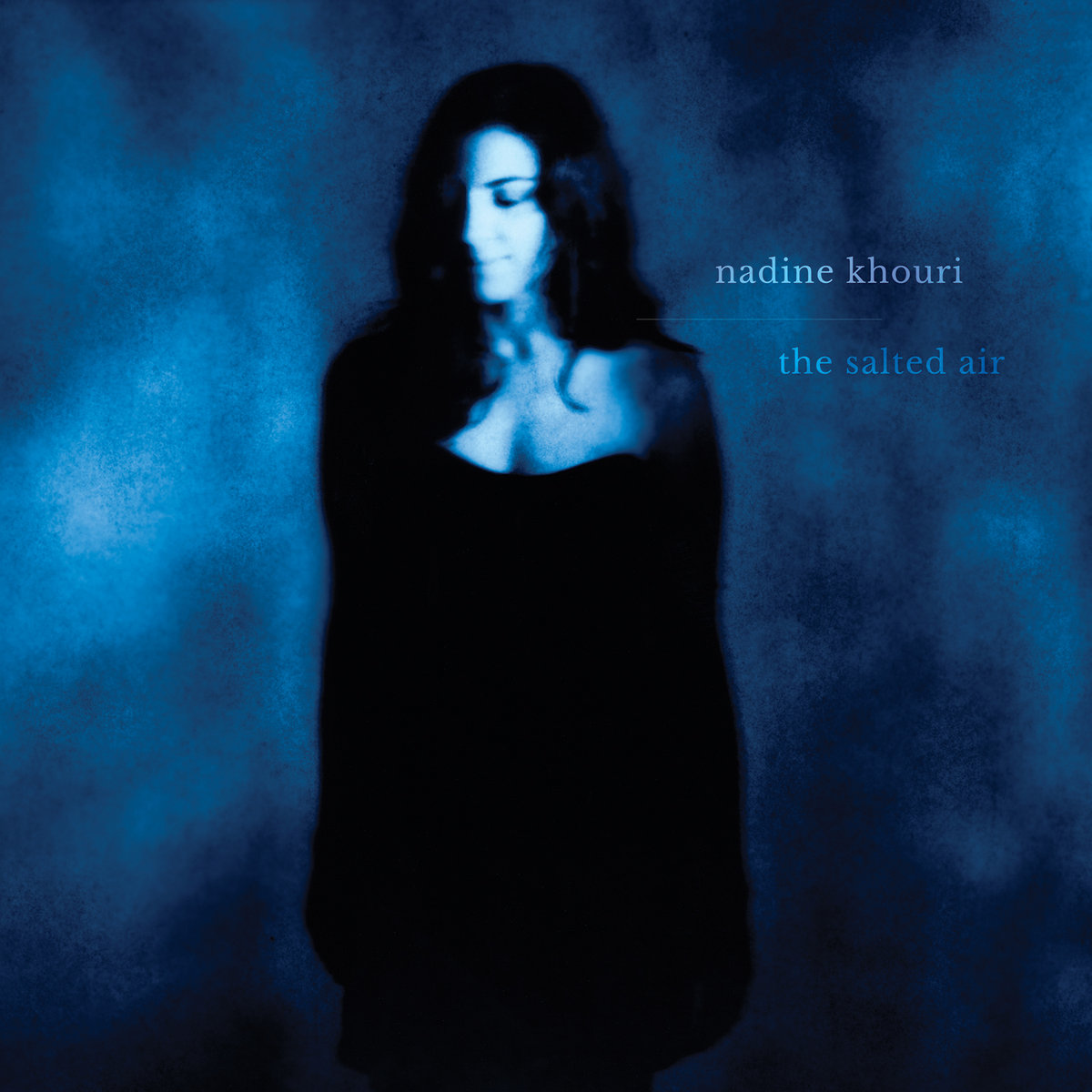
Nadine was born in Beirut, although was forced to leave at the age of seven during the conflict in Lebanon. She is now based in London, and at some point over the past couple of years since Elsewhere was launched we got back in touch. I was especially excited to hear, and then receive, Nadine’s new album The Salted Air, which was released in January. It has been playing on heavy rotation ever since, a haunting and atmospheric collection of songs that contain a sense of loss, displacement and yearning for someplace or something else that certainly resonated with me as I was thinking about the theme of transition that is at the heart of the upcoming issue of the journal. 

Drowned in Sound describes The Salted Air as “a pocket-sized book of lullabies, and gothic shanties, whose sounds and lyrics evoke a series of wondrous daydreams and sorrowful, mood-filled, late-night tales,” which should be more than enough to get you to go and check the album out. Below are the answers to the Elsewhere five questions, that I fired over to Nadine by email in the last couple of days, and a live performance of 'Broken Star' from the album. For more on Nadine, her music and upcoming live shows, take a look at her website.

Five Questions for... Nadine Khouri

What does home mean to you?

For a person who was displaced from a young age and had to navigate between various cultures, you can end up feeling a bit fragmented, or at least unable to point to a single place.  "Home" is probably more of a state of mind for me, of total presence.  

Where is your favourite place?

Oh, it’s hard to say!  I love my room at my parents' place in Beirut as it’s inspired many a song…  And anywhere on the Mediterranean.

What is beyond your front door?

Some withered trees and a Turkish corner shop.

What place would you most like to visit?

I just got back from playing some dates in Portugal and I’ve always felt I'd like to spend some more time in Lisbon.  Honestly though… the list is long! 

What are you reading right now? 

Carlos Drummond de Andrade 'Multitudinous Heart' (Selected Poems) 
 

'Broken Star (live)' at Urchin Studios features: Basia Bartz (violin) Huw Bennett (double-bass) and Jake Long (drums) DoP: Maeve O'Connell | Assistant Camera: Ignacio Crespo | editing: Jasper Verhooert | grading: Joseph Bicknell | sound recording/mix: Matt Ingram LIVE AT ST.

Beyond the Camera: Copenhagen

IMAGE: Laura Harker

IMAGE: Laura Harker

By Laura Harker:

The late-November winds blew down Nyhavn, biting my cheeks as I walked between colourful canal-side buildings and small wooden huts selling hot glog wine and sugared treats. Tourists and locals were meandering along the road, enjoying the Christmas markets that just opened a couple of days previously. Following the pavement around to the left, I came to a stop by the Royal Danish Theatre, its high glass walls loomed over the mouth of the canal, and the wooden decking was slippery underfoot. I peered inside and saw huge floor-to-ceiling photographs of stage actors in the theatre’s entryway and spacious café, none of whom I recognised from TV or cinema. This huge theatre also wasn’t something I recognised from the silver screen, and I’d never seen the view in front of me until now. Water in the canal sparkled under the low sun that cast a soft toffee light onto the ripples, a sight that the camera could never truly capture.

I’d only been in Copenhagen for half a day, and already my preconceptions were slipping. Even before I stepped off the plane at Copenhagen Airport, I had an impression of the city firmly in my mind. After being drip-fed information about Scandi-noir crime dramas from newspaper TV columns and mentions of Danish films by heavyweight directors like Susanne Brier and Nicolas Winding Refn in film podcasts, I’d immersed myself in Danish cinema and now wanted to see the city for myself, away from the rose-tinted glare of the camera. Even though I’d never been, I was convinced that the hours spent watching detective Sarah Lund chase suspects around the city in The Killing would be enough to get my bearings.  I’d even watch the city age and develop, going from political liberation in A Royal Affair to the gun-shot scared buildings during the Nazi occupation portrayed in Flame and Citron. Reams of show reel loosely sewed the city’s history, culture and geography together.

It’s impossible not to be influenced by what you see on film; a 90-minute snapshot greatly shapes your preconceptions of a city. James Bond’s London is all cocktail bars and Windsor knots; Amelie’s Paris centres around a bohemian Montmartre made up of quirky bistros; Hollywood shows us the American Midwest as a blur of white picket fences in God-fearing towns. I’d decided that Copenhagen would be chunky knit jumpers, muted Scandinavian tones, and omnipresent hygge.

Right at the end of the film Open Hearts one of the main characters gets in her little red car and drives around the city, the shaky handheld camera and low evening light giving this impromptu tour of Copenhagen a somnambulant atmosphere. As we’re taken around the city, it has a dream-like feel as lights in shop windows twinkle, cyclists and pedestrians are unwittingly caught on film, and the camera flicks across facades of hazy, non-descript buildings. In the run up to my trip, I used this scene as a starting point, recollecting shots from this final scene and weaving them together from scenes I’d watched elsewhere. I imagined walking through the city, through each scene, making note of each notable landmark: the town hall in The Killing; Tivoli Gardens in After the Wedding. Taking my mind along the pastel buildings along Nyhavn Harbour, knowing that the Charlottenborg Palace would soon pop up, and I could turn around and face the white-washed façade of the Noma restaurant across the river. My mind panned like a camera, framing the city in vibrant technicolour.

I told myself I knew the city: I could walk through movies and TV shows, I knew the tone of the city, I just had to follow the leads of directors, actors and film crews. I decided to leave the guidebooks and recommendations from friends at home. But I soon realised that wandering around the city isn’t as simple as flipping a page or cutting between scenes to get to the next attraction. It takes time working your way through a city and getting to all the sites. These slow walks or bustling train journeys always end up on the cutting room floor in the movies.

At the end of my first full day in Copenhagen, I climbed to the top of the Round Tower, looked across the burnt-orange skyline and realised I actually didn’t know this city at well as I’d told myself. This wasn’t going to be the Copenhagen showcased through film and chasing scenes in my head would be pointless; there’s no wide, sweeping shots of the city and there’s no camera that pans out, neatly framing each landmark for you. The nearest you get is staring out the window of the metro of the S-train as they pass underground, behind buildings or through industrial estates. You don’t have anyone telling you where you should look once you’re away from the TV screen. It takes longer to find the attractions if you’re your own editor and narrator, making your way on foot through streets.

I decided to write my own script for Copenhagen after that first day, and took to the streets on foot to explore and experience it for the city it really is, away from the stories told by a fil industry. Walking the streets, my view of the city wasn’t cut short by edited shots or hasty direction. I saw landmarks and buildings I’d seen on screen, but I also found a completely new side to Copenhagen, one that hasn’t had the gazing eye of an audience on it. And it is in these unpublicised, unglamorous areas and neighbourhoods in which the true soul of the city hides, far away from the intrusive gaze of the camera and the editing skills of a post-production team.

Laura Harker is a freelance writer based in North Yorkshire. She blogs at northquarters.com

Poetry of place: Chalybeate, by Evie Connolly

IMAGE: Evie Connolly

IMAGE: Evie Connolly

Chalybeate
(from a visit to Gorthaclode)

Do truths find their way home? Are there
imprints left behind from centuries before, when
smoke and steel drove paths beneath
amaranthine skies, through rolling forests
ablaze with oranges and golds? The spa well
spills its secrets into the pools of colour
collecting in the millrace and along the weir and
in the trout streams. 

In the shadow of a blasting furnace, iron water
was collected by the bucketload and pilgrims
soaked in the chalybeate spring. The
Gorthaclode Spa was hailed as miraculous
before events and circumstance dissolved a
ritual into history and stories were hidden in the
rivers and streams.  

Does a landscape summon its stories home?
Does an element return to its source over and
over?

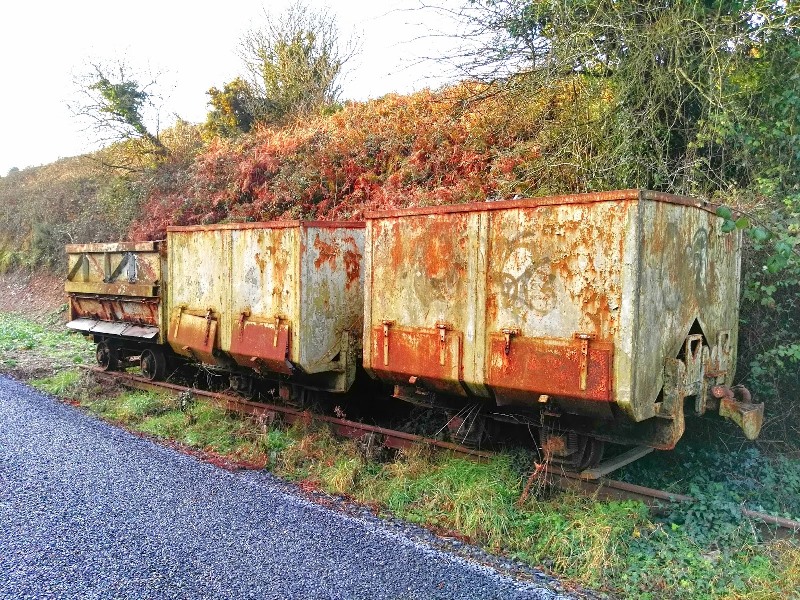
Sitting along a pathway at Gorthaclode are
wagons loaded with steel as they wait patiently
for an old railroad to return to life. Sharing a
history with the crystalline rock birthed in the
soil and pulled home by the lodestone buried
in the hills, is this celestial metal merely finding its
way home and are we merely the transporters?

Evie Connolly lives in County Waterford, Ireland. Her poetry and short stories have been published in various literary journals and anthologies.
 

Mystical Mount Koya

IMAGE: Pete Martin

IMAGE: Pete Martin

By Pete Martin

Koya-san, which is 857 metres above sea level, is the base for the Shingon Buddhists, an esoteric sect of Buddhists. There are over one hundred and twenty temples on the mountain and there’s been a religious community here since 816. A monk named Kukai, who had studied Buddhism in China, founded the Shingon sect on his return to Japan. Legend has it that he threw his vajra (ritual sceptre) from China and it landed here in the mountains in Wakayama. The Imperial Court subsequently granted that Kukai was to build a place of meditation on the mountain. After his death, Kukai became known as Kobo Daishi. The monks to this day still believe Kobo Daishi to be alive, meditating in his tomb for the arrival of Miroku (the Buddha of the future) and they prepare three meals a day for him in Okunoin cemetery.  

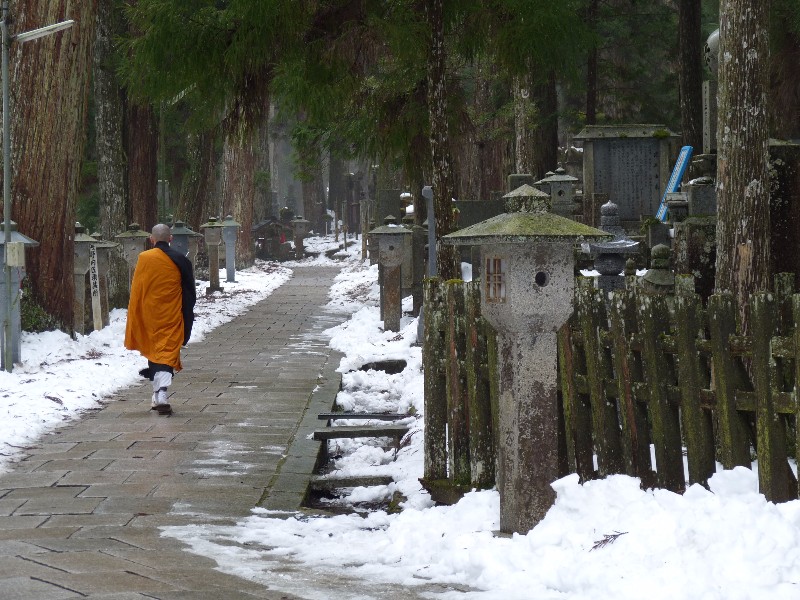
I get off the bus at Okuninguchi for the Okunoin Cemetery. The cemetery is a sacred area and the pathway runs for two kilometres from here to Kobo Daishi's mausoleum. The path is lined with old, tall cedar trees and the cemetery contains over two hundred thousand gravestones and memorial pagodas. The trees are huge and close together blocking the sunlight. The graves are also packed together tightly, the dark grey stone, wood and black-grey marble give an eerie atmosphere. The ground is covered with snow and the base of the trees and the headstones are covered in moss. It’s not a place for anyone who is claustrophobic. The air is fresh, but the whole place is damp and slightly misty, adding to the enchantment. 

There are various signs in English and Japanese describing the legends that abound in the cemetery. This just adds to the ambiance. At the Sugatami-no-Ido (reflection well), legend has it that if a person looks into the well and does not see his reflection then he will die within three years. At the Ksitigsrbha Shrine, the bodhisattva Jizo is the Asekaki Jizo (sweating Jizo). The Buddha is made of black stone and is often moist due to the weather conditions. It is said that the statue is sweating because it bears the sufferings of others for their wrongdoings. At the Zenni Jochi memorial, a visitor can place his ear on the stone and hear the cries in hell. Near the end of the pathway, at the Mizumuke Jizo, the faithful pour water on the statues of the Buddhist deities for the peacefulness of their loved ones. Close to this is the Miroku-ishi, which is a stone that it is said to feel light to virtuous people and heavy to sinful people. I can't tell whether this is true or not, as it’s too heavy for me to lift. 

Along the path there are many gorinto (five-tiered stupas). The five tiers represent the five elements, from bottom to top, of earth, water, fire, wind and space, and these elements form the Buddha Mahavairocana, the fundamental deity of Shingo Buddhism, or the life force that is the origin of everything and that illuminates all. The goal of Shingon is the realization that each one of us is identical to Mahavairocana in nature, a goal achieved through initiation, meditation and esoteric ritual practices. 

Many of the statues have bibs, which provide the only colour in the cemetery. The bibs are placed on the statues by those who have lost children, in prayer to Ojizo-Sama, who is the guardian of children. It is said that the souls of children who die before their parents are unable to cross the mythical Sanzu River, as the children have not been able to undertake enough good deeds. Ojizo-Sama saves these souls from the eternal penance of piling stones on the river bank by hiding the children’s souls in his robes and this is symbolized by the bibs on the statues. 

At the end of the long pathway through the cemetery, there are three wooden temples in front of the stone bridge that leads to Kobo Daishi’s mausoleum. A group of four monks, again in orange robes and geta, walk noisily from temple to temple, stopping to pray and chant at each one. The stone bridge depicts the entrance to the precinct of the mausoleum of Kobo Daishi. The bridge was originally wooden but it’s now rebuilt in stone. It has thirty six stone planks that, with the bridge itself, mark the thirty seven Buddhist deities of the diamond world mandala, which is the representation of the unchanging cosmic principle of the Buddha. 

To the right of the mausoleum, up the steps from the bridge, is the Torodo, the lantern hall. This is a plain wooden building, a modern reconstruction of the prayer chapel of 1023, erected by the disciple Shinzen. In 1016, a poor woman sold her hair to buy a lantern to pray for the rest of her deceased parents. The Emperors, Shirakawa and Showa, donated lanterns also, in 1033 and 1948 respectively. These three lanterns are kept burning continuously in the hall. 

Inside the mausoleum itself, monks sit at stalls at the front copying sutras carefully. The wooden building is dark and atmospheric. Lanterns and pendants hang from the low ceiling. Two monks flank another who sits in the middle of the temple chanting. Incense burns and the only colour is from the orange robes of the monks. I feel I’m encroaching on a sacred service, but another monk waves me forward for a closer view. It feels very spiritual with the chanting and the incense. It even smells other-worldly. I’m apprehensive about intruding further. On my way out, to my embarrassment, I noisily slip on the wet entrance floor. Nobody notices. Outside I catch my breath. The tomb is usually closed. I was only inside for a matter of perhaps five minutes but it felt like time stood still inside. The gobyo (tomb) has an aura that I have felt only in a few other places.

Pete Martin’s book Revolutions: Wandering and wondering on a sabbatical year is a compelling tale of travel and change and is out now. More information can be found at www.wander2wonder.com.

Breath

IMAGE: Louise Kenward

IMAGE: Louise Kenward

By Louise Kenward:

I sick up the last of my breakfast. Spittle drips on my arm and over the side of the boat. Diesel fumes mingle with sea and sweat. Anxiety has purged my stomach and pumps adrenaline in an attempt to stop me. I am compelled.

It is the second time I have reached this point, I cannot stay on the boat again, I cannot return to the shore without seeing for myself what lies beneath the surface.

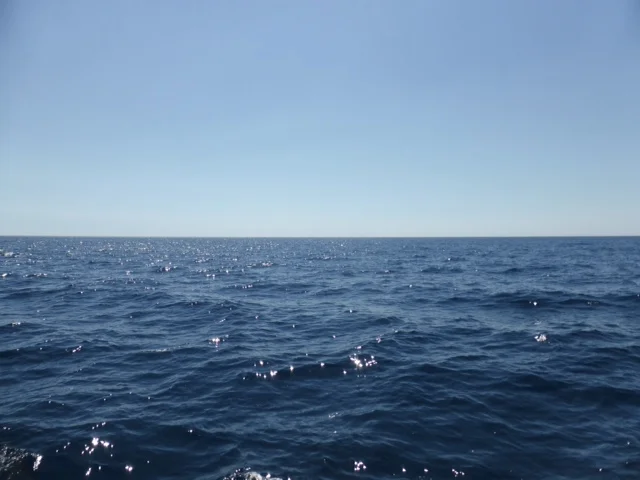
Watched over by Mount Agung, I tip backwards over board and into the Indian Ocean. Weight and discomfort of my dive kit on land disappears with the horizon.

I suck at air, teeth gripping the mouth piece. It sits awkwardly, jaw aches, I'm holding too tightly. I adjust weight belt, tighten straps loosened by the water. The pressure gauge registers a full tank, clean tasteless air. I have already checked these things twice.

I am last to dip beneath the waves. Air released from buoyancy jacket, I am weighted down with equipment and 6 kilos around my waist. Despite this, I struggle to sink. Instinctively I take a deep breath before putting my head back under water. I bob up to the surface again. Looking down I watch others as they drop through the door to an other world. I continue to pull, to knock, it is jammed. Resistance of water against my body is too great. The blue beneath me tantalises and terrifies.

I'm being pulled down. My right leg is being tugged below me, dragging me under. I realise the need to push at this door, not pull. I let go of the breath I've been holding and slowly, slowly sink.

My first breath beneath the waves. Colour scattered blue, movement of fish, glitter and gold. Constant motion and total stillness. Swollen bubbles escape my mouth joyously as I descend further. Three, four, five metres deep. Submerged in water, a return to the womb, to the source of life, a time before evolution brought legs and lungs. A sanctuary. Yet life is taken as easily as it is given, stolen by cruel and unsentimental seas. A careful balance of body, air, water. It is easy to perish, to dissolve into saline. I try to swallow, for airways to adjust and regulate pressure in air cavities. I shift my jaw, willing ears to pop. Swallowing with the mouth piece is difficult. I bite down hard, swallow, ears release. I drop further.

Ten metres. I realise my buoyancy and its control is the biofeedback of my breath - my body acts as a balloon. I inhale, lungs swell, I rise up. I exhale, lungs deflate, I fall deeper. Having risen and fallen with initial breaths, I am now learning to pace inhalations, exhalations, slow, deep, breath. Steady, calm breath. An exercise in stillness, a meditation. The whole of my body is needed to focus on this one thing. Body connects breath, breath connects body.

Fifteen metres deep and I have never been so aware of my own breath. Never before have I had to attend so carefully or so completely to inhaling and exhaling. Rib cage expanding and contracting. It is more than concentration - to think about what I am doing I may lose control - I am a whole, mind and body acting as one.

Elusive, delicate, fragile breath. Mouth open, organ of life, pulls in air. Lungs, heart, connected, pumping blood, sustaining body. Twenty metres. Slow, full breaths. Senses alert. Mind quiet. Air swells from regulators as I exhale. Steady, measured, breath. All I can hear is the escape of bubbles to the surface and the crunching of parrot fish on coral beneath me.

I sink further. I look more closely, orange and white clown fish dodge the caress of pink tipped anemones. Wide flat laced table corals shelter blue and purple nudibranchs - tiny molluscs the size of a finger nail wearing their lungs on the outside of their highly decorated bodies. Delicate red sea fans sway gently as yellow tipped black and white striped angel fish glide past. There is an abundance of life quite oblivious to my presence. I watch, I drift, all feels at peace, all feels just as it should be.

Slipping through depths the gentle grip the ocean has taken does not let go. I do not ask it to. The further I descend, the tighter grasp the sea takes of me. Temperature drops, light weakens, I surrender to it. All consumed, it holds me. Immersion of body and mind. My pulse gently beats in my ears.

Sense of time is lost. I check the pressure gauge, I am running out of precious air. The spell broken, I have to surface. Again, gradually, slowly, I readjust my body to changing pressure. Rising too quickly is as risky as not rising at all. Emerging upwards warmth returns and sunlight dusts my face.

I return again and again. A calling of the sea sings more loudly than before. A sense of arrival, of coming home when I stand on the shore. A restful calm descends and envelops me, a sense of other, of completeness. Shoulders fall, breath quietens, thoughts calm. I am now embedded in molecules of ocean and they in me.

Louise Kenward is an artist engaging with place and person, past and present. Making journeys, writing, connecting. At times accompanied with 19th Century Victorian traveller, Annie Brassey.

Elsewhere editor Paul Scraton on the Papertrail podcast

By Paul Scraton:

I was extremely pleased to be asked to take part in the Papertrail podcast, a fantastic new audio series that invites writers and other artists to chat for a while about some of their favourite books. Because of my own writing, and the theme of our journal, we decided to select three books that are somehow dealing with the idea of place but which also have a special personal connection for me. If you want to find out what they are about, and why they are important to me, then you'll need to have a listen. Thanks to Alex for inviting me, and I hope if it inspires any of you to read these books I am sure you won't regret it.