April Clouds

170417_Himmel_maerkischesland_lr.jpg

Märkisches Land, 17 April 2017, East

By Rolf Schröter:

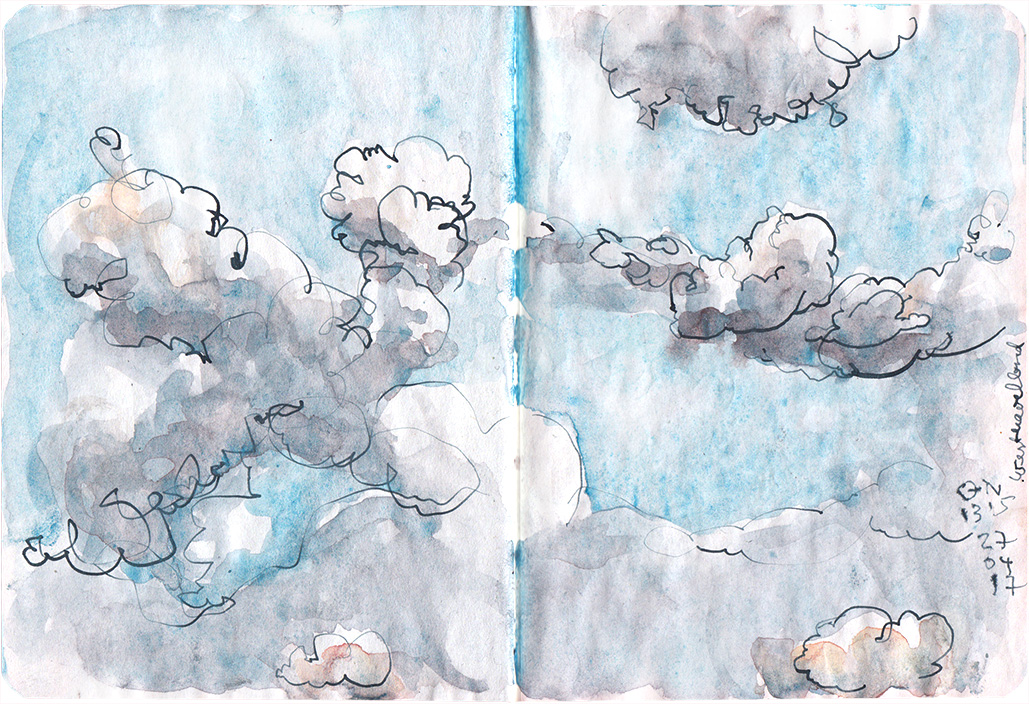
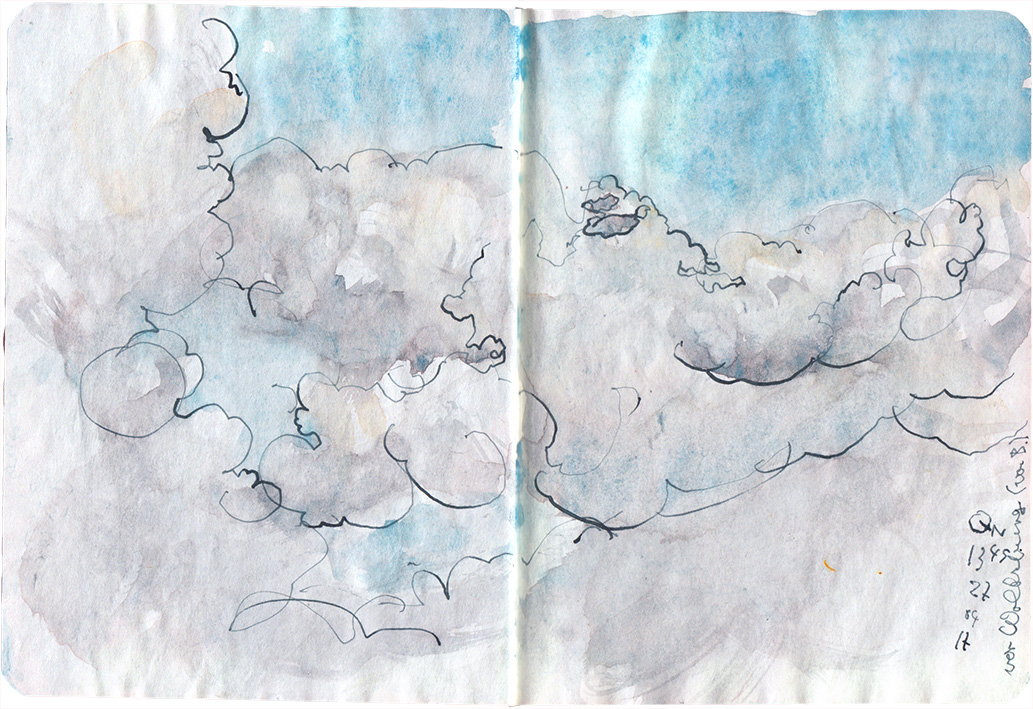
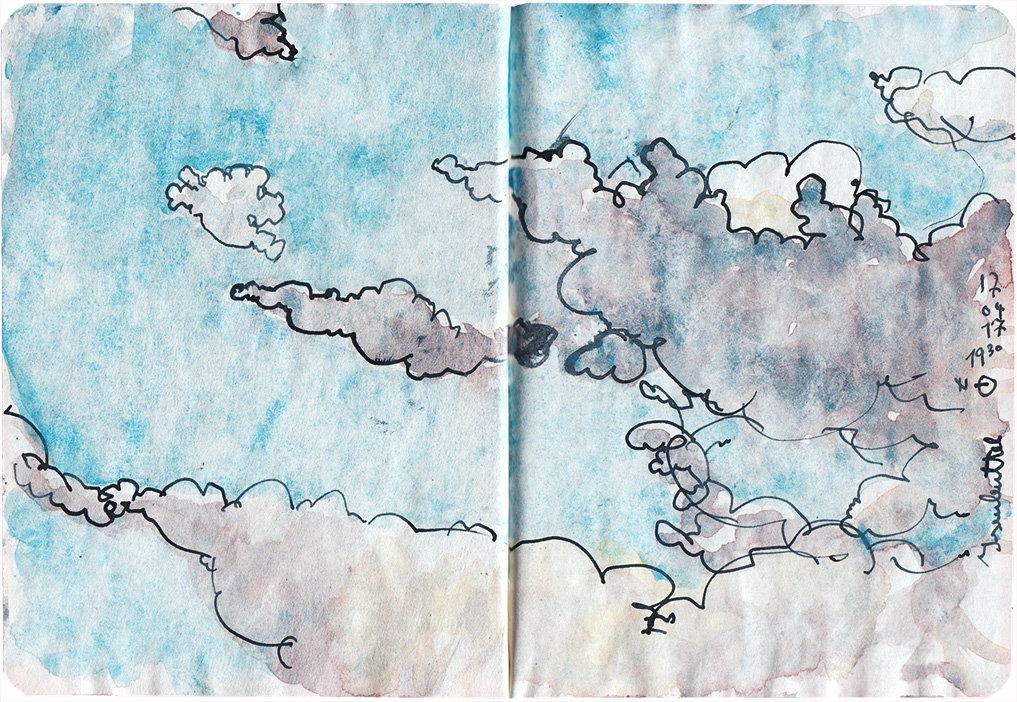
The landscape that can be viewed through the window of an intercity train flies by, and things one might wish to focus on vanish too quickly. The only real world thing outside the train that can be grasped, that stays long enough to let musing begin, is the sky. This is especially true in spring, when above the monotonous agricultural deserts of the German plain the clouds and sunlight perform their works of great theatre. I try to focus on small excerpts of that performance, to capture them in a small notebook that I carry in my pocket. It is hasty work, as the clouds and the train move, and by the time I am finished things have progressed so far that I cannot check my sketch with the original any more. It doesn't matter. Instead I note the time, the approximate place, and the direction of travel. I take home with me a report, even if it might be fiction.

Westhavelland, 28 April 2017, West


Wolfsburg, 28 April 2017, West


Isenbüttel, 17 April 2017, East


Uetze, 17 April 2017, East


Rolf Schröter is a draughtsman living in Berlin. While doing technical and design drawings for the living, he is spending a lot of free time sketching from observation in his town or on journeys. He publishes this work on his blog skizzenblog.rolfschroeter.com.

Back down Ashley Vale

IMAGE: Matt Gilbert

IMAGE: Matt Gilbert

By Matt Gilbert

Sometimes when I go back it feels like nothing’s changed. The abrupt left turn from Ashley Hill, the sudden switch from concrete underfoot to earth, the choice of downward paths between high hedges.

The place I’m thinking of is Ashley Vale, St Werburghs, in the north east of Bristol. Here, hemmed in by roads and railway tracks, is a V shaped territory within which can be found allotments, woods, scrubland, grassland, a couple of streets, a pub, a city farm, some lock-up garages and a hill – Narroways Hill.

The name Ashley Vale – I later learnt – derives from the Anglo Saxon ‘aesc’ meaning ash tree and ‘leah’ – wood. There was once an estate here called Asselega. Not far away was my infant school, Ashley Down. For now Ash remains the predominant tree on the ground and in the local place names.

Entering from Ashley Hill, there’s an iron gatepost on the right a short way down the lane, which leads towards a track that runs through a small ash wood over and alongside a railway line, before sloping down gently through allotments until reaching Mina Road, where a left turn will take you through a graffiti covered tunnel – a reminder that you’re still in Bristol.

More often, I would go the other way, take the left hand path and drop on foot swiftly down to the floor of this urban valley, past a lone house in the middle, adrift in a sea of allotment gardens. These have always been subject to change, moving through the seasons and an ever-rotating cast of crops; tended and grown and pulled out and dug up.

On one side of the lane the plots rise steeply towards Ashley Down Road: stretching away uphill, a hundred small empires of beanstalks, cabbage, carrots and potatoes, bordered by narrow, leaning sheds and water butts; punctuated with crab apple trees and Hawthorn. The ground patrolled at night by cat and fox, carefully treading around each other.

On the opposite southern side, a smaller number of allotments on flatter ground filled the space between Gaunt lane and the steeply banked woody edge of the railway line.

*

As a teenager and into my early twenties I’d walk this way on route to my favourite pub – The Farm – which sat on the edge of the Ashley Vale allotments, next door to the St Werburgh’s City Farm.

Here we’d sit and chat in what we imagined were converted pig sheds in the garden, or try our hands at bar billiards in a little room at the back. With the 1990s rapidly approaching, this strange relative of billiards seemed something of an anachronism, yet the clanking element of playing against time and a dropping bar, as you tried to avoid sinking wooden mushrooms was deliciously compelling.

The pub’s position, at the bottom of two sloping hills, bordered by green lanes and allotments on two sides, faced only by a row of tightly terraced houses on Hopetoun Road, gave it the feel of a village inn, rather than the city pub it really was. As a result I indulged in private fantasies that The Farm was somewhere in the Shire; its lush surroundings, small green hills, gardens and stands of trees forming a tiny Hobbiton in Bristol.

On the way home from visits here, on still-light summer nights, I’d often stop on Hurlingham Road, on higher ground, a little beyond the bounds of Ashley Vale and look back over the scene. As I took in the view beyond the woods and allotments, my eyes would follow the blur of yellow street lamps as they merged into the whiter light of cars on the M32, and I’d find myself wishing that like them I was heading somewhere else.  

Now, far removed from those teenage years, my relationship with this place has been transformed. I remember once reading in David Lodge’s Small World about an essay, by an academic character, on T S Eliot’s influence on Shakespeare. In the book this is presented as the pretentious waffle of a postmodernist. However, I was struck hard by the notion that later readings and experience can change your perception of a writer, a person or a place.

Certainly in the case of Ashley Vale my view of it has altered over time. For a long while I even had the name wrong and referred to the whole area as the Narroways, when in fact, this is just the hill at one end.

*

When I first encountered the lanes that criss-cross the area, I appreciated the woods and greenery only as a kind of abstract, scenic backdrop for visits to the pub. I certainly had no idea that the place was under any kind of threat.

Firstly in 1997 in the face of efforts to sell off the land around Narroways hill by Railtrack, a mass protest was organized by the Narroways Action Group and the plans were eventually dropped. Then in 2000, thanks largely to the actions of local people, The Narroways was granted Millennium Green Status.

Today there looms a different kind of danger. The ash, like all ash in our diminished country, could be killed off by one or both of the Emerald Ash Borer or Hymenoscyphus fraxineus, the fungus behind ash dieback. This thought presents a nightmare vision of a denuded hollow, its woods stripped away, leaving open ground, ripe for levelling and development.

So now, more than ever, I appreciate the life that can be found within this small area of land. I look at the website of the Narroways Millenium Green trust and delight in reading a rollcall of the plants and creatures that can be found here.

Amongst old fruit trees, grasslands, sycamore and ash can be found waxwings and slow worms, common lizards, Small Copper and Marbled White butterflies and hedgehogs, not to mention robins, blackbirds, blue and great tits.

The names checked and logged in a recent ecological management statement from the Narroways Millenium Green Trust, sounds a little like a floral class-register: Upright Brome, Black Knapweed, Agrimony, Autumn Hawkbit, Lady’s Bedstraw, Field Scabious and Yellow Oat Grass, all present and correct.  

There is something reassuring about learning that these things are here, and while I can’t pretend that I am able to identify them all, knowing the names and knowing they are there makes me care about the place more deeply than before. I definitely take care now to try not to confuse Corky Fruited Water Dropwort for Cow Parsley.

*

Since those early days my sense of the history of the place has grown. Largely through a wonderfully resonant brief history by Harry McPhillimy of the Narroways Millenium Green Trust.

I have learnt the story behind the fantastically named Boiling Wells Lane, an atmospheric pathway entered at one end through a dark railway tunnel. This name comes from a spring that ran here, whose water was gaseous in nature and as it bubbled and frothed on its course gave out the appearance that it was boiling.

Nearby on the other side of the hill lies another path with a tale to tell: Cut Throat Lane. At 18 I knew the name but not the history. The story goes that In 1913, a woman named Ada James was murdered by her fiancé Ted Palmer, who cut her throat during a row; but Ada didn’t simply collapse and die, first she staggered back as far as Mina Road, where in front of witnesses, she managed to write her killer’s name on a piece of paper. Before she died she apparently declared that  ‘My fiancé did it’. Soon, Palmer was arrested and hanged within a couple of months. Poor Ada’s ghost is now said to haunt the scene.

Even the allotments, which always seemed so ephemeral, it seems have deeper roots than I once believed. In the same short history mentioned above, I learned that during the medieval period, strip lynchetts – short individual field terraces – once lined the slopes above Boiling Wells Valley. So those ever-changing small plots of land are also echoes of and heirs to a land use that stretches back for centuries.

I no longer live in Bristol, but often find Ashley Vale and the Narroways still with me. I see hints of it in other places as I’m passing through. On trains in south east London for instance, watching crowded tree and bramble covered banks flicker past, I’m taken back. Amongst these crow haunted verges, amidst rogue forsythia, ivy carpets, old paint pots and littered cartons, there is always a glimpse to be had of this somewhere from my youth. A place I once dreamt of leaving, but now no longer have any desire to escape.

Matt Gilbert grew up in Bristol and now lives in London. He blogs about place, books & other things at richlyevocative.net and tweets @richlyevocative

References:
Narroways Millennium Green Trust
Harry McPhillimy From Norway To Narroways

In the village there is a river

IMAGE: Martin A. Smith

IMAGE: Martin A. Smith

By Martin A. Smith:

In the village there is a river.

Or perhaps it would be more accurate to say that along the edge of the river there is a village.

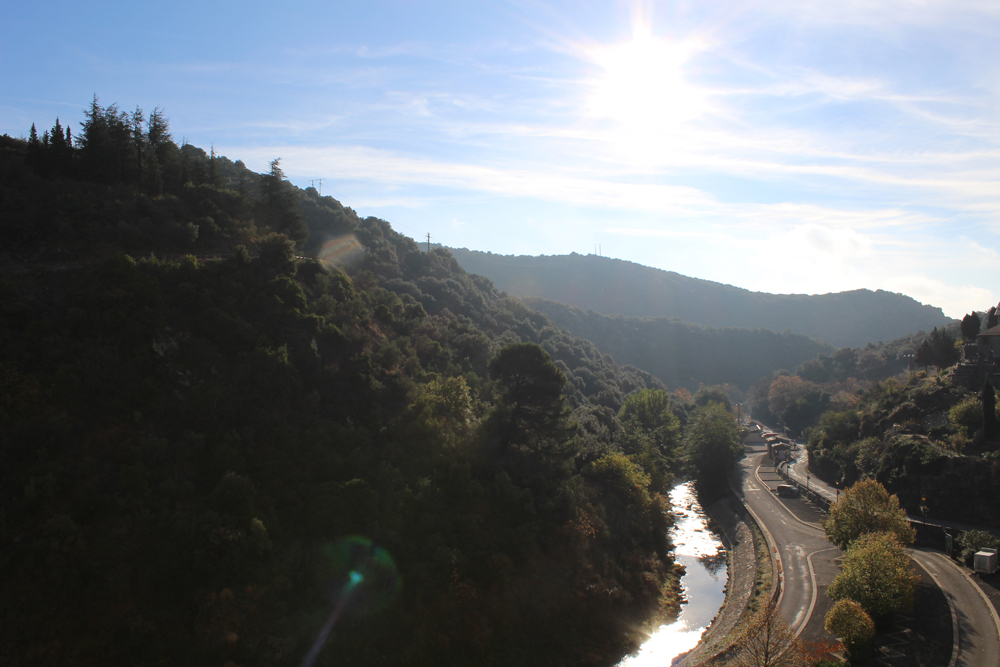
It is not a big river, or a grand river. It is a small river, alive with trout, which slowly, gently makes its way down from the hills and the mountains, skirts the four ruined castles that give this place its name and passes through to the world beyond.

As it approaches the village it first passes a couple of houses, both with chickens running around the garden, then a ruined factory full of broken windows and rusting machinery. This was a textile producing area and every town or village on a river had a mill. When the industry became too expensive the mills and factories were shut down and left to decay. Now all towns and villages with a river have a ruined factory.

A part of the factory in this village though has been turned into a visitor centre for the castles, another part into a restaurant that has a Michelin star, luxury out of decay.

The river continues past the restaurant, the town hall, the bakery (open every day except Tuesdays) and the post office (open Tuesday afternoons and usually runs out of stamps)

The post office used to be a night club and, rumour has it, a brothel.

The river runs past the car park and away.

It is a large car park for a small village. It is used by the tourists visiting the ruined chateaux on the top of the hill and is the site of the old station.

A village this size wouldn’t normally justify a station, let alone a nightclub, or indeed a brothel. But they were not for the village; they were for the goldmine further up the mountain.

But the mine didn’t last long, the station closed, the nightclub became a post office and the village returned to being a small quiet village with a large car park for the tourists.

Along the river’s edge running adjacent to the car park there are large sloping walls. Flood defences built with granite and concrete and cement. The gentle river seems trapped at this point, encased between the mountain on one side and these defences on the other. They seem incongruous, ugly, unnecessary.

I do not know if they were they built to protect and support the railway line, or built later as part of the car park. But I know that they are unforgiving and I wondered why they were built so.

Then it rained and we watched as the water rise.

And suddenly the walls looked small and insufficient. People ran to remove their cars and protect their homes from the onslaught.

It was only for two or three days but the rain was relentless, obliterating the view across the valley, shrinking the world to a few feet in front of the window.

Swept down from the mountains by the crying winds the rain and the river it fed brought whole trees past our doors, broke the banks upstream and some villages were evacuated.

But the walls were enough. The river was contained and the rain eventually stopped.

The water started to subside and the village could relax, this battle with the elements was over. The locals met and discussed the water, how many leaks their homes had, the after effects of the flooding, all thankful their homes remained intact. Because for a time it was not certain.

In the village there is a river, and there is still a river and there is still a village and the walls that seemed incongruous, ugly, unnecessary kept us safe.

Martin A. Smith is an artist and composer whose work is concerned with the emotional response to the nature of place, memory and environment.

This piece is part of a gently ongoing project to discover the story of a small village in France.

Elsewhere No.05: Some thoughts from the editors

IMAGE: Paul & Julia in discussion, Tim hiding behind the camera

IMAGE: Paul & Julia in discussion, Tim hiding behind the camera

For the first time in the short history of the journal, for Elsewhere No.05 we did the submissions process a little differently. Unlike with the previous four editions of the journal, we had a call for submissions  and a specific window of time in which people had to get us their work. On top of that, Elsewhere No.05 is also the first time we had a theme. So we were certainly interested, as the 31 March deadline approached, as to what writing and visual art on the theme of place and transition we would receive.

This week, after weeks of reading, I sat down with our editor Tim Woods and our creative director Julia Stone, at Elsewhere HQ Berlin-Neukölln to discuss the submissions and, slowly but surely, build a contents list for the fifth edition of the journal. With the number of submissions, we were unable to give personal feedback to every person who sent us their work, but we thought it might be a nice idea to share some general thoughts from our perspective, which might be food-for-thought for anyone submitting to us or another magazine/journal in the future:

Theme

Elsewhere is a “journal of place” and we decided, for issue No.05 to add the theme of “transition” into the mix. Now, within both of these there is an awful lot of room for manoeuvre. We had said from the beginning that genre or style of writing is not a deciding factor. Fiction or non-fiction. Poetry or prose. We will consider writing that could be labelled memoir or travel-writing, psychogeography or local history, reportage or experimental fiction … we really don’t care. What we are interested in is that it is good, and that it somehow conveys some sense of place within the topic of transition. Unfortunately, some submissions either did not relate to the issue theme of transition and/or were not related to the topic of place, and so however well-written they might have been, they were just not right for us.

That said, we did receive an incredible mix of writing and other submissions that DID fit the theme of the issue; from prose essays to poetry; illustration to photography; interview suggestions and book reviews. What was most gratifying was not only the quality of the work shared with us, but the diversity of approaches and styles that made it so much fun to read and also so difficult to come to a final decision. It meant that the decision-making process took a bit longer than we would have hoped, but it was certainly never boring!

Transition

Talking of the theme, and this is not a criticism but more an observation; we were interested in how many of the writers sending us the work interpreted the theme of transition on a very personal level, relating to movement, home and emotion, rather than on a political or societal level. As you will hopefully see when Elsewhere No.05 is published, we have tried to put together a journal that offers a mix of different perspectives on that theme.

Paris and Berlin

Perhaps because of where we are based, we often get a lot of submissions on the topic of Berlin. And for this issue, the German capital was joined by its French counterpart as the most popular place to write about in our submissions pile. But especially when it comes to Berlin and other places we know well and – more crucially – have been written about a lot, we are extremely picky. It is a reminder that writing about places that have been covered a lot, or with which your audience are familiar, it can sometimes be more difficult to make your writing stand out.

Format

At Elsewhere we consider every submission that arrives, however it is formatted and even if it is clear at first glance that someone hasn’t read our submissions guidelines. Sometimes, in very rare cases, we also receive submissions from people who appear to think we are someone else, or haven’t actually looked at what we DO publish. It would not take long on our blog, for example, to know that we are unlikely to publish a listicle piece about 30 Ways To Get Cheap Spring Break Tickets To Europe. It is also better not to send submissions addressed to our friends at The Berlin Quarterly or Gorse.

In general though, what was really nice about this submissions window was how many people did appear to be following what we do, both in print and online, and had sent us pieces that they thought would interest us. In the vast, vast majority of cases this was true, and the reading process was all the more pleasurable for it. We also wanted to use the blog to say thank you to everyone who took the time to send us their work. We really appreciate it. And we can’t wait to share the details of Elsewhere No.05 in the coming weeks.

Paul

The 2017 Berlin Writing Prize

With a theme like “Home is Elsewhere”, it is no wonder that we wanted to get involved in the 2017 Berlin Writing Prize, presented by our good friends The Reader Berlin, The Circus Hotel and SAND Journal. The prize is a month-long writer’s residency in our home city, where “the winning writer will have undisturbed time to observe, explore and write in one of the world’s most inspiring cities.”

The closing date for submissions is 31 July 2017, the competition is open to published and unpublished writers resident anywhere in the world, and the judges include, award-winning author Irenosen Okojie, author and creative director Michael Salu, SAND editor Florian Duijsens, Katrin Schönig from The Circus Hotel and our very own editor in chief Paul Scraton. The competition is for prose writing (fiction and non-fiction) and there is a maximum word length of 3000 words.

For all the various bits and pieces you need to know about submitting your entry to the 2017 Berlin Writing Prize, please head on over to the competition page on The Reader’s website. There you will find the submissions guidelines, details of the prizes and biographies of the judges.

We’re really excited to read what comes in and to celebrate fresh, original writing and emerging writing talent.
 

MAP6 Collective - The Milton Keynes Project

Postcards from Milton Keynes by Richard Chivers

Postcards from Milton Keynes by Richard Chivers

We are really pleased to introduce the latest project from the MAP6 photography collective. MAP6 was established in 2011 and each year creates a body of work around a central theme or geographical location. Working together on the group project, the result is both individually diverse and yet unified by the joint project theme and the shared curiosity within the collective for exploring the complex relationships between people and place.

In 2017, having previously worked on The Moscow Project, The Home Project and The Lithuanian Project, the collective have turned their shared attention to Milton Keynes, to coincide with the city's 50th birthday and in order to capture its geography, people, structure and architecture. Milton Keynes was born out of a visionary plan - a garden city planned around a rigid grid; a low green lush place, planned for the car and with self-contained neighbourhoods at its core.

MK Millenials by Heather Shuker

MK Millenials by Heather Shuker

The Milton Keynes Project aims to ask the essential questions about whether or not Milton Keynes was a success, how Milton Keynes is understood now by those who live there, and whether or not an artificially developed new town can have a genuine culture. Themes within the project and explored through the photographs include portraits of those who live and work in Milton Keynes, the relationship between the car and the landscape, and a celebration of the ambiguous, original and visionary architecture to be found there.

We have very pleased to be able to share some of the images from the project here on the Elsewhere blog, and you can find out more about The Milton Keynes Project and the other work of the MAP6 Collective on their website.

Postcard from... Bingley Five Rise Locks

IMAGE: Paul Scraton

IMAGE: Paul Scraton

By Paul Scraton:

We walked up the Leeds and Liverpool Canal from Bingley town centre, past old factories and the quay where barges would once have been loaded and unloaded. The towpath was busy; Easter weekend and the walkers, runners and cyclists were out in full force. When the canal network was built, its function was transport and the aim was making money. What it is now is a reminder and a resource, a web crisscrossing the country that at once offers us a stroll through some of the country’s most beautiful scenery while charting the rise and fall of industry, and how water was replaced by rail and road.

I grew up a few hundred metres from the Leeds and Liverpool Canal, in West Lancashire on the other side of the great divide from Bingley. The canal was an ever-present in my childhood and teenage years, a place of walks and birthday bike-rides, the place where we snuck our first cans of beer and then – later – our first legal pints in a pub by the locks. There was a mill in our village. Now it has been turned into apartments. Where the bridge crossed the canal on my way to school there has been a new development since I left home, a cobbled courtyard surrounded by cafes and restaurants, galleries and other craft businesses. The 21st century industry on the banks of the Leeds and Liverpool Canal.

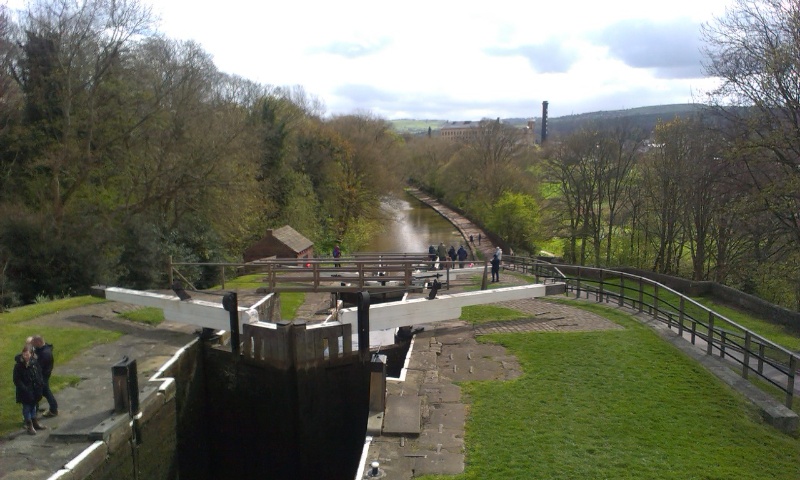
At Bingley Five Rise Locks we arrived as a barge had just entered the first of the locks. The lock keeper had come down from the office and was making the initial steps of opening and closing the various parts of the five-step system. In less than a hundred metres, the barge would rise nearly twenty – the steepest canal ‘staircase’ in the British canal network and a marvel of engineering. When the Bingley Five Rise locks opened in the 1770s, almost thirty thousand people came to celebrate. It was the 18th century shuttle launch, a technological wonder, and in all those years since there has been no real need to substantially alter the locks system. It just works.

We stayed to watch the barge make its progress, ever upwards, until it had reached the top of the locks. Later, I learned a word that seemed almost too good to be true. A gongoozler is someone who enjoys watching activity on the canals, born out of a derogatory term canal-workers used for those who stood idle while they worked up a sweat. The lock keeper at Bingley Five Rise did not look like he needed any help, so we let him get on with it. On either side of the canal, the gongoozlers stood and watched. We joined the club. 

Poetry: Zenith, by Shirley Jones-Luke

Image: Katrin Schönig

Image: Katrin Schönig

Ancient mariners were guided by a celestial sphere
they revered it like worshipers of a false idol
that's why many ships were swallowed by angry seas
sailors' cries of help silenced by waves of torment
wreckage of their lost lives scavenged by the villagers

A mast holds up the roof of my cottage on a neighboring beach
like a sundial its shadow moves with the passing sun
I use fabric from the sails of old ships to block the rays
splotchy patterns decorate the sundial's form
at night, silhouettes of palm trees are shadow puppets

Morning brings more storm-battered treasures
a ship's wheel entangled in seaweed, a broken
rudder wedged between two alabaster boulders,
a cannon torn in half floats in the water, 
I see the wealth in the sand

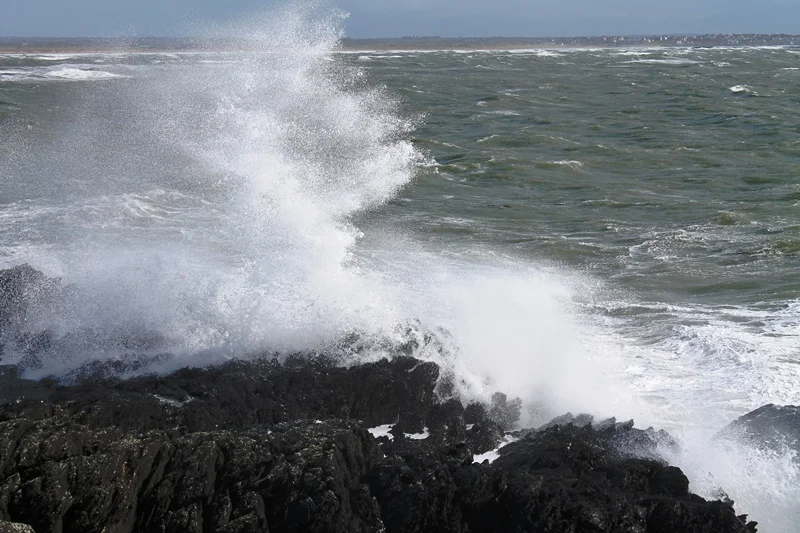
Hurricanes are common in the area, when
clouds turn black, destruction is on the horizon,
the villagers hunker down in caves on the
side of the mountain, I pack up my few
possessions - clothing, my journal and a picture of you

There are no ships at sea, the sailors
have learned the ocean's lesson, gulls glide
on electrified air, squawking their disapproval,
I make a note in my journal to collect feathers
once the storm has passed

The sky cracks open, rain comes down
like a butcher's knife, cutting into the island
the gulls are gone, nestled in their own
shelters, the villagers pray, casting wide eyes
at the sky, I think about you

In the morning, the sun brightens the damage
huts have lost their roofs, my cottage was knocked
off its foundation and leans to the side, the gulls
feast on dead crabs washed ashore, the villagers search
for what remains and I search for remnants of you

Shirley Jones-Luke is a poet and a writer.  Ms. Luke lives and works in Boston, Massachusetts. She has an MA in English and an MFA in Creative Writing.  Shirley was a 2016 Watering Hole Poetry Fellow. Her work has been published by Adelaide, Damfino, Deluge and ENUF.