Announcing Elsewhere No.05 - Transition

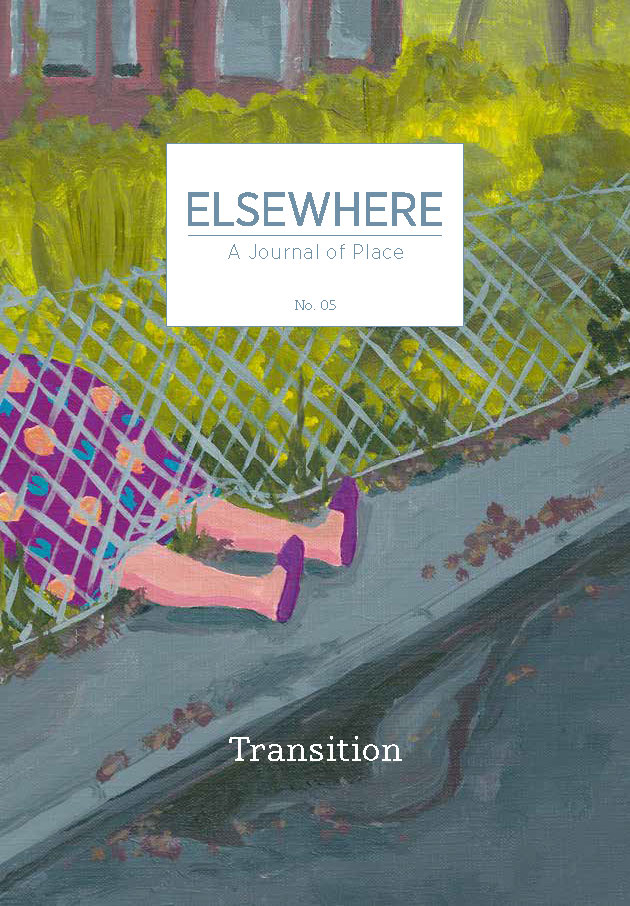
We are extremely pleased and proud to announce the publication of Elsewhere No.05 on the 13 July 2017. With contributions on the theme of place and transition from great writers, poets, photographers, illustrators and other visual artists, we are sure you will enjoy it too.
 
Order your copy of Elsewhere No.05 from our online shop

This is the first issue of Elsewhere where we have a theme beyond that of place, and in our editorial we wrote a little about what the theme of ‘transition’ meant to those writers and visual artists who answered our call for submissions: 

“For some, it was personal: stories of memories, of what changes in us, in growing up and the moments that can shape a life. For others, it was about the transformations brought upon a place: a theme park that became a naval base; a fortified border that becomes a patch of woodland. About how a house, a street or neighbourhood can alter, incrementally, until it is no longer recognisable. About the impacts of war, the decline of industry or the first waves of ‘new money’ washing through dilapidated streets.  

Transition is also about movement, about the nature of travel, and thus of home, belonging and identity. And it became clear that these have always been the themes of Elsewhere, and that the idea of transition has, in part, shaped the journal from the very beginning.” 

As well as publishing the new edition on the 13 July we will also be holding a combined launch event and fundraiser for the Sparrow Home in Thailand, a project which features in this issue. It will be in Berlin and hosted by the Circus Hostel – we will announce more details soon.

In the meantime, every order before publication date is a great boost for us, so head on over to the shop where you will also have the chance to buy No.05 in combination with other issues of the journal, or back issues to complete your collection.

Elsewhere: A Journal of Place online shop
 
It would be a great help to us if you could share the news with anyone who you think might enjoy our journal. Word of mouth is what got us started and what keeps us going.
 
Finally, we would like to use this opportunity to once again thank the wonderful contributors to the journal and we really hope you will be holding their work in your hands soon.

Worlds Apart

IMAGE: Frank Hajek

IMAGE: Frank Hajek

By Jessica Groenendijk:

The otter changes course and heads into a crystalline, shallow tributary. I snatch up my binoculars and see it flush a large catfish, water surging as it chases its prey over a sand bank. The fish escapes and the otter, too, is swallowed by the jungle. How will we identify it now?

“Quick, let’s follow on foot,” I say to Frank. “We might be able to catch up.” 

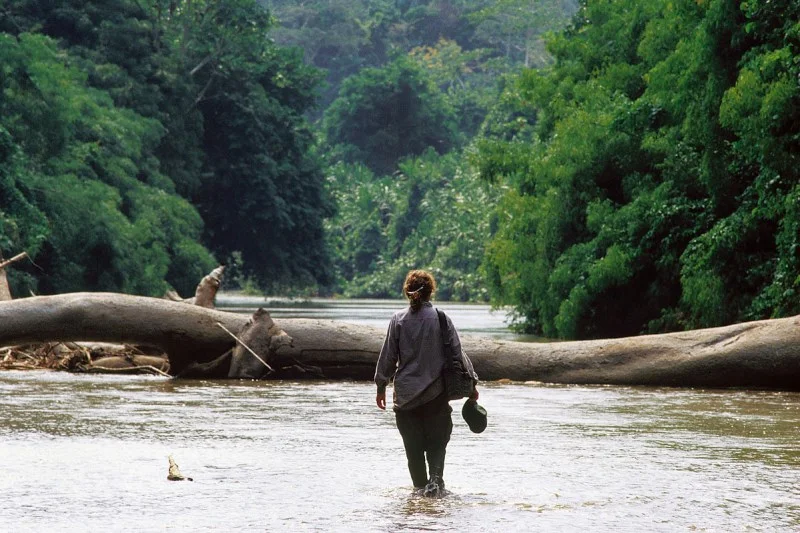
Frank gestures to our boat driver, Zacarias, to nudge the bow of our fifteen-metre canoe into the mouth of the stream. I grab the day's provisions and tug on a pair of light trainers, token protection against sting rays. Then I swing my legs over the side and lower myself into the current, enjoying the shock of cool water on my skin. Frank follows, the camera and zoom lens slung around his neck. Zacarias reverses the engine; he agrees to moor the boat nearby and wait for us. 

It is mid-morning. The sun is a hot weight on our shoulders and leaches the green from the surrounding vegetation. We are nearing the end of our annual giant otter census in Peru’s Manu National Park. We have already filmed all the resident families, but the nomadic solitaries present a greater challenge. They are elusive, silent, and secretive. We still smart from our failure to film the throat marking – as distinctive in giant otters as our fingerprints are unique to us - of a lone individual sighted yesterday. 

I push my feet through the water, feeling the thin cotton of my trousers swirl against my legs. Pristine, crescent-shaped beaches flank the banks of the meandering stream. Water slips sinuously between rocky shelves and over drifts of sand, nibbling at miniature, sculpted cliffs until they crumble and dissolve. The polished trunk of a majestic ceiba spans the current, its bark long gone, its sun-warmed wood smooth and satisfying to the touch. I revel in the freedom of walking in the stream, after so many hours spent in the dense, claustrophobic forest. 

There is surprisingly little wildlife. No sign of the otter, only small schools of fish flitting from pool to pool. I disturb a sting ray, a tiny spurt of sand staining the water where it had been resting. Lime and lemon butterflies shiver on damp soil where a tapir urinated at dawn. Twice I spot the tracks of capybara. I know it is the wrong time of day for animals to be out and about, yet I am disappointed. 

Sand bunches in my socks, rubbing raw the skin between my toes, and the vicious sting of a horsefly enhances my discomfort. By now, I have given up hope of seeing the solitary otter again. A shady spot on a beach tempts me and I whistle to catch Frank's attention. 

“Let’s stop awhile, have something to eat,” I call to him. The sound of my voice makes me wince. Like shouting in a cathedral or an ancient library, it seems wrong, irreverent. 

Frank flops down next to me. “I feel like Alfred Russell Wallace,” he says, looking at our tracks on the sandy canvas. “Like we’re the only humans ever to have ventured here.” 

I nod, conscious of an all-too-human desire to claim this remote pocket of rainforest as our own, by right of first passage, even if only in spirit.  A kingfisher arrows past, it's challenging chatter ringing in my ears. I push myself off the sand and brush my hands. “Let’s keep going.” 

The channel narrows and trees tower on either side. The beaches all but disappear. We penetrate deeper and deeper, and with every step I feel more alive. My senses hum. 

“Jess.”

Frank’s voice beside me is low and taut. I glance at him and follow his gaze. About one hundred metres upstream, a tree has collapsed from bank to bank, forming a bridge over the water. On it lies a jaguar. 

Frank lifts the camera from his chest. But even with the zoom we are too far away. We walk, our paces measured to avoid splashing, our eyes never leaving the jaguar. Excitement wells in me. Nothing but air separates us from the big cat. Not the metal and glass of a car, nor the wooden hull of a boat. Here we are on an equal footing, as we were meant to be. 

My eyes burn and I blink. In that split second the jaguar is gone. There is no in-between, no slow slinking into the forest. Anywhere else I would have regretted the loss. Here it feels right. 

“Strange,” says Frank. “I didn’t think he’d be so scared of us.” 

The sun is lower in the sky, the foliage now luminous, greens burnished with old-gold. Although it is tempting to explore further, we will find ourselves spending the night unprepared if we do not turn back soon. 

“What do you think, just one more bend?” I ask. Frank agrees without hesitation. 

As we round the meander, a beach, larger and higher than any we have seen so far, slopes gently up into the forest. Our shoes squelch as we step out of the current and walk onto the sand. Hollow, blackened tortoise shells litter the ground. There must be over fifty of them: pathetic, tiny domes, the size of cupped hands, scattered amongst great carapaces. Three stout baskets, woven from a single palm frond, lie abandoned next to the charred skull of a brocket deer and the voice box of a howler monkey. 

Frank and I stare at each other. 

A pair of macaws flies overhead, their agonised cries startling me. We pick our way through the clutter. A dozen makeshift palm frond shelters dot the beach. At either end of every shelter are the ashes of a small fire over which the tortoises were roasted. Alive? I grimace. Between the hearths is space for two or perhaps three people to sleep. 

Frank’s soft “Hey!” interrupts my thoughts. He motions me to the water's edge. At his feet is a set of human footprints, unexpectedly large, even allowing for time’s erosion. 

A cloud blocks the sun. We both know what we have stumbled upon. The hunting camp of a group of so-called ‘uncontacted’ people, known by outsiders as the Mashco-Piro but who call themselves the Nomole, meaning “brothers”. People who, due to past traumatic conflicts with what we call civilisation, choose to live in complete isolation from the rest of us, rejecting all we represent. People who walk naked, hunt with bows and arrows, use stone axes, and eat almost exclusively meat. I recall the jaguar’s fear. 

It seems inconceivable that only a few hours’ walk from here, engine-powered boats pass by daily, laden with tech-savvy tourists. 

Logic tells us the Nomole are unlikely to be nearby – there is no acrid smell of smoke and the footprints are not fresh – but I cannot shake the feeling we are being watched. My skin prickles. We might have walked straight into them. What would have happened then? Would they have shied from us, run into the forest? Or would they have attacked us? Judging from what we’ve heard, an encounter might well have been fatal. 

With this comes the uneasy realisation we are intruders. The stream is not ours. It never was. We are trespassing. 

I take a last look at the silent camp, suspended in a web of gathering shadows.  Frank cannot resist taking some photographs, and even this benign act feels like an invasion.
We retrace our steps, subdued in thought, trying to reconcile what we have seen with our lives outside. We have not witnessed the past, nor the future, but a different present. The otter and jaguar, the Nomole, and ourselves: three separate, parallel worlds briefly intersecting, almost colliding, on the banks of a rainforest stream.

*****
 

Jessica is a Dutch biologist turned conservationist and writer. She fuses her work in conservation and her personal experiences of wildlife and wild places with her passion for words and photography to help connect people with nature. Her writing has been published in BBC Wildlife MagazineEarth Island JournalThe Island Review, and Africa Geographic, as well as in Animal: A Beast of a Literary Magazine and Zoomorphic. Her blog Nature Bytes was Highly Commended in the International Category of the 2015 BBC Wildlife Blogger Awards. She is a member of The Society of Authors and is currently working on a book on giant otters and their conservation. Follow her @WildWordsAuthor on Twitter and Facebook and find her Words from the Wild at www.jessicagroenendijk.com.

Claxton Brick Ponds

By Samuel W. James:
 
The water’s a long way from the road,
through fields and a wood without a path
where dry twigs aim for the eyes.
 
There are ditches filled with brambles
to be leapt over, before the green snakeskin
of the pond appears.
 
In a stream connected with the main body
there is some clear, though still, water
where the white flesh of a great dead pike rots.
                               
No bubbles disturb the weeds of the surface
which seem to be the food of the insects.
On the other side the wood ends
with plastic blue electric fence markers.


Samuel W. James is a new writer from Yorkshire. He has been published in the following magazines: Allegro, London Grip, Peeking Cat and Ink, Sweat and Tears.

The Housewife of New Friends Colony

NewFriends.jpg

A story by Rita Malik

Her husband Ravi had eaten a strange leaf in the first strange country he had visited long ago, under the pretense of his business affairs, no doubt. But his gastronomic tendencies were awakened to the new possibilities. Possibilities that did not include in any way shape or form, yellow or red ground spices, mixed all spice, cinnamon, nor betel nut, no hing, no lentils, and no unnecessary red or green chilies. The peptic ulcer his personal physician had for so long profited over, that helped house him in a perfect Mercedes Benz, was no longer going to provide the funds. The salt had lost its savor. He was a connoisseur of all things non-Indian. He could even gallivant and float and beam over the most delectable and bland fish, boiled potatoes, as long as they were associated with a culinary culture and a national pride of some independent nature, such as Irish dishes. Yes, Ravi had developed a taste for Irish food.

Meanwhile, his friend Vijay had hatcheries all over China. Seema had wondered during many pillow talk parlances with Ravi about the state of affairs if one has only to rely on the revenues from various chicken hatcheries to make a living.

“But he’s doing very well,” Ravi had told her. “How else could he live in that beautiful farmhouse and all that acreage in the middle of Delhi?”

“Inheritance,” she’d replied, flipping a magazine page without looking up. “He’s his father’s son.” Vijay’s grandfather had been the Mayor of Delhi once upon a time. The family had depths of connections, especially in political circles. His wife, a pretty woman, who went by the name of Penny, outright non-Indian, even though she was a Kashmiri, had the gift of youthful looks and a fine figure, Seema reflected ruefully.

Seema herself was darker skinned, but by no means of the blackish sort, seen in the people of Dravidian descent. Her family was from U.P. Bihari’s. Wheat skinned. And there was no noble lineage. She had been able to hide this from her friends. In fact she had led them on to believe she was descended from a long line of Rajputs, before the drastic changes took place, industrialization, globalization. She made self-deprecating remarks and joked about the Rajputs along the way, endearing herself with the Dolly’s, the Sweety’s, and the ruffians of Punjab, as she would call them, in her parlances with Ravi after their partying.

Still, Ravi never understood. He did patiently hear her out, as she ranted about the housewives of New Friends and South Extension.

“Shopping and kitty parties and showing off, that’s all that these women find time to do.” Why she had done this, the deliberate misleading as regards her lineage, she did herself not know.

Swimming in the city and country: Turning - by Jessica J. Lee

IMAGE: Katrin Schönig

IMAGE: Katrin Schönig

Read by Paul Scraton:

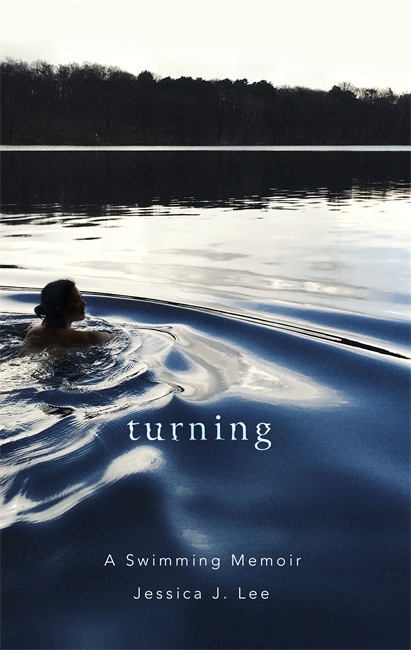
Early on in the pages of Turning, a swimming memoir about taking a dip in 52 lakes in Berlin and the surrounding Brandenburg countryside, Jessica J. Lee admits to fears and insecurities in the water. This is something I share. I have never been a massive fan of swimming, whether in the sea or the swimming pool, and especially when out of my depth. It has only been in the past couple of years, swimming in some of the very same lakes that Lee visits in this excellent book, that I began to conquer those fears.

It was then that I began to understand what people were talking about when they - like Lee herself - quoted Roger Deakin and his description of the ‘frog’s eye view’. As Lee describes being in the water in Brandenburg, surrounded by the pines and the sky, I can picture it exactly as I have experienced it as well. You do get a different view from the water, a different understanding of place. And that, for me at least, is ultimately the story of this book: as well as personal history sensitively and bravely told, Turning is about a person gaining a feeling for the history and the stories of the places she visits, deepening her knowledge of the geology, ecology, communities and political history of the city she lives in and the surrounding countryside, each time she takes to the water.

As someone who both shares these interests about place in general, and about Berlin and Brandenburg specifically, it is not surprising that I found myself nodding in agreement and recognition as I read. There were other elements of the story that resonated as well: the loneliness of being new in a big city and of building a personal connection to the place by getting to know and to love the landscape, the forests, the suburban S-Bahn lines and the gruff owners of rural snack kiosks.

Lee is an elegant writer; precise in her description, thoughtful in her observation, and most of all interested in the world that surrounds her. This is not always the case when it comes to memoirs, which can sometimes become so tied up in the internal emotions of the writer that there is no space for any exterior, for the world around them, and therefore context to the story they are trying to tell. In Turning, Lee’s personal journey is deeper and richer for the reader because the lakes and their surroundings are characters in the story. As is the weather. As are the seasons. The plan was to explore the 52 lakes over the course of a year, and so Lee was swimming at the height of summer and in the depths of the winter, breaking the ice with a little hammer in order to clear enough room for her to have a swim.

Indeed, one of my favourite lines in the book - one that had me reaching for a pen in order to scribble it down for later - concerned the shifting of the seasons: “It’s all too easy,” Lee writes, “to be sucked under by sadness in the autumn.” I understand that emotion only too well, even if I haven’t (yet) tried a plunge in an autumnal pool to try and alleviate the October blues.

And then, a few pages later, more recognition: “I’ve become divided, stretched across places.” At the very time I was reading this book, I was working on my own project about walking the outskirts of Berlin. One of the motivations for these walks was to try and gain a better understanding of the city I live in a time when my feelings about place, belonging and identity had been thrown into turmoil by referendum results and a series of trips “home” that made me wonder, more than I ever had before, where “home” actually is. I too have felt stretched and divided. The only question, is whether it matters. Each walk, each swim, can help the clarification process.

Walking or swimming. Building our connection and understanding of a place by interacting with the landscape, the history and the people, can be done in different ways. The strength of the book is, I believe, that it not only is a good story very well told, but that it will make readers think about their own places, their own feelings of home and belonging, of their own lakes, forests or city streets, and think a little deeper about them. Jessica J. Lee’s is a trip to the lake well worth taking, inspiring even this reluctant swimmer to reach for his swimming shorts (if not the ice hammer).

Support your local bookshop! Go and get your copy of Turning by Jessica J. Lee there. Meanwhile, here is Jessica's website.

The Library: Signal Failure, by Tom Jeffreys

Review: Christo Hall

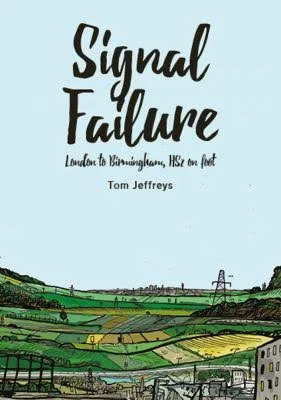
For those who haven’t kept abreast with recent British infrastructural projects, HS2 is a £55bn high-speed railway plan first mooted by David Cameron’s government in 2009. It’s an attempt to renew Northern England’s economic potential after years of neglect from Westminster and deindustrialisation that has accentuated a north-south divide in the country. For its advocates, including the previous chancellor, George Osborne, it will “change the economic geography of this country”, for its opponents it’s over budget and comes at a huge cost to the areas affected – the homes that require to be demolished and the environment.

It’s these various divisions that Tom Jeffreys, in his first book, Signal Failure, grapples with via his attempt to walk the length of the HS2 route – a 119-mile trek that takes him out of Central London, through endless suburbs, beautiful and ordinary countryside and into Birmingham. Along the way he wild camps—in some cases to his own better judgement—in a suburban open space, a pub garden and besides a major road; he meets people that will be affected, in some cases displaced, by HS2; and ponders the disconnect between mind and body as he suffers injury and disappointment halting his attempt to undertake the walk in one sitting.

For one thing I have learnt that I am not a nature writer.

It’s nonsense to try to categorise a book to a single genre and it’s especially so for this one as Jeffreys smoothly and deliberately blends elements of nature writing, journalistic reportage and a meta-review of writing about nature and place. Each of these strands raise compelling passages, such as his observations of how an infrastructure project’s simulations and renders fail to depict relationships with real people, conversely his portrayal of a West Midlands dairy farmer’s complex relationship with HS2’s impact on his land, and Jeffreys’ framing of his book in the context of nature writing that has preceded it, making it in part an ode to the likes of Bruce Chatwin, Richard Mabey and Roger Deakin. It’s a signal of how much of an admirer he is of nature writing, and it reveals a kind of imposter syndrome, that Jeffreys feels incapable to write authoritatively about nature – that’s not to say that this is a bad thing, such reverence offers a welcome subjectivity and an absorbing down-to-earth tone.

Why does building for the future so often involve destroying the past?

While born in Buckinghamshire – as it happens near enough on the route of the HS2 – Jeffreys’ fascination for cities is not disguised, neither is his comfort within them. Nature, for many city dwellers, conjures up untamed forces and barbarism yet nevertheless is apotheosised because of its embodiment of a simple, more human life. It’s a view that at times leads Jeffreys to see the city as an encroachment, continually eating away at nature’s resources and beauty, and that impresses a strong tone of regret. Is it a metaphor for something that should have been done about HS2 while there was a greater chance of impacting the plans?

Perhaps the author’s greatest contribution is the perceptive and astute power of his social commentaries throughout the book. There are many striking and quotable phrases that come to mind, such as “you can tell officially approved graffiti because the people are always happy” or his insight to point out that state and council-funded outdoor gyms erected at the time of the 2012 Olympics, encouraging exercise, coincided with McDonalds being the Olympics’ official restaurant. In other passages he asks: “at what point does psychogeography become tourism?” or notes that “what bothers me is the implication that the UK’s only landscapes worth saving are those that fit within the aesthetics of the late Romantics.”

Somebody once wrote that as the mayor he would like to see his local country lanes neat and tidy and easily passable. But as a poet he would prefer them artfully overgrown.

Signal Failure is an enthralling and irresistible read, and difficult to review because along the way Jeffreys produces a better summary and analysis of his own book and its place in the canon of nature writing better than I or any reviewer could. As such this is a thoroughly researched book, substantiated by the tomes that weigh down his backpack throughout his walk. But it’s also a vital reminder that it takes more than demographic analyses and cost-benefit models to understand the value of our environment and our place within it.

What’s a train without its passengers, a town without its residents, or any kind of journey without its traveller? – Warts, imposter syndrome, injuries and all.

Christo Hall has written for The Quietus, Prospect, Review 31, White Noise and others, often about cities and urbanism. He is online editor of the Bartlett School of Architecture’s LOBBY magazine and founding editor of Cureditor, a site that recommends arts and culture articles.

Signal Failure by Tom Jeffreys is published by Influx Press

Should've Gone

Edinburgh to London2 May 2015.jpg

By Sibyl Kalid:

We’re standing at the top of Carlton Hill and there’s a fire burning at the oil rig across the water. It doesn’t look like a fire; it is too whole, like someone has trimmed its edges. It’s almost Christmas. M is leaving tomorrow, and I’m going back to London next week. Neither of us is sure when we’ll be back. The city is indifferent.  It winks obstinately, as it has done for four years, cars beating down tracks through the long stems of buildings, pace unflustered by M’s stifled tears. In the time we’ve been here Scotland hasn’t left the UK, the UK has decided to leave Europe, and the Starman has left the earth. We’ve been living on the endless rumble of national events, registering them with the stable acceptance of a barometer. It’s unnerving to discover that now we’re the thing moving, and it was this tumbling collapsing city that was the constant all along.

Last night I had that strange feeling of sleeping in a different room to the one I’m used to – my flatmate’s, mine having been taken over by its new tenant and her green bed-sheets. Most disorienting were hearing footsteps to the bathroom and not being able to place them. I had the realisation that, through the past year, night-steps have been like little sonic messages, bouncing back from a friend to my half-asleep consciousness, orienting them in an identity and route through the mumble of slipper on carpet. Eternally scornful of those with a domestic inclination, I’ve discovered nesting instincts I never knew I had.

In October we started receiving packages from Specsavers addressed to someone called Hannah Steeds. We knew nothing about Hannah Steeds, other than that she was, presumably, either long or short sighted, and had at some point lived in our flat. The Specsavers boxes piled up next to the front door, as poor Hannah must have found everyday tasks increasingly difficult, and our shared apathy halted us from either contacting our landlord or returning the boxes to sender.

The mystery then spooled when a postcard arrived from someone self-determining as ‘Mumsykins’. We assessed from this moniker, and from the quaint stone-walled house featuring on the front of the postcard, that this wasn’t just a gaffe from a friend who had fallen out of touch. The writer of the card indicated that she was looking forward to seeing Hannah at home, that she had recently visited a small rural town in the West Country that she thought Hannah would have liked. The baffling thing was how a mother cosy enough with her daughter to call herself ‘Mumsykins’ could have not kept abreast of her daughter’s address. Using the digitised Yellow Pages we tracked a Hannah Steeds to a family address in Bristol.  It’s not an uncommon name, but we were worried about Hannah’s eyesight and didn’t have anything else to go on, so we were prepared to take the punt and send Hannah’s accoutrements on to that address.

One day Hannah Steeds herself turned up at our door. I wasn’t in when she arrived, so it was my flatmate who passed over the postcard and contact lenses. He reported her as ’25-30, tall, but quiet and shy with the body language to match. Glasses. No Bristol accent’. And, apparently, absent-minded; she lived at 26/4, the flat below ours. She had just given out the wrong address, both to her mother and to Specsavers.

As with the solution to most mysteries, big and small, I found this disappointing. Hannah’s post wasn’t the imprint of collateral scattered in transition. Simply a casual mistake of the misplaced mind, as it unwittingly misplaces the body. There was no great conspiracy of illness, or amnesia, or filial alienation. My bank statements and reminders to renew my National Galleries of Scotland membership still roll into my flat in Edinburgh. But I don’t get the same wistful satisfaction from these forlorn reminders of my past inhabitancy as I did at the prospect that Hannah Steeds once lived in that flat, and that in the lost universe of some long-delayed postcard, or long-neglected mother, still did.

That endless pouring in of ancillary admin also seems like a taunting wink from whatever household god has observed the wearying tugging up of physical anchorage. The sentimentality of moving is always quashed by the picking up of detritus, as we concern ourselves with box sizes and bubble wrap and the turbulent ownership history of a frying pan. Every time I shift I am bewildered by my astonishing ability to explode myself over all available surfaces. My handwriting scrawled over paper pinned to the wall. My broken dvd player, rejected from my family home. Flour I bought for a cake I didn’t make. The fruit bowl with my name carefully painted on it above a picture of kiwis. Four mugs. Three cacti. A duvet. One pillow with case. A soup bowl. Matching coloured spoon. Shampoo. Half empty gin bottle. My desire to become a monk alternates with an impulse to gather everything up and attach it to me in a memorialising shroud, as I assess the ghostly inventory of the things I did do, and the things I could have but didn’t. That’s always the real sting of leaving anywhere. That gnawing concern that you didn’t live a place well enough. The minute you start walking away time horse-shoes and you remember your initial expectations of a place, before you first arrived. What you thought you’d do there. Who you thought you’d meet. Who you thought you’d be. I also start to mourn every grumble, and remember the sense of guilt I felt when my uncle came up for my graduation and commented on how beautiful the city was, how many levels there were to it, as if there were two cities sloping on top of each other. My vision of the city had plateaued into my daily grudge across the meadows, and now I felt like I needed to touch every corner, to make sure I’d appreciated it properly.

On the way home from Carlton Hill M and I climbed up into the alcoves in the wall that faces a graveyard. We felt like statues, whose only duty was to watch, that if anyone walked by we’d be offered the privilege of being an invisible onlooker, eternal and impassive. But no-one did.

Sibyl Kalid’s website

Postcard from... Samarkand

IMAGE: Tim Woods

IMAGE: Tim Woods

By Tim Woods

How did I get through 39 years – four of them studying geography – without even hearing of Samarkand? A vital stop on the Silk Road for centuries, and today one of Central Asia’s major tourist attractions, I knew nothing about it until I had to travel there for work and started reading up. How did that happen?

The answer is in its location: I’ve never had much reason to think about the countries of Central Asia. For most of my childhood, they weren’t even countries, just unmentioned parts of the USSR, then briefly the CIS. They were not part of the backpackers’ highway by the time I’d reached that stage of life, their brief heyday as a hippy route into Afghanistan long since over. Too far east to sneak into Eurovision, and too rubbish at football to qualify for the World Cup, they never crossed my frame of reference and I rarely gave a second, even a first, thought to Uzbekistan or its trickily spelt neighbours.

My loss. Samarkand is incredible, an irresistible combination of breath-taking buildings and security so lax that you can walk among these ancient sites that would be cordoned off in most places. I only stayed for one night, but was grateful for a glimpse; one day I’ll hopefully return and give the city the attention it deserves.