Hermannplatz

self.jpg

By Mike Hembury:

Sometimes words fail me.

Sometimes I struggle to put a name to even the most commonplace, the most obvious of things.

I don’t think it’s pathological in my case. But there is a word for the condition: dysnomia.

Curiously, Dysnomia is also the name of the Greek goddess of lawlessness, praised by some as the daemon of freedom and rebellion.

***

My first flat in Berlin was on Sonnenallee, almost at the corner of Hermannplatz.

That was back before Sonnenallee turned into Little Damascus.

Don't get me wrong, I like the way it is now. But I liked it back then too. Loud, dirty, unpretentious. The beating scraggy heart of North-Neukölln.

No-one would ever say that Sonnenallee is pretty. No-one can claim that Hermannplatz looks nice.

It has some "art" these days though. There's a statue in the middle of the square that has two golden figures in a pose you could possibly interpret as dancing. It's a crap statue, only serving to make the place look cheaper than it already is.  

When I arrived back then it was a golden October day. I was due to link up with a friend of a friend, a guy called Harald who lived near Hermannplatz. I came out of the arrivals gate and there was this guy beaming at me. Maybe he recognized me from my friend's description, maybe he was just smiling at everyone. It was 1982. There was no email back then, and we hadn't been in contact before.

I said "You must be Hermann."

He just laughed. "Hermann from Haraldplatz?"

I was a little taken aback. "Sure, I guess so. Or not?"

He stretched out his right hand. Long fingernails. A guitarist's hand. "Harald. Easy mistake. Good to meet you."

We took the bus back from the airport. Changed at Zoo and took the U-Bahn to Hermannplatz. Dumped my stuff at his place and I let him guide me down to the Landwehrkanal, where we sat in the garden of Café am Ufer and drank large bowls of milky coffee.

The autumn sun was warm and the sunlight filtered through the orange leaves of the beech trees lining the canal.  

Everything was new except, strangely, Harald.

He had already acquired a familiarity that maybe should have surprised me, but somehow didn't.

We just clicked. He was like the older brother I never had. I was 21, he was 26 or 27. Still a student, driving a taxi, making music and writing poetry like a real Berlin intellectual.

He knew the ropes.

He was part of a posse of draft-dodgers who had fled to West Berlin from Stuttgart on receiving their call-up papers.

After three months of hanging out with Harald's crowd in Berlin I spoke German with a Stuttgart accent.

***

One time he took out his teeth to show me. He had smashed his jaw in a trampolining accident in his teens, and now had a full set of false teeth which he could hook onto a few remaining stumps in his mouth.

He was a heavy smoker, so his teeth had a kind of patinated ivory quality to them, like you see on the keys of pub pianos.

Harald's flat was a dark, first-floor two-roomer in the rear courtyard of a vaguely slummy Berlin tenement. It had an outside toilet and a boiler over the sink for hot water.

When I asked, on the evening of that first day of my new life in Berlin, where he wanted me to sleep, he just pulled the keys out of his pocket and flung them across the table where we were sitting.

"It's all yours. You take the bed. I'll be upstairs with Sabina."

Sabina was his Lebensabschnittsgefährtin - his 'life phase companion', to use the dry jargon of the times.  

***

The October sunshine didn't last. Winter came quickly, with snow in November. I learned to use the Kachelofen - a big, tiled, lignite burning room heater of the type that have now all but disappeared from the city.

If I had to tell you one smell from those years it would be the particular smell of burning lignite - "brown coal" to the locals - in sub-zero air. Preferably alcohol-fuelled, in the three-in-the-morning snow.

Back then I would wake to the sound of the kids on the school playground next door. Put the kettle on for coffee. Take a trip down half a flight of stairs to the little loo in a cupboard on the landing. Come back and fire up the coal burner. Roll a cigarette, drink a coffee and think what a grand life I had.

No, I'm lying. Even with new friends, Berlin can be a tough place. I missed my girlfriend, who was on a student exchange in Paris. I wasn't suited to living alone. Half the time, I didn't know what the fuck I was doing there.

Harald had become a big part of my life though. Big and getting bigger. One time, returning from a trip to England, I literally leaped into his arms, footballer-style. That should perhaps have rung a few bells, but it didn't at the time.

I was ignorant. Unversed in the hearts of men, and ignorant about myself, and the possibilities within me.

So when Harald took the logical step, and put a name to the obvious, and told me that he had fallen in love with me, I was like: "Ok, so now what?"

I remember him raising an eyebrow. Looking at me, with his dark eyes.

"I mean, what do you want me to do with that information?"

I was cool, detached. Hurtful, I guess, because afraid. My English upbringing hadn’t equipped me with the words to deal with such a situation.

"Is it going to change anything?"

"I guess not."

It did change something though. It changed everything.

We ended up in an ill-advised ménage-à-trois with his latest girlfriend, Karin.

It didn't end well, for me at least, though I think they are still together.

What can I say? I was young and stupid, and still had so much to learn.

Our friendship exploded.

We've lived in the same city for 30 years and seen each other maybe twice, accidentally.

Hermannplatz still has a Harald-shaped hole in it, a scar that troubles me sometimes.

I guess sorry is the word I was looking for.   

*** 

Mike Hembury is an Anglo-Berliner originally from Portland, England, and describes himself as a writer, musician, photographer, sailor and environmentalist in no particular order. He is the author of a novel, New Clone City, and writes a regular environmental column for the online journal The Wild Word. He is also a member of Extinction Rebellion, the Dark Mountain Project and the Climate Cultures network. You can find out more about Mike on his website: mikehembury.org.


Njideka Akunyili Crosby: painting the ‘contact zone’

Njideka Akunyili Crosby "The Beautyful Ones" Series #6, 2018Acrylic, colour pencil and transfers on paper 151.8 x 108 cm 59 3/4 x 42 1/2 in © Njideka Akunyili Crosby Courtesy the artist, Victoria Miro, and David Zwirner

Njideka Akunyili Crosby
"The Beautyful Ones" Series #6, 2018Acrylic, colour pencil and transfers on paper
151.8 x 108 cm
59 3/4 x 42 1/2 in
© Njideka Akunyili Crosby
Courtesy the artist, Victoria Miro, and David Zwirner

By Rachel Kevern:

During her studies at Yale University School of Art, Njideka Akunyili Crosby encountered Mary Louise Pratt’s ‘Arts of the Contact Zone’ (1990), which identifies ‘social spaces where cultures meet, clash and grapple with each other’. This idea of a ‘contact zone’ is present in all Akunyili Crosby’s work, reflecting the artist’s own experience of feeling a sense of belonging to two distinct cultures. Having left Nigeria in 1999, at the age of 16, to study in the United States, Akunyili Crosby’s work is often autobiographical, depicting domestic scenes of herself, her Nigerian family, and her American husband. The universe depicted in her compositions is, according to her, neither Nigeria nor America, but some other space, the space that every immigrant occupies.

Her pieces are large-scale depictions of domestic life, and combine painting, drawing and photo-transfer techniques. Often, Akunyili Crosby will merge very personal, intimate images with cut-outs from magazines and favourite designers; images that she has collected and stored over the years. In an interview with arts journal The White Review, the artist explained that she usually chooses “pictures that tap into Nigerian culture in the eighties and nineties – popular musicians, iconic album covers, movie stars.” She searches for images that give her “a feeling of recognition”, that will connect her with other people of her generation who grew up in Nigeria through their shared memories. The depth and richness of her compositions defies simple classification and forces the viewer to take a closer look.

Njideka Akunyili Crosby "The Beautyful Ones" Series #7, 2018 Acrylic, colour pencil and transfers on paper 152.1 x 108 cm 59 7/8 x 42 1/2 in © Njideka Akunyili Crosby Courtesy the artist, Victoria Miro, and David Zwirner

Njideka Akunyili Crosby
"The Beautyful Ones" Series #7, 2018
Acrylic, colour pencil and transfers on paper
152.1 x 108 cm
59 7/8 x 42 1/2 in
© Njideka Akunyili Crosby
Courtesy the artist, Victoria Miro, and David Zwirner

Collecting picture became a way for Akunyili Crosby to stay connected to the Nigeria of her childhood, Nigeria as she knew it, which “wasn’t the same Nigeria that [she] was experiencing in the US, in terms of the questions people asked [her].” Speaking to The White Review, she explains that she “became aware that people had no clue, not just about Nigeria but about Africa as a continent”. Her pieces stem from a deep desire to share the Nigeria that she knew with other people, “in a way that felt real or sincere”: “I wanted to give people a glimpse of this other space that they weren’t familiar with.” The paintings are both deeply personal and reflect wider issues of identity, belonging, immigration, and Nigerian culture. Her compositions themselves act as personal, cultural and political ‘contact zones’, forming a space in which different cultures mingle to become one image.

Her first solo exhibition in Europe, which took place in 2016 and was entitled Portals, featured a multitude of doors, windows and screens. In the description of the exhibition, the Victoria Miro gallery notes that these portals in her work function as “physical, conceptual and emotional points of arrival and departure, while in a broader sense the work itself is a portal through which mutable ideas about transcultural identity flow back and forth.” The doors and windows, - as much of Akunyili Crosby’s work - function as gateways to new ways of thinking about multicultural identity and what it means to forge your own space and place in the world.

***
Njideka Akunyili Crosby’s website

Rachel Kevern is an undergraduate at the University of Oxford, studying English literature and French. In her spare time she writes, acts, paints (but not as much as she'd like to), drinks a lot of coffee and reads any book or magazine that she can get her hands on. She has previously been published in The Liverpool Echo, The Warrington Guardian and online magazines such as Flux and The F-Word, as well as running her own blog and being Arts and Travel editor for The Oxford Student, her university's biggest newspaper.


Spring In This Place – a poem by Will Burns

I choose the bee-flies for company today.
Sunlight on beech leaves,
cool sweat in the warm wood,
the blue flowers of the season.
Not numerology or some old painting
I think you might like.
Not a poem I hope you read for signs of life.
I fall hard for this place every day
the way we do for people we shouldn’t.

***

Will.JPG

As part of The People’s Forest project, the poet Will Burns is creating a series of new works inspired by Epping Forest. Over the year Burns is penning a collection of poems, one per season, in part reflecting on the unique nature of Epping intertwined with his own experience of the forest real and imagined – here we have had the pleasure and privilege to publish Will’s poem for spring.

Sunrise to sunset: walking Kolkata

P1020413 black and white.jpg

By Alex Cochrane:

Kolkata has been called a city of furious energy, the city of joy, a dying city. It is teeming, intense, broken and modern, old British empire and a stronghold of Bengali pride and culture. It’s crumbling and developing, wealthy and poor. It’s digested a tragic history but has a unique soul where it’s almost obligatory to have chats, or ada, with random strangers in the streets.

Four am and I’m drifting through a north Kolkata neighbourhood. The streets are quiet, owned by scuttling rats and packs of dogs who strut and bark at my intrusion. It’s their time to own the streets. The night’s storms have slickened the streets and freshened the air.

Figures swathed in cloth sleep on the pavements, on rickety frames, under rickshaws, on mats, on ledges and on carts. Whole families curled up together under tarpaulin shelters, their washing strung out on nearby railings. The poverty is not as bad as it used to be, but it’s still a depressing sight.

The first tram of the day clanks and grinds its way through the still-dark streets. We sit in first class where instructions are written in English, for the old British colonialists. The streets are still silent but there are flashes of activity. The wholesale markets are up and running. We pass through one at the crossroads with huge mounds of coconuts; another has bundles of sugar cane ready for distribution to the juice crushers.  At another crossroads, groups of men stand around, sipping on early morning chai. These are the mechanics waiting for work.

Now the day is getting started - fires are being coaxed into life, figures are stirring, families are washing by the gushing street standpipes. Lights are lit on chai stalls cubby holes, pavement stalls. Power is hijacked from spaghetti junctions of illegal hook-ups. The first of the porters are pulling carts with huge piles of cooking pots. The crows hop about, looking for food and material to build their nests.

Soon it will rev up to full throttle, to the full cacophony of noise and traffic. Soon, along Rabindra Sarani or Chowringee Road, the pavements will be choked with so much trading you’ll be forced to walk on the road. The streets will smell of ghee, spices, urine, overripe fruit, smoke, pollution and incense from the Hindu street shrines. The beggars will rattle their tins and the rickshaw wallahs will ring their bells to attract business.

Since I was last in India, I had forgotten how busy its streets could be. The streets come at you from all angles - broken pavements to trip you, traffic to dodge and open drains to avoid.  The traffic is ferocious and fluid, furiously flowing round the ambling street sweepers with their carts of rubbish. The traffic snarls, beeps and roars at itself. Hawkers sleep, hawkers hustle, hawkers hawk. Conductors shout their destinations from ramshackle colourful buses that bolt off with sudden manic energy. Kids play cricket on a bit of wasteland amongst the tramlines.

Is this chaos intoxicating or overwhelming? In his book, The Epic City, Kushanava Choudhury, explores his ambivalent relationship with Kolkata. “Calcutta”, he writes, “is an impossible place”. When he was a boy he dropped a water bottle into an open drain and watched sink into the dark sludge with a great sense of loss. “Any of us, any time, could fall into the black river that bubbled below the sidewalks of our city and be sucked into oblivion.” This city built on a swamp that compels him to return home from New Jersey to the astonishment of his family.

We walk to the flower market in the shadow of the Hooghly Bridge. Great mounds of flowers are gently emptied out of large sacks. The sparrows descend on the flowers in search of insects. The market is a muddy warren divided into sections for marigolds, roses, leaf. The mobile flower sellers wander off with lines of orange and yellow flowers hanging down from around their neck. They put their hands on their heads to avoid crushing their delicate wares.

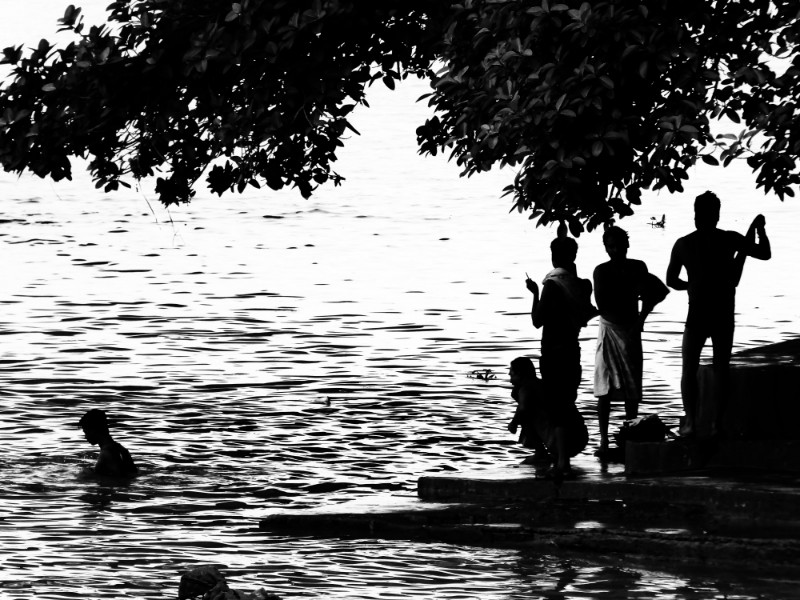
Pushing through the marketplace, we emerge onto the ghats where locals are bathing and washing. A man sluices out a row of pools for the birds to drink from.  By the river, a priest is blessing a man. They are crouching down with incense and flowers at their feet. A group of men with shaved heads watch and wait nearby. An air of sadness hangs round for them for this is a ritual of grief for those who have  a lost a parent.

P1020511-01.jpeg

We catch a ferry. I’m astonished when I see a man latch onto to the tyre on the side of the ferry, surfing with the wash. No-one bats an eyelid. This is why I love India. As the ferry nears the jetty, the man hauls himself onto the ferry and dives into the river, swimming to a jetty with moored fishing boats.

From the ferry, we walk to Kumartuli, the neighbourhood where gods and demons emerge out of clay and mud. It’s a warren of workshops, where statues are lined-up in all the different stages of creation - from crude straw and mud forms to colourful, painted gods waiting for transportation. We stop off to feast on delicious Bengali sweets and pastries.

Back around Park Street, men listlessly sit about or sleep under carts, sit at doorways to dark interiors, waiting for the intense heat of the afternoon to pass. Business has slackened a little but the pavement still offers every service you could need. Have a crumpled shirt? The iron wallah will sort with an old heavy iron heated up by a charcoal burner. Men stand ready with the tools of their trade at their feet - extracting wax from your ears, repairing your mobile, cutting your hair, polishing your shoes.

The evening sun floods the rooftops with a golden red glow as it quickly sinks away. Kites soar around the buildings, scouting for prey. Lizards scamper amongst the flower pots. Then in the last flush of daylight, it begins, the first murmur, then a growing sacred chorus rising and drifting across the city. It’s the call to prayer, the mosques summoning the faithful. As the call tails off, the sun sinks behind the horizon on this city of endless contradiction and its ceaseless human parade.

***
Alex Cochrane is based in Glasgow and blogs about exploration, travel, history, historical erotica and other curiosities on his website. You can also follow Alex on Twitter at @alexdcochrane. You can also see more images from his Kolkata walk here.

Edgework Artist Profile #1: Layla Curtis

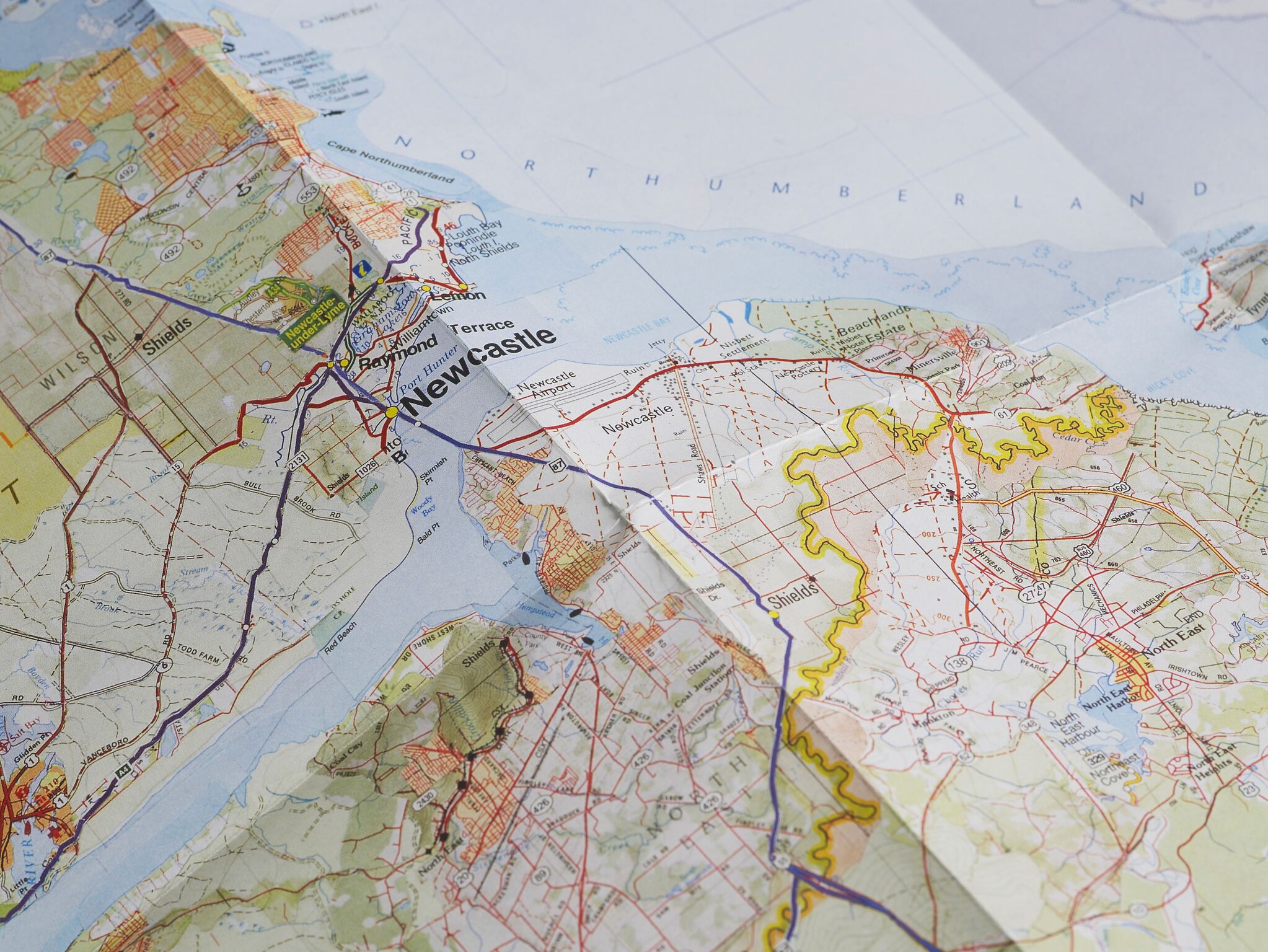
Newcastle Gateshead, 2005 by Layla Curtis

Newcastle Gateshead, 2005 by Layla Curtis

As part of our collaboration with Edgework an artist-led cross-disciplinary journal and store with an emphasis on place, we are running a series of monthly profiles of the artists here on Elsewhere. Where better to start than with Layla Curtis, founder of Edgework and previous contributor to our blog:

Layla Curtis’ practice has a focus on place, landscape and mapping and often examines the attempts we make to chart the earth, how we locate ourselves, navigate space and represent terrain. 

Polar Wandering, 2006 by Layla Curtis

Polar Wandering, 2006 by Layla Curtis

 Layla’s works include Trespass, an app for iphone which maps an oral history of a northern English edgeland and tempts the user to trespass in order to access the work (and which we featured here on the Elsewhere blog); Polar Wandering, a 27,856 mile long interactive online drawing charting her journey to Antarctica with the British Antarctic Survey, exhibited in solo shows at New Art Gallery Walsall, and Ormeau Baths Gallery, Belfast; and Tong Tana, a moving image work made while trekking with nomadic hunter-gathers in the Borneo Rainforest and exhibited at Matt's Gallery, London. 

 As well as featuring in international collections including the Tate Collection and Government Art Collection forthcoming projects and exhibitions include the collaged map The United Kingdom, currently on display in Ideas Depot at Tate Liverpool, UK (until 21 July).

Tong Tana production still, 2012.

Tong Tana production still, 2012.

A documentation of Trespass will also be included in the forthcoming exhibition This Land is Our Land at PAPER, Manchester, UK (curated by Edgework contributor, and PAPER curator Simon Woolham) from 29 June - 3 August 2019. Curtis is currently working on a series of new commissions for Tate shop to be launched later this year.

Layla Curtis on Edgework
Twitter
Instagram

Dispatches from Olsztyn - Practitioners

Photo 11-05-2019, 14 44 25.jpeg

By Marcel Krueger:

This year, I have been selected as the official writer in residence of Olsztyn in Poland by the German Culture Forum for Eastern Europe, and until September I will be living here, observing, taking part in cultural activities organised by my local partners the City of Olsztyn and the Borussia Foundation, and of course writing about the city. You can find regular posts over on the official writer in residence blog www.stadtschreiber-allenstein.de in German, Englisch and Polish (thanks to my official translator a.k.a. my Polish voice Barbara Sapala). But I will also write irregular dispatches from Olsztyn for the Elsewhere blog. As an amuse gueule, here is one of my first pieces for the Stadtschreiber blog, about a wander along the local river.

***

“Walkers are 'practitioners of the city,' for the city is made to be walked. A city is a language, a repository of possibilities, and walking is the act of speaking that language, of selecting from those possibilities. Just as language limits what can be said, architecture limits where one can walk, but the walker invents other ways to go.”
― Rebecca Solnit, Wanderlust: A History of Walking

I like walking. This seems to be an odd statement, given that anyone does that on a daily basis. But I think we don’t walk enough these days, and not consciously enough. Or, as writer and editor Paul Sullivan writes in his essay Walking the City:

Like writing someone a letter by hand, visiting a friend across town spontaneously or just sitting on a bench and watching the world go by, the act of meandering slowly through the city streets with no particular destination in mind is one of life’s simple pleasures – and an almost entirely lost art. While most of us would argue that we do stroll through the city to some extent – to the post office, through the park, around the block – a combination of factors, chief among them a general deficit of leisure time and an abundance of convenient public transport options, conspire to ensure we usually don’t get very far on foot.

So during my first week in Olsztyn I did what I always do when I want to learn about a place: I went for a walk. I actually went on a walk every day, though some days I cheated by taking a bus or the tram. I first drew circles in and around the old town with my feet, exploring the main thoroughfares and shopping centres, but also the back alleys, laneways and suburbs of the city.

For me, someone who is now living in a central location and without a car, Olsztyn really is a city that lends itself to walking. The new parks along the Łyna river (the German Alle) are pleasant places to stroll and to linger, and on Friday afternoon there where students and teenagers sitting under bridges or on the wooden steps that lead down to the water, swigging from beer cans and smoking; office workers on their lunch break sat on benches and licked ice cream, parents leisurely pushed buggies along the pathways left and right of the river.

Photo 07-05-2019, 14 29 46.jpeg

From the parks, I then walked northwards, past the castle from 1346 and the Warmia brewery from in a former mill building from 1868, and finally under the railway viaducts from 1871 and 1893 and the newer road bridges into the city forest proper. Every time I see the viaducts I’m reminded of Robert Budzinki’s tongue-in-cheek travel book 'Die Entdeckung Ostpreußens' (The Discovery of East Prussia).

Budzinski (1874 -1955) was a painter, graphic artist and author, and – even though he himself was born in East Prussia in Klein-Schläfken (Sławka Mała today) – in 1913 published his 'travel book' which is not only full of wonderful woodcuts, but also sardonically talks about East Prussia as the proverbial distant eastern province. He also records the often exotic-sounding East Prussian place names, before they were 'Germanised' by the Nazis 20 years later:

During my wanderings I continuously discovered places with not very known but quite illustrious names; so that I often thought I was roving about in a magical landscape. One day I took the train from Groß-Aschnaggern to Liegentrocken, Willpischken, Pusperschkallen and Katrinigkeiten, breakfasted in Karkeln, arrived in Pissanitzen, Bammeln, Babbeln, and had dinner in Pschintschikowsken while aiming to overnight in Karßamupchen.

The book remains in print until today, which I think is a testament to his enduring humour and skill as an artist. From under the bridges then I made my way into the city forest proper, with the Łyna growing wider to my right and only the occasional biker disturbing my solitude. I like to be out, walking, slightly removed from the noise of the world. Or, as Walter Benjamin writes in 'Berlin Childhood around 1900', 'Not to find one’s way around a city does not mean much. But to lose one’s way in a city, as one loses one’s way in a forest, requires some schooling.' The beauty of Olsztyn is that the forest proper is never far – so I can train to get lost both here and in the city. The lady walking her dog just that came towards me on the forest path did not seem to agree with my Waldeinsamkeit: the look she gave me over the rim of her sunglasses seemed to suggest that only idiots stand in the middle of a forest and scribble in notebooks.

I continued for another 30 minutes before I decided to leave the Łyna valley and loop back to the city centre. I walked up the wooden slope right of the river and came across the Leśny Stadium, now almost completely reclaimed by grass and trees, where athlete Józef Szmidt (the so-called 'Silesian Kangaroo', born in 1935 and an honorary citizen of Olsztyn today) broke the world record for triple jump in 1960 with a length of 17.03 metres. I wonder if the soft peat soil here had something to do with that. Further on, I came across a graffiti of three knights on a wall, maybe a harmless reflection of the Teutonic Knights that haunted these woods long ago.

Photo 11-05-2019, 15 09 33.jpeg

A not so harmless reminder of the violent past was just up the road – two cemeteries of honour, one a German one with dead from both World Wars that was restored and is looked after by the German Minority Association of Olsztyn, with men who died in 1914 lying next to men who were born in 1914; and the other a small Russian plot, with no headstones left but a German memorial set up in 1914 that reads:

Here rest Russian soldiers who followed the orders of their ruler, found their death fighting against the liberators of East Prussia and are now buried far from their home

It seems a futile honourable gesture, something that would have surely not been set up following the industrialised mass murder of the Somme and Verdun and during the Brussilov offensive, which surely eradicated all humanity left then.

When I walked back from the cemeteries, my head full of somber thoughts, chance and sunlight and the city cheered me up: a pizza taxi stopped near the forest entrance and two teenage girls emerged from the woods, inexplicably wearing white plastic antennae and white plastic fairy wings. They paid for the pizza and skipped back into the woods, to what I can only imagine must have been the first fairy pizza picnic of spring in Olsztyn this year.

The People's Forest

The Peoples Forest with type-small.jpg

We’ve been following The People’s Forest project with interest, rooted as it is in place and what it inspires. Co-curated by Kirsteen McNish and Luke Turner, The People’s Forest includes a programme of events, talks, gigs and artistic collaborations, and continues the history of great writers drawing inspiration from nature and the outdoors to present a literary programme designed to seek out new writing related to Epping Forest – London’s strange and wonderful woodland, and its unique history that has been shaped and maintained by man.

As part of the project,  Faber New Poet and Caught by the River poet-in-residence Will Burns will create a series of new works inspired by Epping Forest. Over the year Burns will pen a collection of poems, one per season, in part reflecting on the unique nature of Epping intertwined with his own experience of the forest real and imagined, and we are extremely pleased and proud to announce that we will be publishing one of the forthcoming poems here on the Elsewhere: A Journal of Place blog.

Burns has proposed a long walk from Wendover Woods to Epping Forest, revisiting the physical act that his mother made in her lifetime, and as a family unit twenty years ago. This journey will in part shape the latter part of the series and will revisit family history, memory and these two forests many miles apart. This journey will cross the rivers and chalk streams and hillsides of this odd and lost middle land between the capital and the bulk of the country. He will also be exploring what this strip of lush, wooded country means - this dividing line, in this divided time.

Will’s first poem “The Word For Wood” appeared in Caught By The River’s online journal in March that conjures up themes of isolation, crisis and crossroads:

The fertility symbols of other, older cultures
harass me through the cold wood.
The sounds of jackdaws going berserk
(though the sound is not their name…).
I might as well come clean—
all this is to impress somebody else
though they have long given up interest.
First I read they had left the conversation,
then I watched them leave the house,
finally I heard they left town

Speaking about the project and his connection to the location, Burns said:

“Epping Forest has loomed strange in my imagination since childhood. I grew up just outside its shadow, in Enfield, and my mother was born in Epping itself without ever knowing the place. Since moving out of London at 10, I have always loved woods – either 'my own’ out here in Wendover, or others that I’ve visited. They are places unlike any other in our imaginations and I feel as if there is a whole chapter of my memory linked to that part of London but somehow missing. I hope to recover it through a year of walking and thinking and writing in the forest.”

We are really excited to read more from Will as the project continues and we hope to bring more from The People’s Forest to our readers in the coming months. For the full programme of events taking place, click here.

Record Release: Outcrops, by Spaceship

An extended Trailer for the new Spaceship LP 'Outcrops', featuring excerpts from the tracks 'Whirlaw Stones (delta) and 'Bride Stones (glacier)'. Album available to order from www.wiaiwya.bandcamp.com

Listened to by Paul Scraton:

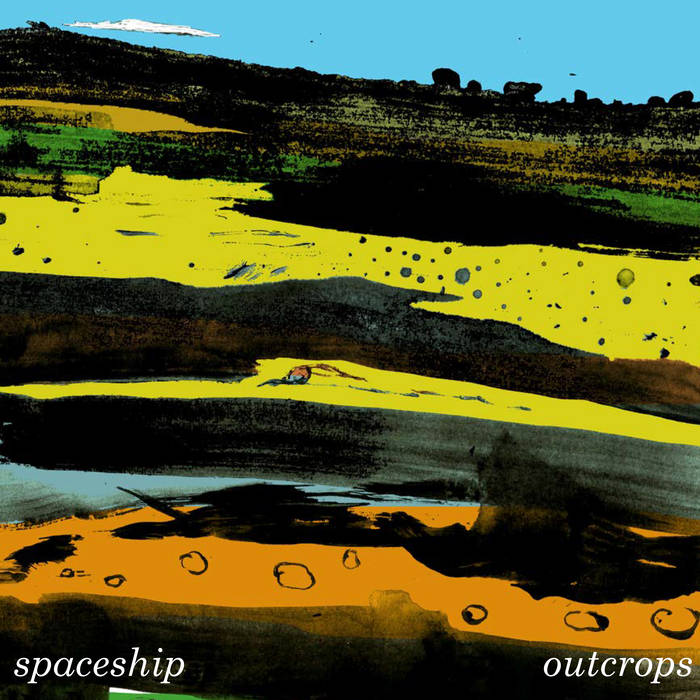
Spaceship is Mark Williamson, a musician and sound artist based in West Yorkshire, and today marks the release of ‘Outcrops’, a site-specific, haunting and melodic album that is not only inspired by the landscapes of northern England but was recorded there. The sandstone outcrops can be found above the town of Todmorden, and the album was recorded in place, with Williamson taking his synth up into the rocks to create the pieces encased in small caves. Each of the tracks on the album is named for its location and incorporates field recordings and found sounds, and was also created to evoke a particular phase in the geological history of the outcrops – Orchan Rocks evokes the Ocean, Bride Stones the Glacier and so on. This story is also lyrically told in the sleeve notes, describing the rivers as they “surged from the uplands,” the “peaceful, aquatic interlude between the ever-shifting chaos,” and the ice as it “plucked and scraped and tore at the land…”  

Crossing the Pennine hills a few weeks ago it came to me once again that how we interpret a landscape, how it makes us feel, is tied to what we know about it – the stories we have heard and what we bring with us as we approach it. The same can be true of works of art. What we know of the author or the painter, the musician or the photographer can shape our interpretation of a work, whether we want it to or not. The knowledge of how it was created feeds into our experience. I sit at my desk in Berlin and listen to the Spaceship album and I can picture the sandstone outcrops and the fields beneath the moors as behind the melodies I’m sure I can hear the wind blow and the birds call. Are they there? I’m not sure. But I know one thing: the next time I cross the Pennine hills the tracks from this album will echo. I have added to my collection, the one that helps me understand a place. The hills will be different somehow. That’s the power of art, the power of music. The power of storytelling, in all its forms.

***

outcrops.jpg

‘Outcrops’ by Spaceship is available on 12” and download, and is released on 24 May 2019 by wiaiwya.


Mark Williamson on twitter
Spaceship on soundcloud