
A Small Heap of Stones
/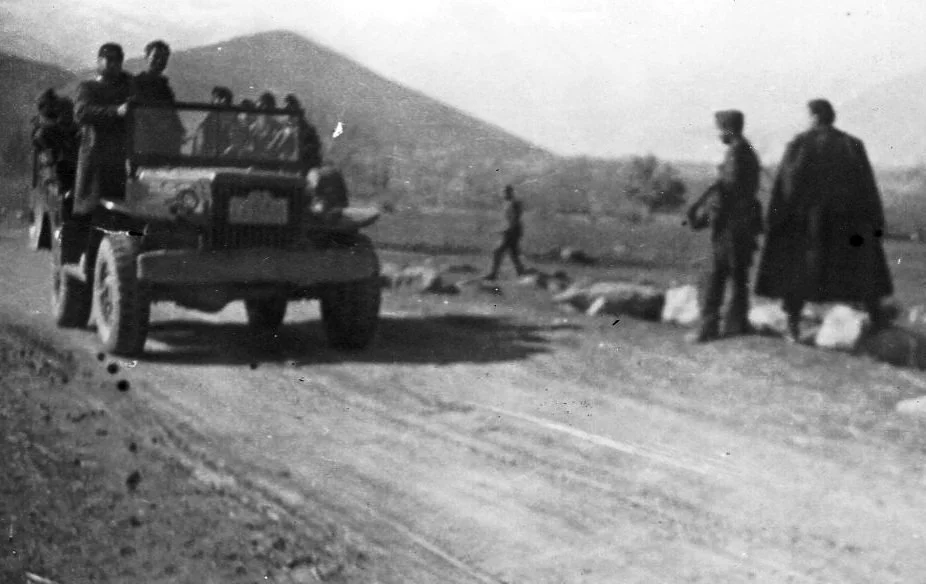
Fighters of Democratic Army of Greece in Prespa, Wikimedia Commons
Lifelines - Searching for Home in the Mountains of Greece by Julian Hoffman, published by Elliot & Thompson 2025
Read by Marcel Krueger
On the golden sand
we wrote her name;
but the sea-breeze blew
and the writing vanished.
From “Denial” by Giorgos Seferis (1900–1971), translated by Edmund Keeley and Phillip Sherrard
The map of Europe is still slashed with past trauma, embedded in the landscape. And it is maybe at the periphery, away from the centre, that these remnants are best visible. The Greek Civil War was a key conflict of both the Second World War in Europe and the Cold War that began in 1944 and continued until 1949. While it is an obscure conflict for many in Europe, it haunts Greece to this day.
As these things often do, it began with wide gestures at a conference table. The Axis powers had occupied Greece in 1941, with a British-supported resistance emerging soon after. The two principal Greek guerrilla forces were the communist-controlled EAM-ELAS (Ethnikón Apeleftherotikón Métopon–Ethnikós Laïkós Apeleftherotikós Strátos; “National Liberation Front–National Popular Liberation Army”) and the right-wing EDES (Ellínikos Dímokratikos Ethnikós Strátos; “Greek Democratic National Army”), which occasionally cooperated in action. After eliminating all of its political and guerrilla rivals except the EDES in early 1944, EAM-ELAS set up a provisional government in the mountains of Greece. Upon the withdrawal of German troops in October, all Greek guerrillas were brought together under British auspices in an uneasy coalition government in Athens. British Prime Minister Winston Churchill however feared that Soviet advances in the Balkans would lead to an EAM-ELAS communist puppet regime. So at a meeting with Joseph Stalin in Moscow in October, he suggested to his counterpart: “So far as Britain and Russia are concerned, how would it do for you to have 90 percent predominance in Rumania, [and] for us to have 90 percent say in Greece?” Stalin agreed, and the people of Greece suffered.
It all fully erupted in Athens on December 3, 1944, in what would later be called the Δεκεμβριανά or Dekemvriana, the December Events. On 1 December 1944, the Greek government of “National Unity” under newly installed Premier George Papandreou announced an ultimatum for the disarmament of all guerrilla forces. As a result the six EAM-ministers resigned from the new government, and EAM called for a general strike and a demonstration in front of the Greek parliament for December 3rd. On the day, at least 200,000 people marched towards Syntagma Square. Once the crowds had arrived there, Greek police loyal to the new government opened fire on the crowd, killing 28 and injuring more than a hundred. In the following days, EAM guerilla attacked police stations and abducted, tortured and killed policemen and others they thought of as loyalists, often under the eyes of British soldiers who were ordered not to engage by their commanding officer General Ronald Scobie. Only a day later did Winston Churchill order his troops to fight EAM-ELAS on the side of the Greek government. The attack succeeded in driving out the communists at the cost of 210 British troops killed and a few hundred wounded. 2,000 EAM-ELAS fighters were killed, as were around a 1,000 government troops. Hundreds of civilians lay dead.
Communist forces remained in the mountains, while right-wing vigilante bands operated in the central part of the country. A cycle of reprisals and counter-reprisals began and set in motion an internal displacement within Greece that would be repeated again and again over the next years. The communist guerrillas evacuated Athens taking thousands of hostages in order to dissuade the Royal Air Force from bombing during its retreat, with many of the hostages dying from the winter cold on the forced march. In turn, 13,000 members of EAM-ELAS were arrested by British forces and handed over to the Greek authorities which interned them under dire conditions, often on remote islands.
The communists accepted defeat in February 1945, and a general election was held in March 1946. As the communists and their followers abstained from the voting, a royalist majority was returned. A plebiscite was held in September 1946 which restored the Greek king to the throne. Unwilling to accept that, a full-scale guerrilla war was reopened by EAM-ELAS. They received support in form of rifles, machine guns and anti-tank weapons from Yugoslavia, but everything else was lacking: the communists did not have enough food, clothing, and especially transport; they had just enough to carry on resistance. And that resistance played out against a dramatically beautiful landscape.
The Prespa lakes are some of the oldest waters of the Balkans at the borders of North Macedonia, Albania and Greece. There are two lakes separated by an isthmus: the Great Prespa Lake, divided between the three countries, and the Little Prespa Lake, mostly within Greece. They are the highest tectonic lakes in the Balkans, at an elevation of over 800 metres, in a region where limestone and granite meet and which nurtures an abundance of wildlife including brown bears and wolves that regularly cross state borders on their wanders. Julian Hoffman, who has lived in Prespa since 2000, writes about the landscape in his latest book “Lifelines”: “Prespa is a crossroads place. [...] it’s where limestone collides with granite, generating a cosmopolitan citizenry of plants and associated invertebrates. It’s where three countries come together around two lakes, the invisible borders slicing through lake water, uniting through its natural watershed a range of languages, histories, religions, traditions and ethnicities. And it’s where heat-adapted Mediterranean ecosystems meet their cooler, Balkan relatives.”
Britain formally withdrew from Greece in 1947, but the USA, in an early example of what would later be called the “Domino Theory”, took over supporting the Greek government to avoid a communist victory. Bolstered by American equipment, government forces pushed the rebels deeper into the mountains. In 1948, Yugoslav leader Josip Tito broke with Joseph Stalin, Yugoslavia became a bloc-free country no longer aligned with Soviet domination in Eastern Europe, and it stopped the support of EAM-ELAS. As the war entered its final phase, the situation for civilians caught on the communist side became even more dire. Desperate for fighters, EAM-ELAS initiated what would become known as Παιδομάζωμα, Paidomazoma, the forced removal of children. The communists began “evacuating” children out of northern Greece to neighbouring communist countries, officially to remove them to safety from combat areas. But it also meant that their parents would be free to fight, and the Greek government alleged that this was an attempt to indoctrinate Greek children into radicalised communism abroad. Between 25,000 and 28,000 children were removed from Greece and resettled in socialist countries, with some only returning decades later.
The war climaxed in 1949 when government troops stormed the final communist stronghold in the Grammos mountains. After days of brutal combat the rebels finally broke, fleeing across the Albanian border. As Julian Hoffman writes:
And in 1949, as the war between the Hellenic Army of Greece’s right-wing, royalist government and the Democratic Army of the anti-monarchist Communist Party of Greece neared its terrible end, Prespa was key to its coda. From here – where the General Secretary of the Greek Communist Party, Nikos Zachariadis, directed the Democratic Army from his headquarters in a hilltop cave just a few kilometres from the trenches on this limestone ridge – refugees and fleeing left-wing soldiers desperately tried to escape the country when the Communist forces finally collapsed. As they did, the Greek Air Force, reliant on planes, equipment and training supplied by the British and American governments, rained bombs across the Greek portion of the basin in an attempt to disrupt the flow of escapees. And napalm was unleashed on select landscapes of the north.
For a small nation like Greece, the human tally was devastating. Over a 150,000 people were killed and around a million Greeks were displaced internally and externally. It took until the mid-1950s before the last communist prisoners were returned to their families from their island prisons. The Greek economy was shattered, but now that a communist takeover had been thwarted funds were coming in via the Marshall Plan and over the next decades Greece slowly recovered – economically. The wounds of the war however are still embedded in Greek families, and in the landscape.
Julian Hoffman and his partner Julia moved to Prespa on a whim, but the hospitality and friendship of the local community meant that the two really could find a “home in the mountains of Greece”, as the subtitle of “Lifelines” promises. His home has inspired him ever since, and he has written about it in many essays and books like “The Small Heart of Things” (2012) and “Irreplaceable” (2019). But it is his latest and probably most personal book that exquisitely conveys the beauty and complexity of the Prespa basin.
Despite Hoffman's rich signature prose this is however not a bucolic, escapist book for those dreaming of living the ouzo-and-souvlaki life. Hoffman honestly and openly talks about his personal challenges and the limitations of an outsider-point of view, but also about the dangers the humans and animals of Prespa face in times of a splintering European Union, tightening borders, and the effects of climate change. “Lifelines”, a small part of which was published as an essay in the first-ever Elsewhere print issue in 2015, is mostly a classic memoir but also branches off into reflections on the wildlife of the region including pelicans and bears, and is also part reckoning with Covid and the damage it has done to all of us. The strongest aspect of the book however is laying open the many layers of memory embedded in the landscape, by example of the community of which Julia and Julian have become part.
If a single mountain ridge could ever symbolise this place, it is this one. Its underlying limestone is prone to dissolution, being worked by water over fathomless spans of time so that any natural cracks, hollows and fissures are gradually opened and enlarged through the slow process of erosion. It feels as though the stories of these varied shelters – of sacred trees, livelihoods, traditions, war and exodus – have been poured whole into the stone. The entire mountain a vessel of memory. But the stories of these shelters aren’t yet complete: they’re still in motion, continuing to reshape our lives just as clearly as water reshapes these stones.
With its horror and despair, its shifting allegiances and complex narratives within the wider global conflicts the Greek Civil War remains a key part of European history that changed the region forever. But with like so many other European topographies at the periphery, it is here among the beauty of the Prespa region that the complex pain and horrors that humans afflicted on humans in the appalling European 20th century manifest to this day. Not in monuments or museums, but in the stories of its people.
On a late August morning, I met a man called Ritsos in a place where I'd never seen anyone before. “What are you doing here?” I'd asked him, having abandoned my telescope and other gear to run down the slope as fast as I could in the hope of speaking to him before he left. “I was born here,” he replied, pointing to a small heap of stones beside him. “This is all that remains of the house that we left when I was five years old in 1948 during the Civil War. Make sure you tell them there are people up here as well as birds.”
“Lifelines” is a wonderful book about the importance and the beauty of the periphery. We ignore it at our peril.
Read previous Elsewhere interviews with Julian about the Prespa region and his work here and here.
Marcel Krueger is one of the editors of Elsewhere. He works as a writer and translator, and through the prism of family history explores the European past and present and writes about memory, nostalgia and identity, especially focusing on Ireland, Germany and Poland.