
The Letter
/
By Claire Everett
At some indeterminable point it became more than a walk. We are now deep in conversation. When I say "we" I'm not sure if I'm communicating with the land itself or the spirits of place. I believe it’s both, along with all who've dwelled, toiled, or battled here through the ages. It's a circular route of my own making, beginning in the edgeland before crossing railway line and stile to enter the hollow where three fields intersect somewhere between the Moors and the Dales. Sheep graze either side and swallows skim the ripening wheat to sip from an ephemeral pool, by turns untethering and gathering my thoughts as they to and fro. The wind always rises here whatever the weather, keening like the buzzard whose shadow drifts lugubriously over my own. I feel the dialogue viscerally as sure as the rails hum faintly underfoot from a high-speed train approaching miles away.
Ahead of me, and to left and right, I see Sovereignty in this humble stretch of land that I have come to know so intimately. I am in the presence of a Kingmaker. How many would-be heroes did this Loathly Lady woo before she finally bestowed stewardship on the one who proved his worth? And for his integrity and loyalty she was magically transformed into the most beautiful maiden he had ever laid eyes on. At what point did I become aware of myself and this vessel that contains me? I remember being upside down, or spinning, and the scent of grass stains on my knees. Then the self-consciousness of a mole in the centre of my left wrist, or the way my cheeks flushed when my name was spoken in class. And this land, too: when did we lay claim to the shape and substance we are now? We have both known those who would celebrate us and others who would despoil and maim, some priding themselves on not leaving a mark.
The history remains, indelibly, whether we can see it, or not. From my scant research I know the Brigantes would have lived and loved here in their hill forts, centuries before the Romans made it a garrison, or at least a beacon. When the Great North of England Railway was under construction, one sarcophagus was unearthed bearing an inscription to a fallen Centurion in the words of his beloved. There, the sensuous curve of the embankment lined with hawthorns tells the almost forgotten story of a stronghold for William the Conqueror when he was encamped here, subsequently fortified as a motte and bailey castle for the Bishop of Durham until it was razed to the ground by King Henry II circa 1178. Like the relics of a long-fallen Empire, the vestiges of those once commanding ramparts were also discovered with the coming of the Steam Age. I picture the roots of that barbed, blooming or berried boundary reaching deep into the dark soil decades upon decades ago, a liminal threshold in and of itself, yielding runic wards and charms for my Anglo-Saxon forebears.
Today I think of her. An elderly cousin-in-law, long deceased. A spinster all her life. And how she rejoiced in me as an expectant then nursing mother. Little did she know that in time, he, the husband, the father, would denigrate me for my scars and folds, my breasts, either hot and heavy with milk, or withered and soft like kneaded dough once our son had had his fill. He said I was ruined. When I finally left, years later, I counted the months — three, to be safe —until my skin, renewed, was free of his touch, even if the memory of it remained bone-deep.
I'm not sure why she's come to mind but then I see it. The letter. How tenderly she took the envelope from her bureau drawer, and presented it, gesturing me to open it. The paper had yellowed where it was once sealed. The sheets inside were neatly folded, crisp as freshly laundered linen, tissue thin. I wondered if she had made a ritual of this or if many years had passed since she'd last looked at this exquisitely inked exchange between herself and a young man who had courted her for two years before he was called up. At first glance, the lines were indecipherable, the pages filled edge-to-edge with scribble, as if by a child's hand, dark blue interwoven with black. Then she revealed the secret code, turning the first sheet ninety degrees until the swimming letters became still, and with a little effort, legible.
"Cross- writing", she explained, "We did it initially to save on postage. But he and I used to delight in replying directly over the letter we'd received."
It seemed an imposition to hold in my trembling hands the gentle and considered warp and weft of their romance. I returned it to her and watched her tend to it as if it were the most beautiful work of origami.
"He died in Burma," she said, and briefly touched her chest, "but he lives forever here."
She went on to tell me how they'd only ever kissed but he'd promised that on his return he'd speak to her father, and they'd name the day.
"It wasn't to be," she said, "but no one can erase the fact that he lived, we loved."
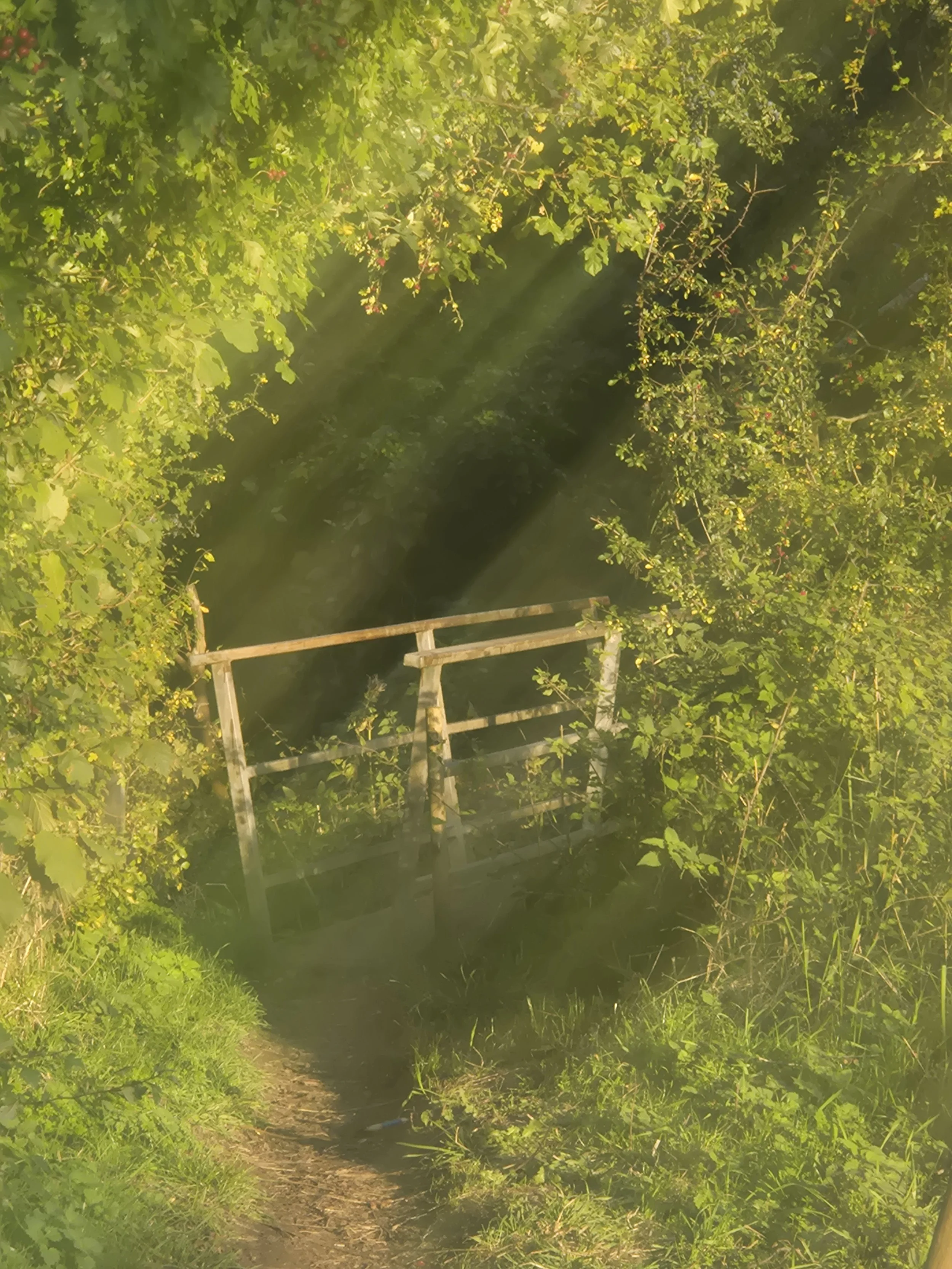
I'm standing on the mud track now, beneath the whispering oaks. I move slowly deliberately, suddenly mindful that the cleats of my boots are overwriting the prickings of rabbits, crow prints, a fragment of a fox's story told in the early light. In a matter of hours, there will be nothing to say I came this way at all. When people ask me where I walk and I tell them, they often show surprise. "Why? There's nothing to see!" But, for me, there is resonance here. As age presses harder and writes more deeply on my skin, rust tattoos railing and lichen, stone, each miniscule embellishment a quiet rebellion, an act of graffiti like a handprint on a cave wall. I am here and I matter.
The path almost complete, I stand as is the custom, in the netherworld between the horse pasture and the housing estate. A robin sings, then a blackbird. Inching closer to dusk, wash over wash, pink to mauve, to indigo, a living watercolour hangs in the breeze, not quite dry before it is transcribed with the lorem ipsum of a song thrush. It is believed the castle moat would have been here where the beck still flows, clear after yesterday's rain, and brighter for the scent of late Sweet Cicely. Suddenly, from under the bridge, like an arrow from an invisible bow, a kingfisher comes into its blue and is gone.
Claire Everett is a Sixties baby born in Shropshire to working class parents. She has written poetry since childhood and from 2010 became particularly interested in Japanese short forms. She has served as editor for various journals including Take Five: Best Contemporary Tanka, The Red Moon Anthology, Haibun Today, and Skylark, and as a contributing editor for MacQueen’s Quinterly.
In 2023, Claire won a prestigious Touchstone Award for her haibun "A Thousand Thens". The haibun and the panel's commentary can be found here: https://thehaikufoundation.org/claire-everett-touchstone-award-for-individual-haibun/
Claire’s writing has begun moving slowly from predominantly poems to chapters, and she has written a nature-themed memoir which she is hoping to publish one day. In her other life, Claire works as a Care Coordinator/Social Prescriber for the National Health Service supporting local people with very diverse needs.
In between working full-time, Claire occasionally posts on Instagram and Bluesky as @a_ life_ of_ short_ lives' and is just starting to explore Substack. Some short experimental pieces have found a home on Tanya Shadrick's A Cure for Sleep.