
Pilgrims
/
Walyunga National Park
By Jamie Lin
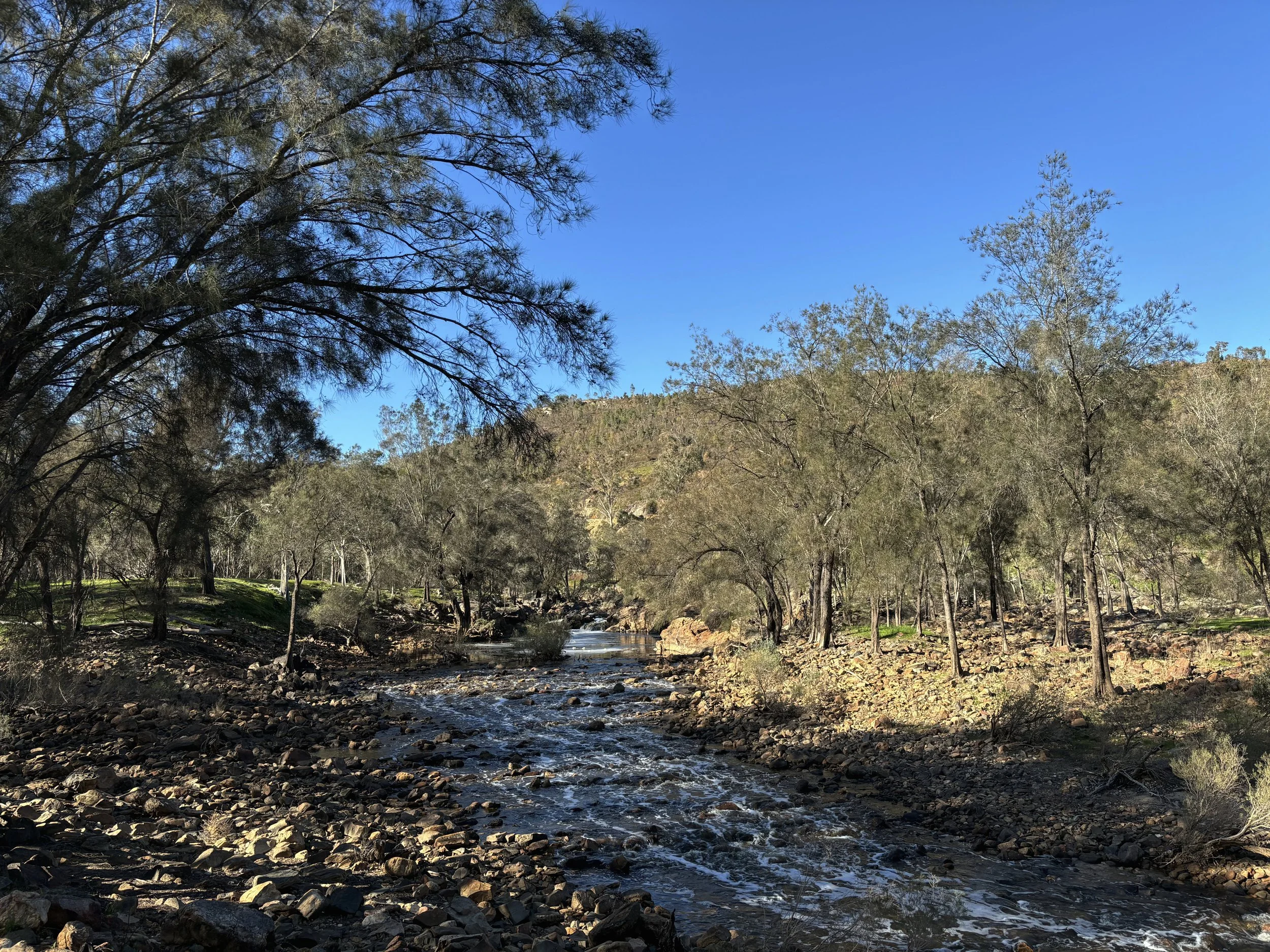
We are scrambling over rocks at Whistlepipe Gully in the Perth Hills in Western Australia, to the soundtrack of water coursing downhill. The sky is blue, cloudless, and the water runs clear. Sunbeams crack into shards as the stream shifts against rocks, while overhead, a Cessna drones by.
It is late in June, deep in the continent’s winter heart. We have made the journey from Singapore, 2,500 miles as the crow flies, seeking, like many others before us, a respite from the concrete and the asphalt, from the countless high-rises that stretch into the sky, from the city’s heat and hustle. The first night at our Maylands Airbnb brings the cold and the wet and the near-absolute quiet, the only sound being the patter of raindrops against the window.
Back on the trail, boulders and rocks defy our intent. Their angled faces are like bared teeth that line our path. We slow, our gazes narrowing to the path ahead as we weigh spaces between jutting rocks and sidestep nodding scrubs threatening barbs in our sleeves. Even here, on well-trodden footpaths, the land is defiant, unpliable, wild.
The Whistlepipe trail is popular and runs upstream on a gentle incline, making its way through jarrah and marri forest. We are tailed by groups of women, quiet couples with dogs, and large families, their children playful and boisterous and very much in their element. We hear them before we see them, fragments of sound and laughter drifting in and out of the bush. We pass those who have stopped to take pictures, their gazes lifted with their phones into the sky.
Towards the end of the looped trail, close to where we began, we emerge onto a massive clearing, an outcrop of textured, pitted stone. Compared to the relative cool of the forested sections, the sun here is unforgiving, even in winter. In the distance, Perth City is a mere sliver of grey and white, almost an afterthought in the vastness of the land surrounding it. Here, the granite under our feet is unyielding, the sun catches in our eyes, the wind sweeps against bare skin.
In my mind, I picture myself as a tiny human amid the towering, shadowy landscapes in Chinese shan shui paintings, or being dwarfed by the figure in Odilon Redon’s Guardian Spirit of the Waters. Was this what writer Robert Macfarlane meant when, documenting his journeys into the British wilderness, he caught a “brief blazing perception of the world’s disinterest”?
But then I think about the Noongars, the original inhabitants of this land, and how, over the course of millennia, they learned to draw sustenance from the seemingly unyielding landscape around them. Noongar stories tell of the Waugal, a rainbow serpent who resides in deep underground springs. As it moves across the land, its excrement forms the limestone features scattered across the Perth Basin, creating rivers, streams, hills, and gullies. These elemental features have given generations of Indigenous Australians shelter and provision – fresh prey and fresh water in the scorching summer, and sturdy protection from the rain and the cold in winter. While in Jewish and Christian traditions, the serpent is the Tempter; here, the rainbow serpent is the guardian of fresh water and creator of the life-giving elements of the Western Australian landscape.
Standing in the clearing, I could almost feel the land around us thrum as if the flora and fauna were accommodating something deeper.
*****
Northeast of Perth City lies Walyunga National Park, and on one cool afternoon towards the end of our trip, we are hiking the Kingfisher Trail, an easy 6 km (3.7 mile) loop. It is one of our favourites. As we come upon the final stretch of the trail where the path runs along the Swan River, we tiptoe carefully around grazing wallabies. They pay us little heed, nibbling on the grass with the sun on their brown fur. It is quiet and the air is bracing. All around us is green leaf and grey trunk, and the ochre ground yields gently under our feet. Then, as if in a dream, we catch a voice on the wind: lofty, ethereal, the language unfamiliar but wrapped in a haunting melody. And as we round a bend, we see three women in what can best be described as poses of reverence, their faces lifted to the river, eyes closed, bodies swaying to the ebb and flow of the melody.
All three stand on the riverbank as the water sweeps downstream with a gentle roar, its surface scattering the late afternoon light. The woman in the middle has her arms wide and her mouth open in song.
In Macfarlane’s book, Landmarks, he describes the life of Scottish writer and poet Anna ‘Nan’ Shepherd, who, though she had opportunities to go further afield, loved simply to wander in the Cairngorms near her home in all seasons, “practic[ing] a kind of unpious pilgrimage” by “tramp[ing] around, over, across, and into the mountain, rather than charging up it.” On another continent, many centuries earlier, in a story told by the Chinese philosopher Chuang Tzu, we read of a forest in Chingshih, where catalpa, cypress and mulberry trees grew. Each type of tree had a specific use, the smaller ones fashioned into posts to tether monkeys, the larger ones used to roof people’s homes, and the largest into exquisite coffins for the aristocrats. Yet, precisely because of their value to humankind, the trees were unable to live to their full lifespan – this he calls “the grief of usefulness.”
While landscapes of the Scottish Highlands and China could not look more different, these reflections challenge how we relate to our surroundings. Does the value of a landscape lie in how it resists our desire for domination and mastery, how it challenges our will? And when we have successfully “charged up” its summits, or depleted its resources, is its value no more than the bounty we can extract from it?
Along the bank of the Swan River, as I approach the trio, I wonder about their historical relationship to this specific piece of land, this river, this valley; after all, a section of Walyunga used to be an indigenous campsite that was in continuous use for thousands of years until the late 1800s. The original inhabitants would have returned to the campsite regularly, close as it was to plentiful resources provided by the river and its surrounds. From the relative safety of their shelters, they would have worked stone, wood, and bone into implements, woven clothes from animal hide, hunted and gathered meals, and joined together in communal and spiritual ceremonies. Did the trio sense how the land’s geology, flora and fauna have safeguarded a creative potential across generations of humankind, and could this be their gratitude returned in song?
Paradoxically, even though the Noongars were so adept at living off the land, in their worldview, Country has never been just a resource. Instead, it is living kin, connection, a place of belonging, and their reverence for it is evident through its centrality in Aboriginal Dreamtime stories, their deep knowledge of and respect for the seasonality of flora and fauna, and their care for its well-being. In stark contrast to the mentality that the British settlers brought to Australia, terra nullius, where land that belongs to no one is there for the taking, for the Aboriginal peoples Country has always been there, and it is all of us who, in briefly passing through, belong to it.
Careful not to disturb, we pick our way past the trio quickly and quietly, feeling almost as if we are intruding on something secret, something sacred. I think about Shepherd as a pilgrim in the Cairngorms, Chuang Tzu’s counsel, and now, the three women and their offering to the tumbling waters before them. I think about how I am here as a tourist, a traveller, or dare I say, a pilgrim, a word derived from “peregrine” that used to refer to something from abroad, something foreign (from peregre, per – through; ager – field). And perhaps it is this idea of coming from afar, this ability to always see something as if for the first time, which helps us cherish even the landscapes we are most familiar with.
As we round another bend, following the flow of the river to our left and dipping our gazes at the sun before us, the voice fades slowly into the distance, until all we can hear is moving water.
*****
Jamie Lin is a writer from Singapore. His published work can be found in The Other Journal, Prose.sg, The Routledge Companion to Death and Literature, Cleaver, Relief, Flash Magazine (UK) and Quarterly Literary Review, Singapore. He tutors writing and communications at the National University of Singapore.