
Surfacing
/
By Anna Evans
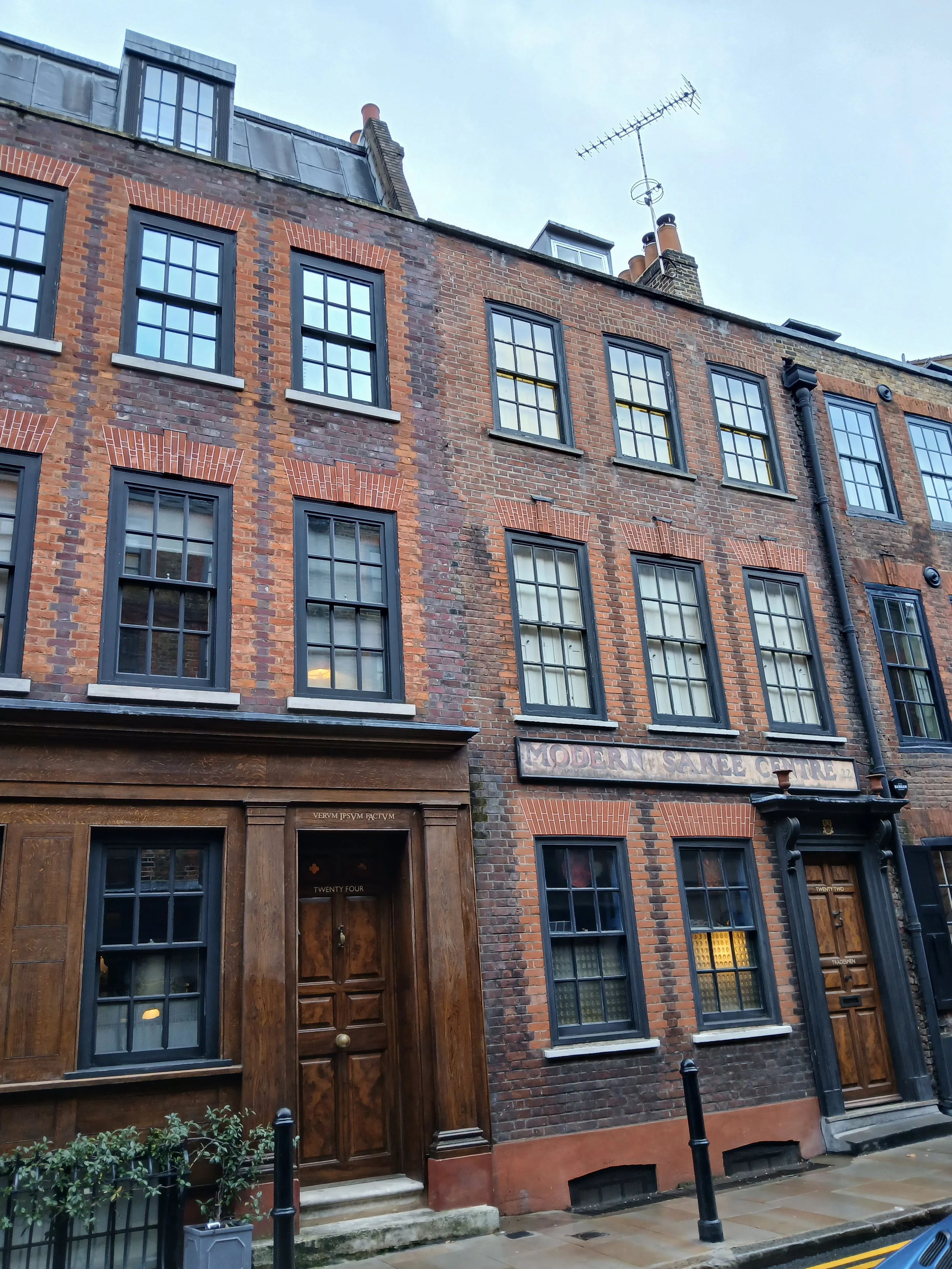
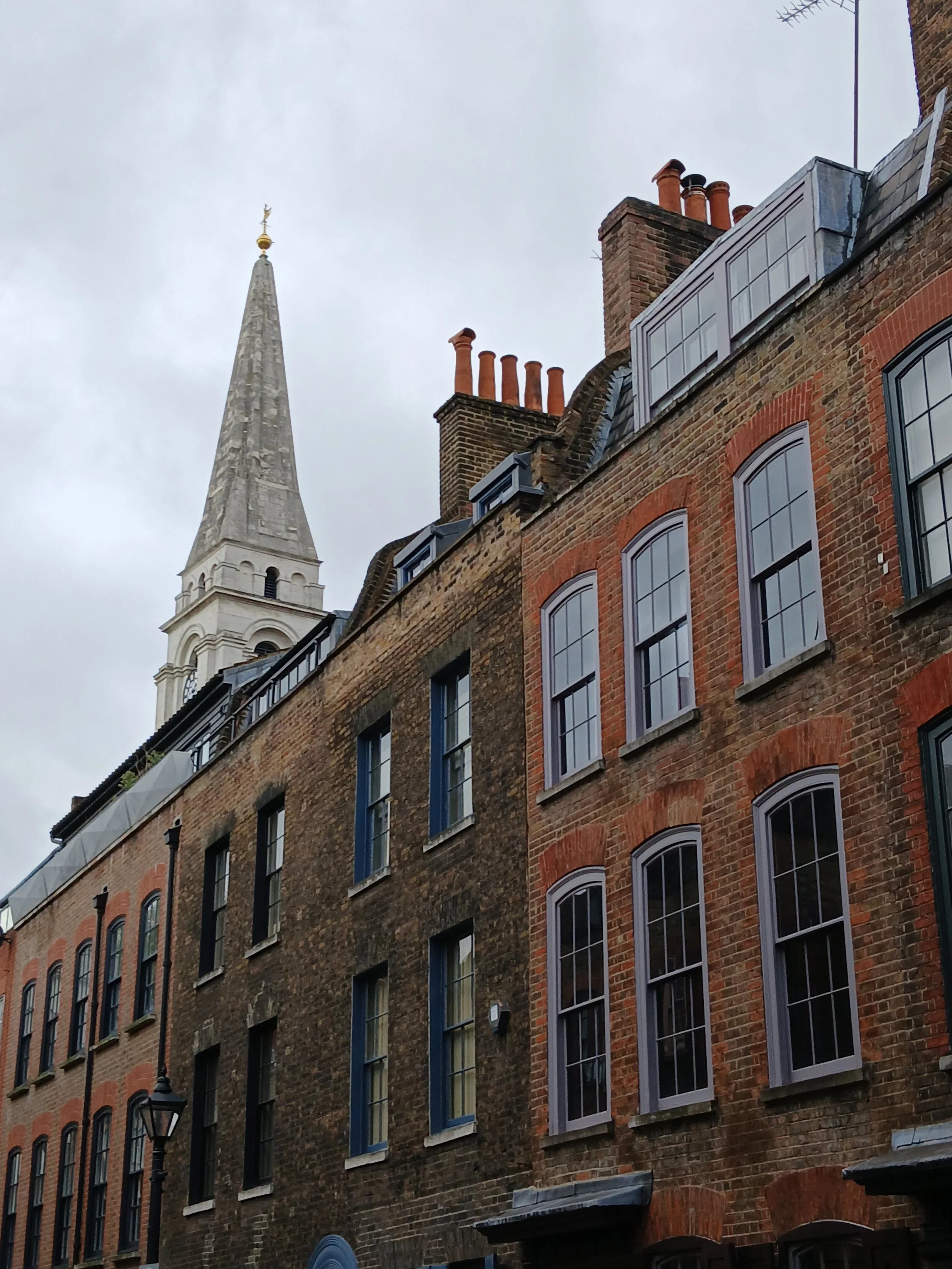
In the mist and cloud of rain-soaked London, I turn the corner into one of the streets off Brick Lane and glimpse a church spire across the rooftops, and just beneath the clock face, the windows of lofts built for weaving. It is as if the streets sink back to reveal themselves, spinning upwards into the mysteries of the narrow-pointed roof of the church. In the enclosure of heavy cloud, reflections on rainy pavements. A Latin inscription above a door reads Verum ipsum factum… truth is itself something made... we can only know what we make ourselves.
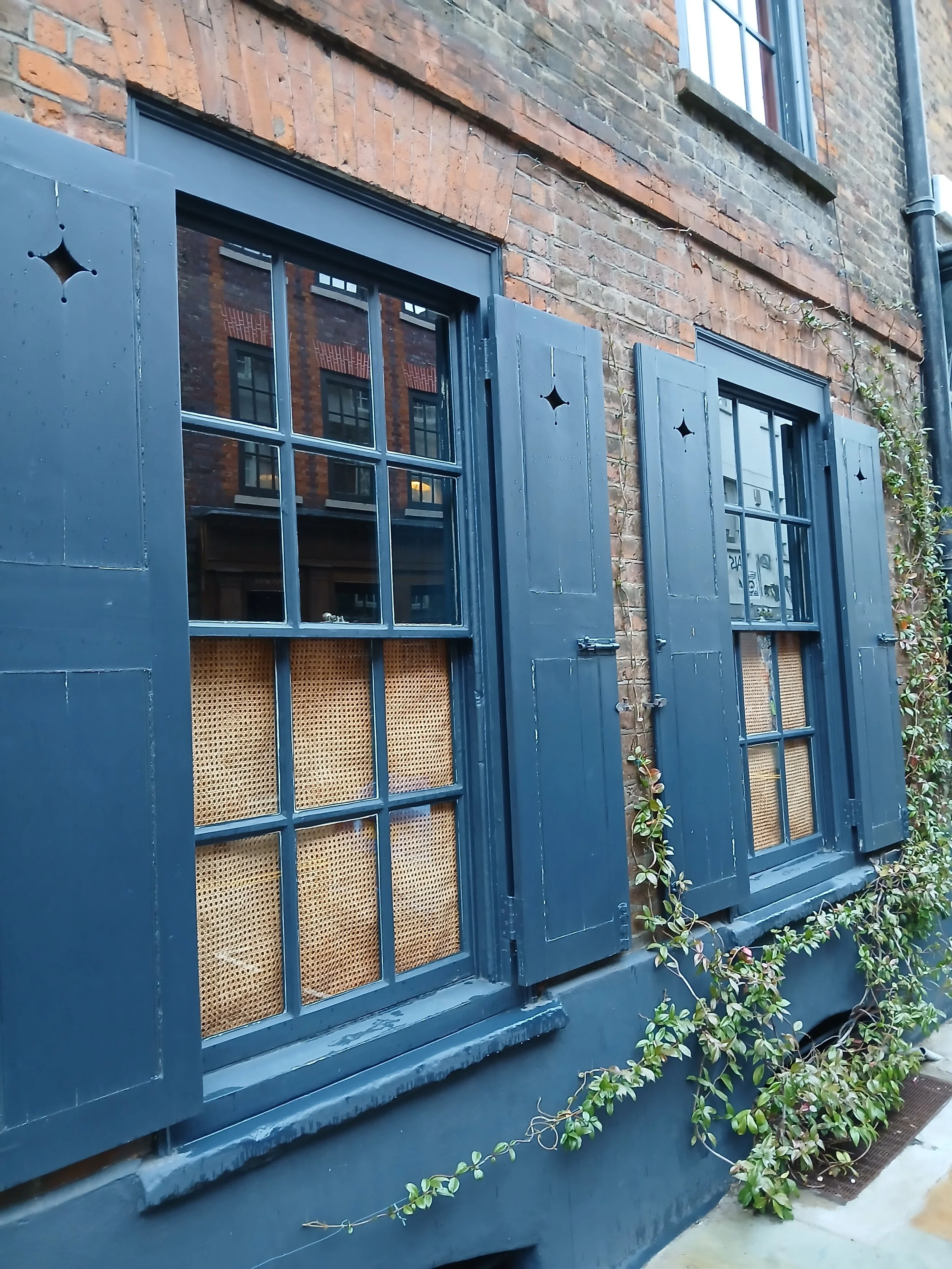
The historic Spitalfields streets that I wander, are elegant and preserved like stepping back in time, with cobbles and lampposts, chimneys, and intricate iron railings. Many of these houses have been restored though most retain features of their previous incarnations. There are arched doorways, wood panelling, sash windows. Plants and pavement gardens, the occasional window box or street planter. Ornate carvings around door frames, of roses and ornamental flowers, decorated wooden shutters on hinges. The colours are sage green, burgundy, dark blue.
At the centre of my wander through this grid of streets lies Brick Lane, an artery running between Whitechapel and Bethnal Green in the east end of London. Brick Lane is a patchwork of contrasts, with stories on every corner, in every building, in the countless footsteps of visitors. These stories are bound with industry and the docks, labour and poverty, the textile and garment trade. This part of the city is one of the points of arrival and a place of settlement for successive populations of migrants. Vanishing traces of the past that overlap with the present. The remains of historic fixtures, ghost signs, street signs in Bengali and English.
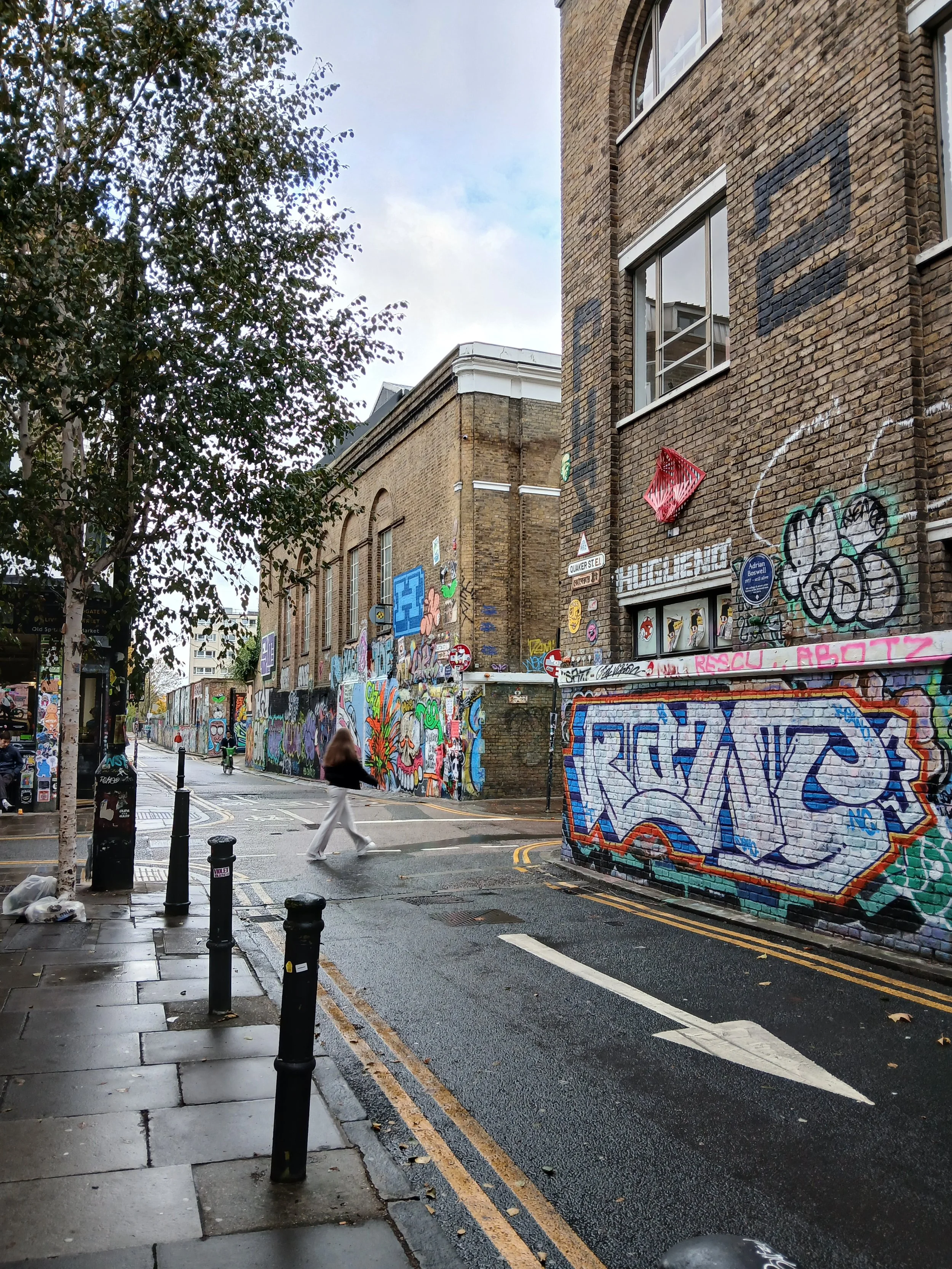
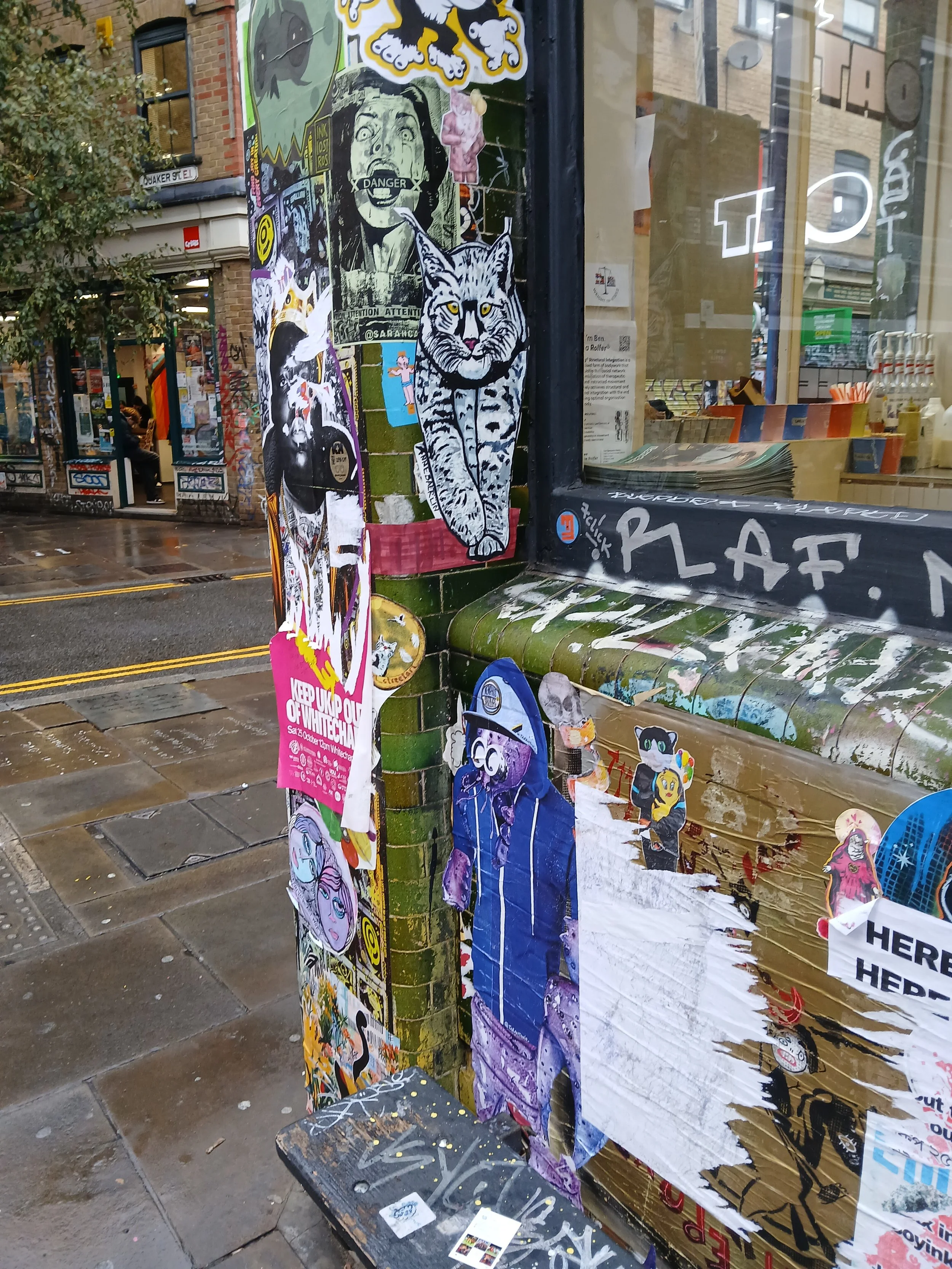
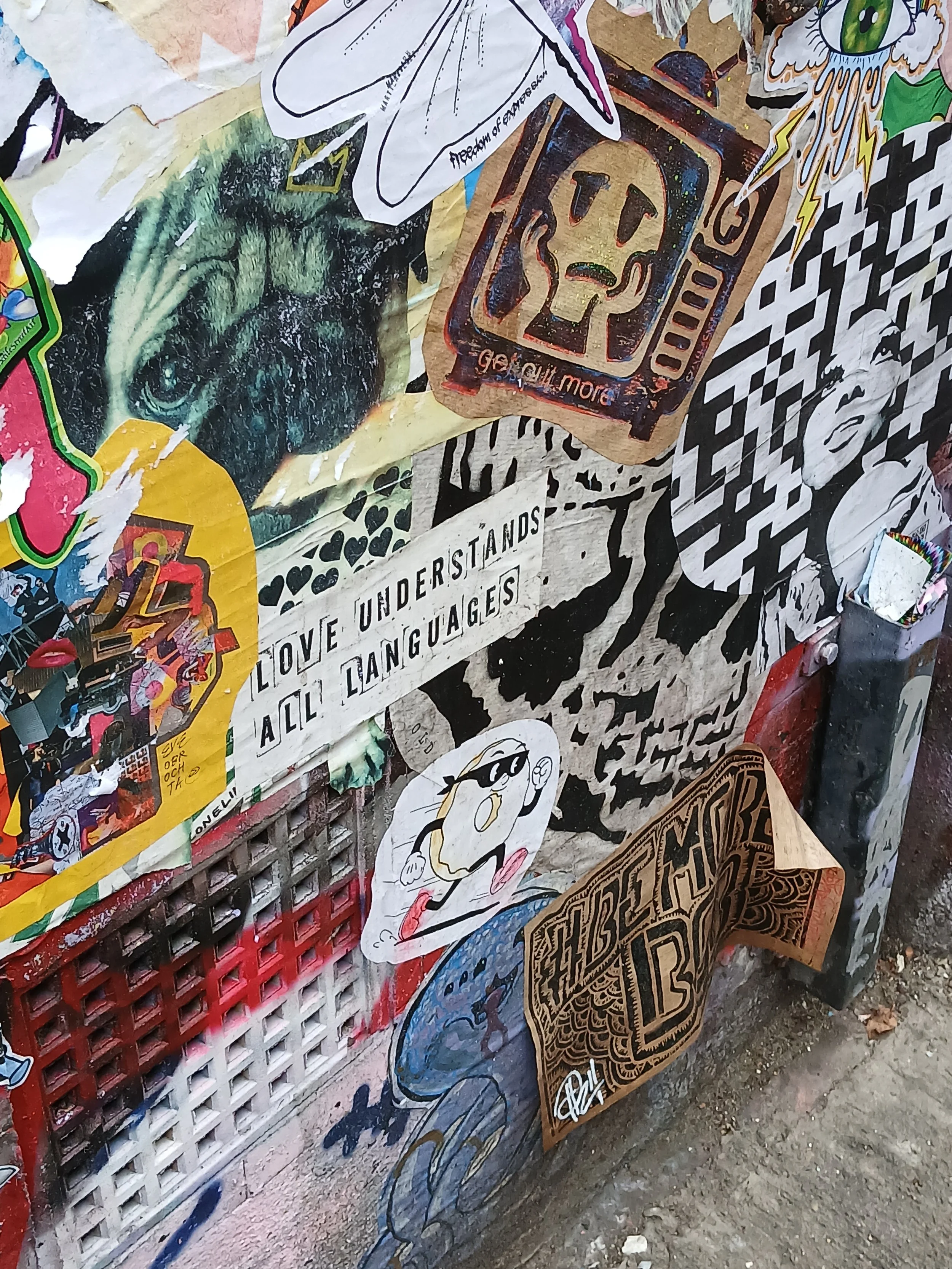
Crossing over the railway tracks, this part of Brick Lane is occupied by vintage stores, tattoo places, coffee shops; there are queues of people outside the bagel bakery. Colourful and highly decorated, patterned with collage and graphic art and the tags of graffiti artists. A proliferation of faces, words, designs; in layers that are never fully removed. It is hard to imagine this place without the psychedelic colour that sharpens its edges. Barely a building escapes it, barely a surface that could be written on.
A wholesalers and manufacturers sign, the storefront boarded up, where posters advertising new looks and outfits compete for space with dystopian features and bubble writing. Train yards and warehouses in states of abandonment. Near the railway bridge in the rain, dark towers loom over brightly coloured walls, tarmac shiny with rainwater. These are the changes that are not mapped, the street art, posters and political slogans that are pasted over, covered by new images and words. Anti-war, anti-fascist, the protests taking their place among the layers of history. This street retains the atmosphere of past and present struggles. ‘Ceasefire now’, ‘Refugees welcome: Stop the far right’, ‘Trans Rights Now’, ‘Stop bombing Gaza’.
Wandering in the city, there are deviations and epiphanies. I walk with the flickering of the present, seeking out signs and symbols, traces of histories that might be tangible still. The voices and conversations of those around me, impressions of my walk, and the memories I carry with me, uncertain and opaque. With me are all the times I have walked here before. What I pull to the surface or choose to leave obscured. The memories from when I studied, just along the road from here in Mile End. Migration stories, my ode to this city of arrivals, and departures. The last time we walked here. The time we walked together, imprinted with significance, in those days we spent before leaving London. What I miss about living in this city, of being caught in its movements and changes.
We walked here in May, retracing our steps and remembering; the long walk we took in east London, from your place near Clapton, through Hackney and to London Fields, the pull of Brick Lane, following its tides, downstream. We walked to Cable Street to see the mural of resistance to Oswald Mosley’s fascists, and along Brick Lane, looking at the street art, the slogans on posters and stickers. Someone had pasted a Daily Mail story about the scourge of vandalism and graffiti in Brick Lane, its outraged headline competing for space amongst the layers of colour. It is spring, there is brightness in the air, and we find a place heady and merry with the trails of many footsteps, a lightness that is intoxicating. The sort of wandering that wants to be festive, to be with others, make noise and congregate. London is a place of contrasts that can be jarring, that can be celebratory; emblematic of any city that has been altered over time by those who passed through.
****
At the end of the street the wider city hovers, beckons. But time is suspended in these streets. The pavements dark grey, rain-soaked, footprints etched in. Reflections in the panes of other buildings, the other side of the street. I am entranced by the way the windows reflect the buildings across several times over. These streets retain a sense of intrigue, and I wonder what might remain behind these facades and what has been lost, what is hidden and encrypted, what has faded with time.
Behind each door and window, stories of dwellings and rooms, of work and longing, conversations and rituals. The refuges and spaces, the familiarity and strangeness in the struggles of daily life; the routine, stifling, necessary, like a trap that forms around most lives. The need to tell stories, all the imagined and unspoken parts that accumulate. The patterns of new generations that cities create and allow; contrary impulses and wanting to be different, to not repeat mistakes. Lost souls and drifters, negative emotions, and all the narrow escapes.
I remember main roads, not deviations so much, as though I were always passing through, heading somewhere. Not understanding then, that there was time. Anxiety took a different form, a worry about the future. The present seemed longer, in the space of each day. Now I take my time, meander, but am restricted by the clock and the feel of days passing – of passing through them. The bus route through Dalston, Hackney, Bethnal Green… on the front seat, a pile of library books, darkness falling… the city passes slowly this way. Sometimes it would take me an hour and a half to reach my destination. I did a lot of thinking on buses, but it didn’t leave much time for other things.
Grey steel and glass, heavy clouds loom overhead, the windows of an office building. The towers of the city loom, a reminder of what lies beyond the cocoon of streets. The city skyline feels temporary somehow and accidental, as if it might be easy to erase it from view, from imagination.
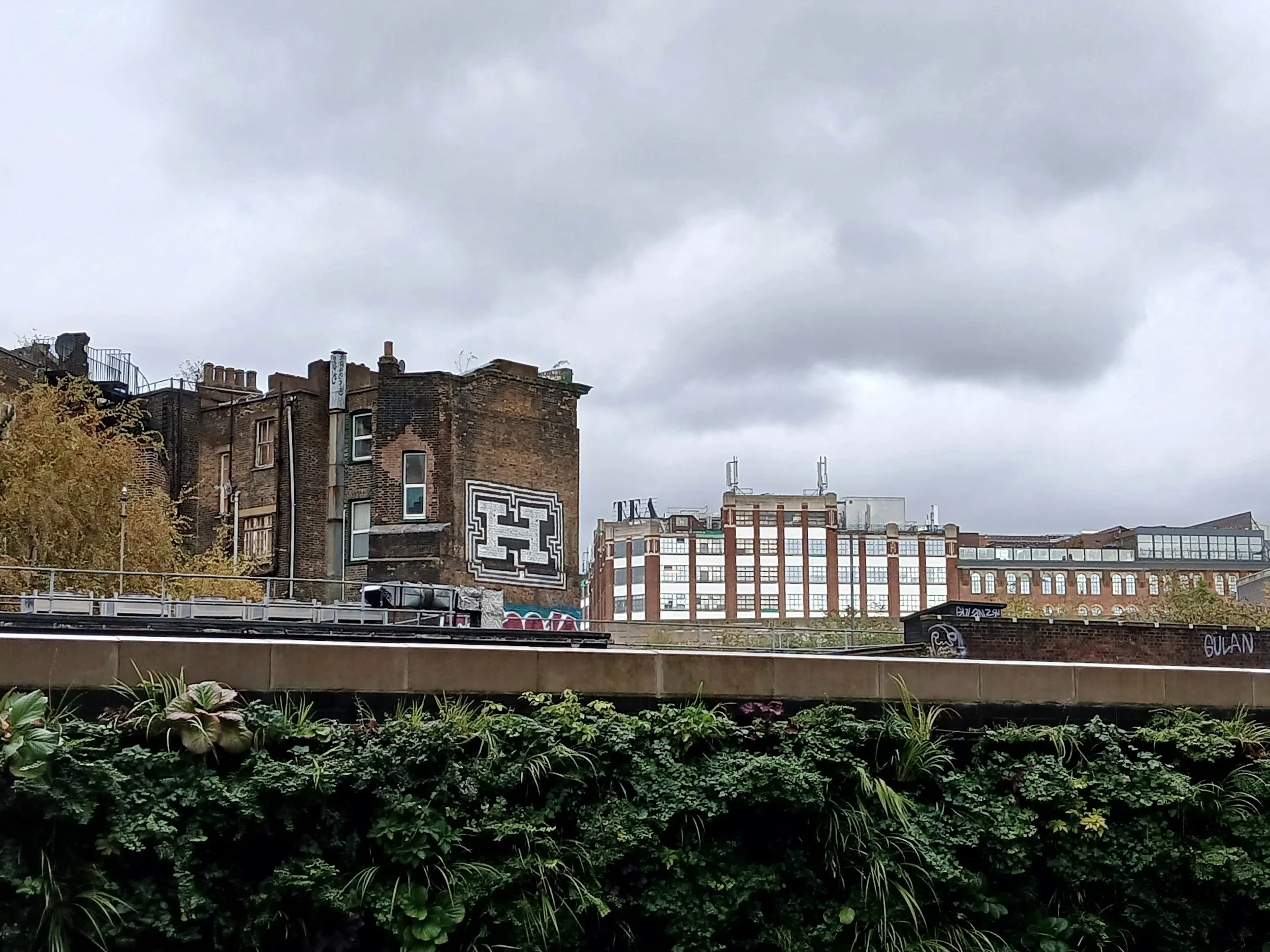
Under overcast skies, and behind a low wall of psychedelic writing, the skyline is bleak and dystopian, tower blocks of glass and metal in the distance. The image of an eye, and formations of letters and faces, etched over with bright tags and slogans; blending as if this were the finished picture. Where every conceivable surface is covered, perhaps it is the backdrop that matters, the material to write over or add a layer. In a city that is constantly evolving, in the struggle for viable space, I wonder if there could still be ruins and wasteland. Post-industrial spaces near the railway lines. Framed for an instant here, in motion, chimneys and the grimacing of boarded up windows, the fixed smile of decaying window frames, smoke-blackened brickwork, scattered weeds and foliage on rooftops.
I walk under the dank tunnel that crosses under the railway tracks leading to the underground station, besieged by memories emerging with the dampness. The railway bridge striped black and white submerged by trees. A figurehead, of a god, looks contemplatively over metal gates, the shadows painted across her face suggest tears, nuance.
Under the tracks, thick foliage grows and frames the edges, like an underwater kingdom that the trains pass over. On such days, the hanging clouds feel scenic, prophetic, as if the damp and the mist is needed to partly obscure such darkness and call it uncertain. Turn the solid walls into dream spaces. From the railway tracks, the view is of the back of things, facades exposed.
I have no claim to tell these stories, so I let them go, let them be written upon me, surface deep. The London I know is one of long thoroughfares, bleak, exhausted, buses queuing, puddles on the street, traffic… A city for trying to get home, that pushes you to its limits, and leaves a dreariness, a tiredness. The harshness and darkness of some of these London streets. The railway snakes through them. Cold and cruel this city could be, and unforgiving.
I want to anchor myself to solid places and histories. But I find myself forgetting, things grow hazy in the motion of the train, returning, leaving once again. Fixed to the window, trying to register what is momentary and impressionistic, as if this train view is all I have, all surfaces and dreams…
On the train back I am drifting through daydreams as the train drifts through the city. Passing under railway bridges, empty arches, tunnels, all the places you can only see from the train, only a moment, barely time to register as you move through them, emerging, overlapping, interrupting. Something uncanny about travelling this way through the city. Palimpsestic, always shifting, always changing. Overwrite what has gone before but don’t erase it. Dark falling as the train passes through east London on the way to Tottenham Hale—chimneys of Bethnal Green—warehouses, modern blocks of flats—stretching towards docklands— Hackney Downs—old London flats and walkways—marshes, canals, tower blocks—in the hazy rain of autumn skies.
Anna Evans is one of the editors of Elsewhere. Her recent essays and non-fiction writing have appeared in Echtrai, Elsewhere, Hinterland and Minor Literatures, among others. She writes about place, literature, migration and memory.