
Ag – Li – NaNO3
/
By P.W. Lewis
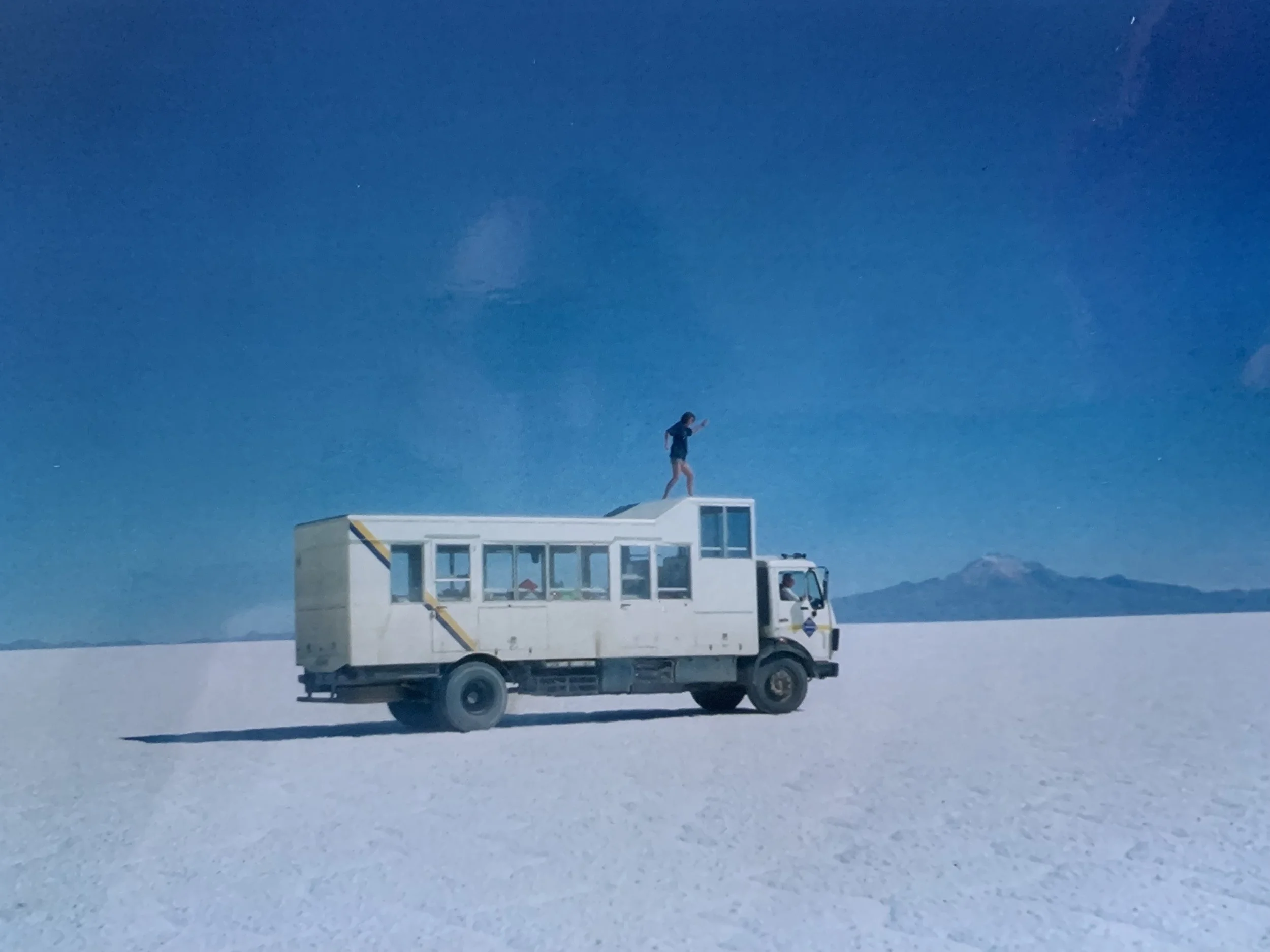
When it was his turn to cook, there were many things Rob didn’t know. At the age of forty-five, he should have had time to learn something, but he knew next to nothing. He knew nothing about cooking, and he knew nothing about Iquique. They had rocked up there after descending all day from the Bolivian altiplano and the dusty white hulk of the overland truck was now standing on a stretch of beach just north of the city. Behind them, on the other side of the road, the land rose up immediately and steeply, a mass of sand-coloured rock and scree. In front was the beach with dark-grey rocky outcrops poking into the shimmering surface of the Pacific, a surface dotted by fishing smacks, with a larger vessel slowly, slowly traversing the horizon. Andy, the trip leader, said this was where they would stay for the night. Who knew if they were allowed to, but they were soon pitching their blue, two-person tents and unloading the grills and utensils in readiness for the evening’s meal and another night’s rough camping.
It is only a fifteen-minute drive to the Mercado Centenario. Jess, Andy’s co-leader, takes them there in the truck. Rob is accompanied by his cooking buddy for the night – a young Italian woman, twenty-something with copious dark, wavy hair, by the name of Graziella. The group call her Grazi for short. Rob finds he is having to make very few decisions. He is tasked with buying ingredients for salad. He thinks he can cope with that and, anyway, Grazi says she will help him. They buy potatoes, tomatoes, avocados, artichokes, cabbage, carrots, onions, cilantro, and chili peppers filling their bags full of red, green, white, orange, and yellow. Fish will be the main course, and Jess suggests they go for mullet if they can find enough of it; there are twenty to feed. From the overpowering smell as they enter the market, there should be plenty. Rob pulls his t-shirt up over his nose until he is used to the stench. He is pleased Jess is with them. She’s more chilled than Andy and she intercepted the Chilean border guards when they tried to plant cannabis in the truck. It's good to have Jess and Andy looking after them. People who know the country.
But when Rob asks her what event the market commemorates, Jess doesn’t know. It has a date plaque saying ‘1930’ above the entrance. He thinks now, some twenty-five years after his visit, that it must mark the centenary of Chile’s independence, gained in 1818. Neither does Jess mention that the Escuela Domingo Santa María is less than two minutes’ walk away. It’s just down the street. The school was one of two sites where striking miners and their families congregated in 1907. These were the workers who extracted the nitrate deposits vital for the production of gunpowder and fertilizer in Britain and beyond. Estimates put the number present at ten thousand. Rob knows these figures can be exaggerated. The story has passed into folklore. Even so, photos from the time show a huge crowd gathered at the school. They had marched into town from the desert, from the mining officinas. It must have been an impressive sight as they walked behind their nations’ flags. Their colours: the white and red and blue of La Estrella Solitaria of Chile; the red, yellow, and green of Bolivia’s tricolour; the red-white-red of Peru; the sky blue and white bands of Argentina. The Union Flag and the Cross of St. George were missing – although the companies that owned the mines were English.
This is what the miners wanted: payment in legal tender rather than tokens that could only be spent at company-owned stores; a fixed wage of eighteen pence per day; safety grates on the cooking vats at the mine; an end to corrupt practices by supervisors when weighing and grading the ore; fifteen days’ notice of contract termination; night schools for workers for educational purposes. This is what they were given: a refusal to negotiate by company bosses; volleys of rifle and machine gun fire by troops shipped in from Santiago to break the strike; bodies buried in mass graves; no death certificates issued; estimates of over two thousand killed; no one ever punished for the slaughter. The Wikipedia entry describes it as a ‘Chilean government victory’. He wonders why neither Jess nor Andy mentioned the massacre when they were camping so close to where it happened. He wonders why it took him a quarter of a century to discover the books he should have read before his trip, books by the likes of Eduardo Galeano that told him something about the history of the place.
Back at the beach, Rob is busy with cutting, slicing, and peeling. Jess has bought some mangoes at the market and Andy shows him how they can be prepared for eating. When the mangoes are diced and ready, Rob takes a cube. A privilege of being on the cooking rota. Mango is good, it’s very good, he thinks, but it doesn’t make up for living in poverty. In Bolivia, many people looked destitute. People who sit on the dusty ground, at the roadside, wearing heavy clothes – hats, shawls, colours dimmed by grime – people who he thinks might not move from that same place all day. They’re not begging, they just appear to drift through the day, and he wonders if those people can afford mangoes. Chile, on the other hand, immediately seems more affluent. The roads have kerbstones. The petrol station on Ruta 5 sells Magnum ice creams. Andy announces that the following night’s stop will be at a hotel, and that’s not all, the town has a McDonalds. Everyone in the group seems to perk up at this news.
Yes, Andy and Jess are full of information about the places they pass through. Rob wonders now if they knew what had been going on in Iquique, if they knew about the girls who had been disappearing, if they had heard of Macarena Sánchez Jabré, 14, Laura Sola Henríquez, 16, Katherine Arce Rivera, 16, Patricia Palma Valdivia, 17, and Macarena Montecinos Iglesias, 15, five girls whose bodies were found close to where the group were staying, on a single day, 10th October 2001, exactly one month before the group’s arrival on the beach. He wonders if they had known would they have mentioned it. Perhaps they thought it best people didn’t know, that they would have felt unsafe, especially the women, even though the perpetrator had been apprehended by then. But the group were safe, as safe as anyone can be. Because they had money. That was the difference between the tourists and those girls, girls who were reported missing, but the police had no interest in finding, assuming they had left home to escape their poverty, to find something better, because those girls had nothing, no money, no bucket list, no importance.
Besides those five, there were at least nine others. It took a fisherman, the father of one of the victims, sixteen-year-old Viviana Garay, to sell his boat for funds and organize the other families. It was the relatives of the girls who started to find clues – belongings of the missing, bags, clothing – in rubbish dumps, out in the desert, in places the girls would not have gone. Rob imagines what it would feel like to find those personal effects. The horror of it. The horror. After the killer had been arrested they found the bodies. Some buried in those same rubbish dumps; others at Huantajaya, an abandoned silver mine in the hills above Iquique. Because there once was silver (Ag) there, like there once was sodium nitrate (NaNO3), minerals that were exported to richer countries, to make more riches, minerals mined by the poor, who never benefitted from the wealth they generated, people like the slaughtered workers in 1907 and the murdered girls in 2001. Now there is Lithium (Li), new gold, and Rob wonders if the poor are even needed in the mining process these days and if the same will happen again in this place where one abuse is overwritten by another but always leaves a trace of the previous one. He thinks it will. He knows it will.
In the morning, they dismantle their tents and load up the truck. They say goodbye to Iquique which seemed fine, just fine, like all the other places they have visited, and everyone is looking forward to that double burger and fries, or a chicken sandwich, or just a strawberry milk shake when they reach Arica. They make sure not to leave any rubbish behind. Their shit they have buried in the ground.
The mullet, by the way, was a great success.
P.W. Lewis is currently working on a collection of short prose pieces (fiction and nonfiction) that explore Spanish-speaking settings and culture. Stories from the collection have previously been published in La Piccioletta Barca, Toasted Cheese, Punk Noir Magazine, the Under Review, and Spellbinder, with another forthcoming in Mythaxis next Spring. He lives in Birmingham, UK. X/Blue Sky: @pwlewis007