Spinoza to Said I
/
By David Koehn
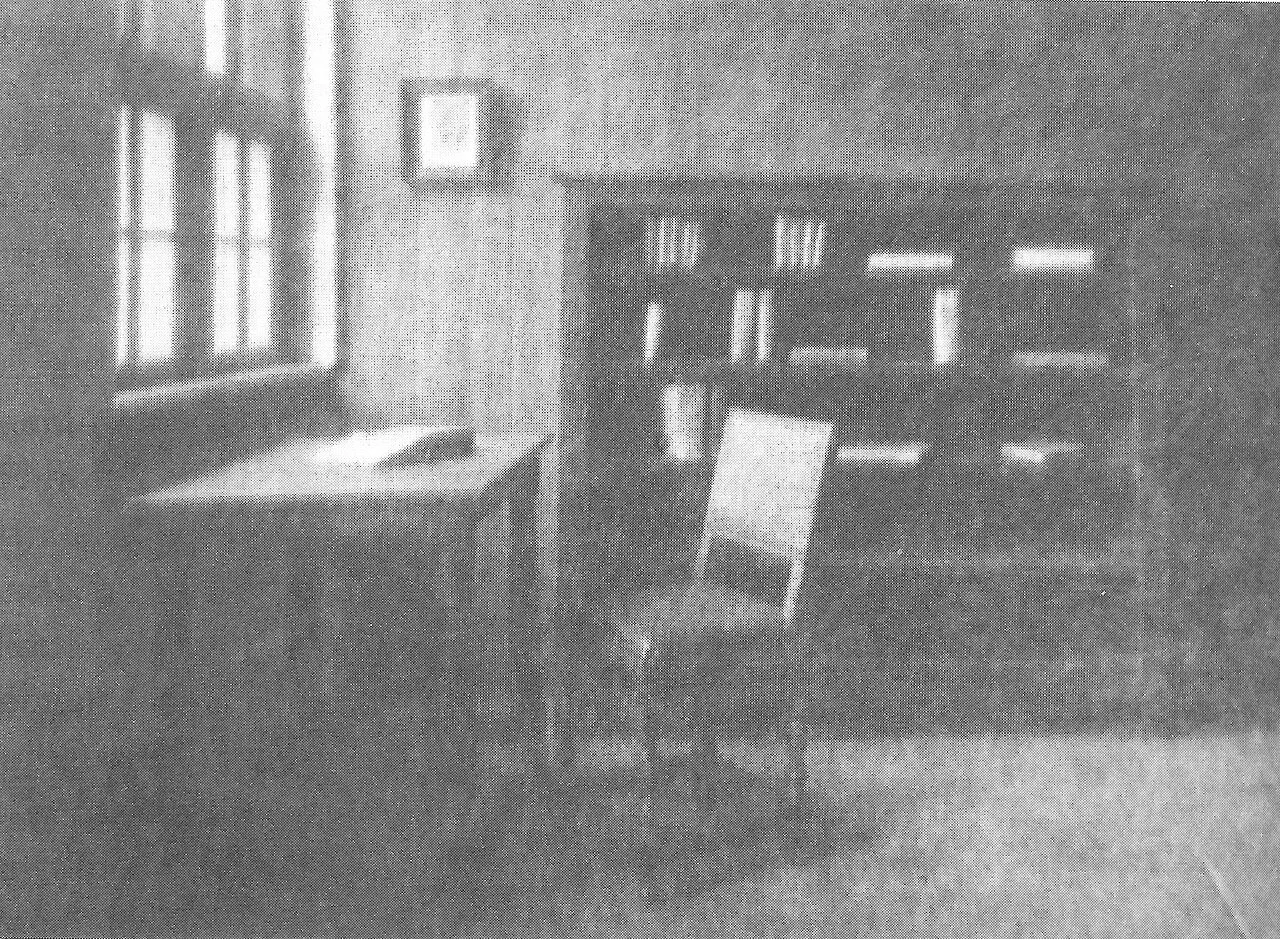
I am alone in my study at Tydeman’s in Rijnsburg.
This dialogue between us spares the guilty,
Unbroken fire hydrants on both sides of the Seine,
The identity of the people who betrayed us,
Let the Dead Sea be “taʾtūna al-fāḥishah”
Because “you commit the outrageous deed”
In Genesis 19, can we see Lot’s wife, her feet
In the clay? The air we breathe corrupts us,
The lens reveals Dunaliella algae’s rusted
Blooms. The Dead Sea turns kidney red
Same as the salt ponds of Dumbarton Bridge
Over the Bay. Seals under seals over seals:
Haram emits the cornucopia of our daily
Fee, fi, foe, fum. דָאס ברויט איז שטעל
A hand rests on the brass rail. A boy in leather
Boots, twill pants, and suspenders, no shirt.
I am alone in my study at Tydeman’s in Rijnsburg.
When the curtain in the window lifts in the breeze
I think of you, or at least the possibility
Of you, not as ally nor as enemy. I so despise us
As “unclassifiable.” The hippopotamus of us:
A lack of evidence in the evidence app
Does not mean there is no proof of absence.
Believe them. Or don’t, to be loved by all
But confuse most, to walk en passiagata
As indeterminate weather, asymertrically,
(Bodies long the place, because the place longs the body)
Feels closer to heart than the balanced scale
Redesigned to resolve the room of acts.
So displeased with their confinement –
But refuse to leave when the door opens.
This lens, the finest of glass, the best I made,
I imagine you’d use it one day in a pair
Of readers, or on a length of chain in a monocle,
Maybe while enjoying the Umm Kulthum,
Or while playing the Goldberg Variations.
If we went to Vegas together, we’d stay at the Cosmopolitan,
“Just the right amount of wrong.”
For, according to Ueno (thank you, Norma),
“It is the imitation that provides
Him with his own imaginary figure.” We’d be like
Private detectives, we’d suggest the answers live in
The casino’s poker chip’s clay, the clay person
Wanting to be free of its utility as mug
And cup and bowl, its Emet, desired to own
Us, not out of good intention either.
But out of its desire to be where
It is not. It’s progress toward pocket,
And palette and police and and politico.
We’d track her down, that Golem, and we’d
Erase her “E.” The Evie because Vie.
Or as Eave becomes Ave.
And Emet becomes Met.
I am alone in my study at Tydeman’s in Rijnsburg.
We’d invite your wife over to my place
And the two of you would embrace
Tucked beneath the sheets, I’d slide between you
And we’d fuck and then sleep the sleep of a libretto.
A boy once tried to stab me with a dagger
And the blade tore open my cloak. I keep
The cloak hung on a peg aside my bed.
The new dough rises, the yeastiness of the air,
The nets of the Seine have caught us again.
This, my love, is the opposite of that.
David Koehn is the author of three books of poetry: Twine, Scatterplot, and Sur. He also co- edited Compendium, revisiting Donald Justice’s approach to prosody. His work has been published in journals including Apartment (forthcoming), Alaska Quarterly Review, Carolina Quarterly, Denver Quarterly (forthcoming), Diagram, Gargoyle, Gulfstream, Kenyon Review, Lana Turner, McSweeney’s, Michigan Quarterly Review, New England Review, North American Review, Prairie Schooner, Quarterly West (forthcoming), Rhino, Smartish Pace, The Greensboro Review, The Rumpus, TAB, Volt, Zyzzyva, and elsewhere. He holds a BA from Carnegie Mellon University and an MFA from the University of Florida, and he teaches comp and creative writing at San José State University.