
Fragments
/
By Eleanor Updegraff
Recently, I have begun a collection of shoreline pottery. Small, thumbnail-size fragments, sanded by the waves. Sea glass, of course, is a well-known beach find – white, green or turquoise, the colours churned milky – but I’d never heard or even thought that the sea could also produce ceramics. Not until I started to find them, here on the beach at the end of the world.
They are small, as I’ve said, and hard to notice. You need to walk with a sharpened eye. Sea glass is simpler, mottled and lumpen, its hues a little too vivid to fit within this beige-and-cream landscape, but the pottery fragments are often white, swiftly mistaken for pieces of shell. Some, however, are coloured Delft blue, tiny swatch from a larger pattern, and this week I found one washed in lime green with a minuscule flicker of black near the rim. The tail of a signature, scrawled by the potter? No way of knowing.
The piece reveals nothing.
Still, when I see them, I bend to collect them. Brush off the sand, hold them tight in my palm. I walk on the beach most evenings at sunset and come home invariably with something or other: a striated pebble, a shell smeared with lilac, a hagstone, a gull’s feather, driftwood bleached white. I place them in groups on my desk, by the window, the reach of the tide supernaturally extended. I look at them often while I am working, might pick up a pebble and turn it in my hand. I am struggling, these days, to find the words I need to. It can help to have something solid to grasp.
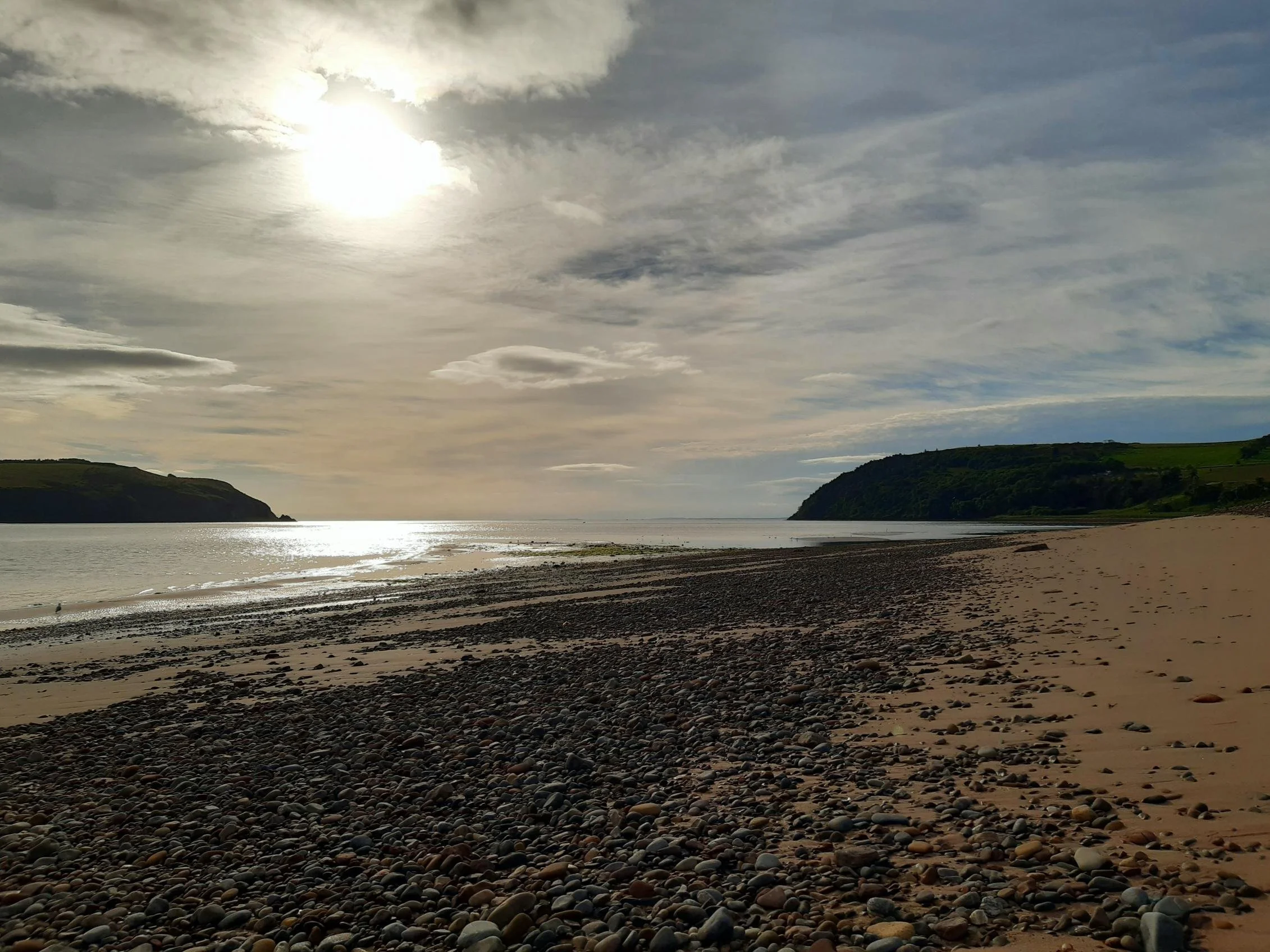
I think of this place as the end of the world, though of course it isn’t really. It is simply the place where the road runs out, where no one can walk or drive any further. Just past the house, the peninsula tapers into a pier and a red-walled harbour, where a sign reads
FERRY SEASON ENDED
and boats rock at anchor, crusted with barnacles. Over the firth, the land does continue – most days you can see it, the coastline’s lazy scribble – but now, in winter, with no boats crossing, it seems an impossible notion to reach it.
Out there: unknown lands.
The wilds of the northern territories.
Lights, sometimes, in the distance, holes cut in the fabric of Earth.
At first, when I came here, I thought there was nothing. Just the sea and the beach and the cool silver sky. The pier with its sign, the leviathan oil rigs, a huddle of houses lashed to the land. And the wind – for the storms here will teach you how the end sounds. Like cowering under a giant cobbler’s bench. Some mornings we step outside slowly, blinking. Disbelieving, somehow, in the dawn’s fresh-washed gaze.
It suited me, this did. A place that held nothing.
That asked me no questions, offered no answers. Back home I was losing a parent to dementia, watching each day as memories shattered, struggling to process the grief and the guilt that comes often with caring, of feeling you’ve failed. I was tired, while elsewhere the bombs were falling, the ice caps melting, the oceans rising. The headlines shrieked and yet no one listened; the sun burned fast through the brittle horizon. Easy enough to believe it was over. We’d reached a new limit. The centre would not hold. So why not just sit down and watch it all happen? Here at the harbour: the end of the world.
But then. There was the strandline.
The blistered, blackish seaweed, marking out the soft space where the water meets the land. The strandline and its treasures, once hidden but slowly emerging, coming into focus as I taught myself to look. The sea glass and the driftwood – the tide’s post-modern sculptures. The ceramics smoothed at the edges, holding no memory of when
they fell.
I imagine how they might have been once, these fragments. These pieces of larger things. A plate, a mug, a shallow soup bowl, a jug overspilling with day-bright tulips.
Sometimes there is an angle within one, suggestion of corners, a fluted rim.
Shapes whose existence I can now only guess at, purpose unmade by the action of waves.
On the phone I speak to my mother, weekly. I do this cocooned in the silence of the house. After, I walk down the road to the harbour. Pace on the salt-crusted boards of the pier. Listen to the gulls screaming news from the rooftops.
Open my eyes against the wind.
There is a pottery here – a workshop. Here in this place, on a road near the shore. The woman who owns it is, like me, a transplant; she came from Germany years ago. Came as a visitor, never left. She says this now with a shrug and a grin. The pots that she makes are large and rounded, painted free-hand with female figures. Mostly these women are pictured in motion: swimming, or dancing with arms held aloft. The potter sits day after day in her studio, spinning her forms out of wet lumps of clay. If one doesn’t come right, she folds and restarts it. Shaping, reshaping, and shaping again.
On the beach at the end of the world at sunset, I walk back and forth along the strandline. I raise my eyes sometimes, look out to the distance, notice the oil rigs, the fog that obscures them; the sun that sinks blazing, the waves that rise choppy; the far purple hills that I may never visit. But always as the light fades, its last rays of brilliance picking out objects with greater clarity, I look down – for pottery; pale, tide-thrown pieces.
How long, I wonder, does it take to make each one.
I’m unsure what to do with all of these beach finds.
A museum of the strandline? I write to a friend.
Perhaps, if I leave, I should simply return them – go for a walk
trailing
pebbles
like
footprints.
Or maybe the fragments of sea-shaped ceramics – which aren’t shards or slivers, no hint of sharpness – can be turned into something I can’t yet picture. A mosaic. A tiled floor. A splashback for a kitchen. A vase that is just as much glue as ceramic, joins lacquered gold in the style of kintsugi. It wouldn’t hold water, but nor would it have to.
Enough if it held air, the waves’ constant echo.
Eleanor Updegraff is a writer, translator and freelance editor. Born and raised in the UK, she studied English Literature, German and Russian at Durham University before spending nearly a decade living in Austria. She has translated authors including Teresa Präauer, Annabelle Hirsch and Tanja Paar, while her creative and critical writing has appeared in Lunate, Linseed, Stanchion and Panel. She currently splits her time between Hampshire and the Scottish Highlands.