
First Light
/
By Claire Everett
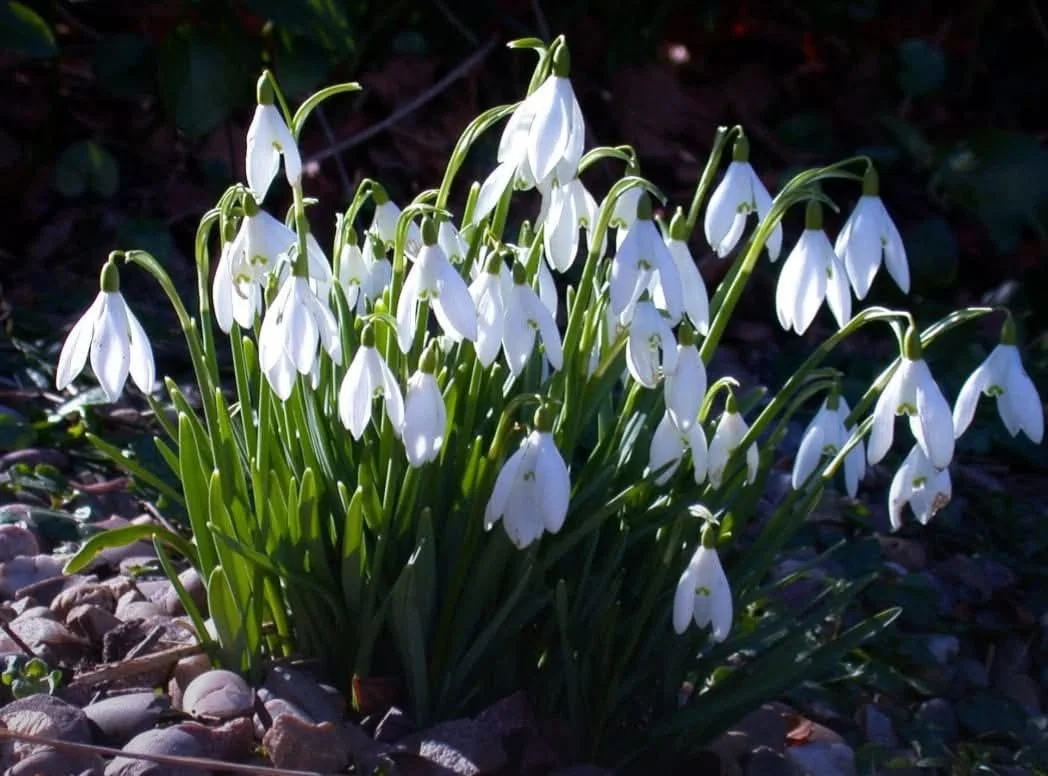
I first discovered it aged five, running too fast for my legs among the ruins of Wenlock Priory towards the brush-stippled swathes of snowdrops, lamb-white, rabbit-from-a hat-white, icing-on-the-cake white, the flame flickering like of which I’d never seen before. February’s Fair Maids, Dad called them as I brushed them with my fingers, touched a cheek to their silky softness, on my knees to breathe them in. He told me about a Saxon princess who had lived there long ago because she’d had to flee from a prince who wanted to marry her. The River Corve had saved her by becoming an impassable torrent when he and his army were on her heels. She settled there, founding the priory and becoming the abbess. After a lifetime spent healing the sick and ripening just-sown barley in a day, or striking up springs where she walked, she eventually came to be known as Saint Milburgh, which Dad said meant she got to live forever in a way. I didn’t pick a single flower but basked in their gentle presence careful not to scrape a petal or bend a stalk. I gathered their light to me like a beauty queen at a pageant, drawing another and another bouquet to her breast. I often think that very young self was instinctively holding fast to all she was about to lose, little by little. This was our most precious season of wild walks and old stories, when he still came to all my Parents’ Evenings, before the daily arguments and the “going away to work.”
The next time was a decade later, in another part of Shropshire, in the town where I was born, just over a year after they had lowered him into the ground in a kingdom of granite, marble, and frozen snow, hungry crows, and plastic flowers. According to the church noticeboard it was Candlemass. Because snowdrops were his favourite, Mum had planted a few bulbs sometime in those raw weeks after he was ripped away from me so suddenly, along with my childhood. And there it was in the tentative sunshine, the first angelic bloom, spindly yet fierce, a tenacious force of nature which I imagined had been dreamed into being by Dylan Thomas himself with a tiny inscription on each of the innermost petals written in green ink. It had thrust itself upwards through the frigid earth against all odds, as if to remind me there was so much love to come, not merely the bitterness, anger, and regret that spilled by turns from Mum’s eyes and mouth as she stooped there, tending the newly grassed grave as if it were his sickbed. But how I missed him telling me how we came to be us, and I, me. How his father’s parents had walked over the Black Mountains into Shropshire and my maternal grandfather had come from County Mayo, Ireland, in the lean years after the Potato Famine. Both my grandmothers were English.
For much of my early adult life as I moved further and further away, my memories of that shire weren’t rooted in tumbling hills and laughing streams but a landscape of desolation and abandonment, boarded up shops in wet-newspaper streets, my shoes making no sound as I revisited the friendless corners that lingered in my mind. And yet, somehow, year upon year, at that pivotal time, wherever I was calling ‘home’ briefly became a thin place with the sight of those white elven-flowers unlocking visions of lanes frothing with cow parsley, heaths laden with heat-shimmer and gorse so bright it stung my eyes, or the rusty rails of the disused railway track that wandered into what was surely forever, ablaze with butterflies and a scent uncannily like just-ironed cotton. There were times when I would have to search harder, but at last, there it would be in their silent voices calling me from manicured gardens, fenced-in, contained, tamed, but no less steadfast than those of their wild kin. They sustained me like picture postcards sent by a past self for times like these. By now I was familiar with the word Hiraeth, and I could feel its sad, sweet song in my bones as if I were a skylark about to ascend the bluest of skies above some faraway field.
Then, unbelievably, there I was in my forties, at Richmond Falls in North Yorkshire, surrounded by the sound and energy of the Swale in full flood between Green Bridge and Mercury Bridge whose names sang to me that particular Imbolc day. The sense of the sap rising was palpable, my blood, too, like quicksilver, charged with newfound love and a life rewilded. Midway across the stepping stones, barely above the white-capped flow, he took my hand, leading me to the very edge before wrapping his arms around my waist so we stood like a figurehead at the prow of a longship where one life ended and another began. With his help, five counties now separated me and my children from all that we had escaped, and this river, roused by the breath of spring, protected and emboldened me as if I were that Saxon princess saved by a torrent long ago in the shire of my birth. And he who held me close later told me that he had whispered an invocation to the Celtic goddess Brigid asking her to instil me with her creative fire and guide me back to my poetic self. Within a few weeks, I was writing again, ink swift as the Swale “that rusheth rather than runneth”, so named for its tumult by the ancient people of that place.
This year I find it on the narrow path between the East Coast Main Line and the factory, amid the intermittent rumble of passing trains and the smell of roast chicken and vegetables wafting from the nursing home. Such as it is, much as it is, it is my own wild walk. Even as my world has contracted, it has expanded like the pupil of an eye to admit more light in the darkness. Soon enough I am on my knees, leaning in to listen, and to see. There is comfort in the details. The certainty of the miniscule green “v”; on each paperwhite inner tepal (as I now know them to be), reminding me of geese flying in formation or the tip of my school pen poised to capture the words in my head and spin them into cursive. It is here as I exhale, the relief and gratitude my forebears must have felt when they realised they had survived the darkest days of winter. It is here in the ellipsis between the then and now, the after and before, as sung by the thrush. I am here! I am here!
Claire Everett is a Sixties baby born in Shropshire to working class parents. She has written poetry since childhood and from 2010 became particularly interested in Japanese short forms. She has served as editor for various journals including Take Five: Best Contemporary Tanka, The Red Moon Anthology, Haibun Today, and Skylark, and as a contributing editor for MacQueen’s Quinterly.
In 2023, Claire won a prestigious Touchstone Award for her haibun "A Thousand Thens". The haibun and the panel's commentary can be found here: https://thehaikufoundation.org/claire-everett-touchstone-award-for-individual-haibun/
Claire’s writing has begun moving slowly from predominantly poems to chapters, and she has written a nature-themed memoir which she is hoping to publish one day. In her other life, Claire works as a Care Coordinator/Social Prescriber for the National Health Service supporting local people with very diverse needs.
In between working full-time, Claire occasionally posts on Instagram and Bluesky as @a_ life_ of_ short_ lives' and is just starting to explore Substack. Some short experimental pieces have found a home on Tanya Shadrick's A Cure for Sleep.