
Last Red Sky
/
By Cecy Grace
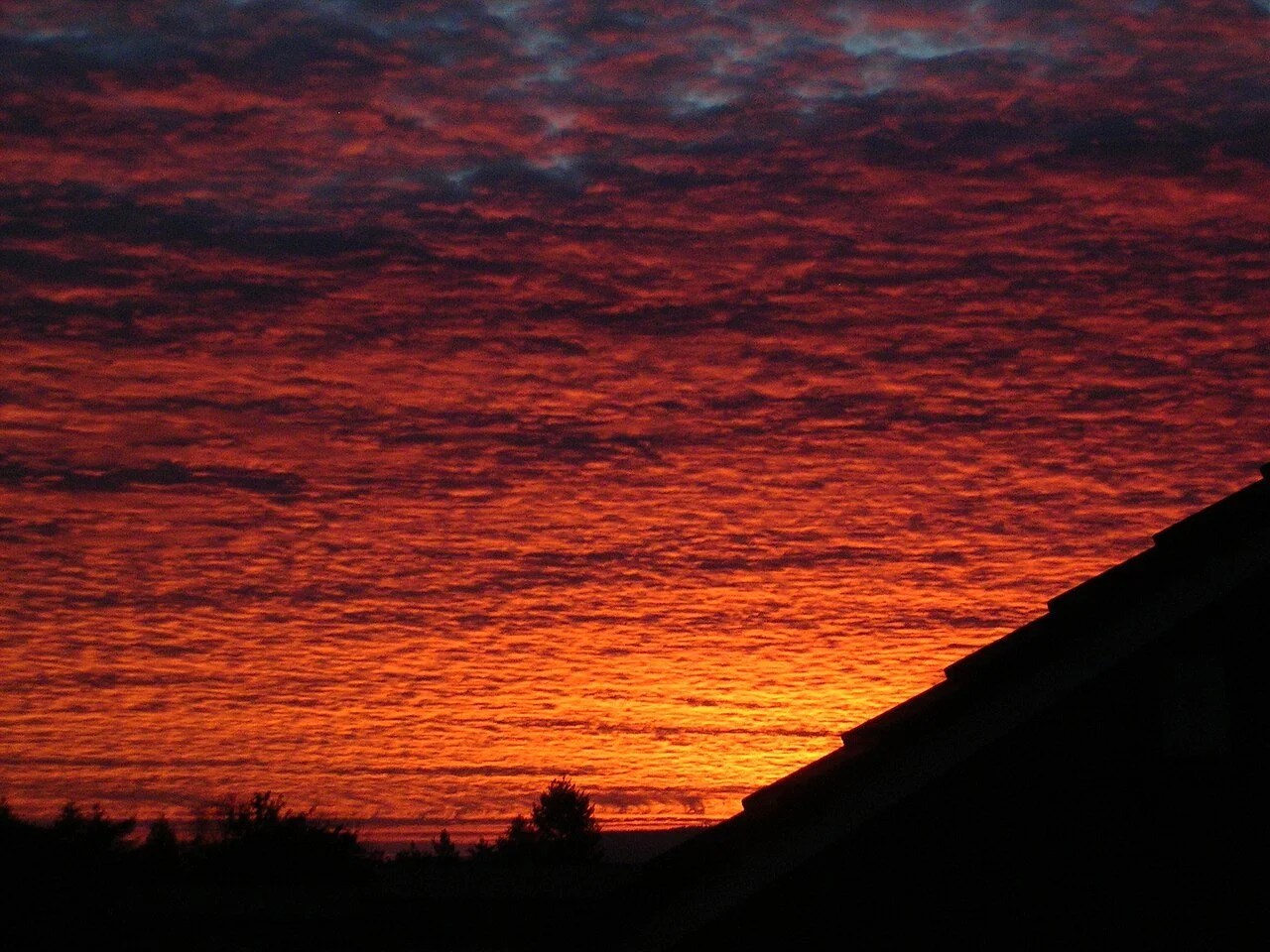
Outside, the sky is bruised red. Crows wheel in ragged circles above the rooftops. Even the breeze carries a dissonant sweetness, drifting over our town graveyard — the lazy, hollow patience of a ghost staring at its own headstone come this bright, sunlit afternoon.
You only came over so I could sign the papers. I spent weeks pretending I didn’t understand them, pretending ignorance felt safer than consent. But it’s all over now.
You called this afternoon, said you were driving over with my things. I turned on the television, hoping the noise could fill the spaces between us.
That’s when the news came.
Breaking News: Humanity Faces Extinction as Asteroid Heads for Planet Earth.
Fifty-three-year-old Sally Higgins delivers the news with the same calm precision she’s had since 1992. Our town’s viewership has sustained her family through three divorces and five children. They say that six months ago, Sally met a foreigner, an Irishman, at the local watering hole. He’d bought her a drink and six fleeting months of happiness, which ended the way most things here do: quietly, without witnesses, just before it could be called permanent. On the screen she drones on. “The asteroid is now thirty minutes from impact. Prepare for evacuation. All residents are urged to seek shelter immediately. This is not a drill.”
And now here we are, you standing in my front porch light, holding that same envelope as if it can fix everything.
The words blur together, twisting like smoke in my mind. I try to focus, but my thoughts keep returning to you. Your eyes — the ones I used to get lost in, the ones I swore would save me from all this mess — are hard to read now.
You step inside, your shoes muffled against the hardwood floor. The smell of rain is thick in the evening air, the kind that feels like it’s coming straight from the earth’s lungs, desperate to exhale.
“I thought I’d be more... prepared for this,” you say quietly, holding up the manila envelope like a peace offering. But no peace is left between us and the world. I don’t know what to say. I take the envelope from you and set it on the counter. A piece of paper containing everything we couldn’t save. It feels absurd, as if the fate of the world has come down to ink and signatures.
“Prepared for the divorce,” I say, “or for the asteroid?”
A corner of your mouth twitches. “I don’t think it matters anymore.”
“How did we get here?” I finally ask, my voice a brittle whisper that barely carries in the thick, tense air. I don’t expect an answer. But you give me one anyway.
You don’t hesitate. “We stopped choosing each other.”
I nod. It’s true, though I don’t think we ever really found what we were looking for. We built a house with a foundation of need, not love. We tried to make it a home, but it always felt hollow, echoing with every promise we couldn’t keep.
“That’s not the same as not loving,” I say.
“No,” you agree. “It’s worse.”
A silence stretches between us — thick, suffocating. The sound of the television fills the space, a monotonous hum, but all I can hear is the thumping of my own heartbeat. It’s a strange thing, knowing the world is about to end, yet this final conversation feels more final than the meteor itself.
“You never told me you loved me,” you say. Your voice trembles, like it’s breaking something deep inside of you.
I bite my lip. I never told you. Because I didn’t know. Or maybe I was too scared to admit it. Maybe I thought love would fix things, make everything easier. But love doesn’t fix anything. It’s just the thing we hold on to when everything else is falling apart. I study the wall behind you. The hairline crack running from ceiling to doorframe. Easier than your face.
“I thought you knew.”
“I wanted to hear it.”
You swallow hard, nodding. I wonder if you knew all along.
“I didn’t know how to say I loved you without disappearing,” I say. “And I liked who I was before us.” You nod like that confirms something you already suspected. “I kept waiting to feel ready,” I admit. “Like love was a test I could study for.”
“And?”
“And I failed it anyway.”
We both glance at the screen. Sally Higgins’ face flickers in and out, as static buzzes through the air. Thirty minutes, it says again. Thirty minutes. And then, in the stillness that follows, you do something unexpected. You step closer to me, cautiously, like we’re both walking through a minefield. You reach out, hand trembling just slightly, as if asking permission before you touch me. For the first time in what feels like forever, I let myself be touched. I don’t pull away. Instead, I place my hand over yours, the warmth of your skin against mine, and for a moment, just one, I let myself remember what it was like before everything fell apart.
“It doesn’t feel real,” you whisper. Your voice breaks.
I want to tell you it’s not real. I want to tell you that if we both just close our eyes and pretend, maybe we’ll wake up and none of this will have happened. But I can’t. Not now. Not with thirty minutes left.
So for twenty-seven of them we stare at the fuzzy screen, curled up on my worn maroon armchair. The telly’s humming is radio static as the news tickers streak crimson warnings across our irises.
Three minutes.
“Well... this is it, then.”
You say it like you’re commenting on the weather. Like the sky hasn’t already split itself open in shades of arterial red. Like the crows haven’t begun to scream as one body, a single dark thought circling the town. I laugh — a short, ugly sound — because what else is there? The end of the world deserves something more dignified, but all I have left is a broken noise in my throat.
“Looks like we finally picked the right moment,” I say. “We always were terrible with timing.”
You smile at that, or something close to it. Your mouth remembers the shape before your face does. It used to be my favourite place to rest my eyes. Now it feels like a photograph left too long in the sun.
Two minutes.
The television cuts to footage of cities evacuating — highways strangled with red brake lights, people dragging suitcases that look laughably small. The caption reads GLOBAL EVACUATION UNDERWAY, as if there’s anywhere left to go.
“We’re not going to make it to a shelter,” you say, practical as ever.
“No,” I agree. “And I don’t think I want to. Not underground.”
Outside, the breeze carries the smell of wet earth and iron. The graveyard down the hill is lit gold and red, every headstone glowing like it’s finally being acknowledged. For years, the dead have waited politely. Now they get to be right. You lean back into the chair, exhaling. “If this is how it ends,” you say slowly, “I’m glad it’s... quiet.”
I think about all the ways we were loud — arguments that slammed doors, silences that screamed louder than words. Quiet was never our strength.
“I’m sorry,” I say suddenly.
It’s the most dangerous sentence in the language. You turn to me, really look at me, like you’re trying to memorize the exact configuration of my face before it’s erased.
“For what?” you ask.
“For not choosing you,” I say. “Every day. For assuming love would wait around until I was ready.”
The room feels smaller. The clock above the stove ticks too loudly, counting down seconds that no longer mean anything.
“I didn’t make it easy,” you say.
I nod. There’s relief in it — like we’re finally speaking the same dialect, even if it’s too late to be fluent. The television volume spikes. Sally Higgins’ voice cracks for the first time in thirty-four years of broadcasting. She clears her throat, presses on. Professional to the end.
One minute.
The windows rattle faintly. Somewhere far away, something screams — metal, maybe, or the sky itself tearing. I reach for you without thinking. You come easily, like you’ve been waiting. Your head fits under my chin, an old muscle memory snapping into place. I can feel your heartbeat, fast and stubborn.
“I loved you,” I say into your hair. “I swear I did. I just didn’t know how to live inside it.”
You close your eyes. I feel the dampness where your cheek presses into my shirt.
“That might’ve been enough,” you whisper. “If we’d said it sooner.”
Outside, the light changes. The sky deepens, bruising into impossible colours — purples and reds and burning white at the edges. The crows scatter, finally abandoning their vigil. The power flickers. The television dies mid-sentence. The house exhales, settling into a silence so complete it feels holy. There’s no explosion yet. No fire. Just the sound of us breathing.
I think of the divorce papers on the counter — unsigned, irrelevant. A relic from a world that believed in tomorrows.
“If we get another life,” you say softly, “promise me something.”
“What?”
“Find me earlier.”
I press my lips to your temple. “I will.”
The light floods the room — not violent, not loud — just overwhelming, like stepping into the sun after years underground.
And for the first time in a long while, we are not unfinished.
Cecy Grace is a 19-year-old Singaporean who enjoys sleeping, reading and writing.