
Earth and Water
/
By Alexis Keir
Memories may differ.
Mud (2003)
The boys are a gaggle, T-shirts and tracksuits a rush of colours. There are no girls. They are laughing and chattering, looking back and ahead, leaning over each other. Hands on bony shoulders, arms around skinny backs. They are ready to play and explore. Years ahead, I will not hold onto the shapes and lines of their faces. Names will not come back to me. But I will still remember the heat of their excitement as they entered this massive building with its bleached surfaces and distant ceilings. Their eyes eagerly explore the spaces, the vast volume of emptiness in the halls and rooms. There is enough air to shout in, wide open floors for legs to eat up and build speed over. Except, my colleague and I have to remind the boys that they cannot run and that loudness is forbidden.
There are perhaps twenty in the group, all of them Black and Brown young people. Most of these children - because that is who they are - have travelled from African countries but some are from Afghanistan also. They are unaccompanied minors seeking asylum who have come to the UK alone and without the documents or adults who could anchor and legitimise their presence here. I am Black too, but I am allowed to call myself British without complication. Like these boys I once had to arrive in a distant place without my parents, but I returned to this country where I was born and am surrounded by the love of my closest relatives. These boys are saplings cut off from their roots.
They are mostly between 16 and 18 years old, but a couple are only just entering their teens. To me they seem even younger because of their dislocation and lack of connections in the new world that they have been plunged into. But they are judged by politicians and parts of the media on the basis of their height and gangly limbs, and the clothes and trainers charities and kind donors have given them. Some people do not like them receiving treats like bicycles and outings. Those who see their presence as an invasion, are suspicious and dissatisfied that these refugees do not display in their faces and behaviour the trauma of witnessing death and torture. Even though it is the not showing that has helped them to survive. That has meant they could make it this far.
My colleague and I work for a charity that runs the project supporting these boys. We have done this several times before, taking young people to the seaside and cinema or to visit museums and galleries like the Tate Modern today. Things to do and distract which we think will be fun and help them settle in their new locations. Or supporting them to take part in arts activities that might be therapeutic, giving them an opportunity to express memories of former lives and communities in the materials they are given to paint and mould with. Ways to own again what they no longer have and to connect with their resilience and desire to keep on keeping on. We want to help them to deal with the pain of their losses and perhaps we need help ourselves in coping with what we imagine has happened to them. It takes a while for the stories to emerge.
Previously, we had asked other groups to come up with ground rules for their days out. A few weeks before we had been with a clutch of East End boys, a jumble of White British, Somalian and Bangladeshi backgrounds, who we took to an Essex outdoor activities residential centre to get muddy, exhausted and wet together, mountain biking and kayaking. The boys sat and wobbled on the morning train out of London and with the chunky felt-tips we handed out, scrawled their boundaries onto post-its:
no bad language
respect each other
listen when someone is talking
be friendly
no fighting
do not fight
it is important not to fight
I wonder how those rules would have landed today with these boys who had fled conflict and survived massacres that had shredded away those they loved and all they had ever known. Who had survived somehow as laws were subjugated to prejudice, hate and fear.
Our guides take us to a room and ask the boys to sit on their bottoms between two walls, a perfect circle of red flint on the floor close by. On one side is a wall that has been covered in mud and clay from the Avon estuary. These media have risen, oozed and flowed with the tides, been shaped by human touch, and now we can touch the wall too. These boys know mud. They are invited to come up to the wall. To reach their fingers up as high as they can and then run them across the textures to trace the lines and ridges. The tallest did so slowly in drawn-out horizontal strokes while the youngest ones moved their hands round and round in hurried circles, the join between skin and the dried surface a hungry synapse.
We spend some minutes this way and then the guides tell the boys to return to their places and to swivel round. My colleague and I lower ourselves to sit down with them. On the opposite wall is a faded wash of yellow and green merged with the faintest hints of purple. The boys sit quietly and listen while a guide describes the life and works of Monet. As she speaks about water lilies and the ponds at Giverny, I see out of the corner of my eye, that a boy, one of the youngest aged about 12 or 13 on the furthest side of the group from me, has stood up. To get a better view over the heads of his friends in front of him, I think. There are two security staff sitting on stools in the corners of the room - they have noticed him too and smile as he stands. How lucky this kid is they must think, to be this close to this work of art worth tens of millions of pounds. To experience the majesty and supremacy of Western art. The child begins walking towards the canvas, hypnotised by its colours and scale. Soon he is very close and now the guards are not so relaxed. Across the seated boys they look at me and my colleague then back at the only one standing, all of us wondering what is happening. The boy carries on his march. To him this is just another muddy wall. As he stretches out a hand the adults all rise.

Shard (2013)
My son was stuck. He could not move one foot in front of the other. The lime-green water that matched his boots was nearly spilling into them, and his giggles and wobbles were as funny as the swaying of a marionette. Any loss of balance and he would topple, with a cold and sodden car ride back to Hackney in his future but maybe we would all still be laughing on the way. He and his brother had waded into the shallows following the line of orphaned jetty struts that pointed upwards, relics marking place and time like the gallows embedded in the sands nearby. They were adventurers in an offshore world while I waited in port for their return. Now I splashed out into the water and when I reached him, I slid my hands under his armpits to hold him close. I tugged his thin torso but could not pull him free that way, so I reached down to wriggle each leg and Wellington up out of what we would later determinedly call quicksand, and then carried him back to where the riverbed became shore and was firmer. Now we could continue exploring.
I could always find exciting destinations for my sons and I to reach and discover. On days when the service was not cancelled because of fog or breakdowns, we sometimes caught the ferry over to Woolwich – we started doing this when one son was still in a pram and the other held my hand as we crewed our longship through the morning mists. On our bikes we soared across the grass plains of the marshes between Clapton and Walthamstow. We bumped through the thistles and mud of narrow tracks that were hidden in dense urban copses before the overgrowth was cut back and landscaping for the Olympics brought gravel paths to open up those lonely spaces. At Hollow Ponds I bought us all ice-creams, and the boys each took an oar to row our hired boat across the limpid channels to banks and islands that we said were undiscovered so that we could claim them as our own.
We roamed the towpaths of east London, sliding under bridges whose walls still bore the grooves of ropes that had been attached to the horses that once pulled laden barges along the Lea Navigation. Our rides took us north past the vast blocks of the incinerator at Edmonton, its chimney puffing invisible traces of effluent into the sky. We followed the canal under the broad flyover that carried the M25, the barren, denuded space underneath, a sometime home to travellers, entirely alien both to drivers on the motorway overhead and cyclists passing beside it.
We rode the elevated strip of the Greenway as it bored through Newham to the desolate slopes of the Beckton Alps. We went south as well along the Limehouse Cut which brought the waters of the Lea to its terminal basin crowded with houseboats, yachts and the craft of weekend cruisers. Often for our journeys we had to check crossing times, calculate how far young legs could pedal on the journey out before turning to come back, pack soft drinks, apples, boxes of raisins, packets of crisps and sandwiches. But even on the quietest days with no preparation we could just jump in the car and drive down to Wapping. On those days the only thing we needed to know were the tide times and when the waters would ebb and allow the secrets of the Thames to resurface.
It always seemed sunny, light breezes unable to raise grains of sand across the foreshore. The water shimmering even under skies of London grey. The day that my son got stuck we had followed the river westward, across mud corrugated into worm tunnels by the tides and the wash of passing boats, till we could see in the distance the bulge of the Onion between the shiny-new Shard and Tower Bridge. We looked at the hull of a boat beached on the opposite Rotherhithe shore and for the umpteenth time made up stories about how it had been marooned and wondered who plotted wickedness behind the blinds of the cabin squatted on its deck. We meandered along the shoreline, bending to pass under the empty pockets beneath former wharves, vesicles in the membrane separating the river from the expensive dockside flats whose walls were clad with brown industrial ironwork. Remnants of vanished toil, as useful now as the wagon wheels, and horseshoes decking out a country pub.
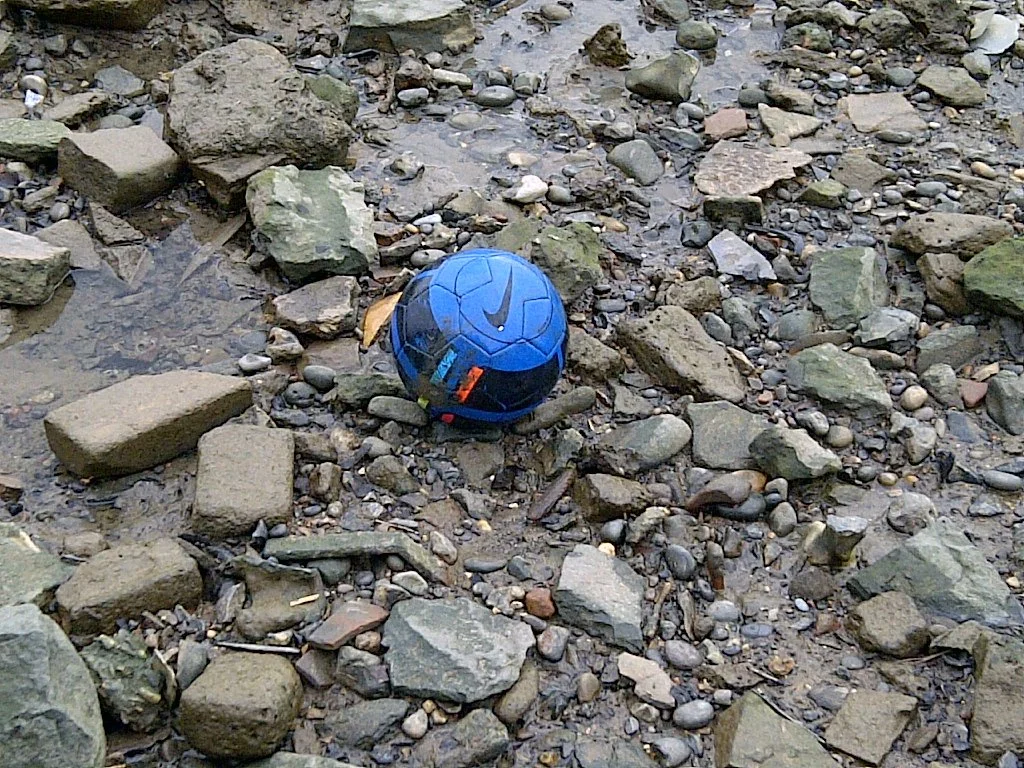
As we walked in the direction of Tower Bridge and the riverboats pushed their way past, I wondered if their passengers wondered about us, my children scurrying ahead and me hanging back fretting that we would go too far and that the incoming tide would sweep in forcing us to have to quickly find a way to clamber up to the Thameside streets. The routes to safety did not seem that numerous - on our way we passed ghost ladders planted in the sand, but their rotted rungs led nowhere. We picked our way over thick lengths of rope tangled with weeds and alive with the moss that that had colonised them. A bright blue football emblazoned with a swoosh, lay among the rocks and lumps of hardcore, still inflated as if it had only just now been kicked over a fence.
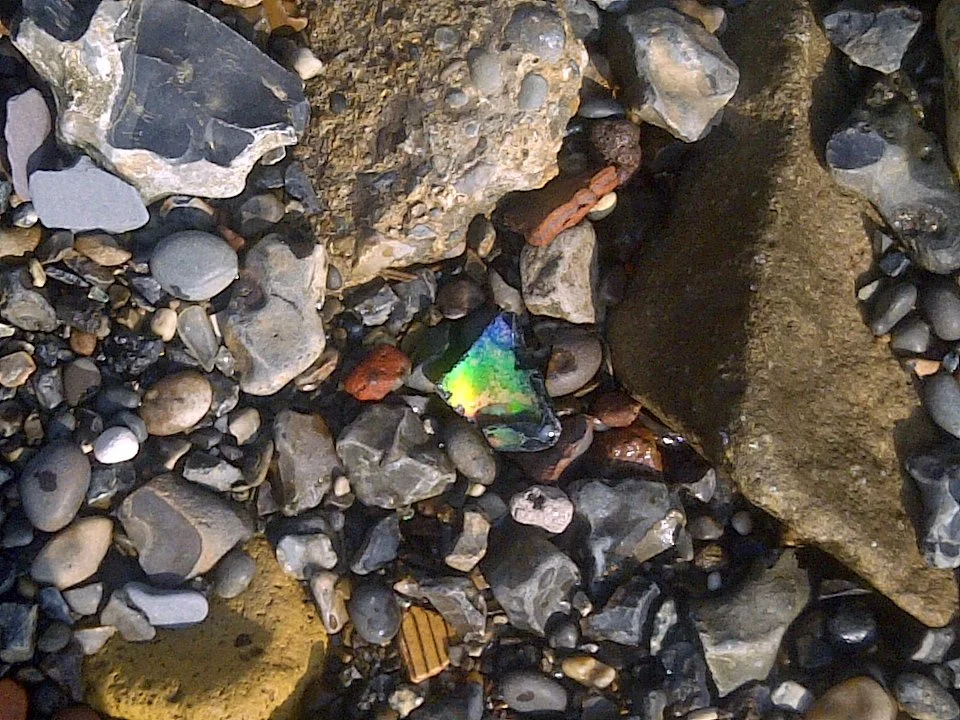
Men in pairs, latter-day mudlarks with heads down over their metal detectors, passed up and down, with no time for talk or the excitement of children. But we saw the only person we regularly spoke to even though we did not know her name. A lady with a ponytail, usually in a black raincoat, and always on her own although she told us about her children and how she brought her finds home to them. The boys always rushed to share their treasure with her, especially thrilled when they had found pennies and shillings with the silhouette of a young Queen or even a King. She showed my boys the things she had found and dug up, broken blue and green bottle tops, dolls’ heads and arms and fragments of brown pottery sometimes marked with a date before either she, I or our parents were born. The three heads of dark hair, curly and straight, bent close together over the detritus of a hundred generations and discussed the mysteries of bones that were worn into smooth white softness, discards of anonymous creatures. When we finally said goodbye and separated, she carried on towards the pier of Wapping Police Station while we turned east again. Now we were walking faster than when we had headed out but on the way the boys noticed a particular stone within a constellation of rocks and broken concrete. It was sharp edged, almost a triangle, black with yellow, blue and green pulsing implausibly within it. For a moment we stopped, held by the colours, the stone refracting a light our cells had already been steeped in. None of us mentioned taking it with us. This was a sometime lighthouse for fossickers and although we might never see it again, we knew it our responsibility to leave it for those who would follow. The memory would stay with us, holding us firm the way the river held my son. The way I held them both.
Line (2026)
The cold was sharp, the river a black valley to our right. The queue my friend and I stood in was a thin thread parallel to the Thames path. Chatter was all around us - a Thursday night wave of noise. Surely the building beside us could not hold the thousands waiting to enter I thought, but still we shuffled forward as the Tate sucked us in. Everyone patiently obeyed the rules of the line except for friends finally finding each other and introducing never-met partners and dates.
I smiled at the trendy, shivering people and their air kisses, but did so kindly because I was content to be with them. We were part of the queue too even though we firmly thought our provincial backgrounds set us apart us from these metropolitan manners. Now we had sunk into London but we were not from here, our childhoods and upbringing in smaller places. We grew into all the new places and environments we experienced but never let go of our roots.
As we walked down the ramp to the entrance I told my friend - not for the first time through years of tumbling through life together as young and middle-aged men - how I loved coming here. I remembered waiting on the train platform at Leagrave as a teenager, excited to come down to London to explore and discover. Neither of us took access to places like this for granted like the city-raised people we met at university or worked with years after. Institutions like the Tates were not places that we were introduced or taken to; we found them ourselves through our own searching and curiosity. We were entranced by the images, installations and artists that we found and driven by our love for what we thought they were telling us.
We moved up the levels, wandering the galleries and sinking deeper into them. We weaved through the crowds and drank in the challenge of creations by Duchamps and Warhol, walked between stunning visions of Nigerian Expression and crossed a floor covered in strange fruit. We wrote our names and silly messages in red carpet that had been lain from floor to ceiling. Then we arrived in a space that felt as familiar to me as a childhood classroom. On one wall the artist Richard Long had smeared mud with his own hands, the grooves and drips shaped by gravity and his fingers and palms. The colours were different from those buried in my memory. I had imagined it sculpted in thick red mud bands mixed with lighter browns, scooped by hand in gelatinous lumps from an Avonmouth shore and spread horizontally. But the predominant colour on the wall I now saw was black, covered by white vertical streaks and striations, while the border across the top mimicked a band of dirty ice. The image I had held onto was different, but the mud sucked me in again. What I remembered still felt whole, authentic and connected to this space. Many years ago, arriving here so far from where the Lea began its flow, had been a stepping out of place but it was also the beginning of who I was now. The person who fell in love with art and who would return to these spaces again and again to browse in the quietness with the crowds gone. Here was where I could feel comfortable and at peace. Even on my own.
There was a line on the floor and peering intently at the wall a young woman in an expensive looking lime coat accidentally crossed it, engrossed like a boy whose face I could no longer remember. A whiny alarm sounded and she jumped back then looked around to see if anyone else had noticed. No-one stood up, no-one rushed towards her. She turned to me with an embarrassed smile and I smiled too. Like the wide circle of white stones on the floor behind us, an orbit was full and complete.
***
With thanks to my sons. And to Paul Baldwin, Julie Keir and Seán Kelly.
Alexis Keir grew up in Luton, England but now lives in Kent. For part of his childhood he lived in Saint Vincent in the Caribbean, which is where his parents were born and where he returns regularly. He is a proud Vincentian and member of the Writers for Saint Vincent group. His book WINDWARD FAMILY which was published in 2023 explores the lives of Vincentians who have travelled to England over generations from the 1800s through to his own parents arriving in the UK in 1960.
Alexis has been selected for Spread The Word’s (now the London Writing Centre) London Writers Awards and the London Library Emerging Writers Programme. His writing has been published in The Caribbean Writer, Hinterland, The London Magazine and The Selkie. He works as a manager for NHS England.