A lost world at Crewe Station

IMAGE: Alex Cochrane

IMAGE: Alex Cochrane

By Alex Cochrane:

Late night at Crewe station. I wander empty dark platforms where rain drips down and fog drifts through the lights. A non-stop London-Glasgow train arrows past with unnerving silence and speed. 

It’s Sunday night and there are few travellers about which is surprising given Crewe’s renowned status as a major transport junction. Then again Crewe is also smaller than you would expect. The station will interest the railway history buffs with its many firsts, for example the first station to have its own adjacent railway hotel. The Crewe Arms was built in 1838 and is still in use although tonight its dark, foreboding airs make it look like the setting for a 1930s murder mystery novel. Then there are the glimpses, on the approach to the station, of ancient and decaying railway stock clustered around the Crewe Heritage Centre.  Crewe will interest and frustrate the urban explorers with its large swathes of inaccessible overlapping edgelands, wilderness and railway landscapes. One of the platform stalls serves an excellent hot chocolate often needed to warm up passengers waiting for connections. Even at the best of times, with the sun shining through its new roof, Crewe station is a little charmless. At night it is downright shabby and gloomy. But if you’re there on a Sunday afternoon or evening you can imagine a world now lost that does lend Crewe a hint of nostalgia. 

Ronald Harwood’s celebrated play, The Dresser, explores the relationship between a personal assistant and a brilliant but disintegrating Shakespearian actor as they tour the province theatres of World War Two England. In an emotional outburst Her Ladyship, the wife of the actor, Sir, laments life on the theatrical road, a litany of complaints which includes spending Sunday evening on Crewe Station.

In the age before television, theatrical and musical mass entertainment was provided in the variety theatres up and down the land. Every town had a variety theatre and the migrating performers were its blood. Bookings were weekly and on their Sunday rest the performers would travel to their next venue, often via Crewe. The station became a social as well as a transport hub; where the performers caught up with each other, like the railway lines criss-crossing, before separating and heading off for another town and another week of performance.

Tales of Sunday at Crewe, no doubt exaggerated, have been handed down one side of my family. In those days the goods vans of trains carried all the equipment which would be unloaded onto the platforms along with dancing girls, comedians, singers and circus acts. There was chaos and gossiping on the platform, drinking at the station bar, performers dancing and practicing their acts, performing dogs running amok amongst cases, props and surreal looking costumes.

It always sounds chaotic and lively.  Crewe is quiet and this world is gone now, even its ghosts have disappeared and the variety theatres have closed down or been redeveloped into flats and bingo halls. The train for Glasgow arrives. There’s little nostalgic or elegant about these trains with their stale airs, cramp seats, sticky plastic tables, garish lighting and jarring colours. Not unless you pay for the muted, sleek modernity of first class.

The train slides out of Crewe, gathering pace as it heads north.

Alex Cochrane is based in Glasgow and blogs about exploration, travel, history, historical erotica and other curiosities on his website. You can also follow Alex on Twitter at @alexdcochrane.

Looking For The Southern Cross

IMAGE: Yessica Klein

IMAGE: Yessica Klein

By Yessica Klein:

crickets / across the ocean / loud songs of summer in the tropics / chords of trembling leaves / frogs // sleep with the windows open to the drizzle / warm breeze / moonlight / cicadas // a red double decker / visit Brazil / I’ve betrayed my mother tongue for foreign sounds instead // silence gone / fights / sirens / headlights dancing on my ceiling / adapt to the most unusual situations / look for the Southern Cross / Alpha Crucis / Beta / Gamma / Delta / Epsilon / to Camberwell or Brixton // no / the North Star kingdom / don’t know where that constellation is // lucky enough getting a glimpse of the moon / full in Virgo / purification, astrologers say // saw Venus once / only at sunset or dawn // a glimpse of my skin / ash / craving the sun as the days get darker / 730 days abstinence / beating for sunshine / tropical heart / solar soul // an English word for that restlessness in the stomach / craving for the unknown / emotional anchor up / sail to new shores / don’t predict what’s coming / pack the bags / black hole of the future // the crickets I miss the most / through perfectly still silence / another red double decker / visit Morocco / maps / phone / music / the noise inside my head / Starbucks every other corner / chains make believe the world is tiny / yeah / I’m aware of the distance / miles and kilometres / the physicality of space / learned concept / the furthest place we know is our grandmother’s house / 45min up the mountain on a dirt road / once across the Atlantic / take the train and Paris / Le Starbucks // cultural predators learn others’ ways to lose their own / adapting / freckles after the sunburn in Málaga / knuckles rough after frost bites in Berlin / skills at Maths from calculating currencies / scars / sweet trophies of endurance / visible or not / where is home if we’ve left it already / where to go next if we can always go back // can’t trace those accents home anymore / where are you from / a country defines an identity / thought you were French / a red double decker / visit Brazil / last time I spoke Portuguese I was told I had an English accent / oh dear / my native speech cadence drowns in Earl Grey / time to go / not back but forward // warm breeze tangles my hair / leaves / frogs ribbiting // muscles stretching / too long a hibernation // hope is a feeling not a place / can’t pin it down anywhere // crickets / cicadas / the air vibrates / the sky lights up / Alpha Crucis / Beta / Gamma / Delta // Venus the love planet / full moon in Libra / my star sign // reunion, astrologers say // finally going home

Yessica Klein is a writer and artist currently based in Liverpool (UK). Her first collection of poems is coming out in Brazil in 2017 and her artwork is represented by Carolina Badas Gallery (London). @yessicaklein or www.yessica-klein.com.  

Return to Lakenheath, Suffolk, England

 By Rosamund Mather:

When I was four years old, I moved to a village with a foot in two camps. Tucked into the northwestern corner of the eastern county of Suffolk, Lakenheath straddles two climates; search for it on Google Maps, switch to Satellite Mode and zoom out a little bit. You’ll notice that to the west, it is light green, and the villages are few and far between. This is the Fens, a marshy area spanning four English counties and lying almost three metres below sea level. To the east, there’s a clump of dark green spilling out, denoting an abrupt contrast: the Brecks, the driest part of Britain.

And funnelled right in between these diverging landscapes is a strange organelle. This is RAF Lakenheath, a base that has hosted United States Air Forces since the 1940s. Its presence meant that the new classroom I had stepped into was a microcosm of the US.

Today, I have made a trip to Lakenheath with my mother. We’ve been doing this every couple of years. We say it’s out of curiosity, but we both know it’s more for reassurance. The school looks the same. Some shops are still there, others have been pulled down.

The car grumbles along the track to the Warren’s entrance. Comfortingly, the crunch under the tyres hasn’t changed since those weekends of putting the bikes into the wide boot of the red Volvo.

The Warren is where the Brecks portion begins. It is a mysterious place. There’s a touch of Roswell about it; electricity substations, tall wire fences, juxtaposed with a sandy heath, houses concealed by tall bushes. If you’d asked me to describe the Warren as a child, I would have said it looks just like Mars; perhaps grassier, but very dry, certainly, with patches of sharp fringing the dusty craters. The fields are dotted with Scots pine, which I always thought were the same trees in the African Savanna. When I learnt the word "drought", I associated it with this place. Before any of us were alive, the Brecks were characterised by their seas of sand. What’s left behind is what makes the area so supernatural. It doesn’t look like it belongs in damp England at all. Even when it is grey, it glows.

‘There is a rusty light on the pines tonight;
Sun pouring wine, lord, or marrow.’
'Emily', Joanna Newsom, Ys (2006)

Mum and I traipse over the thin, golden grass shimmering at our ankles, then tear through fluorescent ferns to get to the sandy part of the Warren. A nettle nips my shin. I remember that you’re not supposed to scratch the sting.

I was slighted by the Warren on one of these walks as a child, when my blue Tamagotchi fell out of my rucksack. Swallowed, never to be retrieved. That’s when I realised that the Warren signified something greater than myself. The tall wire fence, cordoning it off from the base, still lends it a spooky undertone.

‘There are nuclear weapons under there,’ Mum mentions as we survey the vast airfield, coated in tarmac and dotted with hangars. Indeed, it chills me that deadly US military operations in Libya, Afghanistan and Iraq have all started life in my childhood hometown.

After school, I’d jump into my American classmates’ SUVs - many of which had a puzzling combination of a left steering wheel and a UK licence plate - and tag along to the base. Admitted on their parents’ IDs, we’d go rollerskating, eat bubblegum ice cream and see movies not yet officially released in the UK.

These friendships were fun, but fleeting; usually they return to the US after a year. First there’d be tears, but finally a stoicism in the way that only children know how. How was their impression of my country shaped, from within the incongruous Lakenheath bubble?

The airbase’s history may be palpable, but there is still something primordial in the air in Lakenheath.

The craters giving the Warren its Martian look were Ice Age periglacial ponds – pingos – linked to sediments of the Bytham River found there. This is thought to have been the main route into Britain by its earliest settlers.

In 1997, the skeletons of the 6th-century Lakenheath Warrior and his horse were excavated, heralding the discovery of some 400 further graves. This archaeological breakthrough put Suffolk on the map again, 58 years after the discovery of a gargantuan ship burial at Sutton Hoo, on my grandparents’ side of the county.

It all refutes the aphoristic belief that villages are stagnant, that the only thing that changes is their residents, who faithfully live out their days until the next generation receives the baton.

The six years of Lakenheath that I can call my own – the window in which I existed and grew, shadowed by centuries and millennia – saw a village with a cosmopolitan edge. That window closed when we moved away. A fortnight later, there was one more, most unforeseeable change.

The past is a foreign country, they say. Lakenheath now straddled not only the Fenland and the Breckland, but pre- and post-9/11.

Not long afterwards, we were travelling via Lakenheath. The entrance to the base was bricked up, lines of cars backed up, fences even barricaded the residential area. It was now a fortress. No visitors. No after-school ice cream. All vehicles subject to inspection.

America no longer existed just at the end of my street. The world had been flung into an inscrutable, grown-up turmoil.

We have seen what we came for today, yet melancholy will follow us home. We indulge in a minute or two of stalling outside our old house. The garden fence has been pulled down, solar panels inserted into the roof. My childhood bedroom window is now frosted, suggesting it has been merged with the bathroom: no cell of me remains in there, not even in the rough white carpet.

Rosamund Mather is a Berlin-based writer, editor and translator. She tweets at @spookytofu and blogs at roseailleurs.net

Postcard from... Papaverhof, The Hague

By Kelly Merks:

I was riding my bicycle when I first saw the Papaverhof. The sense of place I felt is unforgettable: with the simple motion of turning a street corner, my 1930s brownstone neighborhood ceded to a horseshoe-shaped row of low-lying but imposing white concrete blocks. I froze in fascination, and my bike slowed gently to a stop.

“It’s De Stijl! In real life!” my head clamored. My eyes followed the geometric masses of white that tumbled down the street, hemming in short and bold lines of black, blue and yellow. The scene recalled Piet Mondrian’s iconic Tableau and Composition series; the buildings mimicked the paintings’ cubic rhythm and primary colors. This unique housing development, the Papaverhof, was like nothing else I had ever seen, and my modest district of The Hague was not the place I would expect to see something like it... but here it was. 

The discovery was only a personal one, of course, because people have been living in the Papaverhof for almost a century. It’s a housing development that represents a unique moment in Dutch and local history, yet many people in The Hague don’t know about it. 

After the First World War, Dutch cities faced a shortage of adequate housing and building materials. In 1917, before the war ended, a 25-hectare (61.7-acre) plot between The Hague and an adjacent village called Loosduinen was created as a suburban extension and given the name Daal en Berg after the farmland it occupied. This new development was meant to help alleviate the region’s crowded urban living conditions, and is seen today as an early example of Dutch suburban social housing. Later the same year, Daal en Berg became a Coöperatieve Woningbouw Vereeniging Tuinstadwijk — roughly translated, a Cooperative Housing Garden City Association. I found no evidence that this garden city initiative was influenced by Ebenezer Howard’s Garden City Movement. Daal en Berg’s reality, in fact, was closer to that of a mini garden suburb. Garden suburbs are built on the outskirts of cities and are typically absent of industry, density, or connectivity: the antithesis of Howard’s garden city dream. 

Daal en Berg’s social housing complex—called the Papaverhof in keeping with the area’s botanical street names, like Rozenstraat, Magnoliastraat, and Irisstraat—went from concept to creation under the direction of architect Jan Wils. In 1919 Wils was favored in a design competition by the cooperative’s commissioner, Hendrik P. Berlage. Berlage is regarded as the patriarch of Dutch modernist architecture. He was especially enamored with Frank Lloyd Wright’s work after a 1911 tour of the American Midwest and east coast, and he became a liaison between Wright and “both the expressionists of the Amsterdam School and the rationalists of the De Stijl movement,” according to the Frank Lloyd Wright Trust. 

Indeed, the Papaverhof is not only one of Wils’ and Berlage’s important works, but bears the fingerprints of other contemporarily and regionally influential artists and architects: Gerrit Rietveld, Vilmos Huszár, Piet Mondrian, and the De Stijl movement founder Theo van Doesburg, who lived at Daal en Berg (on Klimopstraat, across from the Papaverhof) for 20 years. 

The Papaverhof is also an exemplar of a short-lived architectural movement called Nieuwe Bouwen, or “New Building”—an offshoot of Functionalism that centralized economy of scale and relied on modern technology. If De Stijl provided the development’s aesthetic, Nieuwe Bouwen concerned itself with materials and organization. It was a response to the interwar demands of economic and demographic expansion. Nieuwe Bouwen reorganized the home to provide more light, air, and space, focusing on efficiency and modernization instead of ornamentation. “Form follows function” lives on at the Papaverhof.

Despite its architectural and social importance, the Papaverhof’s 128 units were initially slow to sell. People were wary or just turned off by the large open garden in the center. But this problem doesn’t exist anymore; residents tend to stay for decades, and the waiting list to buy is long. The Papaverhof is among the top 100 national rijksmonumenten, or heritage sites, and one of only 11 in The Hague. 

Today the city has subsumed Daal en Berg. The once-suburban satellite is now well within city limits and sits only a short walk from the Laan van Meerdervoort, the longest avenue in the Netherlands at 5.8 km (3.6 miles). To celebrate Daal en Berg’s 100th anniversary in 2017, residents of the Papaverhof have created a virtual tour of a model home, and hope to eventually recreate for virtual tour a home as it was designed by Jan Wils in the early 1920s. 

(Follow this link to take a virtual tour of the Papaverhof)

Kelly is an American enjoying life on the frigid North Sea after a few years in Japan, having swapped great sushi for better beer in the Netherlands. As the daughter of an aerial photographer and a geographer, she grew up in a home of mapping equipment, old globes, and atlases that have informed her search for hidden contexts of the landscapes we travel and live in. You can find her on Twitter at @flaneurie and read more of her work on her blog, Bullet Trains and Bike Lanes. 

Postcard from... Conakry

By Tim Woods:

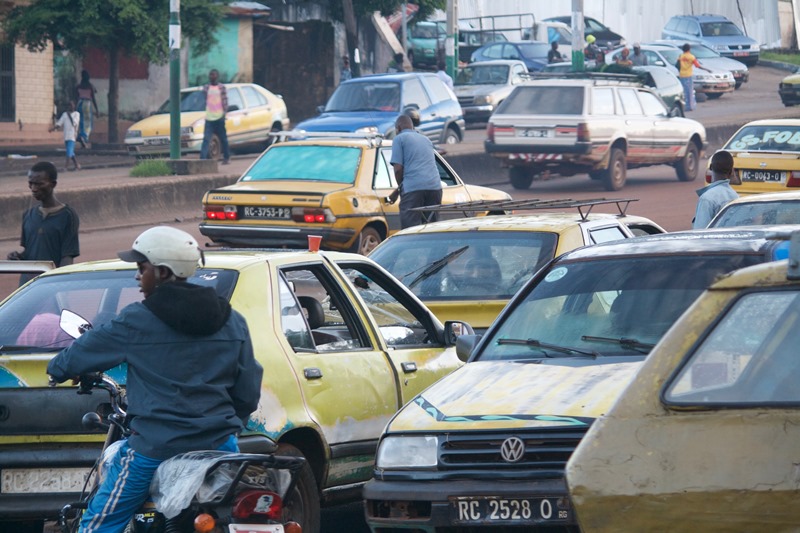
Conakry is a city with few options. Surrounded on three sides by the Atlantic, the only direction in which it can expand is inland. New apartment buildings rise rapidly in the hills to the northeast, with poorer dwellings springing up wherever there’s a gap in between. Yet the city’s heart remains in Kaloum, out on the peninsula’s furthest tip and where the main port, markets, office blocks and government ministries are found.

The result? Traffic clogs the three main highways to Kaloum from before sunrise to long after dusk. My taxi to Ratoma – barely a quarter of the way through the city’s total area – takes more than two hours; the driver’s frequent attempts at a short cut being beaten by potholes, floods or others with the same idea. 

“Traffic’s quite a problem in Conakry,” I venture.
 “Problems have solutions,” he smiles. “Here, traffic is just life.”

Postcard from... Koh Kret

By Julia Stone:

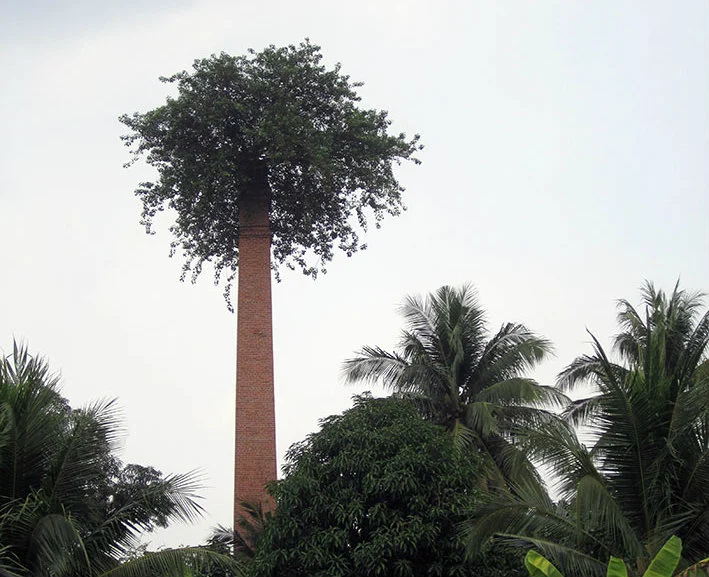
As we approach the island by boat, the chimney has the appearance of a ginormous tree, sprouting high above the coconut palms and temple rooftops. Out of the mouth of the chimney a bush of some sort is growing, like a head of curly hair.

Koh Kret became an island in 1722, when a canal was constructed to create a shortcut in the Chaophraya river. To this day there is no bridge connecting the two by two kilometre island from the mainland, and only bicycles and motorbikes travel the path that runs around it. You will find Koh Kret to the north of Bangkok, in the district of Nonthaburi, where I my dad lives. I love coming to Koh Kret for the rural atmosphere and absolute contrast to the bustle and noise of the mainland, just a two Baht ferry ride away, although not on the wekend, when hordes of Bangkokians arrive to eat, buy pottery souvenirs or visit the Mon temples on the island.

Mon immigrants settled Koh Kret after the destruction of Ayutthaya in 1767, during the Siamese-Burmese war. Today the majority of Koh Kret's population is still Mon, with their own distinct version of Buddhism and a traditional style of Mon pottery called kwan aman, for which Nonthaburi and especially the island are famous.

The chimney is the remnant of a pottery village, I can see some of the brick kilns still standing below as I approach it via an elevated path between crops growing in water, but it looks like it hasn't been used in quite a while. As a kid, my mom used to take me to the Koh Kret and sometimes one of the potters would let me have a go at forming the clay on the rotating wheel, but now I wonder about this inactivity. As the visitors pick over the choice of pottery souvenirs in the village shops I have to question whether they are even made here any more. 

Postcard from... the Eternal Sea

By Julia Stone:

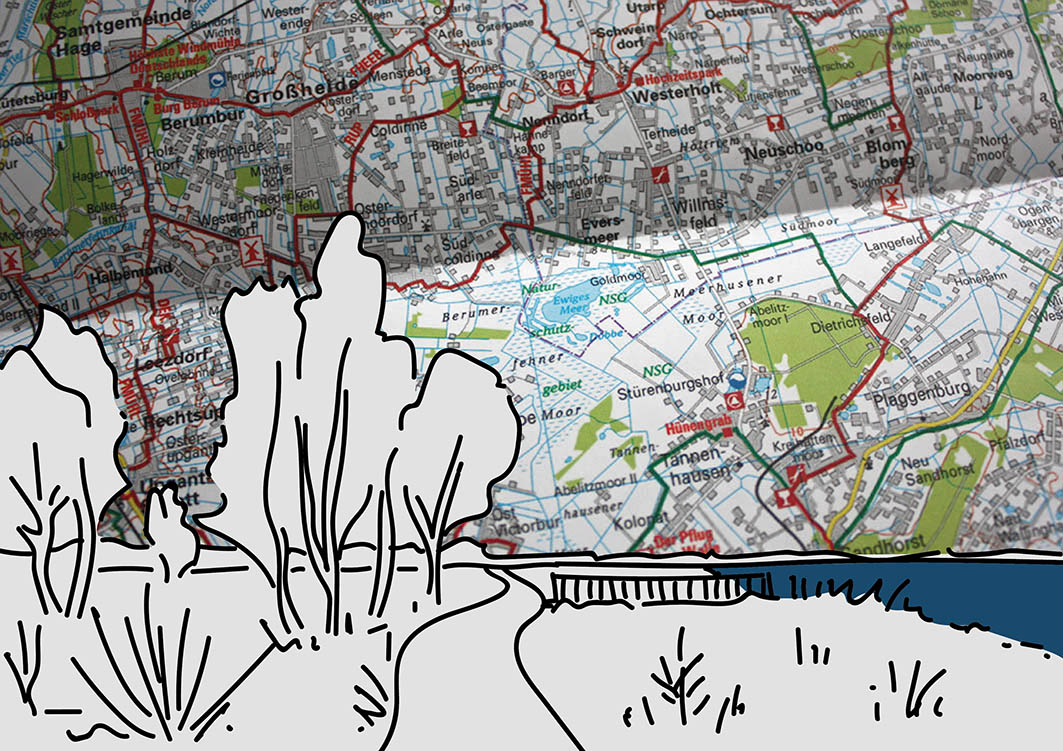
It was the name on the map that intrigued us. Scanning through the places and landmarks of Ostfriesland the name jumped up off the page. Ewiges Meer – the Eternal Sea. We knew nothing else but the name was enough. We took a detour and followed a wooden path above the marshy moor for two kilometres, all the while watching the sky warily for the onset of a promised thunder storm.

We found the lake and immediately noticed there was none of the usual reeds and other plantlife growing in the shallower waters along the shore, and from the information boards by the path we learned that this was a result of the nutrient poverty of the moorland waters. The Eternal Sea is a Hochmoorsee (high moor lake), around which peat was long extracted until it was declared a nature reserve in 1939. It may be only three metres deep but it is 1.8 kilometres long and almost a kilometre wide.

Under darkening skies the waters were choppy, and although the information boards promised a variety of birds and other wildlife there was none to be seen. No people either, and standing out there with no chance of shelter from the cloudburst, feeling rather disconnected from civilisation, our surroundings felt strangely timeless... you might even say: Eternal.

Elsewhere No.04, featuring illustrations and artwork from Julia Stone, is out now. You can order your copy directly with us via the online shop.

Citrus Country: Mildura, Australia

By Nick Gadd:

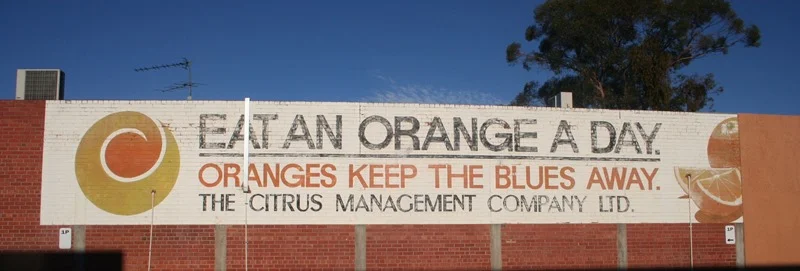
Eat an orange a day. Oranges keep the blues away, reads the large painted sign on the north wall of the former Sunraysia Citrus Management Company. On the right, the signwriter added a bunch of segmented oranges, like a Dutch still life. On the south side is a matching sign for lemons, reading Lemons add to life. Be in it! There’s no doubt about it: you are in citrus country.

Mildura is a regional city on the Murray River, which marks the border between Victoria and New South Wales, and without the river the city would not be here at all. In the late 1880s, two Canadian brothers, the Chaffeys, irrigation experts, moved to Victoria from California, where they had established successful fruit-growing colonies. They persuaded the Victorian government - after much political shenanigans - to allocate them 250,000 acres for a similar colony on the Murray.

The creation of Mildura was a remarkable feat of public relations. How else to explain the fact that droves of people from Britain, Europe and elsewhere threw up everything to travel to this non-existent settlement in a remote part of Australia? They were responding to an international advertising campaign that made shameless promises about the profitability and fertility of the land. Victoria had experienced a gold rush a few decades before: this was a fruit rush. 

Many would be disappointed. The Chaffeys were not as well capitalised as they claimed; their irrigation works were incapable of delivering as much water as was needed. Settlers had to clear their blocks of huge, stubborn mallee roots. There was no railway, making it impossible to transport the fruit to markets. And then, of course, there was the river, which proved an unreliable partner. In some years the Murray shrugged its mighty shoulders, swelled and flooded over the orchards and vineyards. In other years it turned its back, shrank to almost nothing, became a dusty gutter. 

The Chaffeys went bankrupt, resulting in a sensational public inquiry at which settlers accused the brothers of conning them. In spite of all that, the settlement survived. And through the extraordinary efforts of the remaining pioneers and their descendants, along with government support, a successful city based on irrigation did indeed develop.

I’m here in citrus season, and everywhere I go people press fruit on me: oranges, lemons, mandarins from their own trees. It’s not all citrus: today, farms producing grapes and almonds swallow vast amounts from the river.  Now the debate is: How much irrigation is too much?  “We’re OK for now, but when another drought comes, we’re stuffed,” a local greenie told me. Here, as in many parts of the world, how well the water is managed is the critical question for the future. 

Nick Gadd was writer in residence at the Mildura Writers Festival in July 2016. You can read more from Nick on his website Melbourne Circle: Stories from the Suburbs and follow him on Twitter. Nick was a contributor to Elsewhere No.02 where he wrote an essay on the ghost signs of Melbourne.

Elsewhere No.04 is published on 28 September 2016 – Order your copy here.