Postcard from... Hyltenäs kulle

Image: Katrin Schönig

Image: Katrin Schönig

By Paul Scraton:

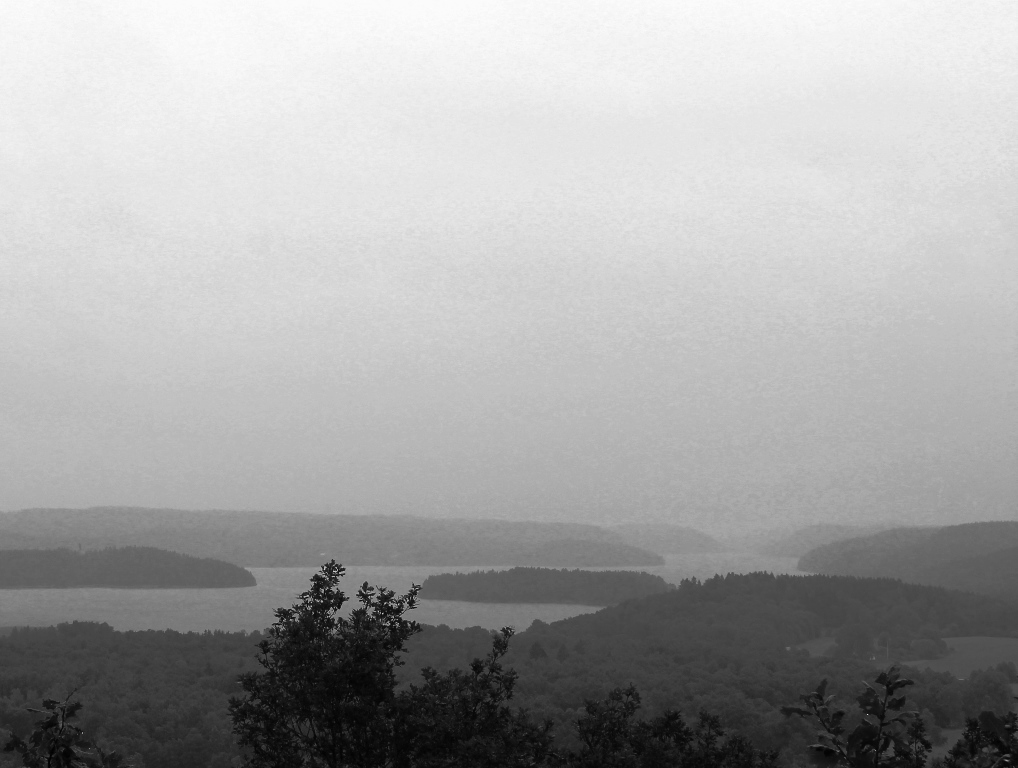
The marketing material promised ‘West Sweden’s most beautiful lookout point’, the Hyltenäs kulle rising above the dense forests and lakes of the Mark municipality, but as we followed the narrow, winding road up the hill the mist was descending and a light rain had begun to fall. At the top, a solitary man stood with an umbrella against the drizzle, looking out into the gloom.

‘I’m supposed to be photographing a wedding up here,’ he said, glumly.

‘When?’ I replied.

‘In about an hour.’

I left him to his thoughts of where he could place the bride without getting too much water on her white dress, and began to explore the summit of the hill. In the early years of the 20th century, the merchant George Seaton built a huge hunting lodge on the hill, which at the time of construction had been cleared of all trees and other plant life in order to maximise the views for Seaton and his guests. Perhaps this was tempting fate. They barely had time to enjoy it – just a handful of hunting seasons – before the lodge was destroyed in a fire. Now all that remains are the stone foundations and the hill, declared a nature reserve in the 1970s, is once more overgrown with a forest of oak, birch, hazel and mountain ash.

But the views that brought George Seaton to the Hyltenäs kulle remain. However dreich the day.

Paul’s essay ‘Bordercrossing’ appears in Elsewhere No.05 – Transition. You can order the latest edition of the journal and all back issues directly with us, via our online shop.

Five Questions for... Brendan Walsh

IMAGE: Brendan Walsh

IMAGE: Brendan Walsh

For the next of our semi-regular series of short interviews with contributors to Elsewhere and other friends of the journal we have five questions for Brendan Walsh, whose poem 'Playing War’ appeared in Elsewhere No.05. You can find our more about Elsewhere No.05 and order your copy here.

What does home mean to you?

I've realized that home, for me, can only be determined in retrospect. Home is a memory. I can look back at times/places and say, "yes, that felt like home," but in the moment I'm not sure it can be pinned down succinctly. Oftentimes we equate "home" with "comfort," but why can't comfort exist without home? The more comfortable one becomes in the absence of a defined location, the greater comfort one can find in every single place.

Two years ago I would have said that home is wherever I am with people who accept/love me, but it isn't that easy. I have been with wonderful people in places that were definitely not my home. Before I had the ability to travel freely, this question was much simpler to answer.

Where is your favourite place?

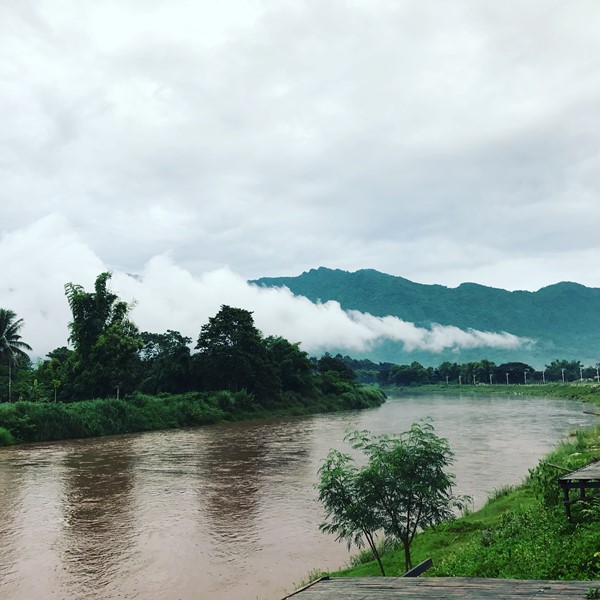
My favorite place is Laos. I lived in Vientiane for one year, and I'm currently back visiting for a month. I won't say that there is one place within Laos that I prefer--I am simply enamored with the feeling of being here. In my life I've never encountered a collective society that is more welcoming, humble, kind-hearted, relaxed, and hilarious. The landscape is calm and brutal in the same blink. Mornings are hazy, slow, and warm.

What is beyond your front door?

Palm trees, geckos, coffee, mangoes fallen to the sidewalk, beaches, hopefully sun.

What place would you most like to visit?

Right now it's a tie between Papua New Guinea and Mozambique.

What are you reading/listening to/looking at right now?

I'm reading Viet Thanh Nguyen's The Sympathizer, Between the World and Me by Ta-nehisi Coatesand Become What You Are by Alan Watts, listening to thousands of motorbikes tear through Vientiane's Lane Xang Avenue, and looking at three women congregated around a cart weighed down with coconuts. 

Printed Matters: NANSEN Magazine

As small independent publishers of a small independent journal, we are always interested in the work of like-minded folk, especially if the subject matter relates to our own investigations of people and place. NANSEN Magazine is a new project from an old friend of ours and tells the story of migrants of all kinds. Their first issue was published yesterday, and we caught up with editor and publisher Vanessa Ellingham to find out more.

Hi Vanessa! Can you tell us a little bit about yourself, and what inspired this new magazine?

I’m a journalist and editor, originally from Wellington, New Zealand, now living in Berlin. I’ve been here for four years, but before moving to Berlin I lived in Copenhagen for a year with my partner, who’s Danish.

My year in Copenhagen didn’t go very well. I was struggling to settle in, find work, make friends and feeling pretty lonely. One of the things I did was go and volunteer at a refugee camp, where I met other newcomers in a very different situation to myself - for one thing, if I was so fed up I could just move home again, which they absolutely could not. It got me thinking about all the things we had in common as newcomers to Denmark and the solidarity to be found between different kinds of people living far from home but all giving it their best shot.

What is it about the topic of migrants and migration that interested you?

Migration has always been part of human life on earth and it certainly isn’t going to stop. I think the events of 2015 only highlighted the need for us to better understand why people leave home in search of a - hopefully - better life.

I first had the idea for a magazine about migrants a couple of years before the “refugee crisis”, when I was standing in IKEA in Berlin, having just shopped for new furniture in a new country for the second time in a year.

With NANSEN Magazine we want to introduce our readers to all kinds of people on the move and explore the personal experiences of migration that other migrants can relate to and non-migrants probably will, too.

Because migrants aren’t just refugees. We’re also doctors and artists and lovers and diplomats. Some migrants are better known for being movie stars than for their immigration status. But they likely have many shared experiences with other people who’ve upped and left home.

That’s why we focus on one migrant per issue, to go deep into their experiences so that, after reading the magazine, you feel like you’ve really gotten to know that person.

What can we find in issue #1?

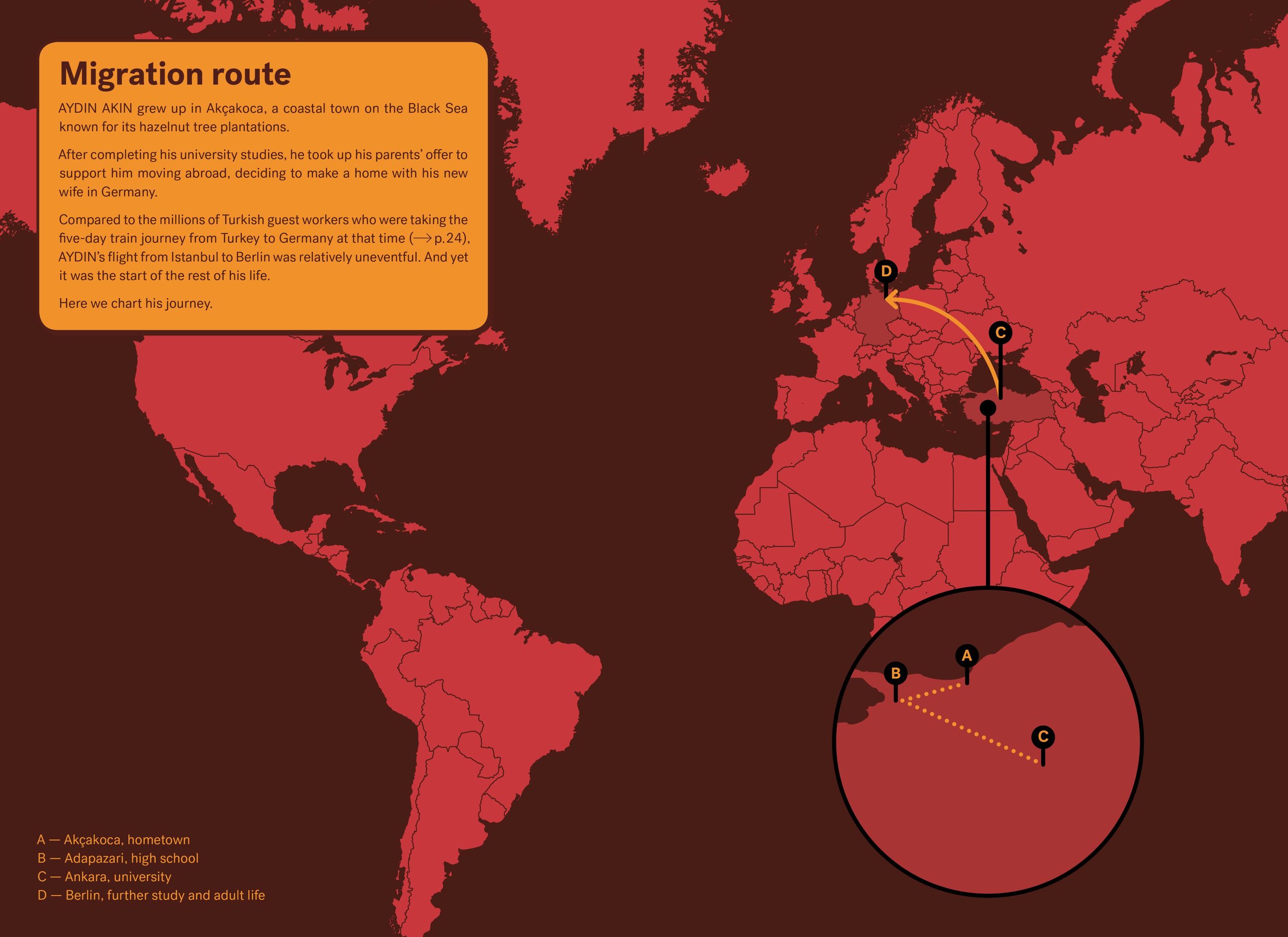
Issue 01 centres on Aydin Akin, someone many Berliners will know, although most likely not by name. Aydin is a 78-year-old Turkish-German man who cycles across the city each day, demonstrating for migrant rights.

It’s an endurance protest - his trip takes three hours each way - and he’s been doing it for 12 years. But if you spot Aydin on his bike, decked out with his handwritten protest posters, his two megaphones blasting music and his protest chant, and the annoying whistle he bleats on as he rides, it can be hard to see him as anything other than totally crazy.

Turns out Aydin has some great ideas for how to better welcome newcomers to Berlin and Germany. He’s spent almost 50 years now living in Germany and advocating for equal rights for all of Germany’s migrants. He believes that giving newcomers equal footing from the get-go is the best way to prevent the anger, hate and violence that occurs when people are excluded from the societies they live in. I think Aydin’s someone worth listening to, whether you live in Berlin, Germany or somewhere else.

So Issue 01 is about Aydin and his life in Berlin. But because he’s so focused on others, and the broader migrant community, this issue spins out to explore what it’s like to be a Turk living in Berlin today. We spend a day waiting in line at the Ausländerbehörde, we chart the history of Turkish guest workers in Germany - another large group of migrants who arrived en masse by train, decades before the 2015 “refugee crisis” - we talk about Willkommenskultur and we meet the next generation of Turkish-German Berliners.

What is next for Nansen?

We plan to make future issues of NANSEN about migrants of all kinds living all over the world.

And we promise they won’t all be people working in the area of migration, Aydin just seemed like a great subject to start with. We like to be bold and a little playful - you can expect us to go beyond the melancholy of traditional migration reporting. Because there’s plenty of joy in being a newcomer, too.

But making future issues really depends on how Issue 01 sells. So we’d love to sell you a copy of our mag!

Can you also tell us a little bit about the Give Something Back to Berlin project?

At GSBTB I work in communications. I edit and manage the online magazine, which is by and about Berlin's newcomers.

GSBTB started as one answer to the gentrification taking place in Berlin neighbourhoods like Neukölln, where hip young newcomers were moving in and pushing up the cost of living, to the frustration of the locals, both Germans and other, more established migrants. GSBTB offered a platform for newcomers to be matched up with volunteer opportunities, enabling them to give back to their new home city.

We started with a Facebook post in 2012. Today GSBTB runs many of its own projects, from cooking groups to social meet-ups to art therapy, that support newcomers to get settled in Berlin. At any of our events or projects, you’ll find locals, expats, refugees and people somewhere in-between all mucking in, invested in the idea of doing something good for the city together.

NANSEN Magazine website
NANSEN Magazine on Facebook
Give Something Back To Berlin website

Ruin Renewal: Manchester's Upper Brook Chapel

Photo: Mark Dyer

Photo: Mark Dyer

By Mark Dyer:

Nestled amongst the busy hum of traffic and surrounding car garages, I noticed the crumbling remnants of the Upper Brook Chapel when I first moved to Manchester in 2014.  Recalling a ruin from a Turner painting, the roofless Neo-Gothic church never failed to strike wonder in me. As unopposed vines and vegetation encroached upon the sandstone columns, the elements mounted a relentless assault upon the exposed innards of the building. The open husk of the nave, like the splayed ribcage of a fossilised whale, provided ideal nesting space for winged critters, whilst the intact rose window hinted at its former glory.

A fascination with ruined structures is nothing new. Like the above-mentioned painter, I never fail to recognise the poignancy of man’s futile attempts to defy nature and time. It is a sentiment that fascinated the early modern period when confronted with the remnants of antiquity, through to John Ruskin and the Romantics who contemplated man’s relationship with nature. It could be said that my reaction to the Upper Brook Chapel was commonplace, expected even, or, simply, inevitable.

Then, in early 2016, development work on the Chapel began. According to the aptly named website ‘Saving the Chapel,’ [1] Manchester City Council agreed a proposal from developer Church Converts to renovate the building into micro flats. This involved relocating the Manchester Islamic Academy, who were leasing the attached Sunday School from the Council. By mid-2016, the scaffolding that would support and surround the structure during these developments was erected.

However, the east-facing façade of the Chapel, which I frequently passed, was bedecked with a denser layer of intricate metal. This method of scaffolding is known as Double Scaffolding and is commonly adopted for stone masonry to avoid drilling into the walls. This criss-cross thicket, belted on like a muzzle, transformed the humble chapel ruin into an iron basilica. From the pavement, I was confronted by a fortified cathedral whose stockade loomed above passing pedestrians and would-be invaders. Indeed, the St George’s flag raised on top of the monolith in June 2016 cemented the image of a battle-weary and battered bastion.

We might liken the braced edifice to more modern trends in architecture. Consider Fritz Höger’s Chilehaus, Hamburg; or the Grundtvigs Church, Copenhagen, designed by Peder Jensen-Klint and Kaare Klint. The bare metal of the scaffolding in particular evoked in me a dystopian imagining of Jean Nouvel’s Fondation Cartier, Paris, as if the glass had melted away in some unknown catastrophe. Whether a fortified citadel, a fragment of expressionist architecture, or the future bones of one of our cultural houses, the Upper Brook Chapel had certainly been transformed from its Gothic origins.

So, through the preservation and development of one ruin, we are presented with another, very different, sort of ruin. Robert Smithson conceived the idea of ‘ruins in reverse’ [2] whereby the apparatus and detritus of construction work will grow out of ruin into the finished building. But Upper Brook Chapel was already a ruin and has been made more ruinous, so how might we articulate what is occurring here? Ruin regeneration? Ruin renewal? Ideologically, we might understand such an activity to be part of and run in parallel with urban renewal and cleansing. Aesthetically, however, it appears to work in contrary motion. Presented with such a dichotomy, my interpretation of the Chapel was more nuanced than before the development work began. The preservation of heritage has resulted in a temporary ruin that is somehow more commanding, more socially engaged, and more representative of how ruin can challenge us in the 21st Century.

Illustration: Mark Dyer

Illustration: Mark Dyer

Then, one evening, during the full throws of development, I chanced upon a particular sight. In the wake of fading twilight, where the inky sky provided a fitting backdrop to the obsidian basilica, a lone construction site lamp warmly permeated through the vacant double lancet window and surrounding labyrinth of iron. This simple scene, serendipitously witnessed, instantly transformed the imposing ruined monolith into a tender and reverent sanctum.

The gentle glow amidst the darkness gave an air of solemnity that the Chapel had not hosted in years, though this prompted an image of private worship or individual spiritualism as opposed to the institutional congregation.  Consequently, I was reminded of those forced to worship in secret, away from persecution in its many guises. Post-Reformation? Post-Referendum. A sanctuary for the minority, the unwanted, the forgotten. The St George’s flag erected during the EU vote now cast a more sinister shadow across the windswept parapet.

This asylum buried in the stone masonry in turn reminded me of Lud’s Church, Staffordshire, England; a natural chasm in the rock that provided a safe place of worship for the Lollards in the 15th Century [3]. Similar to Upper Brook Chapel, this cleft in the Peak District features towering columns of Millstone Grit rock festooned in lichen, a dizzying open skylight and a quiet aura of solemnity. However, instead of being carved by and into nature, the Chapel has been formed as a result of additive manmade processes to form a composite structure whose social and contextual recollections are multifaceted and era-spanning.

When the development work of Upper Brook Chapel is complete, the church-cum-mosque will host plush apartments for students and young professionals, lining the pockets of shrewd property owners, if not the Council itself. Whilst I appreciate the importance of preserving our architectural heritage and history, as well as the financial viability of sustaining derelict buildings for non-commercial purposes, should stone and mortar be prioritised above existing religious and social networks and relationships? Where will these people now seek sanctuary?

About the author:
Mark is a composer of concert and installation music. His primary artistic focus is the ‘musical ruin’: the quotation and fragmentation of existing music, that might elicit a feeling in the listener analogous to that experienced when visiting an architectural ruin. Mark has worked with ensembles such as Psappha, OUT-TAKE Ensemble and Collective31, and has published in the new music journal Tempo. In September 2017, Mark will begin a PhD in Composition at the Royal Northern College of Music, supported by an AHRC scholarship awarded by the North West Consortium DTP. Listen to his music at http://www.markdyercomposer.com/

Notes:
[1] Czero Developments. (2017) Saving the Chapel. [Online] [Accessed 27th February 2017] http://www.savingchapel.com
[2] Smithson, R. (2011) ‘A Tour of the Monuments of Passaic,’ In Dillon, B. (ed.) Ruins. London: Whitechapel Art Gallery, p.49.
[3] Cressbrook Multimedia. (2017) Lud’s Church. [Online] [Accessed 28th February 2017] https://www.peakdistrictinformation.com/visits/ludschurch.php

The story of a beach: Strandbad Wannsee, Berlin

Image: Bundesarchiv, B 145 Bild-P014703 / Frankl, A. / CC-BY-SA 3.0

Image: Bundesarchiv, B 145 Bild-P014703 / Frankl, A. / CC-BY-SA 3.0

By Paul Scraton

Down in the south-west of Berlin, close to the border with Potsdam, is a wide expanse of golden sand. This the Strandbad Wannsee, the city’s most famous beach, and a popular place to escape the heat of the summer in Berlin without leaving the city limits. The story of the Strandbad Wannsee, which has been name-checked in popular show tunes and punk songs, reflects Berlin’s experiences in the 20th century, and especially the years of division, when this beach became the Riviera, the Adriatic and the North Sea of the West Berliners imagination, all rolled into one.

The tale of the Strandbad begins, as so much in Berlin, with the rapid growth following German unification in 1871. From three quarters of a million residents, the city boomed to reach almost two million at the turn of the century, less than thirty years later. The majority of incomers lived in one- or two-room apartments in so-called Mietskaserne (rental barracks), enduring cramped conditions with limited sanitary facilities. It was unsurprising that as soon as the spring weather turned warm people flocked to the lakes and rivers surrounding Berlin.

At the same time, public bathing was technically illegal – Victorian morality was just as pervasive in Wilhelmine Germany as it was on the other side of the North Sea – but soon the numbers were such that the local municipality of Teltow, south of Berlin, bowed to the popular pressure and in 1907 it made a 200m stretch of the Wannsee shoreline open to the public. The Strandbad Wannsee was born, with two separate beaches (one for men, one for women) and a motley collection of ‘facilities’ among the trees, usually housed in tents. By the late 1920s the tents had been replaced by the buildings that remain to this day, designed by Martin Wagner and Richard Ermisch in a simple, functional style known as ‘New Objectivity’.

By the late 1920s, the visitors to the Strandbad Wannsee had access to changing facilities, terraces for sporting and other leisure activities, the beach itself and various culinary offerings, each designed to accommodate tens of thousands of bathers at any one time. But while this corner of the city might have felt like an escape from the city hidden beyond the trees, it could not remain aloof from the turbulent events of the period as Weimar Germany lurched from crisis to crisis and the National Socialists came ever closer to power.

The tension in the city was reflected in the street battles between Nazis, Communists and agents of the state, flaring up dramatically in the working class neighbourhoods of Wedding, Prenzlauer Berg and Kreuzberg. Yet another place where such battles occurred was the beach at Wannsee. Planting flags each political grouping would mark out its territory on the sands indicating allegiance by sewing the appropriate patch of identity on bathing costumes. Add to the simmering mix long hot summer’s days and excesses of beer and soon fighting broke out, often involving members of staff and, once the alarm was raised, the authorities.

The man attempting to manage the Strandbad through this period was one Hermann Clajus, a local Social Democratic councillor. After Hitler took power in 1933, Clajus was dismissed from his post and learned that he was about to be arrested. On the 18th March 1933 Hermann Clajus took his own life, and as with the rest of Germany the Strandbad had fallen into Nazi hands. By 1935 Jews were forbidden from bathing at Wannsee, although this regulation and its accompanying signs were removed for the 1936 Olympics, presumably in an attempt to hide overt displays of discrimination from visiting dignitaries. By 1938 Jews were forbidden from bathing in any public baths, open air or otherwise.

After the Second World War, particularly following the building of the Berlin Wall, the Strandbad Wannsee became very important for West Berliners. With sand imported from the West German Baltic coast, it offered a very real sense of escape within the limits of their surrounded city. Most of the lakes and much of the Baltic coast, lying within the territory of the German Democratic Republic, were now off limits, and so Wannsee and the surrounding forests became the only really accessible “countryside” that did not involve a flight, train or autobahn transit through the GDR to West Germany. This sense of longing for a seaside far away, having to ‘make do’ with the beach at Wannsee, was best expressed in the lyrics of West Berlin punk band Die Ärtze’s 1988 single Westerland, which namechecks the Strandbad in its opening line.

The Wall is now long gone, and West Berliners have the choice of many lakes in Brandenburg. They can be on the beach at the Baltic Sea in a couple of hours, but the Strandbad Wannsee retains its popularity, celebrating its centenary in 2007 and designated a cultural heritage site. Its popularity with Berlin’s public is undiminished and approximately a quarter of a million bathers pass through its turnstiles every summer.

About the author: Paul Scraton is the editor in chief of Elsewhere: A Journal of Place, and his short essay on crossing borders appears in the latest edition of the journal. He is also the author of Ghosts on the Shore: Travels along Germany’s Baltic coast (Influx Press) and you can read more of his work on his website www.underagreysky.com.

Five Questions for... Louise Slocombe

Image: Louise Slocombe

Image: Louise Slocombe

We return to our semi-regular series of short interviews with contributors to Elsewhere and other friends of the journal. Today we have five questions for Louise Slocombe, whose essay 'Quarantine' on the Point Nepean quarantine station in Melbourne, appeared in Elsewhere No.05. You can find our more about Elsewhere No.05 and order your copy here.

What does home mean to you?

That’s always a difficult question for an immigrant. I love living in New Zealand and it was very easy to settle when I moved here from Britain ten years ago, but I find that the feeling of having uprooted myself has grown stronger over the years. So home has to be more than one place for me – it is both where I live now, but also the places and people that I reconnect with when I visit Britain.

What is your favourite place?

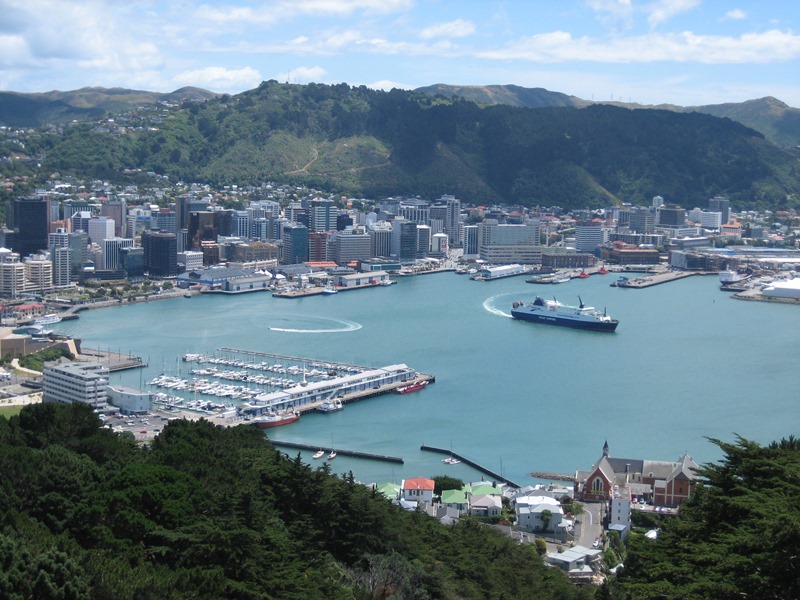
Wellington in New Zealand, where I live, has an ideal balance (for me anyway) between being big enough to have a happening cultural life but small enough to escape from without having to get into a car. At the same time, it is in a completely ridiculous location for a city – on a major faultline, built over rugged hills and steep valleys, and subject to crazy winds. It’s the sort of place you only live in because you want to, but these things all give it a vibe that I really like, not to mention the great views from every hilltop.  

What is beyond your front door?

Lots of native birds – I live on the edge of the city, close to a wildlife sanctuary that has been amazingly successful in bringing native birds back to the city. Watching them gives me a huge amount of pleasure. If I venture further afield I can get down to the city and the harbour, or I can head off into the bush and wander for as long as I feel like wandering.

What place would you most like to visit?

I would really love to visit the subantarctic islands, which have amazing flora and fauna, and I also like the idea of how remote and wild they are. Needless to say, they are not easy or cheap to get to, but that all adds to the attraction.

What are you reading right now?

At the moment, I’m reading about the psychology of memory. There is some really beautiful writing about memory – it seems to be a subject that invites the use of metaphors.
 

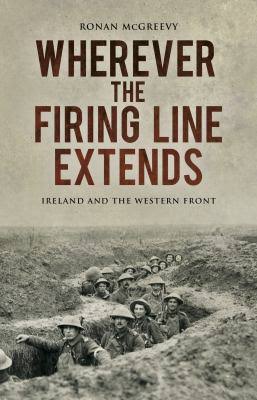
The Library: Wherever the Firing Line Extends - Ireland and the Western Front, by Ronan McGreevy

Read by Marcel Krueger:

One of the interior decoration staples of many an Irish pub, or really any self-proclaimed 'quirky' beerhouse between Norway and Sardinia is the 'On this site in 1856 (or 1768 or 1699) nothing happened'-sign. There is no statement more untrue. Even though the events that took place near the sign over the last centuries may have gone mostly unrecorded in written or oral history, it does not mean that all the love stories, tragedies, atrocities that occurred there have never happened. For this exact reason, I am an advocate of memorials, regardless if they are large Victorian stone slabs in public parks, small blue plaques on buildings or even smaller, unobtrusive ones like the German Stolpersteine dedicated to the memory of Holocaust victims or the Last Address plaques in Moscow remembering the victims of Stalin's purges in the 1930s. All these memorials and monuments help us to view both the past and the present in context, to provide details and names of happenings long ago that we would have otherwise passed by without thought.

Ronan McGreevy has done a similar thing in his book: through a framework of site-specific memorials, all accessible today throughout southern Belgium, the north of France and Germany, he paints a picture of the actions of Irish troops on the western front in World War I. Beginning with the first shots fired at Casteau in Belgium to, incidentally, one of the last 1918 actions near Mons (where a marble plaque remembers the 5th Royal Irish Lancers) just 12 kilometres from that first engagement. Printed in hardcover and enhanced with black-and-white and colour images as well as maps for most chapters, the book is structured along both the British troop movements and the memorials that came after. Some chapters focus on specific military actions and the units involved, like the railway station at Le Pilly and the 2nd Royal Irish Regiment; others focus on single soldiers, like poet Francis Ledwidge (remembered by a plaque from 1998 near Passchendaele) or Robert Armstrong, a World War I veteran who became the head gardener of the Valenciennes military cemetery after the war and who died in a German prison camp in 1944. One story and chapter that stood out for me is the story of the Iron 12, twelve Irish prisoners executed by the Germans after being caught hiding with Belgian civilians.  

Despite that fragmented approach, the book manages to provide an excellent overview of the Irish involvement in the British campaign 1914 - 1918 in contrast with the Easter Rising in 1916 and republicanism at home. As McGreevy puts it in the introduction: 'It is perhaps the great paradox of Irish history that more Irishmen died fighting for the Crown than ever died fighting against it.' Sometimes the fragmentation of the chapters however seems to lead McGreevy slightly astray, and in just a few paragraphs we cover decades and move from the detailed description of an action on the ground over to events in Ireland many years later and just barely find our way back to the actions on the western front. Also, due to the wealth of details presented in here the book will mainly appeal to amateur historians and other World War I enthusiasts.

And yet the strength is the concrete interface of occurrence and memory expressed as memorials, and their connection with the landscape. The writing is strongest when McGreevy explores the sometimes hidden or unobtrusive location of the memorials and their equally unobtrusive history and changing political significance, from the small plaque at Mouse Trap Farm to the large Island of Ireland Peace Park in Messines, opened by Irish president Mary McAleese, Queen Elizabeth II and Belgian King Albert II in 1998.  

'Wherever the Firing Line Extends' can be used as guide book on the ground, and at the same time is a fine addition to the canon of publications on the double identity of the Irish soldiers in World War I. While the book is focusing on individual stories in the face of industrial scale slaughter, it is the new approach of appreciating the memorials later generations left for these men that makes it a refreshing read. After all it is for us, the living, that these memorials exist. They remind us not to repeat the mistakes of the past.

About the reviewer: Marcel Krueger is a writer, translator, and editor, and mainly writes non-fiction about places, their history, and the journeys in between. His articles and essays have been published in the Daily Telegraph, the Guardian, Slow Travel Berlin, the Matador Network, and CNN Travel, amongst others. He has translated Wolfgang Borchert and Jörg Fauser into English, and his latest book Babushka's Journey - The Dark Road to Stalin's Wartime Camps will be published by I.B. Tauris in 2017.

The Great Ruins of Love Lane

Image: David Lewis

Image: David Lewis

By David Lewis:

Cities are in a permanent process of evolution, fast or slow, and districts within a city change at different speeds, depending on investment, need, attitude.  Nowhere is this more evident than in Liverpool, which is no longer the crumbling monochrome city of the early Beatles photographs, but a modern holiday and conference destination.  Confidence roared through the city again from the late 1980s, building luxury hotels and celebrity-chef restaurants, revamping museums, opening new visitor attractions and developing the huge Liverpool One shopping development complex, a shopping mall in the heart of the city. 

A slower, more varied pace of change can be seen in the 1840s docklands north of the city centre, which have evolved since 1945 through bomb damage, obsolescence and redundancy.  This has left a bruised landscape of old warehouses and railway yards, closed pubs and overgrown vacant lots.  There is silence here, and sunlight, and huge empty skies.  The Mersey is never far away.

It is precisely this neglect that makes the docklands vulnerable to development.  Slowly, with altered attitudes, the pace of change is quickening and the confidence is spreading northwards.  New uses have been found for giant survivors; Jesse Hartley’s Stanley Dock buildings have become the Titanic Hotel, and the hulking Tobacco Warehouse next door, once the largest brick building in the world, is being converted into urban apartments.  

Image: David Lewis

Image: David Lewis

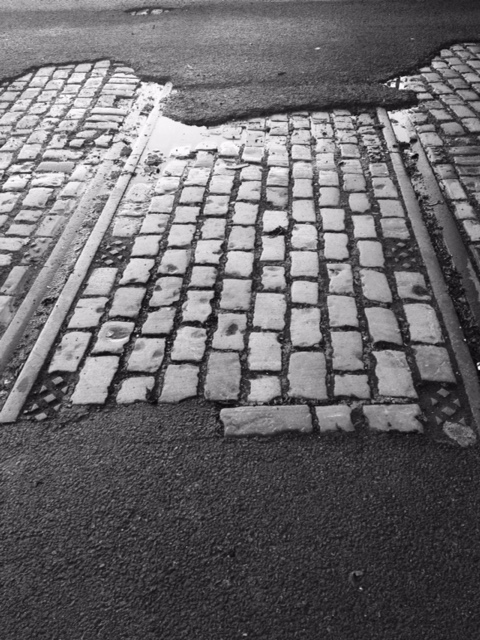
I walk these streets now with a new sense of urgency.  Blackstone Street, Cotton Street, Saltney Street, Dublin Street - I am at home here, clearing street dust to discover cobble or street railway, granite kerb, a softness of old sandstone.  These ground-level Victorian ruins add colour – rusts and steel blue-greys – to the streets.  Old Liverpool is a city of brick, and walls snake through the old districts; ubiquitous and invisible, shiny red or gleaming hard blue-grey; heavily sooted, organic, hand-made.  On the oldest warehouses the brick folds into narrow doorways and narrow barred windows capped with sandstone or rusted iron.  The bricks and mortar have flaked away after 170 years of river weather, but these structures add fluidity and definition to the city and warm colour – chalky reds, dark blues – to the streets.  Each brick was hand-laid decades ago, on bright days or damp days, sooted with river fogs and steam-smuts or laid in warm sunshine as the city roared north along the river; brick by brick, wall by wall, street by street.

This hinterland is full of oddity and unexpected glories.  Gateposts, fragments of walls, arches in stone or brick, monolithic survivors like ruined sandcastles left behind by the tide.  Some have found new uses and stand, silent and dominant, in new fences, new boundaries.  There are also ghost places, vacant lots full of buddleia and butterflies which once housed large railway yards or churches, their histories forgotten.  Nothing survives of the Martyrs’ Church, St. Augustine’s on Chadwick Street; nothing survives of the giant goods stations of Waterloo, Great Howard Street, or Canada Dock, apart from stumped walls and fragments of story. 

Ruins can be invisible here.  Love Lane lies beyond the huge railway arches carrying commuter trains up the coast, and is connected to whole streets of redundancy, truly empty places, scenes for a car chase or a clandestine meeting, film sets for unmade films.  Sprainger Street, Little Howard Street, streets of walls and graffiti, windows and doors bricked up, more buddleia and more grasses, silence, a beautiful decay.  Nobody seems to be here. The air smells of rotting rubbish, vegetation and illegally-dumped engine oil.  At night the few streetlights illuminate the darkness rather than dispel it, sending a weak light spilling across the cobbles to create great polygonal slabs of velvet darkness.  These lost streets are dominated by the amputated, hacked remains of another railway viaduct, overgrown and crumbling, a lost route to the lost station of Liverpool Exchange.  The bricklayers’ art has created great swirls of brick, smooth and close-fitting like dragon scales or armour.  These arches are muscular, seeming to crouch, tense and full of unexpressed energy.  They have the deep calm of gigantic Roman ruins, solid and seemingly permanent. 

Image: David Lewis

Image: David Lewis

And yet these old walls, these folds of brick and obsolete arches, are increasingly vulnerable.  A grandiose, long-term plan called Liverpool Waters is promising apartment blocks, and open squares of bars, restaurants and shops along the waterfront.  Everton Football Club have confirmed a £300m move from Goodison Park to the Bramley-Moore Dock.  At ground level, the Ten Streets project will deliver new work/living spaces, renovated buildings, more public space. 

I believe that cities need dark streets and grey areas, places of awkward, disjointed history and ambivalence.  Cities need to regenerate periodically, but they also need the old, the quiet, the derelict, a sense of faded history.  Is it not possible to have rough edges to our cities, dark corners, un-developments?  We should be able to discover something of our cities for ourselves; not everything should be signpostedPerhaps these old streets are where the city has most potential, perhaps these scraps of buildings and stumps of walls remind us that all things are possible within a city; perhaps without decay there can be no sense of potential, and ultimately no regeneration.  Our ruins should be left to their decay. 

David Lewis has written five books of history/landscape/psychogeography about his native Liverpool and Merseyside.  He posts urban/rural images on Instagram - davidlewis4168 and mutters about the world on Twitter - @dlewiswriter