

A Day in Hartford
/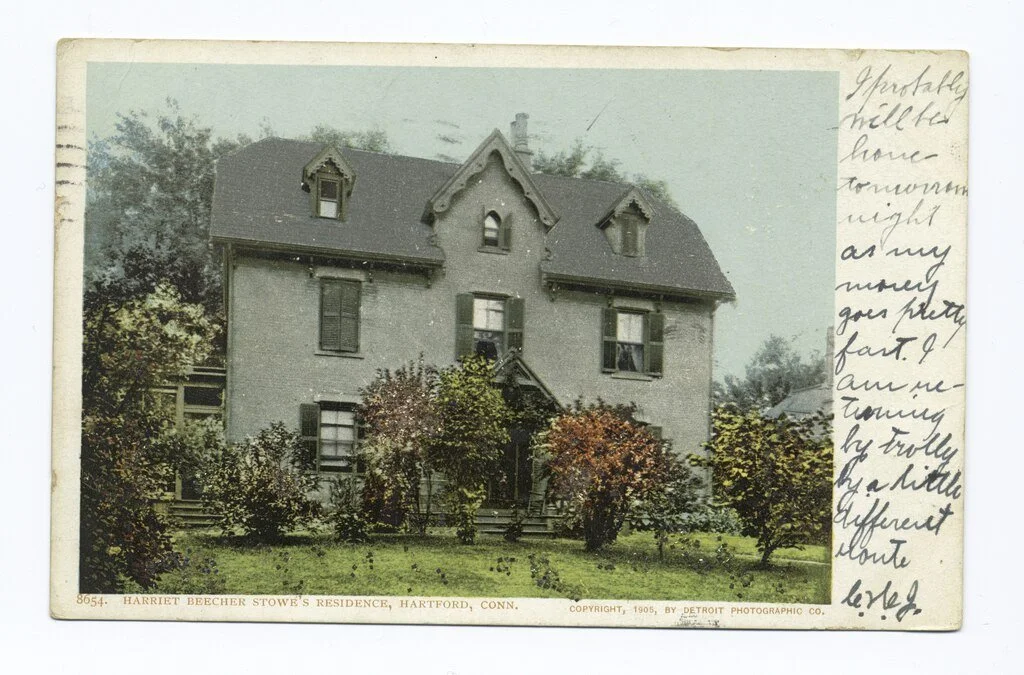
Harriet Beecher, Stowe's Residence Park, Hartford, Connecticut. wikimedia commons
By Elsa Court. Originally published in print in the first issue of A Woman is a Cinema, an intersectional feminist zine based in the Netherlands, 2017.
1.
The morning train from New Haven to Hartford, Connecticut, was air-conditioned like public transportation only is in America. The visiting scholar had anticipated this and was wearing extra layers, a grey hoodie and a cotton scarf, which she took everywhere with her despite the scorching summer heat.
As soon as she passed the small cluster of restaurants and bars surrounding the train station on arrival she found herself in full traffic. The visiting scholar had an appetite for exploring Hartford by foot. She was European, a product of walkable cities. She was here as the recipient of a transatlantic exchange programme’s research grant.
She walked from the train station to Farmington Avenue and retrieved from her phone an itinerary from Hartford’s train station to Mark Twain’s house and museum. This itinerary took her on a route of empty streets filled with cars, parked by the side of the road or driving through the middle. The rare people who were navigating this area by foot seemed to be pausing, more often than they were walking. When she felt thirsty she bought a green apple from a drab corner store; a girl on the way out called “Are you going to bite my apple, lady?” She laughed a cruel laugh.
*
At the museum, the visiting scholar bought a combo ticket, which granted her access to both Mark Twain’s and Harriet Beecher Stowe’s houses. They were neighbours of one another, as if by sheer convenience.
On her way from the visitor’s reception to the steps of Twain’s house, she found herself in a group where all were American but none were local. She also noticed that no one, apart from her, seemed to be travelling by themselves. The guide started the visit by asking the group where everybody was from and there were cheers for every State that was further South or West than Pennsylvania. When her turn came she said “Germany” and people hushed in awe, deserving as this was of a moment of recognition that Germany was not one of the States.
The splendour of Mark Twain’s house was dark but manifest. Several groups were touring in choreographed turns, never meeting once on the same floor, and she happily let herself lag behind and pretend to herself that she was enjoying the tour unguided, while still remaining under apparent affiliation to her group. The dimness of what must have been 19th-century North American interiors was what charmed her the most: oakwood, red velvet. Soon enough she was thrown again into the light of day, confused and lonely, having listened to nothing, having learned nothing.
She met her second guide on the doorstep of the Harriet Beecher Stowe house, and it appeared to her that no one from her former group had followed on to the start of this tour. She felt drawn to this new guide, who seemed ready to start introducing himself, and was very obviously friendly and personable. He was a composed, seemingly wholesome young man of about twenty named Jared Warren. Jared had a sincere and unintimidating cheerfulness about him. He smiled easily. To her, to middle-aged men in polo shirts, and to ladies of all ages and physiques. It was as if he was so genuinely excited to be doing this job that he even gave proper momentum to this very first step, this democratic welcome.
She walked in and out of the Beecher Stowe household’s kitchen, with its copper pots and yellow walls. The sun was beckoning from outside. What would it have been like to have grown up in Hartford in the company of people like Jared? Driving at 16. Eating take-away New Haven-style Neapolitan pizza, spinning empty beer bottles in parking lots at dusk, owning an ever so small measure of those streets. Taking a summer job, a summer guide job. Doing a year abroad in Europe before going home for “college.”
People participating in the tour expressed themselves in ways which she judged to be unbelievably candid. They asked Jared questions such as: What did these people do for entertainment? Out of the house, when the group was facing the closed gates of the old stables, someone asked: why would they have such a big garage? The visiting scholar smiled at the spectacle of Jared’s composure when he explained that “you would have had to house horses in there.”
The interior of this house too was Victorian (an offshoot of England, or possibly the Netherlands), beautiful, though somehow doll-like in comparison with Twain’s. The wallpapers had intricate flowery patterns that drew visitors into a delicate, dark-cool reality. Outside, the sun seemed to be perpetually calling out over modern-sized garages and a shuffling, motorised everyday life.
Jared periodically gave off the impression that his personal insights and assessment of the house were just for them, and not repeated every day. Pouring over the lives and surroundings of Harriet Beecher Stowe’s twin daughters, he confessed that he had always had a preference for Eliza, who had more “spunk” than all of her siblings put together. An awkward silence came during which the visiting scholar decided to ponder the word “spunk” which she had just heard for the first time. Perhaps she would always associate this strange word with this strange context. With Hartford. With make-believe sincerity. His favourite object in the house was this small cabinet exhibiting violas that had once contained cosmetics and potions. In those days, he told them with delight, it was not uncommon to ingest a small dose of arsenic to make oneself look extra pale for an important ball. Jared implied that Harriet’s daughters would do this.
The second tour came to an end. She and her group were invited to email Jared Warren should they have any further comments or questions and of course use the cafe where they could find a comprehensive selection of refreshments, from panini to still and sparkling fruit sodas.
Having met the purpose of her daytrip to Hartford, the visiting scholar took a blind new direction with the intention of exploring the rest of the city. She walked through quiet residential areas with front gardens in bloom. A hand-written sign outside a brown brick house said Dog for Sale, with a round hollow exclamation point. Later she photographed a tall McDonald sign rising from a patch of grass for the attention of motorists that would find the restaurant 1500m down the road.
A long walk down Main Street—the Wadsworth Atheneum clamoured: “Renoir is back in town and he brought some friends”—delivered her to Bushnell Park where a Sunday fair was being held. She was surrounded by families and groups of youths queueing by a lemonade stand while smothered in the smokes of adjoining barbecues. The consumption of candyfloss and weed seemed to unite people in leisure time, across race and age groups. She tried to focus on the joy of others so as not to feel affected by her circumstantial loneliness. She told herself that these lives were examples of contemporary life not so distinctly removed from her experience. That idea brought a form of comfort she wished to hold close. That she might have been born here and might currently be at home instead of a stranger in the crowd held the power of some constructive kind of fantasy.
2.
Making her way back to the station a good hour before her train she ended up amid the cluster of bars and restaurants she had ignored upon arrival and decided to enter the remotest one, which was behind the station overpass. Taking a seat at the bar, she found herself in the company of lone, disparate white men, and demurely ordered herself a beer while considering what the remaining time before her train could look like. American football played on three TVs from three of the four corners of the room. Things here too were pleasantly unusual, transient, and every decision she made while in this country could simultaneously be seized by her and registered as a non-event. A middle-aged, Stetson-wearing gentleman came to sit next to her.
He asked, as a matter of course, where she was from. He didn’t have much to say about her answer. He told her about his lack of interest in the football, about the clients he had met in Hartford today — he was travelling salesman, from Bridgeport himself — but she failed to give him her full attention so he asked what she did for a living.
Then he told her a little more about himself, about the kind of down-to-earth person he was. He told her he was an honest man making honest money and what more should an honest woman want, come to think of it?
You know, he said, after a while, and I hope you won’t take it personal or anything, but can I say something? She was very beautiful, he said, but her hair was already getting thin. It’s true, he said. I think maybe sometimes that is caused by excess stress and straining intellectual work in women, often seen in scholars like herself. By all accounts, and she was truly very pretty, but it looked to him like maybe she was working too hard or at the very least too seriously. Maybe she should relax a little, said the gentleman, have fun, go out.
She wondered to herself, as she sipped beer in the space that was still available to her, whether this kind of person was, like she thought she could guess, endemic the world over. The other patrons, as well as the bartender, were now all riveted by her interaction with the Stetson man. No one said anything. She thought of Jared who was probably giving his fifth tour of the Harriet Beecher Stowe house since he had shown her group through the dark but modest Victorian corridors he seemed to cherish. She thought of the American teenagers moving through the fair in small gangs of girls, giggling and navigating a moment of life which seemed so radically familiar to her yet distant, sisters reclining in devil-may-care poses on grassy slopes and flicking through magazine pages showing white models and white actresses.
Could the man in the Stetson hat—he was still talking—take her out for dinner? She thanked him and said she had a train to catch. I’ve got my car, he said. I can give you a lift to New Haven. Tell you what, I can take you out for dinner and then drive you home. He seemed insistent, known to being rejected. She said, as she grabbed her things and got up from her bar stool to leave, thank you but I prefer to date younger men. It was nothing, of course, but perhaps this decisive departure from Hartford was going to be the day’s only true moment of adventure.
She waited for her train on the platform, lolling in the remains of the daylight. It’s true what they say—or is it because they say it that it is true—that America offers itself to the lonely. Can groups of travellers ever behold the secret life of American spaces? She didn’t think so. She retrieved from her bag the zipped hoodie she carried for the special climate of America’s public transports. On her railway ride through this, a small portion of Connecticut, she picked her phone again and considered the results of the word search for “Jared Warren” on all the social media platforms she used. She found surprisingly little: almost nothing, save for a mood board titled “Afternoon Tea,” in which Jared—yes, it was him—collected pictures of chequered tablecloths, teaspoons, and marmalade jars, and the seemingly inextinguishable blue skies of North American picnics.
Elsa Court is a French-born writer based in London. Her short stories and essays have appeared in Granta, American Short Fiction, New Letters, Worms Mag, and The London Magazine. She teaches Creative Writing at Birkbeck, University of London.