
An Oslo Wordhoard
/
By Mark Crimmins
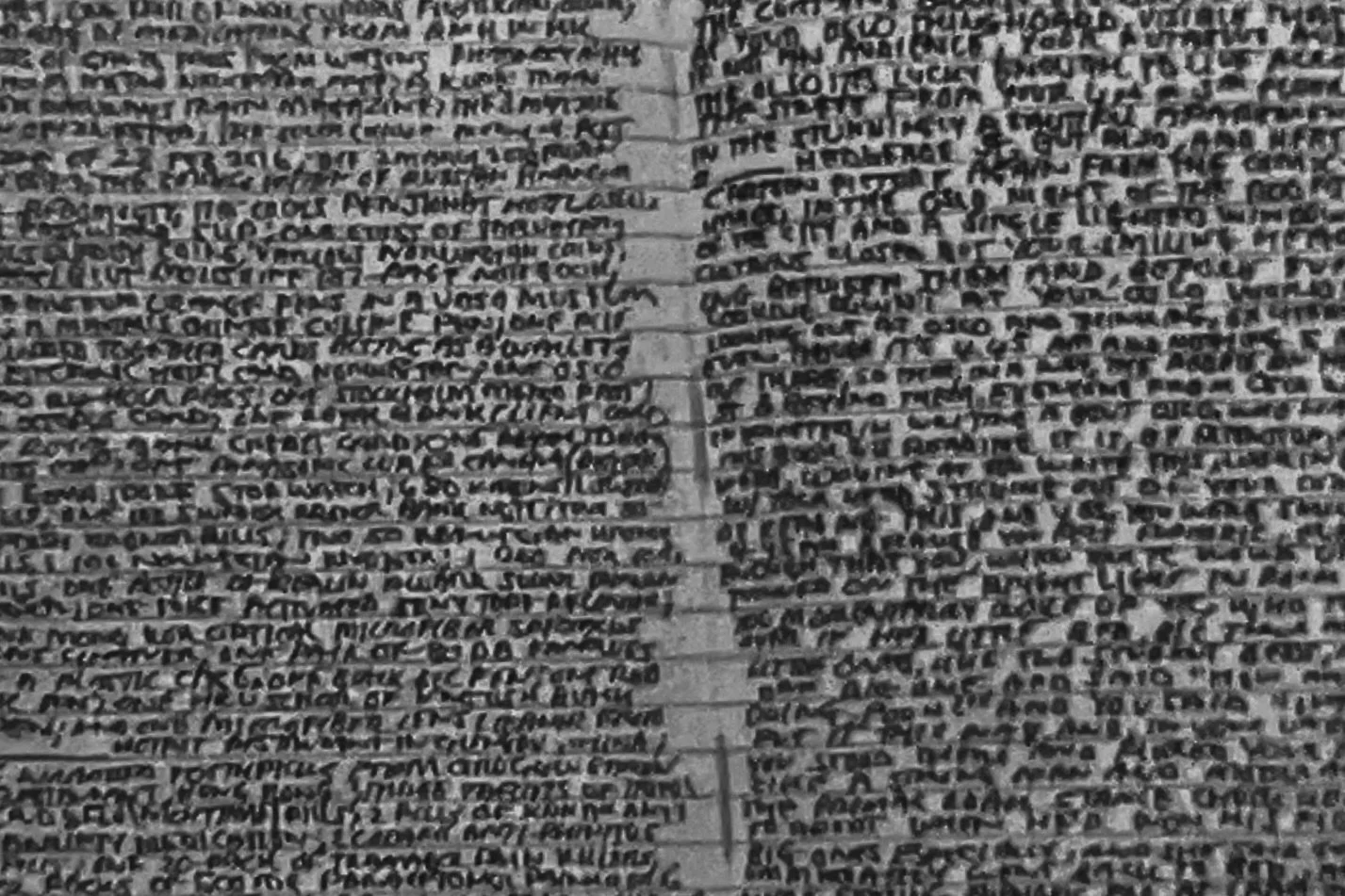
You wake up at 4:30 AM and turn on a light in room 406 of the Cochs Pensjonat Hotel overlooking Oslo’s Hegdehaugsveien, which you have decided to call Hedgehog Street, and you are so tired that you reach onto the windowsill and pick up, not a pen, but a toothbrush with which to write this account of your first morning in Oslo, laughing a little as you notice your mistake—you were giddy when you woke up, euphoric in fact, euphoric enough that you sprang out of bed, stood up, threw your arms above your head (as Japanese people do when they shout Banzai!) and mouthed a silent roar—and soon you laugh again as you glimpse a comic book image of yourself writing in your little notebook with a toothbrush, and you not only see this first image in your imagination but also a meta-image of that first image, another comic-book picture, this one of a man in a bookshop full of comics and graphic novels, (clearly the Transmo Bokhandel, which you— like the hero of Hunger in century-ago Kristiania—were admiring last night as you stood on Universitetsgata in the dark, peering into the illuminated interior of the store after visiting two other bookshops on the same street, the Norlis Antikvariat antiquarian bookstore that had a first edition of Heisenberg’s Elementary Particles and Their Motion in its window display, and the giant Norli Bookstore, where you sat in a corner armchair, scribbling beside a smokestack-tall Norwegian dude with long hair and a fuzzy face, but then the bookshop was closing in two minutes, a Norli employee informed you, the same employee whose Norli T-shirt logo you misinterpreted as a label bearing her name, for you had not yet figured out that Norli was the name of the bookshop, not the girl who worked there) but anyway, in the meta-image, you see a man who is not yourself standing in the Transmo Bookstore leafing through a graphic novel entitled Legends of the Total Writer, and he is smiling because he is looking at the picture of you writing in this notebook, not with a pen but a toothbrush, and this all flashes through your brain before you stick your head through the gap in the curtains a second time to retrieve the notebook—in which you write these words—from the Oslo thinghoard that suggests how one becomes where one is (a catalog of stuff even a total writer would be reluctant to record, but you will do it, if not for yourself, for Volund, chained to his anvil in Stephan Sinding’s sculpture beside the Nasjonalmuseet: one bottle of fluoroquinolone antibiotics; a streetmap of Stockholm; a pair of Aeroflot eye shades; a Stockholm Arlanda Airport Express ticket; a Semikolon notebook from Uppsala’s English Bookshop; Barry Forshaw’s Rough Guide to Crime Fiction; an Oxford Classics edition of Carolyne Larrington’s translation of the Old Norse Poetic Edda; a streetmap of Oslo; a Stockholm Medieval Museum bookmark illustrated with Albertus Pictor’s five-hundred-year-old painting of Death playing chess; a Band-aid; a Hong Kong Airport Express ticket; twelve paper chocolate wrappers decorated with Moscow and Saint Petersburg skyline silhouettes; a pair of nail clippers; two packets of gauze pads from Mannings pharmacy in Hong Kong; a Stockholm Metro free newspaper; a Swedish Rail Kupe magazine; the 3 March 2016 edition of Izvestia; the 28 February 2016 South China Morning Post magazine; the 2 March 2016 edition of Russian financial newspaper Vedomosti; various Swedish coins; various Norwegian coins; the blue Moleskine 187-page notebook that manages (with these words) to contain all the other items on this list, as well as Oslo and a cross section of Scandinavia; three fat orange Vasa Museum pens in a Vasa Museum bag; a pen stolen from the Din Tai Fung restaurant on Yee Woo Street in Hong Kong’s Causeway Bay; the stack of clipped together bank cards that functions as your wallet; an Oslo Metro pass; a Stockholm Metro pass; a Hong Kong Octopus card; a Royal Bank of Canada client card; a Toronto Dominion Bank access card; a Panasonic Lumix digital camera; a Goma Sports stopwatch mounted on a neckband; six 20-Krona Swedish banknotes; two 50-Krone Norwegian banknotes; a bottle of Kremlin Award Super Premium Vodka; a hand-held, voice-activated Sony digital recorder; a large grey microfiber lens cleaner advertising Mong Kok Optical in Hong Kong; a pair of 30-decibel foam earplugs in a semitransparent round plastic case; a red Bic pen; a University of Hong Kong School of English pen; a business card from the Jiao Bei Lao Zao hotpot restaurant on Renmin Boulevard in Chengdu; six wrapped toothpicks from the Chiuchow Garden restaurant in Hong Kong’s Infinitus Plaza; a box of Coltalin anti-rhinitis pills; two packs of Paracetamol painkillers; a bottle of Acetyl-L-Carnitine 500 mg health supplements; and one American passport with a valid Canadian Work Permit, NAFTA Professional Class, Professors Category, for employment at the University of Toronto Department of English, folded between its pages) and as you stick your head through the gap in the curtains you appear—to yourself—not unlike an acting company’s host, pulling the drapes around your shoulders so that only your head protrudes and (as you survey your Oslo thinghoard) is visible, not just to yourself due to the reflection in the glass but also to a putative audience comprised of people lucky enough to live across from your hotel in the beautiful apartments on Hedgehog Street, but also an imaginary audience, for once again you appear in the graphic novel the man in the bookshop is reading, which now depicts you in a nocturnal image of the darkened rooftops of the Oslo cityscape, where a single illuminated window, its curtains closed, reveals your drapes-guillotined head, and (after glancing briefly at the wordhoard emerging as though teleprinted, line upon line, on these tiny pages) you scan the sleeping city so that, in effect, the people on Hedgehog Street and everyone else who is interested in writing about Oslo (including those who are reading this book after it is published) are watching you write this and seeing—by reading this—your head sticking out between these curtains like the head of Strindberg’s troll (but without the smoke rings) and yes—you are smiling because you feel euphoric for three reasons, you realize, but you are going to descend to the Oslo streets, where day is breaking, to write them down (the reasons and the streets) and now you sit here, your bum on the cold stone hotel steps, and write on Hedgehog Street, after wrestling your Manchester-Northern-Quarter-purchased Bench coat over your Xian Southeast-Quarter-purchased Beilin Museum sweatshirt in front of a boutique called Epilogue, resting this pale blue Moleskine notebook on a utility box decorated with two stickers (one announcing Camila Luna’s Cymawax Label Open Up EP along with a disc-shaped image of the singer, the other bearing two red words stenciled on a rectangular black background: Death Aum) and wrapping yourself snugly in your coat because it is minus three degrees in Oslo, and then—after glancing across Parkveien at the Litteraturhuset and Litteratur Caffe signs and seeing that both places are unfortunately closed—going all the hell the way back up to your room for your Panasonic Lumix digital camera because, in your eagerness to tread the Oslo streets, you forgot it, and—having retrieved the camera—coming back down to photograph the beautiful Munch-like Oslo thoroughfares with that amazing cobalt or azure or indigo or aquamarine Norwegian dawn sky flowing above them like a sublime darkwater fjord, and then walking up Hegdehaugsveien until it morphs into Bogstadveien, and continuing to where Bogstadveien bifurcates, the right fork becoming Valkyriegata, and figuring this is an auspicious street on which to buy a coffee and supercharge your writing, an electrification that is nearly instantaneous when you sip the black liquid while sitting at the window counter of the convenience store, knowing this dark caffeinated fuel will animate your attempts to record the three reasons why you awoke in a state of euphoria long before five this morning, the first being that, when you went to bed early last night, in a kind of delirium (brought on by the Kremlin Award vodka you chugged before waltzing along Parkveien to Henrik Ibsens Gate and back), you soon woke up with a headache that hurt like an assassin’s bullet, and your girlfriend rubbed the base of your skull with such rigor that she was worried she might kill you with the force of the massage, as Althusser, she said—reminding you that you had told her this when you read his first autobiography fifteen years and fourteen hundred and thirty-three books ago—had supposedly accidentally killed his wife, and you were afraid that the headache alone might kill you directly, located as it was in the bullseye of the hemispherical bump in the middle of the back of your skull, and when you sat on the edge of the bed, asking your girlfriend to use all her strength to relieve the pressure, fearing the Advil or Paracetamol or Panadol— along with the glasses of water with which you washed them down—might fail to negate the pain, you genuinely worried that she might shatter your parietal ridge with her tiny hands, but then you woke up six hours later with no hint of a headache and no humptydumptied skull; the second reason for your euphoria being that you had woken up early enough to perambulate the streets of Oslo—for the young, half-starving Hamsun of Kristiania, if for nobody else—at an hour when you would have the city almost entirely to yourself; and the third reason being that you had a vivid dream, which you lay in bed and recalled before writing an imaginary email to its heroine, an old friend, an Ibsenian ghost rising from a long-repressed past:
Dear Rebecca,
I just dreamed that our hotel room on Hedgehog Street here in Oslo was your apartment, where we found you—You who I haven’t seen in twenty years!—and I said, “Rebecca! We never knew you lived in Oslo!” and you said with a smile, “How could I resist living on a street called Hedgehog Street?” and then you flung open a bedroom door, revealing a huge feather bed, at the sight of which my girlfriend exclaimed “Waaaaaaaaa!” and you said to her: “There’s a story behind that bed, but this is girl talk!” and then you whisked her into the bedroom for a few minutes, and when you came out you were saying, “So that’s the story of how I got the bed…”
and this dream and the mental message it generated being the third reason you find yourself in a giddy or euphoric or manic or vatic state, but your Oslo morning euphoria has a fourth cause, namely that—rising early and well rested—you knew that you, the Wanderer, would venture forth and navigate the Oslo streetscape, engraving a tribute to the city on these spindrift pages, a labyrinthine sentence with which you would circumscribe—language itself is Yggdrasill, the world-tree—your encounter with this Nordic metropolis, a self-consuming ouroboric sentence that would be read, perhaps, by the denizens of Oslo who helped you decipher streetcar routes and discover bookshops during your first hours here—yes, you would rise from your bed with a polar bear’s roar (like Hamsun straddling the roof of the blizzard-cleaving locomotive, mouth yawning open to gulp the icy air and freeze-heal his tubercular lungs) and write a sentence that came to its conclusion hours after you began to fashion it, completing it only after you veered down Valkyriegata through the Ragnarok dawn, down Bogstadveien to Hegdehaugsveien and on towards Parkveien and the Litteraturhuset, climbing to your hotel bower and waking your Freyja to tell her that you had Thor-hammered a great serpentine sentence on the anvil of your brainbox—a syntagmatic Jormungandr, a reticulating concatenation ten-thousand elementary-particle letters long, an Oslo-begotten and Oslo-begetting, Midgard-encircling wordhoard.
Mark Crimmins grew up in Manchester and dropped out of grammar school to work in a Cheetham Hill factory. He emigrated to the United States as a skilled labourer and entered university to study English Literature after four more years of garment factory work. He holds an MA and PhD in Contemporary Literature from the University of Toronto, where he taught Twentieth Century Transatlantic Literature and Literary Theory from 1999 to 2016. His place-based fictions and nonfictions—often hybrids of the two—have been published in over seventy literary journals worldwide, including Litro, Spelk, Long Exposure, Kyoto Journal, Cha, Quarterly Literary Review Singapore, Eastlit, Flash Frontier, Pure Slush, Queen’s Quarterly, Columbia Journal, Reed Magazine, Tampa Review, Atticus Review, Chicago Quarterly Review, River Styx, Amsterdam Quarterly, and Flash: The International Short Short Story Magazine. He teaches Twentieth Century Literature at the Chinese University of Hong Kong Shenzhen.