
All shall be well
/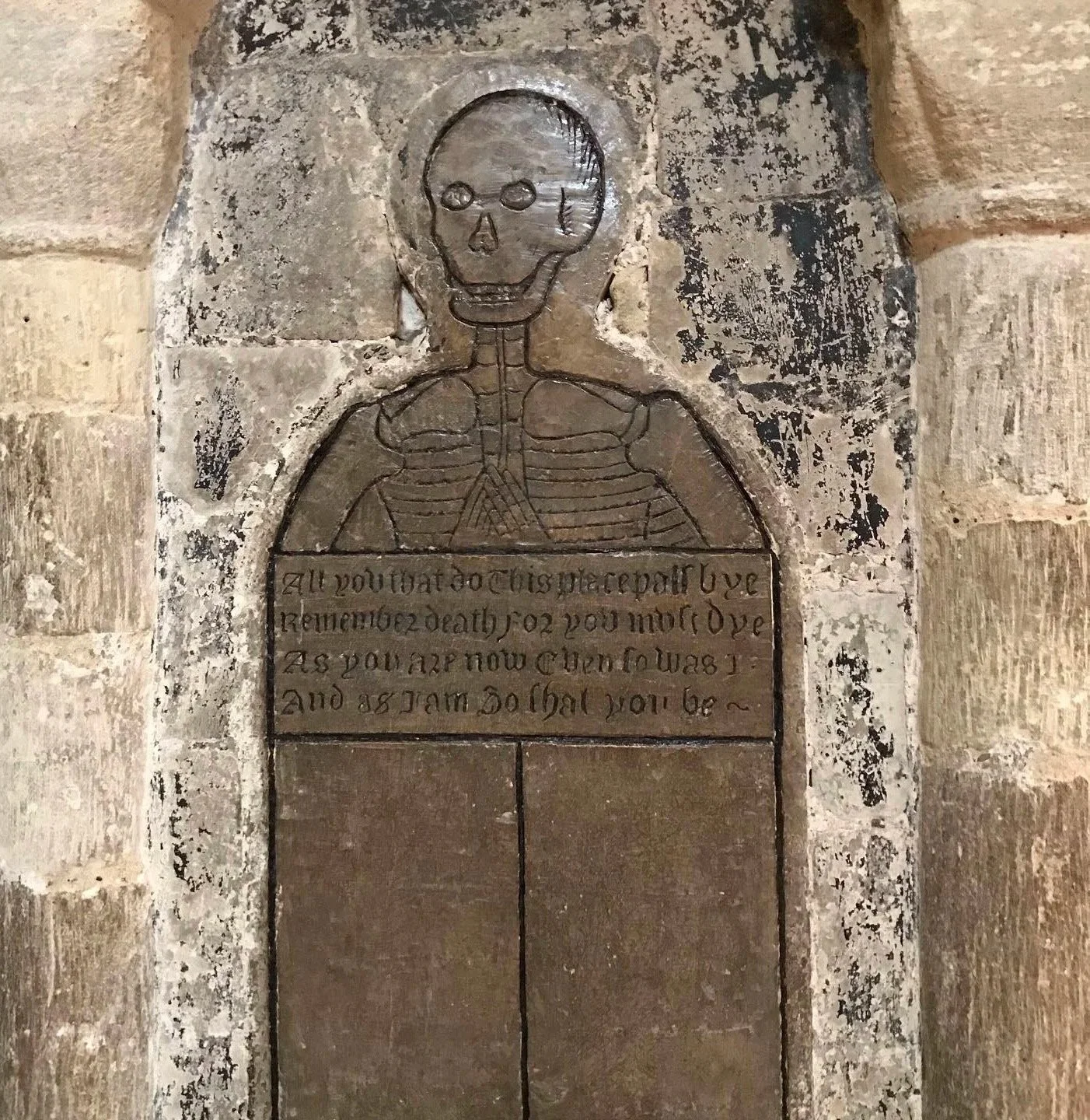
Photo credit Heleina Burton
By Alice Kent
Out here in the edgeland, borderland, hinterland, whatever you choose to call it, I came to realise the problem: nobody could hear us scream. Between us and London was just a vast field of coal-black soil. In the field, the scarecrows, or mawkins as they are called in the Norfolk dialect. Often just wooden poles, or mops draped in white hoods, hundreds of them identical, they look like a religious order swaying out there in the fields under the endless East Anglian skies.
It’s a long way my sister said when I packed up my stuff in our shared flat in Brixton and told her I was moving to Norwich. It’s not too far, just a couple of hours on the train.
I rented a room on St. Benedict’s Street. My job didn’t start for a few days, so I was free to wander the city for hours. I quickly realised things weren’t as they should be. Take St. Lawrence Little Steps, the narrow passage that leads down to Westwick Street, one day I would descend and end up at the back of PizzaExpress by the extractor fans, catch the odd word of the chefs talking in Eastern European accents. That evening I would take the same steps, and end up on the second floor of a hardware store, selling stone cutters, wading boots and ropes. What was it all for?
How could I build a life here, establish anything as concrete as a career path, when nothing was concrete, and at any moment the path might swallow itself like an Escher drawing or a Möbius strip. It wasn’t just the streets that were unsettling, there was something about the people too. Everyone spoke in riddles about centuries-old stories that didn’t seem relevant and yet people whispered them to me in hushed tones as though they were essential information.
Stories of a hound with red eyes scratching the church doors, Peter, a feral child from a Bavarian forest who barked for his supper, only ate acorns and was kept as a human pet, a wealthy gentleman buried standing up so as to get a head-start on the race to heaven on judgement day. Is he buried in his Nikes too? I asked, but no one knew. The stories kept coming and combined with the streets moving I’d had enough.
“A single to London, please.”
“No trains to London today, miss. Planned engineering works.”
“When will the engineering works finish?” I asked (I smile now, thinking of my innocence back then).
“Oh they won’t end miss, it’s like the Golden Gate Bridge, once they’ve painted from one end, it’s time to start at the other.”
“How then do I leave?”
The man in the box behind the protective glass laughed so much he started wheezing and a colleague had to slap him on the back.
I asked again, with a little more urgency this time, “How do I leave?”
Without saying a word he indicated with his fat finger to a note on the glass which said ‘we will always seek to prosecute those who intimidate our staff.’
If I was destined to stay here I needed to work out what was going on. Fortunately a cathedral spire dominated the skyline. I hatched a plan to use it as a compass. Keeping it to my left I would always know in what direction I was going, or just that I was standing quite still, and not going anywhere at all. But even this didn’t work, you see there were two cathedrals in the city, and while different in era, architecture and denomination, there seemed to be some kind of union between the two towers, as though the spires themselves were conspiring, against me.
Dejected I turned to drink. As well as two cathedrals the city had a pub for every day of the year. And I decided to give them all a try, given the never-ending engineering works meant I wouldn’t be leaving any time soon. The pubs were full, everyone else was doing the same.
I found a seat at the back of a lovely red-brick pub on the corner of Duke St called The Golden Star and I ordered a pint. A decade passed. I bought a notebook, I realised I needed to write down all the stories and try to solve the riddle, that this was the key to my escape.
Scribbling in my notebook in pubs drew little attention as everyone else was a writer too. This was the city of Anna Sewell, Malcolm Bradbury, W.G. Sebald. I would have been more conspicuous without a notebook. One entire page I filled with the words Thomas Browne, a 17th Century Norwich resident had added to the Oxford English Dictionary:
Hallucination, migratory, coexistence, coma, literary…retromingent (to urinate backwards).
The stories kept coming, and I realised with a stroke of genius how they were spreading. The city was encircled by a flint wall. It had been designed to keep the residents safe from attack in the 13th century and now it kept us all safe, and unable to leave. It was the wall itself which was spreading the stories. Someone would whisper a story into the flint wall in one part of the city, and it would reverberate until someone heard it with their ear pressed to the stone in another part of the city. The stories were going round over centuries, being passed through generations by the stones themselves.
I then realised things were even worse than I first thought. I wasn’t just lost as one normally is at a surface level, there was a whole subterranean city too. The city was continually building on top of what had gone before.
I became suspicious when an old boy in The Red Lion told me that the city has a church for every Sunday of the year, but that there are also 27 lost churches. He said this in a matter of fact way as he fingered around in the corner of his packet of pork scratchings. But what do you mean lost, how are they lost? He held the pork scratching packet up, and shook the meaty dust into his mouth, mumbling something about a Viking raider called Forkbeard.
How can a city lose 27 churches? I mean to lose one may be regarded as a misfortune but to lose 27. I took a torch and went down there to the second city, there were people buried alive while weaving a shawl, getting hold of the wrong thread, I realised there was nothing down there for me, nothing that would help.
People drank and drank, toasted each other and insisted that all shall be well, and all manner of things shall be well. If you say so people I said, and began to spend more and more time alone with the wall. Always listening for clues. Kazuo Ishiguro had studied in the city, and I read his book Never Let Me Go, where the earnest teacher presents the clone children’s artwork to the education board to prove that the children have souls. This seemed important. I whispered to the flint wall ‘If we make our writing good enough, is this the key to salvation, and the way out of the city?’ It’s hard to speak wall, it takes centuries to learn, but I think it croaked, you have to win the Booker Prize to escape, or at least be longlisted.
So now I knew what had to be done. I wrote and wrote. Of course I heard of people trying to leave through other means. There were farewell parties, gifts and good luck cards. They made it out through one of the arched gateways in the flint wall, some even made it past the mawkins, but they always came back. And always dripping in mud. Nobody ever got beyond the mudflats of Manningtree. When they came back these waif golems had to live among us, trailing mud through the streets in shame like they were carrying the chains of Jacob Marley.
I saw a friend today, one I hadn’t seen since I was 24, when I first moved here, but she hadn’t aged, and we spoke about things we’d done yesterday, but Lucy that was 22 years ago I told her and she laughed, and said shall we go for a drink buster, The Golden Star has a small beer garden. I know Lucy I wanted to shake her, I know it has a garden, I’ve been there hundreds of times.
And so I buy a new notebook I write and write, I dream of the Booker. I look around the pub everyone doing the same. We will write and write, until the end of the world, and when the end is near we will write our wills and request that we are buried vertically, standing up, ready for the day of judgement.
Was this a life well spent? Are we to be saved?
Alice Kent is a non-fiction writer who was shortlisted for the Borough Press Non-Fiction Prize, and has twice been longlisted for The Observer-Burgess Prize for Arts Journalism. Alice edited the book Walking Norwich: The Real and Imagined City. She’s had two pieces published in Hinterland - the journal for new creative non-fiction, founded at the University of East Anglia. Alice has a degree in Philosophy and a Masters in European Journalism. She studied in Aarhus, Birmingham, Cardiff and Utrecht. She lives in Norwich with her partner, two children and cat Mishka.