
Of raddle and cattle: mapping the story
/
By Jenny Mitchell
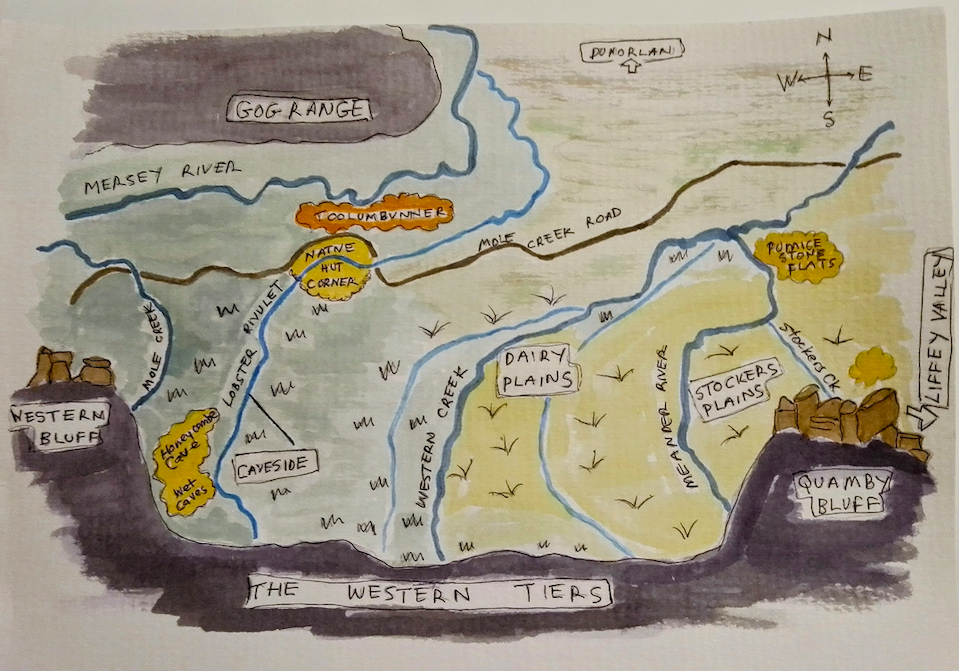
This writing is for me. I want to understand more about the lives of Aboriginal people at the time when Van Diemen’s Land was colonised by the British. For this I have chosen to look at an area which I have previously, briefly visited and with which I have a connection. There will be a lot to take in, which is why I am putting it down on paper. I have in front of me an A3 sheet of acid free 300G/M2 board. My intention is to include in my map only what is necessary.
Thomas Scott in his 1824 ‘Chart of Van Diemen’s Land from Actual Surveys’ (i) says of the area I am interested in: “THIS PART of the COUNTRY UNKNOWN’. I will try to keep everything in perspective, though it is a violent story. Along the bottom edge of my board, I hatch shading for the Great Western Tiers and draw in projections for Quamby Bluff on the right of my map and the Western Bluff on the left. A large part of this story will be within their radius. The country beneath The Tiers is crossed by the first Western River (later called the Meander) in the east and in the centre by the Western Creek, which then turns north eastwards and joins the Meander. Both of these are fed by numerous small creeks. In the western portion of my map, I trace a line for Mole Creek which runs into the Mersey River. Captain John Roland, travelling up the Meander River in November 1823 and then around the foot of The Tiers to the Mersey River, saw “good grazing country.”(ii) Beyond the Mersey in the west, he found the country impenetrable. The Mersey flows west to east half way across the top edge of my map, to where it then turns north. These rivers and creeks all have their origin in the Central Plateau of Tasmania, of which the Western Tiers form the northern boundary.
I draw a line on a slightly downwards slope from the Meander River in the top right of my map to Mole Creek. This represents the cattle route surveyed in January 1827 for the Van Diemen’s Land Company by Joseph Fossey. Fossey’s track became the Mole Creek Road. Near the centre of my sheet, it crosses a rivulet later said to ‘abound in freshwater lobsters.’ On Henry Hellyer’s February 1828 map, (iii) Native Hut Corner is indicated on a small flood plain immediately west of this rivulet. At the very top of my map, directly above Native Hut Corner, is the Gog Range. It is situated within the bend the Mersey River makes when it turns back on itself, after it is joined by Lobster Rivulet. This range will be of great significance to my story. In its foothills were the Alum Cliffs to which the native people made seasonal visits to secure the best red ochre for body painting – known as raddle - to be found in Van Diemen’s Land. One more location will feature in my story and should be added to my map. Riding south of the Mole Creek Road on January 15th, 1829, Assistant Surveyor Thomas Scott noted, “a very extensive plain of beautiful grazing land, claimed by Mr Gibson, who has a stock hut there. Near it is another tract of good land claimed by Stocker and Dr Garrett. We named these plains the Dairy Plains.”(iv)
It’s time to populate my story. In 1819 at the Lent Assizes in County Antrim, Northern Ireland, my ancestor James Cubit was sentenced to seven years transportation for the stealing of two sheep with an accomplice. Arriving in Hobart in 1820, Cubit was assigned to William Stocker of the Derwent Hotel. Stocker had also begun his life in Van Diemen’s Land as a convict. Having done his time, he married a wealthy widow and became a hotel proprietor and wholesale and retail Carcass Butcher (v). Very lucrative if you could get a contract with the VDL Commissariat to supply their military barracks and convict establishments. By 1825 Cubit was minding cattle on Stockers Plains, Crown Land “of great extent and fine quality”(vi) at the base of Quamby Bluff, for which Stocker had the grazing rights. The geological map for Quamby,(vii) reveals that the lush, wet country expropriated for cattle is comprised largely of alluvium and windblown sand. A narrow seam of talus and scree – left over from the last Ice Age - snakes its way up from the floor of the Liffey Valley – beyond the right of my map - to beneath Quamby Bluff. This seam marks the way through from the east coast for the Aboriginal countrymen coming for the raddle.
What was it like, the world that James Cubit now found himself in? A proprietor with a grazing lease “had only to erect a stockyard and ... a bark hut for stockmen who would tend the cattle that roamed freely and assist in the muster two or three times a year.”(viii) It is not always mentioned that this was the land of the Pallitorre people. In the late nineteenth century, it was said that in the first years of contact, the natives were not ‘aggressors’ and that stockkeepers, “without molestation, though constantly moving about the bush after stock, frequently ... came upon their recent tracks and must have been the object of their observation, without catching sight of any.”(ix) At Pumicestone Flats on the Meander River, a local stock-keeper, “once crossed this plain and saw a kangaroo stumbling. He run towards him and soon stumbled himself and fell, and on examining the cause he found the tussocks of grass tied together, which had been done by the natives.”(x) Twenty-first century chroniclers are inclined to cut to the chase. “December 1825 ... In that month the Pallitorre had returned to their country from the north coast, expecting to hunt kangaroo in the Western Marshes. To their surprise they found vast numbers of cattle occupying their kangaroo hunting grounds and heavily armed and experienced stockmen like Thomas Baker and James Cubit mounted on horseback shooting their kangaroos.”(xi)
Certainly colonists were alarmed by large gatherings of the natives. “150 Aborigines attacked Mr Stocker’s hut and wounded one of his servants, James Cupid”; ‘A convict called Thomas Baker claimed he was once surrounded by 200 Aboriginal people near Quamby Bluff.” What are we to make of it? I would have thought if one hundred and fifty natives really wanted to finish Cubit off, they would have made a better job of it. Some thought that in the early years, the Pallitorre were more concerned with repelling the incomers than killing them.(xii) But what was behind such large gatherings of natives, as reported for 1826 (xiii) (the year that James Cubit became a free man (xiv),) and 1827 (xv) respectively? It’s possible that these were native ‘corrobborees’ - important gatherings at which news was shared, negotiations undertaken, accommodations made and cultural life celebrated through singing and dancing. This kind of firming of relations was obligatory if people from one tribe were to proceed onto the country of another tribe, as happened when natives visited to collect the raddle. Quamby Bluff, at the site of well grassed and watered plains, where the track taken by the natives coming to collect the raddle emerged from the Liffey Valley, would have been well suited to such a gathering.
Someone must have worded up Stocker. It was not a fine house he wanted. Just a lease on Crown Land – for the grazing. Fresh meat’s been at a premium forever. Finding the cattle at the end of the day, I don’t complain. They’ve nowhere to go, abutted as we are against Quamby’s and hemmed in by the river and Stocker’s creek. I don’t complain. Stocker’s as good as his word. There’s a lot don’t take up their grants hereabouts. “Country Unknown’ it’s called. I’ve money put away. My time will come. I’m not in want of company. Baker – I knew him from before – and Johnson. They’re alright. Johnson’s woman, Dolly. Accommodating, you might say. Yet she can do what I can’t – write her own name. Not much call for that out here. I liked her fine but was not free in that way. She’s busy now with her littluns. This mud hut is small, but it won’t burn down. I’m not short on visitors. Don’t know why that ‘friendly’ man came here. Doll’ wasn’t going nowhere. Not so many of the blighters now. Time was I was forever slapping red clay on spear cuts - a poultice like – and binding them round. Baker told everyone he saw two hundred of them near here. Plenty of fires and singing. Not what I call dancing though they’ve a sleek way of moving. Imitation is their thing. I’ve watched it mysel’ from behind a tree. Short and sweet and then other persons take their turn. Whoops all round. They like a laugh. It’s the raddle. If you ask me that’s the whyfor of all the grass hereabouts. They light a fire as soon as they approach. I’ve seen it. The fires is to let the others know. Their big camp was at Native Hut Corner. Vaughan knew fine well. And now they’ve burnt his sheds down. (His thoughts)
I flounder amidst the different versions of what took place. By all accounts, however, things took a nasty turn in June 1827. On the 12th at Gibson’s Hut, a native was eviscerated. Ten days later, Simpson’s stock-keeper Knight, was speared before being clubbed to death. (xvi) Local accounts of the reprisal for the second death were veiled. Smoke was noticed from a fire, “judged to be near Laycock falls, now known as Liffey Falls, at the base of Quamby Bluff, and by the end of the day the party had located Pallitorre sitting around six campfires. That night the party quietly surrounded the camp, planning to attack at dawn ... But just as they were about to commence the operation, the Pallitorre were alerted by their dogs and ‘they ran away’. [Corporal John] Shiners said his party set of in pursuit. He later admitted that ‘three of their guns went off’ and that one of the Pallitorre may have been wounded by a shot fired by one of the stock-keepers.” The Colonial Times of 6 July 1827 told a different story. “The people over the second Western Tier have killed an immense quantity of the blacks this last week, in consequence of their having murdered Mr Simpson’s stock-keeper. They were surrounded whilst sitting round their fires, when the soldiers and others fired at them when about thirty yards distant. They report there must be about sixty of them killed and wounded.”(xvii) Visiting the area on 6th March 1828, Governor Arthur’s Land Commissioner Roderick O’Connor reported that Cubit had been “frequently speared by the Natives. He had received three dangerous wounds a few days before we were there, the Natives telling him that they would have him yet.”(xviii)
It was a small world in those days. People knew everyone who was about and were not short of an opinion. “Native women seem to have often associated with white men, especially sealers and their kind.”(xix) Dolly was the daughter of George Briggs, a Bass Strait sealer based in the Furneaux Islands, and Worretemoeteyenner, the daughter of Mannalargenna, chief of the Trawlwoolway people from Cape Portland. Her mother was around 13 at the time of Dolly’s birth. When Dolly herself was about twelve, she was taken into the household of Dr Jacob Mountgarret, Surgeon to the convict establishment at Port Dalrymple, George Town. There she was known as Dolly Dalrymple and was taught domestic skills and to read and write under the care of Mountgarret’s wife, Bridget. In her mid-teens Dolly left the Mountgarrets. She had for several years been living with the stock-keepers Thomas Baker and James Cubit in the vicinity of Quamby Bluff when, in September 1830, George Augustus Robinson decided to pay her a visit. He was on the final leg of his first ‘Friendly Mission’ to the natives of Van Diemen’s Land. He had in mind to bring tribal Aborigines to a place of sanctuary, though this was not something he publicised on his approach to Stocker’s hut.
On his way, Robinson took tea at Dunorlan, the home of Captain Moriarty. There Robinson perused copies of the Hobart Town Courier of 11th and 18th September and thus learned of Governor Arthur’s impending formation of a militarised Black Line to remove Aborigines from the settled districts. He spent the evening at Stocker’s hut, which he viewed as a poor habitation. In his diary entry of 24th September, he wrote that Dolly was “a stout, well made person” and that her two offspring were “exceedingly fine children, as are all the half-caste children that I have yet seen. ... The children are very fair and their hair is white. ”(xx) Robinson did not record the name of the stock-keeper present at Stocker’s on this occasion. By the following year Dolly was living at Dairy Plains with Thomas Johnson when their hut was attacked and her eldest daughter was speared. After rescuing her daughter, Dolly fought off the attackers with gunfire until Johnson returned. They would remain together for the rest of their lives. Before turning in for the night, Robinson’s native guides sang together, as was their habit, providing a no doubt interesting diversion for Dolly and her young daughters.
At Native Hut Corner at the base of Mt Gog, Aboriginal people camped in bark huts, waiting their turn to collect red ochre from the quarry - of which the Pallitorre were custodians. It was the women who crawled underground to procure the ochre, using their digging sticks. They then wrapped it in kangaroo skin and took it back to the men at the campsite, where it was ground and mixed with animal fat to make the raddle. I think of Thomas Bock’s portraits of the chiefs Wooraddy and Mannalargenna – red ochre paste glistening on their faces and upper torsos and plastered into their tangled locks. (xxi) Robinson recorded that the native name for these ochre pits was Toolumbunner. In September 1829, Lieutenant Thomas Vaughan took up a grant of 2,560 acres (xxii) which included Native Hut Corner and named the property Bentley. For many years afterwards, disc shaped stones and pounders were unearthed at this spot. (xxiii) In 1832, members of the Big River Tribe, coming for the raddle from the Derwent Valley and having crossed the Central Plateau and descended by way of the Mersey Valley, ransacked Vaughan’s unattended homestead at Bentley, (xxiv) ripping open flour bags, stealing sugar and spearing the pigs, in what can only have been an act of pure rage.
In February 1835, Robinson reported to the Colonial Secretary, that “the entire aboriginal population are now removed.” (xxv) Two years later, James Cubit purchased the right to a grant of 400 acres of ‘uncleared marsh’ at Caveside near Mole Creek. This land had originally been granted to Anna Maria Wood and her husband but never taken up. Captain Moriarty handled the paperwork. Cubit had been joined in the preceding year by his wife and twenty-two-year-old son from Ireland. They attempted to drain the marsh by cutting a deep channel from the property’s southern boundary and running it into Lobster Rivulet. When they got their dairying off the ground, the milk was stored in the nearby Wet Caves - part of the cave system that includes the Honeycombe Cave, which was used by Aboriginal women for birthing (xxvi) in the time before their lives and country were taken from them. I mark these sites on my map. Cubit spent the final twenty years of his life at Caveside. Commentators writing fromthe 1840s onwards were looking for the villains in the piece and readily found them in the convict stockkeepers sent in the early years to the remote fringes of settled areas, to patrol the country in pursuit of cattle. As to what Cubit may have thought, there is no way of knowing. When he married for a second time, he made his signature with a cross, having remained illiterate for the whole of his life. I take out my watercolours to finish the map, and pause. It’s been a sombre tale.
i Scott, T. (1824) Chart of Van Dieman’s Land from Actual Surveys, engraved Charles Thomson, Edinburgh.
ii Skemp, J.R. (1964) A History of Deloraine from the earliest settlement to the present day. Tasmania, p.5.
iii Hellyer, H. (1828) Map to accompany Report dated 10th Feb 1828 Tasmania northwest coast and interior
iv Skemp, p.8.
v Colonial Times & Tasmanian Advertiser 13/1/1826
vi Land Commissioner Roderick O’Connor, quoted in Skemp, p. 8.
vii Pike, G. (1973) Geological Survey Explanatory Report, 1 mile series, Zone 7 Sheet No 46, QUAMBY, Tasmanian Department of Mines, p.8.
viii Cubit, S. (1987) “Squatters and opportunists: occupation of lands to the westward to 1830,” in Tasmanian Historical Research Association: papers and proceedings, vol 34, p.9.
ix Bonwick, J. (1884) The Lost Tasmanian Race, Sampson Low, Marston, Searle and Rivington, p.57.
x Plomley, N.J.B. ed. (2008) Friendly Mission: The Tasmanian Journals and Papers of George Augustus Robinson 1829-1834, Queen Victoria Museum and Art Gallery and Quintas Publications, Launceston, p.253.
xi Ryan, L. (2012) Tasmanian Aborigines: A history since 1803, Allen and Unwin, pp.170-71.
xii Breen, S. (2001) Contested places: Tasmania’s northern districts from ancient times to 1900. Centre for Tasmanian Historical Studies, University of Tasmania, Hobart, p.24.
xiii Colonial Times and Tasmanian Advertiser, Hobart, 6/1/1826
xiv Certificate of Freedom issued to James Cupitt, Castle Forbes, Hobart Town Gazette, 20 May 1826.
xv Breen, S. (2025) First Tasmanians: a deep history, The Miegunyah Press, Melbourn University Publishing Limited, p.182.
xvi Breen, (2001) pp. 25-27.
xvii Ryan, (2012) pp.94-95.
xviii Skemp, p.8.
xix Crawford, J., Ellis, W.F., Stancombe, G.H. eds. (1962) The diaries of John Helder Wedge (1824-1835), Royal Society of Tasmania, Hobart, (1962), Notes p.85.
xx Plomley, p.254.
xxi https://www.britishmuseum.org/collection/object/E_Oc2006-Drg-55, https://www.britishmuseum.org/collection/object/E_Oc2006-Drg-61
xxii Cubit, p.12.
xxiii https://alandyerbooks.com/who-were-the-first-inhabitants- of-kentish-1/
xxiv Skemp, p.11
xxv Plomley, p. 960
xxvi https://alandyerbooks.com/aboriginal-activity-around-the-mersey-forth-region-2/
Jenny Mitchell is in her early seventies. She lives in Melbourne, Australia and started writing at the beginning of 2022 as the city emerged from its extended Covid 19 lockdowns. She has had stories published on the Assynt Wildlife Trust and National Literacy Trust websites in the U.K. and was runner up in the 2022 Books and Borrowing 1750-1870 Creative Writing Competition.