
Big Cougar Island
/
By Charissa Egger
It rained 165 days the year we moved to Big Cougar Island. Though, at the right time of year, not a drop of rain is to be seen; at the right time of year, the island is only fair weather. In memoriam, the island only ever existed under the rain. And by the time that rain finally evaporated from the earth in late spring, it seemed we didn’t know what it meant not to be wet.
We happened upon the island in 2003, my parents' final posting in the Canadian Air Force. “You used to call it Big Cougar Island,” my Mother says. It was a misnomer of my own designation. I simply could not wrangle my small tongue around the words ‘Vancouver Island’, the real name. My name, however, is not entirely incorrect, as the island is home to a large population of cougars.
THE BIG ONE. We made earthquake kits for school. Teachers told us to gather up things like granola bars, and family photographs, and packets of tissues. How special it was choosing my granola bar. Did I prefer chocolate or strawberry? My coveted choice would be tucked away in the classroom, stored for the remainder of the school year, that is, unless the “Big One” should finally come.
“Like a granola bar was going to help you,” Dad tells me.
I hadn’t paid much attention to the other contents but, inside, Mom always left a letter. In the quake's absence it seemed irrelevant to read it, and in the event of a life-altering earthquake, I’m not sure I would have noticed the island turning to chaos as I suckled on my juice box.
THE FIRST WEEKEND IN AUGUST. It happens every August. I didn’t care much for the Nautical Days festival, except for the night of the fireworks. I recall how bodies filled the marina, spilling over into boats and dinghies. Townsfolk dawdled along, scoping out the best spots to watch the spectacle. Children held their eyes open sleepily, while fathers and mothers corralled them along. At 10:00pm everyone remarked on the lights blowing up in the sky, noted our favourite part, then piled back into our hatchbacks and went home. As teenagers, we preferred to swap out our kettle corn for warm white wine disguised in water bottles. At least on one occasion, it was raining.
1640 GUTHRIE ROAD. High schoolers who made their daily commute along Cow Farm Hill knew Tinney. A woman in a white house, sitting, watching, and waving as the students passed by. “I just liked the look of the children, and they all looked in, and I thought, ‘If they’re looking in, I’ll wave to them,' and that’s how it started,” Tinney said. And the students took a liking to her. So much so that on February 14th, 2015, they organised a surprise. Some seventy of them made their way down to Tinney’s from the school. Marching up to her front door and greeting her with Valentine's cards and cookies. Decorating her lawn with homemade hearts that poked up from the ground like early tulips. With age and time, they only grew to love her more. Four hundred students showed up again at Tinney’s house just a few years later, bidding her farewell as she left for an old folks' home.
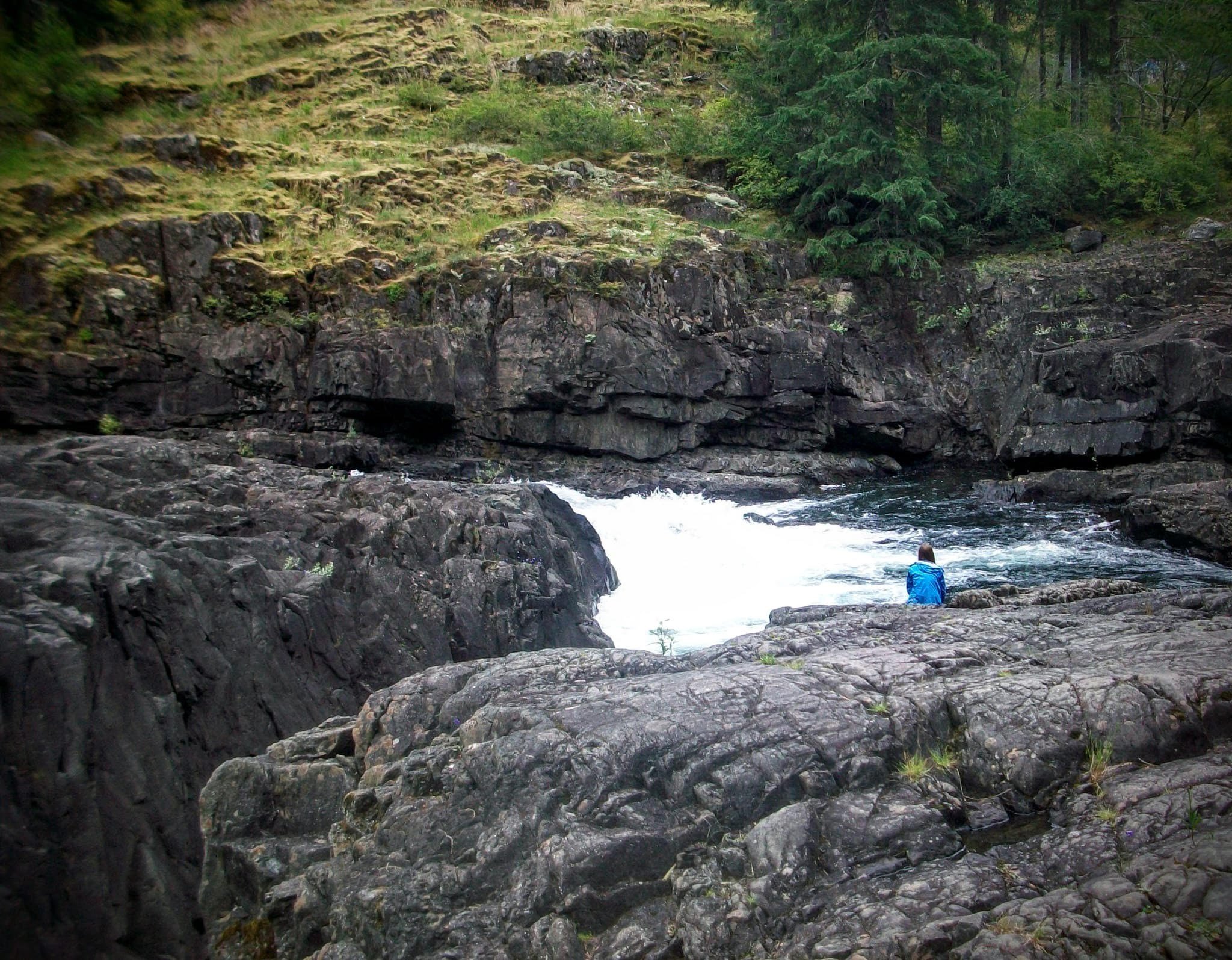
THE SWIMMING HOLE. Everyone made for Barber’s Hole as soon as the sun came out and the temperature rose above seventeen degrees. It never rained there, and the water had a permeating fragrance which ran across the rocks of the Puntledge River: an odour of mineral and vegetation. It could have been from the clay that we all knew the Hole for. Swimmers could reach down into the knee-deep water and scoop up the raw guts of the earth. By the dozen, they baked under the sun, covering themselves in clay like a human tagine. I plastered myself in the stuff one time, and I swear I scrubbed it from the cracks in my skin for weeks; the island seeped into me, and I could feel all the bodies whose skin it had touched before.
They found Frances’ body at Barber’s Hole in June. Some locals had pulled her out and tried to give her CPR before the first responders arrived. “Woman pulled from Puntledge River perishes," the headline read. One hundred and eleven words of text were printed about the incident in the local newspaper. The local hospital was too small, so they sent her to the mainland. She had graduated the year before, just one year ahead of me, and in one of the final weeks of school, the teachers called us into homeroom to deliver the news. Afterwards, the hallways filled with students’ atoning shuffles and the occasional sniffle. No one dared to look one another in the eye. It was June after all, the perfect month for swimming.
VANCOUVER ISLAND. The children still put together earthquake kits at the start of every school year. And their parents still write those tired old letters, a “Letter of Reassurance", they call them. Inside parents are told to use phrases like 'Please listen to the adults who are taking care of you' and 'Be strong and brave.' On the last day of school I wonder if the children read their letters whilst eating forgotten snacks and sitting on the playground.
Maybe they too have a difficult time pronouncing the name of our great island. And when they attempt to twist the cumbersome noun off their tongues, the adults giggle at their efforts.
And they’ll say, “That’s right, honey, Big Cougar Island."
And all the while, the Juan de Fuca plate is shifting below.
Charissa Egger is a Canadian writer and journalist currently based in Paris, France. She holds a bachelor’s degree in biology and a master’s degree in cognitive neuroscience and recently completed a fellowship in journalism at the University of Toronto.