
The Largest Mud Building in the World...

Photo: Mud Mosque, Mali – Mike Manson

Photo: Mud Mosque, Mali – Mike Manson

By Mike Manson:

I arrived in Djenne as the Sahara light faded. Twilight was quick and grey, the air heavy with desert dust. The mosque, said to be the largest mud building in the world, sits alongside what was now an empty market square. Squat towers and a minaret were outlined against the grey sky. The pale light flattened the features. I was excited by the obvious energy of this powerful building. 

Djenne

Dotted along the milky Niger from Mopti to Kabara - the tiny river port that serves the legendary Timbuktu – are several intriguing village mud mosques. These structures are classic examples of Sudano-Sahelian architecture, an eco-friendly style of building characterised by the use of mud bricks and wooden support beams that jut out of the walls.

The most splendid mosque of all is in Djenne. The building stands like a castle on a rise overlooking the town’s market square. Djenne, an ancient flat-roofed adobe town, is built in a loop of the lethargic river Bani, a tributary of the Niger.

After a night in a straw-roofed adobe hut I was eager to explore. I got up shortly before dawn to avoid the heat. The market traders were already setting up their pitches of vegetables, second-hand clothes and piles of pungent dried river fish. 

Since 2007, when a fashion photographer disrespectfully held a photo shoot in the mosque, non-Muslims have been barred from officially entering this holy structure. However, as I walked around the building admiring the construction I was quietly approached by a guide who, for a small contribution, offered to slip me in through a side door.

The ochre coloured walls of the mosque are buttressed and pierced by spiky wooden struts. The roof is supported by ninety gargantuan pillars making the prayer hall akin to an indoor maze. There are no windows. Shafts of dusty light shine from the roof through small ventilation holes which are covered with ceramic caps in the rainy season. Adjacent to the main building is a large courtyard surrounded by six metre high mud walls. 

Photo: Djenne Mosque, the largest mud building in the world – Mike Manson

Photo: Djenne Mosque, the largest mud building in the world – Mike Manson

Although the present structure is only 100 years old, it sits on the site of earlier mosques dating back to 1280.

Sun dried mud is one of the oldest known building materials. Adobe building (the name is Spanish for mud brick) requires few tools relying on material as local as you can get. The shape of a brick is universal - the width is half the length, so it can be used side-on to add additional strength. The tools of the trade may be simple but the skills required constructing adobe buildings are complex. In Djenne, the adobe masons train for an apprenticeship that can last for as long as ten years. The apprentices are also taught secret spells that protect the buildings.  

There are a number of possible approaches to the construction largely governed by what is available locally. The simplest technique is to build-up gradually layers of clay to form walls. To obtain the optimum combination for strength, the raw earth is moistened with water and artfully mixed with straw, dung, animal hair, small pebbles and any other suitable materials to hand. Some adobe buildings will have a supporting wooden frame, others are constructed with an unreinforced raw mud mix. A water-tight roof is essential to prevent the building from being washed away. The roof will consist of roughly hewn timber logs covered in clay. Flat roofs will have wood, pottery or tin drainage spouts. If grass or reed is available a pitched thatched roof is an option. 

In villages I saw bricks drying beside the mud pits from which they had been excavated. Mud bricks, shaped by hand or formed in wooden moulds, are left to dry in the sun. Unfired, the bricks are then laid and cemented with wet mud. To offer additional protection the wall may be covered with a mud based plaster. Before construction begins a text from the Koran will be read.
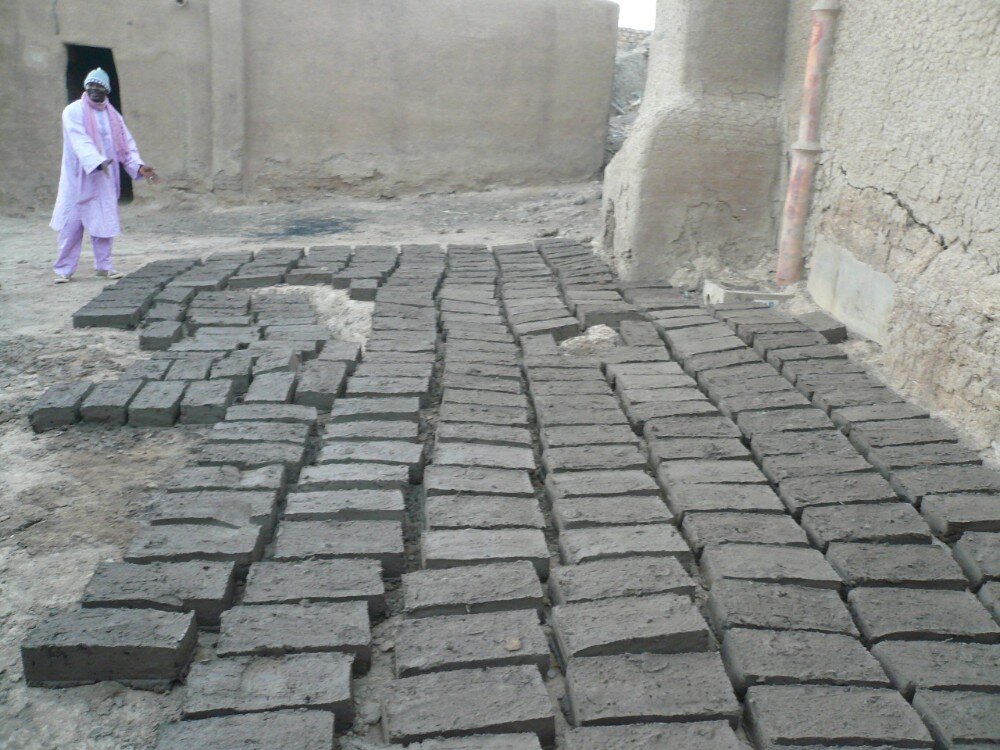
Photo: Unfired mud bricks are left to dry in the sun – Mike Manson

Photo: Unfired mud bricks are left to dry in the sun – Mike Manson

Aside from the use of local materials, the benefits of adobe structures are that the interior is warm in winter and cool in summer. The buildings naturally breathe; in recent cases where waterproof cement has been applied to the exterior this moisture can be trapped, which adds to problems of damp.   

There are, of course, limitations. Walls necessarily have to be thick and doors and windows small; ornamentation is basic. The biggest threat to adobe buildings is rain. Unlike fired bricks, which are hardened and hold their shape even when damp, mud bricks quickly return to their original form when exposed to rain. Over the years, if not properly maintained, unfired bricks melt back from whence they came, leaving merely a hillock on the landscape.  

In Djennne there is an annual festival when the town comes together to repair the mosque. Mud is mixed by foot and handed to agile youngsters who climb the projecting struts and pat on a new protective layer.

The oldest building in Ghana

Other fine examples of Sudano-Sahelian mosques are to be found in the North West of Ghana. Several years later I visited Larabanga, whose mosque is a surrogate Mecca for Ghanaian muslims.

Photo: The whitewashed Larabanga Mosque, Ghana – Mike Manson

Photo: The whitewashed Larabanga Mosque, Ghana – Mike Manson

I paid my respects and a handful of cedi to a sleepy mullah resting in the shade of a tree. Excitable youths escorted me down a lane. Dating back to the thirteenth century, the serene whitewashed mosque, sheltered by a huge tree, is said to be the oldest building in the country. It once stood alone in the sandy sub Saharan scrub, set in its own low walled enclosure for outside worship. Flat roofed huts have grown up around, so now it is in a back street. 

The uneven organic form of the building - low, squat and punctuated by irregular triangular buttresses - is captivating. Scraped from the earth, supported by rare and precious timbers the mosque is built on a simple wooden frame. The ends of the supporting, uncut, beams extend beyond the walls providing useful props when the mosque is repaired after the rainy season. Two pyramidal towers, a mihrab which faces Mecca and a minaret, are capped with plastic orbs. Traditionally these finials, as in Djenne, would have been ostrich eggs. 

The surrounding streets were dirty with animal dung and plastic rubbish but the yard is clean, swept gracefully by a woman with a long handled nylon broom. The Larabanga mosque is entered through a low, 5 ft high doorway. As your eyes adjust to the dim light, the impression is not of a room but of a series of interconnected passageways. Because of this only few worshippers are able to directly see the iman. Uneven steps at the back of the building lead up to a stumpy minaret and a gently cambered flat roof to allow drainage. 

Although there has probably been a mosque on this site since the thirteenth century - the age of the present structure is open to debate. Certainly the Larabanga mosque has recently been extensively restored by the World Monument Fund after the mihrab and minaret were on the verge of collapse after a severe storm.

Over the years most of the mud mosques in Ghana have been replaced by more substantial brick buildings; in 2018 just eight of these Western Sudanese style mosques remain.

In these eco conscious times these organic buildings are about as environmentally friendly as you can get. The building materials - mud, water wood and dung - are local and biodegradable. They leave hardly a footprint on the landscape.

***

Mike Manson is a writer and historian who lives in Bristol, England. His most recent book Down in Demerara (Tangent Books) is set in Guyana.

Postcard from... the Kelso Hotel

IMG_Stairs.jpg

By Fiona M Jones:

I have seen these stairs in one of many dreams: old-carpeted and awkward, all in different directions and never a full flight together. Hardly a room shares floor with another as you climb a little, step down, turn to find yourself above an entryway or down in a strange narrow yard recently wooden-decked. You find yourself neither indoors nor outdoors between high white windowed walls, followed by an archway too low now for horse-drawn gig but surely never meant for a door.

In my dreams every building is like this: old and idiosyncratic, mazelike, defying rectangular expectation, atticked and cellared and easy to get lost in—as though in books or dreams or ancestry I lived in such places and can never quite get used to architecture that makes sense.

It comes almost as a surprise that the hotel rooms boast space and light and all mod cons, and ensuite shower and a huge TV. One single mid-ceiling beam leads me to wonder if this once stood as two smaller rooms. The corded-casement windows are the oldest feature inside, but younger than the building itself by two or three centuries at least.

Noise from the small hotel bar filters up through the floor, but Kelso is a quiet town and the mild revelry of its Saturday night dies down early. From the street below our casements the last late vehicles rattle over cobblestones before night deepens into peace. We are staying one night here in Kelso, and it is not enough. We have walked beside the river, visited one restaurant, sampled a local micro-bar—and already we start planning our return.

***

Fiona M Jones is a creative writer living in Scotland. Fiona is a regular contributor to Folded Word and Mum Life Stories, and an irregular contributor all over the Internet. Her published work is visible through @FiiJ20 on Facebook, Twitter and Thinkerbeat.

Unreal estate No.01: Shruff End

Illustration: Katrina Gelze

Illustration: Katrina Gelze

By Anna Iltnere:

In the first of a new series of essays on seaside houses from literature, Anna Iltnere, founder of the Sea Library on Latvia’s Baltic shore, takes us to Shruff End from Iris Murdoch’s novel The Sea, The Sea. Each essay will be about a different house, illustrated by the artist Katrina Gelze. Next week, we will also publish a companion interview to this essay with Miles Leeson, director of the Iris Murdoch Research Centre at the University of Chichester. 

“What madman built it?”
– Iris Murdoch, The Sea, The Sea, 1978

“My imagination lives near the sea and under the sea,” Iris Murdoch said in 1978. She had never lived by the sea herself, but water played a big role in her books and her life.

A passionate swimmer and with characters who are thrown into water by her pen, Iris Murdoch was fascinated by the sea. Shruff End is one of the seaside houses of her mind, enlivened in her book The Sea, The Sea. 

“Water had a quickening effect on Iris Murdoch’s imagination,” writes Olivia Laing in her book To the River, “for her novels brim over with rivers and pools and chilly grey seas.”

Iris Murdoch was born in Dublin, Ireland, in 1919, as the only child of a singer and a civil servant. When Iris was a few weeks old the family moved to London. She would go on to study philosophy and wrote 26 novels, before being diagnosed with Alzheimers disease in 1997. Iris Murdoch died in 1999 aged 79, her brilliant mind relentlessly erased by dementia during the last two years of her life.

Iris Murdoch’s book The Sea, The Sea was published in 1978 when she was 59, was her nineteenth novel and the one which brought her the Booker Prize. The story is about a retired middle-aged actor, playwright and director Charles Arrowby, who leaves glittering London and moves to a house by the sea to write his memoirs. None of his plans work out, and his memoir evolves into a riveting chronicle of the strange events and unexpected visitors that disrupt his world and shake his oversized ego to its very core.  

“Strange novel”, writes Philip Hoare in RISINGTIDEFALLINGSTAR. “Faintly ridiculous” admits Olivia Laing, but this tragi-comic drama sinks in, and you become soaked in its story just as Shruff End remains forever dampened by the mysterious sea.

The House

Shruff End is a fictional house on an unidentified English coast. Charles Arrowby buys it in a fever of haste, selling his big apartment in Barnes, London, by the Thames. The sea-house takes most of his savings, but Arrowby imagines living simple, hermit days here, far away from his previous life on the London stage. But this dream that has come true soon turns into a strange nightmare, and Shruff End has its own role in the gripping story.

Shruff End is perched upon a small promontory, not exactly a peninsula, and stands on the very rocks themselves. “What madman built it?” Arrowby wonders. The facade, looking out onto the road, is “not in itself remarkable”, but in its lonely situation is strangely incongruous. The house would scarcely attract notice in a Birmingham suburb but all alone upon that wild coast it certainly looks odd. “Exposed and isolated,” writes Arrowby about his first impression. He falls in love with it.

The house is a brick, ‘double-fronted’ villa, with bay windows on the ground floor and two peaks to the roof. From the upper seaward windows the view is almost entirely of water, unless one peers down to glimpse the rocks below. From the lower windows the sea is invisible and one sees only the coastal rocks that surround the house, elephantine in size and shape. “How huge it is, how empty, this great space for which I have been longing all my life,” Charles Arrowby writes of the view. 

The pale buff-coloured blinds, which hang in almost every room, are “in excellent condition”, with glossy wooden toggles on strings, silk tassels, and lace fringe at the bottom. When these blinds are drawn down, Shruff End, as seen from the road, has a weird air of complacent mystery.

The bricks are dark red. The back of the house has been horribly “pebble-dashed” against the weather. “Little do they realise how ardently I look forward to those storms, when the wild waves will beat at my very door!” Charles Arrowby is rather exalted in the first pages of his memoirs: “What a paradise, I shall never tire of this sea and this sky.”

Mr Arrowby lives entirely on the seaward side of the house, upstairs in his bedroom and what he calls his drawing room, and downstairs is the kitchen and a small den next to it known as “the little red room”, where there is a fireplace. On the other side of the house are the the book room, where he has put the crates of his still unpacked books, and the dining room, where he stores his wine. 

The chief peculiarity of the house, and one for which Charles Arrowby can find no rational explanation, is an inner room found on both floors.They are rooms with no external window, but lit by internal window giving onto the seaward rooms. These two “funny” inner rooms on two floors are extremely dark. Throughout the book they seem to be a rib-cage containing the soul of the house. 

The house is “mysteriously damp”, its floor is “curiously damp”. The large – and damp – larder is full of woodlice. “Is it conceivable that the sea could be rising up through a hidden channel under the house?” Charles Arrowby prises up some linoleum in the hall, and replaces it with a shudder. There is a salty smell, he observes. At the end of the book he tries to get rid of the house, and admits that no one seems to want to buy the place, “perhaps because of the dampness, perhaps for other reasons”.

The sea becomes a canvas for Mr Arrowby’s own inner demons. “It is after tea and I am sitting at the drawing-room window watching the rain falling steadily into the sea. There is a terrible grim simplicity about this grey scene. Apart from an iron-dark line at the horizon the sea and the sky are much the same colour, a muted faintly radiant grey, and expectant as if waiting for something to happen. As it might be flashes of lightning or monsters rising from the waves.” 

One morning he does see a monster rising from the waves, while the sea also mysteriously and repeatedly unties the rope that he ties to the shore to help himself get out of the water after his daily swims. It provides one of the most quoted lines from the book: “Time, like the sea, unties all knots.”

The house starts to play tricks on his mind. Is the house haunted? He asks about a poltergeist in a nearby bar. “Any house might be haunted,” someone answers. At first it is a vase that falls down and is smashed to pieces. Then – a mirror. And then there’s a face he sees in the window at night. Or was it moon?

Shruff End seems to have not only its own ghost, but also its own climate, independent from the weather outside. It feels cold even on warm days. One day Arrowby comes in from the brilliant light outside and the air in the house seems grey and thick. The house is gloomy, and there are strange sounds too, or perhaps it is just the bead curtain clicking in the draught from the open door...

“The house was still acting up, but I felt by now that I was getting to know its oddities and I was more friendly towards it,” writes Arrowby. “It was not exactly a sinister or menacing effect, but as if the house were a sensitized plate which intermittently registered things which had happened in the past – or, it now occurred to me for the first time, were going to happen in the future. A premonition?”

When Mr Arrowby puts Shruff End up for sale and runs back to London, he moves to “a peculiar miserable derelict” new flat. If he ever wanted to live as a hermit, retired from the world, then this – he concludes – would be a far better habitat. “It is oddly enough easier to write here, amid all this cramped chaos, than in the open spaces at Shruff End.” 

In the end, he hadn’t been able to concentrate in a house by the sea. 

“Throughout the book water runs like a spell or a curse. The sea of the title is not just a background or vista, it is a character,” writes Daisy Johnson in the introduction of a special edition of The Sea, The Sea. It was published by Vintage Books in the summer of 2019 to celebrate the 100th birthday of Iris Murdoch. 

***
About the author: Anna Iltnere is the founder of the Sea Library in Jūrmala, Latvia. On the Sea Library website you can read reviews, interviews and, of course, borrow a book.

Katrina Gelze’s website

In Imagination's Lighthouse

photo Ian c Smith poem.jpg

By Ian C Smith:

Wind a heavyweight hullabaloo, surrounded by sea-surge, nothing dislodged on my reconnaissance, I stare back at a chill of harboured currawongs beady-eying me here in this receptor of my life’s heat.  I eat plainly, snooze through three-hourly blocks wrestling gothic dreams, jot notes of memories, some of venery, deceit, the sordor of trodden tinsel, consult an old Oxford dictionary, read. Welcome guests, a rhapsody of writers, Boland, Erdrich, Robin Robertson, conjure me to lower their thoughts to my heart recalling scenes from my kaleidoscopic past; seeing flying fish in calm conditions before later plunging through cavernous crescendos of swells coursing the Indian Ocean; collapsing in an Aden market, coming round to fanning by Arabs in an outrage of heat, gentle contrast with tempests girdling our globe here in this citadel at Forty Degrees South.

After the blow, then wreath of cloud whiteout, three small dead sharks in my kelp-covered cove, casualties of net fishing.  I couldn’t see the fish factory for its floodlights, heard its thrumming, an invasion force before the clamorous wind chased it off.  Electronic communication limited to a forsaken spot away from comforts, also limited, sand, not sea-wyf, at scratch of day in my bed, I ritualize chores; bonfires of rubbish, smoke waft evocative, brew tea thinking of Alexander Selkirk, neither of us patient sufferers of fools.  Seldom speaking, I sometimes shout, sing, trim wild whiskers, resemble a derelict castaway by Robert Louis Stevenson, that tubercular tale-teller who sought the faraway. Imagination in solitude salves wounds that can never heal, invisibly stitching emblazoned banners torn in battles past.   

***

Ian C Smith’s work has appeared in, Amsterdam Quarterly, Antipodes, cordite, Poetry New Zealand, Poetry Salzburg Review, Southerly, & Two-Thirds North.  His seventh book is wonder sadness madness joy, Ginninderra (Port Adelaide).  He writes in the Gippsland Lakes area of Victoria, and on Flinders Island, Tasmania.


Podcast: Trees a Crowd

gingko.jpg

By Sara Bellini:

Trees a Crowd is a podcast that celebrates nature, people that love nature and the relationship between human beings and the natural realm. If you appreciate when someone can identify a wren rather than just calling it a bird, and your eyes light up at the thought of Yorkshire national parks, this is the podcast for you. Think David Attenborough without the telly but available on Apple Podcasts, Spotify, Tune In and Overcast.

From February 2019 actor and artist David Oakes has been interviewing people whose job is “inspired by or devoted to the natural world”: scientists, creatives, environmentalists, conservationists, gardeners and sometimes nature itself. “Everyone is working for the natural world but everyone’s agenda is completely different.” 

Why is nature so fascinating and how does it benefit us? How do human beings relate to their ecosystem? Why is it so important to protect the wildlife? David Oakes and his guests discuss these questions during one-hour-long episodes, twice to four times a month, mostly but not exclusively in the UK. Featured topics are: the dawn chorus, horticulture, carbon footprint, Yorkshire sheep, Inga alley cropping in Sierra Leone, Manta Rays in the Maldives, agricultural laws and Extinction Rebellion. 

“Perspective is increasingly key to all aspects of life, but perhaps never has it been more important in terms of our interaction with nature. With our society and technology growing so rapidly, we are capable of causing a huge amount of destruction, but we also now have the technology to limit, or even reverse, the damage it has caused. As Harry* suggests, running up a Devonian Tor or being penned in by trees or mountains helps us reimagine ourselves not purely as a construct of a human society, but as a continuing part of a natural ecosystem, of a natural justice.”

Have a listen, go for a walk, plant a tree.

*Harry Barton, chief executive of the Devon Wildlife Trust (Trees a Crowd, 07th October 2019)


Crossing Brooklyn Bridge

Bridge 1.jpg

By Anna Evans:

And we have seen night lifted in thine arms.
– Hart Crane

I have been dreaming I am in New York. Looking out across the harbour to where the bridge begins and ends. With a paperback of poems to carry as I walk, walk across thee. Waiting for the sun to set, I follow the steps upwards to the bridge where time spans like birds in flight. 

From the book an image draws fragile in my hands. Without looking down I know on the cover is the bridge, pastel coloured and simple. The suspension of wires dominates the view, dark lines crossing over. The lines that cross from the centre outwards, to the bricks of Brooklyn. Birds fly distant, the kinds that children draw, shaping the letter m for movement. Through the middle rising upwards a vertical blue like crayon marks, shading to where the sky and water meet ascending; to the blue of distance that throws outwards and upwards. Joining the impossible like a bridge from shore to shore. The city in the distance marked in pink, as it might look in the morning light. It contrasts with the black lines of iron girders, and the steps leading onwards to the bridge. 

I know that inside the book is an inscription that reads To A. neat and precise with just one x to mark the spot. In your room the books in stacks surround us. The books like bridges: we take turns to select one and read out the first line. I pick up the book of poems saying I want to read it. And so, you take the book, write just inside the cover and give it to me. I never read further than the first poem or skim a few lines here and there. Still the words reach out and form a trail I must follow, in endless rivers crossing the land and all the flow of words that clogs them. Books that don’t belong to anyone, that stay with us for a time. 

I sit down and read, imagining that I look to where your arches end and the point at which the shadow forms. I read: Under thy shadow by the pier I waited / Only in darkness is thy shadow clear.

Hart Crane looked out from his window on Columbia Heights in Brooklyn, compelled by a changing view of the bridge. A vision to chase in symbolic form, in language. I look to find the author in its solid lines, in all its transient footsteps. To see him address the other side and set these bridges in motion. And the bridge moves as we walk. Its solid lines make stillness and motion combine. Iridescent, it sets in motion each day past; as though night and the fall of morning were gone already.

Waiting for night to fall, the dark comes quickly, and in crossing the city changes from the red and pink of dying lights, across purple-blue; to see the bridge come alive and the city melt in its shadow. I walk across moving through the crowds of people posing for photographs; there is no solitary view of the bridge, no chance to stand and look across. 

In the centre, two domed arches from which a series of wires are suspended in grid-like lines drawn against the sky. They are not so much imprisoning as uplifting, reaching high across the city. I walk taking blurry impressionistic pictures, city lights of many colours. Buildings that reflect one another, incandescent and blurring away into hazy distance. Becoming ghostly, they question solidity. Walking the bridge, it lives in motion. The wires suspended in black lines to draw you upwards. The view of the bridge that comes from walking. 

With you he walked across, hand in hand, in rapture. From this moment: these bridges in motion. Always crossing, from what is past and present, to what is on the other side. 

⁎⁎⁎

Walking across as sunset came and went. The sudden descent of darkness and the changing colours of the lights; the endless streams of traffic passing. When everything that lies below becomes murkier and more uncertain. The bridge measures out the distance between each wire, and our eyes fix on a series of lines laid out as far as the eye can see across the unfathomable reaches of water.

As darkness falls the wires suspended are lit with fairy lights that twinkle, that dwindle into distance, even as the darkness seems more engulfing. It saturates the sky above and draws upwards from the dark constant of the river below. And above and below are where the bridge remains suspended. Its very tautness and the precision of its measurement are carefully weighted against the depths; yet still the depths remain and seem ever closer. It is there in the way it joins across a gulf, a chasm; by its very joining it projects our thoughts to what lies below. 

In the night you dance exhilarated holding hands. Dancing over the bridge, uplifted. Like the bridge you are indestructible. The bridge is more than just a bridge. The bridge is life. In rapture you seek to say what daunts, what sinks under river water. To look upwards, where wires close in, suspending thoughts from city to city, from river bank to sea shore. So that for a moment you are flying, though you may always believe in falling. 

The water dark and obscuring. The bridge brings a shape and form to what is unfathomable. You must believe that there is a way to say it, that the bridge is possible. That you can write a message in a bottle and throw it carelessly to the currents, in waves. The bridge that cuts you off, unreachable, lost at sea. Your meaning obscured when you wanted to make visible another world just beyond this one. The bridge transports in metaphor, to carry across, from one side to the other. You leave only your words. While somewhere there are those that fall between the gaps, who find the unknown in the measured reason of the bridge.

While I have been crossing the bridge, darkness has come and changed the world as we see it. Each day, the same adjustment. From the solid mass of stone, soar two great arches, the strength of steel wires, thick and twisted, to iron girders bordering the edges, and thinner wires reaching out grid-like, touching the blue true of the sky, the billowing clouds, the coming light. The light that is always coming. There is colour and a sense of the city all around. Impressions gather like scattered lights and solid lines of steel. 

I am always imagining endings. That I might look down to the river and see your message in a bottle, transcending time. The past is there and waits for us to cross. Now the book leads me to the bridge. Crossing over, crossing back to what came before. A bridge to my past self, wherever time has placed you.

Across the vast silences like the river flowing, ever-flowing. When things changed, and each moment was already lost, unreal. 

I sometimes think we were never present; we were already looking back. You once wrote of me as a silhouette receding against the sky. Was it always so? I find you here again as I pick up the book and read onwards. I am free to cross the bridge and look back across the city, that expanse of time that is past. Is there a chance then, that when you read this you may say, that is not how it was, that is not what I said, that is not how it was, at all?

***

Anna Evans is a writer from Huddersfield in the north of England, currently living in Cambridge. Her interests are in migration and literature, cities and movement, and she has completed an MA in ‘Writing the Modern World’ at the University of East Anglia. She is currently working on a project on place in Jean Rhys’s early novels, and you can follow her progress through her blog, And The Street Walks In.

Letter from Eritrea

Elsewhere journal photo .jpg

By Alex Walker:

I pass under the white awnings of the coffee shop, grateful my walk has come to an end. The air in Asmara is thin – this small capital sits on a plateau 7600 ft above sea level – I am out of breath and in need of a coffee. Fortunately for me, Africa’s only ex-Italian colony still serves delicious macchiatos, made with the strong, dry Arabica beans of neighbouring Ethiopia. The letters of the sign outside are in the style usually seen on the side of Vespa motorbikes. 

It is busy, but an undaunted waitress shows me to a spare chair on a table with some other customers. I sit down to read and regain my breath, but struggle to focus amidst the muted scream of frothing milk and the buzz of conversations in Tigrinya. As people come and go, a smartly dressed man sits down opposite me. Back straight, he sips meticulously at an espresso. I can tell he is watching me, perhaps surprised by the sight of a westerner in a state that guards its own isolation. 

“Is your book factual?” he eventually asks.  

I tell him it’s about Eritrea and questions follow: what does this author say? what sources do they use? is it well referenced? 

He tells me he had been a history teacher. He does not seem angry, but concerned. I’ll tell you something about Eritrea, he says. 

“In the 1930s Eritrea and South Africa were the most developed nations in Africa. They called this city ‘Piccola Roma’. Do you know what that means? Little Rome.”

For the Italian colonists Asmara seems to have presented less an opportunity to create a miniature Rome than a modernist reimagining of it. The wide road that forms the artery of Asmara is lined with giant palms disproportionate to the number of people that walk beneath them. Walking along it you will pass four grand cinemas and come eventually to the famous ‘Fiat Tagliero’ building – a now-disused petrol station in the stylised shape of a majestic plane. It is said to be one of the finest examples of Italian futurism in the world. 

Asmara is quiet now – many people leave, if they can, and the country is undoubtedly poor. The subtext of my companion’s comment is clear. It was the British who treated Eritrea as the spoils of war when they defeated the Italians in 1941: dismantling factories, removing parts of the railway line, demolishing a naval base, and so on. There is no vitriol in his comment, only a desire to be clear. He tells me how much fun he had with British teachers in the 90s – a brief period of peace and optimism sandwiched between the protracted struggle for liberation and the brutal border war that followed.   

How old do you think I am? My new friend asks with a knowing smile. I guess early 40s. 

I am wrong, he is 55 – “but I look young, I have fought in two wars – it keeps you fit,” he laughs. 

***

Alex Walker recently finished a masters at The LSE in Political Theory. Before that he studied at the University of Oxford, where he wrote for various student publications. He currently lives in London and is interested in deliberative democracy and citizen participation.  

Alex on twitter

The Way(s)

IMG_1038.jpg

By Ashley Moore:

You are a fraud for entering the cathedral without hiking boots. A fraud for arriving without a sweat-stained backpack you haven’t been lugging along northern Spain’s Camino de Santiago for weeks on end. Nevermind that you recently put your own sweat and tears into 110 kilometers of the Peruvian Andes, or that you finished your first fourteener there at Abra Mariano Llamocca pass, or that you do not need a cathedral at the end of the journey to know that these long-term treks are their own type of religion, one that relies on a fanatical belief in your own two feet: no horses, no mopeds, no cheating. You will recognize the all-too-familiar zealotry of the wanderers as your own, but in Santiago you still feel like a day-tripper, a fraud.

You know the stories of The Way secondhand, some of them from the plane ride in. How modern-day pilgrims begin the trek solo only to form impromptu families that are just as quickly dissolved when hikers decide on their own pace, their own personal Caminos. The camaraderie in the communal songs sung as payment for dinners at the low-cost albergues many trekkers overnight in, how these same people may never encounter each other again. The time and space that the walking provides, the transformative, even spiritual, effect of the voyage on religious and non-religious pilgrims alike. You feel the energy pulsing beneath their fluorescent-colored all-weather outdoor gear, the triumph of the body and mind over the weeks of walking, a mixture of joy and sadness that the journey has been completed, but is also at an end, as they make their way to the final stop of the trek: the Cathedral of Santiago of Compostela.

From the outside, the cathedral feels tiredly familiar. There is a part of you, having seen so many of these, that has bored of this mixture of architectural styles, the ages of renovations running into and over each other, the 11th century Romanesque and the 18th century Baroque, the masterfully crafted yet predictable stone reliefs of Biblical scenes adorning nearly every surface of the structure’s façade. Inside, you expect more of the same. 

Maybe it’s the way the light changes as you move out of the sun and into shadows, which are only ruffled by the flicker of dozens of candles and the smoky incense wafting from some unknown source— the nearly two-meter tall, gold-sheened Botafumeiro hanging unused above the altar. Maybe it’s all the tragedy, that emaciated Jesus, limp upon the cross, an especially foreboding skull staring directly at you from beneath his punctured feet. Or perhaps it’s the knowledge that at this very moment, you are looking at the silver case in the underground crypt that holds the bones of St. James. 

Here, deep inside the cathedral, you and the brightly-colored pilgrims are all frauds. This place belongs to the true believers, whose energy seems to puncture and slice through the gloom. Theirs are not the glad smiles of the hikers, but the fervent conviction of bent knees on stone floors, of clasped hands held so tightly against bent heads that it almost seems as if you can see the blood beating through the wrist veins. 

An instinctual urge to join them comes suddenly, unbeckoned, with the speed of a tsunami. A natural disaster that cannot be predicted or charted like a hurricane, one that has no tornado season or government-installed alarms. The kind of thing that comes from a deep upheaval of earth and rock and water producing a wave, 20-meters high, threatening to smash into you and all these years of agnostic exile. 

You stand there too long— not transfixed in awe, but immobilized by the shock. 

You leave the crypt but not the feeling. Near the altar, you find walls covered in washed-out medieval scenes of horses, scallop shells, and eight-sided stars. The faded blue and red hues complement the 3-D geometry of the marble floors. You reach out to touch the cream-colored shells painted onto those walls, the same shells that pilgrims have gathered along the Galician coast for centuries as proof of their completion of The Way. You pull your hand back before you can disturb the art and turn, only to find Christ – dead again on the cross – and another Christ – still dead – in the arms of Mary and his disciples. Amid the gold and the marble and the lacquer that turns his face pallid and frail, Jesus always seems to be already extinguished here. 

You finally begin to come back to yourself. No living God could ever call this place home, his love abandoned by his people, no apologies for the burnt stakes or bombed hills, the altar boys or unwed Oklahoma girls secreted off to abortion clinics in order to be married in white, the “rehabilitation” of same-sex attraction. God was forced out of this place a long time ago. All that remains here are the red robes and starched white shirts of the men who ran him out. Them and their relics: the kneecaps and femurs and severed heads of saints and apostles. All the church’s evidence, stamped and approved by its own authorities. An autohistory on repeat, slowly calcifying under the pressure of time into something that they can call proof. 

You do not want their evidence. You want to join the believers, to feel the conviction of your youth. You want to kneel. It’s an ache, a fundamental need to know the communion with God you once felt in prayer, that otherworldly plane of being you’ve only ever been able to replicate in meditation. You want to believe not just in that God of your youth, but in the only living things in this place: his people. 

Garish gold angels look down on you from the altar. More smoke hovers near the winged pipes of the organ, the Botafumeiro impotently hanging, so heavy and so high. The candles, you notice, are all electric, activated by slipping coins into slots, as if this were an arcade. Behind them, the severed saints’ heads are hidden away in gold-sheened boxes, kept behind intricately-designed bronze bars, in the shadows, off-limits, and, for all you know, long-ago turned to no more than dust in their beautiful encasings. 

You won’t kneel, but you still talk to him, unconsciously, the way you’ve always talked— like old friends, apologizing for the time it’s taken to get back in touch. You tell him it’s been so long that it’s almost like he doesn’t exist. You ask him where he went, why he didn’t call. You probably cuss at him, and then apologize for cussing, and then thank him for forgiving the cussing and the doubt. You tell him you’ve missed him, that it hurts to see him there – it always hurts to see him there – all locked up in the stones they’ve carved him into, bleeding in eternal enameled submission to their image of him. 

You know it’s unlikely and that there may well be a special circle of hell for this kind of thing, but you still ask him to come with you, wherever he is. You want the pilgrims to find him living in the sunsets along the Camino, the same way you thought you saw him in that baby sheep that wouldn’t stop following you outside of Yanama as you made your way up that 5000-meter pass in the Andes, in the few minutes that Salkantay’s peak broke free of the cloud cover at the exact moment you made it to the top. You want him to live in the impromptu harmonies of the pilgrims’ amateur songs, in the urge they have to sit a few days out, to stay in one place for long enough to sing new harmonies and form new families. You want him to be found along all of The Ways.

Outside, you are relieved by the brightness of the sunlight and the glad chaos of the fluorescent-tinged tourism. In the large, flat square that opens out before you, cameras click and selfie sticks abound. You rejoin the wanderers, none of you frauds. You take your own photos of 11th-century doorways so short that they only come to your shoulders and notice that the large, centuries-old stones at your feet seem to be opening out as the waters and winds of time work them over. There, among the gaps, are the modern-day bronze versions of the ancient seashells that have marked the Camino’s path for everyone who’s ever walked this way. At the windows of the cathedral, and even along the walls, young green leaves seem to burst right out of the stone. Maybe someday they will be bushes or trees. You wonder how they managed to sprout there, how deep their roots can go before the marble starts to crack. You wonder how long they will be allowed to grow. 

***

Originally from Oklahoma, Ashley Moore is a writer, editor, and educator based in Bayreuth and Berlin. She is a fiction editor at SAND literary journal and teaches at the University of Bayreuth. Her flash fiction was chosen for Wigleaf's Top 50 Very Short Fictions of 2018 (selected by Manuel Gonzales), and her other prose can be found in The Rumpus, Hobart, Monkeybicycle, and other publications.