A Hidden Glen

By Ian Grosz:

We returned to a cottage we’d first rented twenty years before. Hardly anything had changed. There were a few modern scatter cushions on the same old armchair; a new washing machine and sink unit, but it was the same bowed, pinewood ceiling and the same, thick stone walls; the heavy lintel above the fireplace; the same broken clock and faded landscape pictures on the walls; the same, old map of the glen hanging by the stairs up to the mezzanine bedroom. On the shelf beneath the sash and case window looking out to the pines that line the rushing burn coming down from the hills, was a guest comments book still with our entries from twenty years previous. We sat there, reading messages from ourselves from another lifetime. 

The cottage was once the laundry for the main house of an estate belonging to the Ogilvy family, hidden away down Glen Prosen with the evocative name of Balnaboth. Like most Highland estates, with farming and shooting no longer bringing in the revenues they once had, many of the properties had been given over to holiday lets. Even the house itself was now on Airbnb; but when we had first come here the family still lived in one of the two main wings. Their dogs would come to the cottage and scratch at the glass panes of the door to take us for a walk in the mornings: an eager west highland terrier named Una and a low flying, long-haired dachshund whose backside was always tangled up with pine twigs and fir cones.  They’d take us on a tour of the grounds, chasing the resident peacocks and barking at the squirrels. The dogs are long-since gone, but the scratches from their morning wake-up call on the glass of the door are still there, revealing themselves when caught in the low autumn light filtering through the trees. 

There was a thick mist when we arrived, the estate’s trees materialising out of the landscape as we followed the long, single-track road that winds its way up the glen from Kirriemuir, a small country town of red sandstone and the birthplace of the Peter Pan author J.M. Barrie. Barrie had returned frequently to spend some of his holidays away from London in the glens, and was buried in the town’s cemetery. Arriving at the cottage we settled our things; the years rolling back with that curious feeling of never having left. We jammed our weeks’ worth of food into the small fridge and, remembering the dogs, we took a stroll around the grounds to re-familiarise ourselves; the mist clinging to our clothes as we walked back down the track, past the now empty main house with its bright orange-yellow wash of lime rendering and its accumulated memories.

There has been some form of house at Balnaboth since the thirteenth-century, its original name stemming from Baile nam Bochd – the Stead of the Poor – but in its present form is thought to date from 1815 when Donald Ogilvy made a series of improvements, conjoining and adding to earlier buildings after taking over from his father Walter, whose Jacobite brother was exiled in France after the defeat of 1746. Barrie spent time at the house on his retreats from London literary life, meeting here with his ill-fated friend Robert Falcon Scott and later, the Scottish politician Ramsay MacDonald. MacDonald was the first Labour Prime Minister, leading a minority labour government for a short term in 1924 and again at the turn of the decade. He later headed a coalition government with a conservative majority during the early thirties, leading to his dismissal from the Labour party.

It is odd to think of a socialist being entertained at the tucked-away grand houses of the landed gentry, with associations that included the writer and high society hostess Lady Londonderry, wife of conservative cabinet minister Viscount Castlereagh, Secretary of State for the Air during the nineteen-thirties. He was central to pushing through the iconic Spitfire and Hurricane fighter aircraft to replace an outdated fleet in preparation for the war everyone knew was coming, but he had openly antisemitic leanings and known sympathies for a burgeoning Nazi Germany and was forced out of the cabinet in 1935. He died after a series of strokes in 1949, still with a porcelain figurine of an SS flag-bearer on the mantlepiece of his smoking room: a gift from Hermann Göring. 

MacDonald was demonised as something of a traitor due to these associations and in his role with the coalition government during the Great Depression; the government having pursued a policy that protected the currency over maintaining assistance to the poor and unemployed. He was seen to have put his career before his principals in aligning with the Tories, but in his own eyes was putting his personal politics aside for the national good at a time of crisis, holding the country together through a dark period in history. He was a founding member of the Labour Party, with a strong reform agenda, and for the time, held some radical socialist views that looked to redress the inequalities of British society. I wonder how much he might have confided in his friend Barrie in the years leading up to the difficult period of the Depression. 

Born out of wedlock to a farm labourer and housemaid at a farm in Lossiemouth and into a culture of strict nineteenth-century Presbyterianism, he got off to an inauspicious start. The prejudices of his religion would set tongues wagging, but the class system and the inequality of the British state was a very real barrier, there to keep folk in their place and the ruling classes in theirs. His parents never married and he was brought up in the Free Church, but became a teaching assistant, enabling him eventually to move to Bristol to take up a position with a philanthropic clergyman. He later moved to London where, after a period of unemployment, he took up a position as a clerk and deepened his interest and involvement in socialism. 

In 1887, he witnessed the ‘Bloody Sunday’ of Trafalgar Square, when marchers protesting against unemployment and coercion in Ireland clashed with the British Army, inspiring a later career as a freelance journalist that began with an article in The Pall Mall Gazette entitled ‘Remember Trafalgar Square: Tory Terrorism in 1887’. Throughout the late eighteen-hundreds he continued to educate himself at The Birkbeck Institute, now the University of London, and in 1888 took employment as private secretary to Thomas Lough, a wealthy tea-merchant and a radical Anglo-Irish politician, opening doors for MacDonald that would secure his own, later political career. 

In MacDonald’s early courting of celebrity and his frequenting of the grand houses of the Tory heirs, I saw perhaps more than a move to influence and maybe a lingering deference to the upper classes; a need in him to prove his ascendancy; to gain approval and validity from those in the very establishment he wished to reform. He was a supporter for Home Rule in Scotland, declaring in a paper published in 1921 that ‘the Anglification of Scotland has been proceeding apace to the damage of its education, its music, its literature, its genius, and the generation that is growing up under this influence is uprooted from its past.’ Wandering around the old estate grounds a hundred years on, his legacy felt increasingly present. 

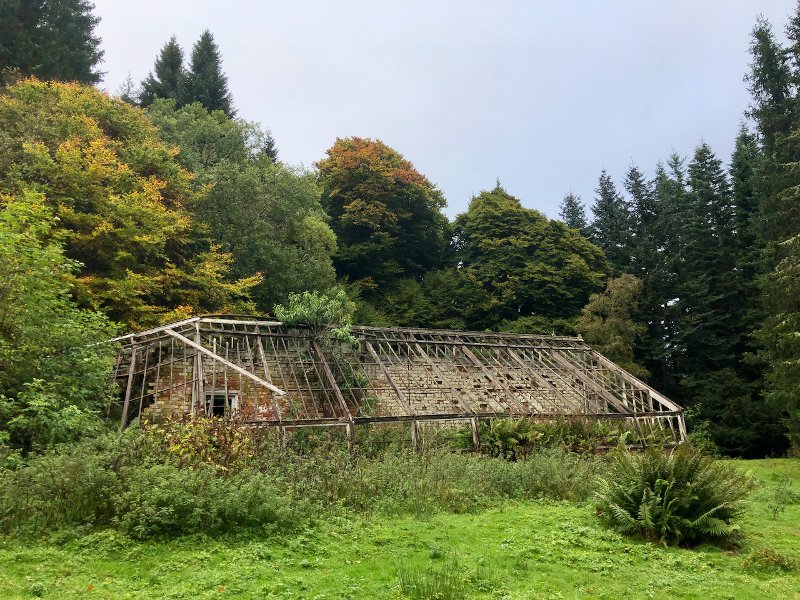
We crossed a low wooden bridge spanning the burn, which was full and fast and courses its peaty way down from the hills like a torrent of frothy Coca-Cola. Following a muddy path through mixed woodland up a short rise into open ground again, we arrived at the old glass house that lies in ruin on a slope overlooking the burn, its timber frame mostly collapsed into its lower brickwork. A few panes of glass were still in place, but its interior was overgrown with tall ferns; a young tree reaching up through its roofless frame. An old wheelbarrow lay at rest under the shade of a nearby fir tree, as though the gardener who had once tended to the vegetables had simply downed tools and walked away. 

A sense of time and time’s passing was all around us; a sense of decay, and yet it was a comforting sort of sadness held within the crumbling walls of the garden and in the collapsed frame of the Victorian glass house. It felt deliberate, almost staged in its picturesqueness, as if arranged for the sentimental eye of the romantic; the grounds slowly but surely giving way to nature and its landowners democratising a once private estate. I felt it was part of the appeal of the place, this fading grandeur; a reminder of the inevitable certainty of time and change. 

***

Ian Grosz is a writer based in the northeast of Scotland. Drawing largely from the landscape, he is published across a range of magazines and journals both in print and online. His writing features in the forthcoming book Four Rivers Deep, a collaborative deep mapping project that explores the rivers Don and Dee in northeast Scotland and the Swan and Canning rivers in southwest Australia, due for publication by UWA Press in January 2022. Ian is currently working on a personal, narrative nonfiction book-project exploring the ways in which landscapes shape a sense of place and identity. 
Dispatch from Olsztyn: My Two Towers

By Marcel Krueger:

In 2019, I was selected as the official writer in residence of Olsztyn in Poland by the German Culture Forum for Eastern Europe and lived there for six months. I wrote about my experiences on the official writer in residence blog www.stadtschreiber-allenstein.de in German, Englisch and Polish (thanks to my official translator a.k.a. my Polish voice Barbara Sapala) and also for the Elsewhere Journal. This November was the first time since the start of the pandemic that I made it back to the city. 

It is cold as I arrive under a low-hanging November sky. As I alight at Olsztyn Zachodni, the former Westbahnhof of Allenstein, the light over the city resembles dusk, despite the fact that it is 2pm. This is the first time since February 2020 that I'm visiting the capital of the Polish voivodeship Warmia-Masuria. But I know my way around, just like my family knew their way around before me. Up the road from the station is the red-brick Jerusalem Chapel from the 16th century, and a cross commemorating the 1866 cholera epidemic is set in front of the entrance. Opposite the chapel is the steep Królowej Jadwigi – Queen Jadwiga Street. Until 1945, this was Pfeifferstrasse, named after now-drained Pfeiffer Lake at its bottom. House number 10 was built in the late 1920s, an unassuming yellow building with two floors. This used to be the house and office of my grand-aunt Ottilie and her husband Emil Pomaska, who ran a haulage firm here. At this house in 1940 my grand-uncle Franz Nerowski, a spy for Poland, was arrested by the Gestapo and led away to incarceration and execution. But I’m not going there today, and instead shoulder my bag and set off down the street on the other side of the station, towards the city park and the ever-rushing Łyna river, the large red-brick castle from 1353 looming over it, and to my favourite building in Olsztyn: the Wysoka Brama.

What makes us haunt a place? A sense of familiarity, of knowing our way around? An extended network and community, the knowledge that we have friends in a place far from home? Or that a place is providing us with inspiration, with food for thought, and allows us to discover new aspects of it - and ourselves - every time we visit?

All of the above is true for me in the case of Olsztyn, but maybe the strongest allure of the city for me is the fact that I am forever drawn to places with multiple identities, where simple nationalistic stories and touristic whitewashing are absent. The port city of Dundalk in the Republic of Ireland, where I live, is also a border town, called "El Paso" during the conflict in Northern Ireland as it had strong Republican ties and the IRA used it as an R&R area, but for centuries before that it was the last outpost of English might in Ireland, protecting the Pale from the Ulster Irish. Its colloquialisms and idioms are mostly of English nature, brought here by migrants from England who came to work as part of the military or for the administration. On my street in Dundalk is a reminder of that, so-called Seatown Castle, which is actually the tower of a Franciscan abbey founded around 1240. The abbey was ransacked by invading Scots in 1315, and the majority of what remained of its buildings were destroyed in the early 17th century. The grey-green, lichen-covered tower of Seatown Castle is the only remnant of that abbey, today looked after by Dundalk City Council. Whenever I want to be reminded of the fractures and fault lines of Irish history, I take my tea mug to my back garden and look at it. 

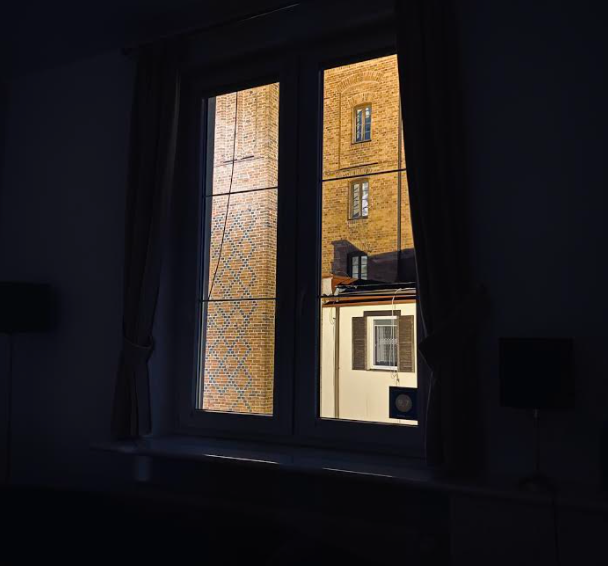
Just like in Dundalk, I have a tower in Olsztyn. During my time as writer-in-residence I lived in an apartment in the old town, and from my living room window I was greeted every morning by the red brick gate of the city. The Wysoka Brama or Hohes Tor or High Gate is the only remaining gate of the three medieval city gates, originally built in 1378 and brought into its current form in the 15th century. In 1788, it became an armory, in 1858 it was converted into a prison, and in 1898 became a police station. Until 1960, one of the tram lines of the city passed through it. Today it also has a glass mosaic of the Mother of God facing the old town, given to Olsztyn by pope John Paul II when he visited in 1991. And just like Seatown Castle, it has lost its original purpose - there is no city wall any more, and you can even walk around the gate to get into the old town. 

But like Seatown Castle, for me it represents the many layers of history here: Olsztyn was founded by Teutonic Knights in 1349 on the hills above the Łyna, became part of the Kingdom of Poland in 1466 and, after the first partition in 1772, part of Prussia. The French defeated a Russian army in and around the city in 1807 and Napoleon paid a visit to the old town, and in 1871 it became part of the German Reich and the province of East Prussia. It was home to a multicultural community of Germans, Poles, Jews, Warmians, one with its minor conflicts of course, but one where the divisions of nationalism were maybe not as acutely felt as elsewhere. That all changed with the Nazis in 1933, and ended with a half-destroyed city and the flight and expulsion of many Germans in 1945. Today however, the city is a pleasant place, and I feel a sense of familiarity and, yes, joy, as I walk to my holiday apartment that coincidentally also has a view of the High Gate. I feel that Olsztyn, a place that was a military and working class city when it was Allenstein in East Prussia, a place that did not need to flaunt its unique selling points and never pretended to be more important or better than, say, Danzig or Königsberg, is again an administrative and working class city today, one that does not need to flaunt its unique selling points and never pretends to be more important or better than, say, Gdańsk or Warsaw.  

In my garden in Dundalk, I can smell the ocean and feel the weather coming in from the Irish Sea. The fact that I live on an island is then often extremely clear to me, and with it comes a sense of security and detachment, a feeling that I am in a good place that is somewhat benevolent towards me and keeps the worries of the world at bay, for the moment. Dundalk lies on an old flood plain and will not fare well in the future floods of the climate catastrophe that seem to be almost certain at this moment. From my holiday apartment in Olsztyn, I looked out at the Wysoka Brama on the night of my arrival. It was illuminated by spotlights, but the cold fog of November crawled in over the old town down from the Łyna and diluted the brightness, made the rest of the world seem detached from the place I was in. There and then, in the old medieval town on a hill and in the shadow of its tower, I felt the same insularity as I do in my old town by the sea in Ireland. I was safe up there, for the moment. 

***

Marcel Krueger is the Books Editor of Elsewhere: A Journal of Place. His writing has been published in numerous places both online and in print, and he is the author of Babushka’s Journey: The Dark Road to Stalin’s Wartime Camps (I.B. Taurus, 2017) and Iceland: A Literary Guide for Travellers (I.B. Taurus, 2020). You’ll find him on twitter here.

Canal walk, reflections

By Anna Evans:

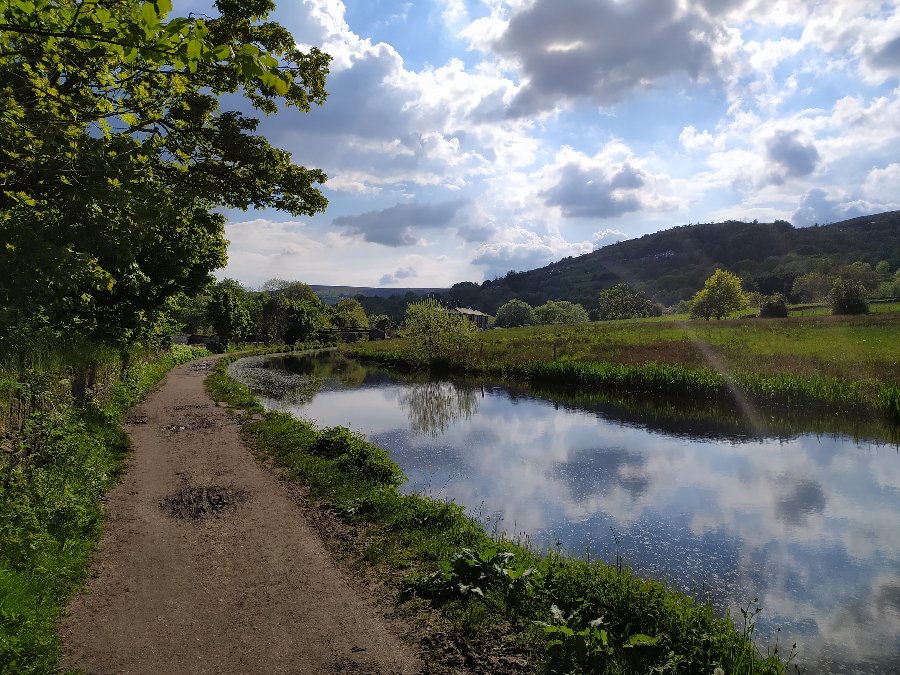
The canal is a great mirror. The stillness of the water reflecting the landscape, with barely a ripple or movement. The trees and the hills are echoed in the water. The clouds are a floating canopy, creating another dimension, a sense of the infinite, a continuous merging of land and sky. 

It is an idyllic day in early summer as we embark on a walk along the Huddersfield Narrow Canal. The sky is a carefree blue, the clouds dance through it. Along the towpath, dappled light and shade falling from the trees, stretching onwards and ahead in measured distances, marked for walking. Looking back towards Marsden village, to the backdrop of the moors, wanting to absorb, not to miss a single view. The houses and hillsides framed serenely, with wildflowers and thickets, patches of heather on the moors. The colour of the stone always feels like coming home. 

The telegraph wires suspended across the sky in lines. Ferns overhang the water, their elegant fronds distinctive, along with the branches, the dark shadows of trees. A tree spills its branches across the surface of the water, its reflection blurring impressionistically, ending there in the clarity of white clouds. The textures of the landscape layered in brushstrokes, like stepping through a painting. A picture framed in a pool of water below, dark hills above, a scattering of leaves and of light, propelled in a drift, into layers of colours. The pretty tree admires its image in the water.

A few narrowboats are moored, their coloured reflections surrounded by the trees; gypsy caravans on the water, landlocked but ready to move again. Here there are meadows and flowering trees, the scenic pause of a lock, painted black and white. A beautifully restored stone bridge, a cobbled lane leading away. I like these crossings, these intersections preserved in time. Each lock is numbered, and each bridge across. The sunken towpath passes underneath. It is damp under there and we bend our heads and lean towards the water.

The canal opens out wide, almost circular, before narrowing again into a lock entrance, towards which the water funnels. In this basin, the water reflects the clouds, the trees, the gates of the lock. The water level plunges so that it is like peering down into the depths of a dark well walled by stone. It is almost a surprise to see the water flowing, its force and light and movement. These locks of wood and iron turning cogs, using the measured weight of the water, to propel, to lift, to move. 

The path bends under trees, casting their shadows, leaning across and straying into the territory of the canal, as if swaying, bending, walking towards the water. The water has another quality to it, dark ripples shroud the reflections of the trees in mystery. They trail their leaves and branches through the mirror pool mingling with what is unsettled in the water, with a certain unexplained murkiness fragmented and immersed, stilled and agitated. 

Like much of the canal this stretch is wooded and the walls are mossy. A stream runs alongside. There are fallen leaves and hidden paths, the ground saturated by the recent rainfall. The trees bend gently obscuring the light and making it feel damper, the kind of mud that never dries out fully, dark with disintegrating leaves. Reeds and rushes grow thickly, and reflections of the trees make it almost impossible to see what’s below the surface. 

The water is densely covered to saturation with flying particles, seeds dispersed by the wind, blown across in sparkles of light and dark; a silver coated pathway travels onwards. A bright patch of light leading out into the dark canal, like a forest shaded in dark patterns of trees and light. The clouds darken again, shift their shapes in silhouetted, weighted light, outlined by the bright lines of sunlight emerging, changing the view. 

We emerge into the outskirts of Slaithwaite, a thriving Pennine village where people sit outside in cafés and bars near the waterside. The canal is a snapshot, like the cobbled streets and preserved architecture, a remnant of another time. Everywhere there are adaptations, an old mill building converted into modern apartments. Passing through the village, the towpath continues. The day has shifted and become more changeable as we cross into a part of the canal with a more industrial feel. The parts I remember most, that are indented on my memory. 

*

It is a walk I have been wanting to take for some time, to connect with my memories, with the impressions I carried with me. The canals were stilled space where once there was movement. A turbulent history mapped across the hillsides. A landscape reined in and tamed, saddened by overwork; lying forlorn and forgotten, waiting for a time when it might heal its scars. The spinning mills that were emptied and slowly given new life. Standing at the canal’s edge they overhang and overshadow; large windows in rows, reflecting the light.

I always wondered at the empty buildings left there, abandoned, derelict. The windows covered over, places of loss, places to avoid. I grew up around these buildings with their patched over windows and doorways. They followed me like shadows. Across these valleys they were everywhere. Desolate ruins blocking out the light and casting a reminder. When I close my eyes, what I picture are the shells of dark stone lying forlorn and forgotten, empty buildings and broken windows reflected in the dank still water. The shadow always remaining, the ghosts of what has gone before. 

The canal was always there in my memory. Sometimes a lonely desolate place, sometimes the sunny light feeling of walking along by the water. You could walk for miles of changing landscape, along its edges and lost waterways, crossing countryside and the hidden parts of the town. From the windows of a train travelling across the valley to Manchester. From the window of my school bus, as it wound its way through the outskirts of the town. Where the chimneys remain, when the clouds hang across the Colne Valley, the canal looks back at me.

*

The day has shifted, and the quietness is palpable. Each corner, each bend, each stretch of the canal seems to bring a new feeling, a difference to the walk. The canal becomes narrower here and the trees start to feel like they’re concealing something. There are high walls, moss-covered, ferns grow along the banks, and the trees bend closer over the water looking down on their reflections. I turn my camera towards the water and the sky lengthens out into a narrow passage of light, pulling towards the edges of the frame, a tunnel of soft, white light. 

The water feels closer, it is eerily quiet in some places. A sense of neglect, broken windows, barbed wire, and corrugated iron. The bank of clouds darker, overhanging. An abandoned building by the water’s edge, the dark symmetry of the windows reflected, slightly distorted by the water, deep and unbending, unmoving. The texture mimics a solidity the water cannot have, so that I start to wonder what it is about that part of the water that sets it apart?

The trees start to ascend the side of the building, its solid walls refuse to yield. Inside, its empty frame, the windows bricked over to conceal what lies discarded within. Through a web of tree branches, another empty structure, broken windows, semi-hidden. The trees beginning to cover the frame in shadow. Its empty soul lies reflected in the water. 

The canal feels like an intruder into the landscape, that many years later is starting to be claimed back. Over time to reflect and to blend with its surroundings, its edges to soften and become less clear cut, less distinct or separate. Blurring its lines, the hard edges cut from the land are overrun with ferns, with dandelions and grasses. Where the seeds, the falling leaves, and trailing branches corrupt the surface of the water.

Yet I think it always resisted, always retained its other quality. The one that is given away by that tendency of the water: to stand still, to resist the inevitable movement of wind and currents. There is something vacant and still, another quality to this water, as if it had a presence. In some places it looks like another surface, no longer water, lying still and undisturbed. 

We are approaching the outskirts of the town and the towpath seems endless. There is something concealed and desolate about these parts of the canal that intrigued me, that I remember. I am trying to work out where we are, where we will emerge when we leave the canal. The water churned and disconsolate from this angle. Empty buildings reflected in the water. Dark bridges and hidden pathways. In the windows, reflections of other ruins. 

***

Anna Evans is a writer from West Yorkshire, currently based in Cambridge. She writes about place and memory, travel and migration, and is working on a non-fiction project on the author Jean Rhys and the spaces in her fiction. You can follow her progress through her blogThe Street Walks In.

Epilogue

By Ian C Smith:

Walking in early light, wetlands a short drive from home, where, like the rest of the world, all is quietly closing due to this ravening plague, part of my way parallel to a usually busy highway. I think of another road, traffic-choked, in my distant past. Figuring the year I last drove it those miles ago, I reach back, meet my younger self who casts several glances at my now thin hair, assessing the ruin.

His surprise at where I live now sweetened knowing how long he shall last, he thinks the nearby gas fields recently discovered that he read about must be the reason: employment. All he has known so far is an expectation of work. I paraphrase how, why, I landed here, both linked to my late education, love, work, try to explain about these three life effects felt by most. Stunned, even excited, by where his life leads, he now wants to hear of my health, journey. Happiness.

He knows about the Spanish ‘flu, read that, too, seems more fascinated than horror-stricken by brief news of today’s scourge, but he is young. His skin fascinates me. I tell him everybody would be relieved if this present canker’s naked statistics we absorb like poison, minus the personal misery, grief, and despair, doesn’t exceed that post-WW1 mortality rate. He mentions being concerned for nothing about the nukes, thinks self-isolation, overrun intensive-care facilities, the end of sport, non-electric entertainment, connection – this propels his interest into overdrive – sounds like a fantastic movie script. He loves dystopian themes. I tell him there are more coming. I know from inside knowledge he prefers damaging news told straight, yet want to protect him, protect hope, that lifeblood. Is he too young to be thinking of worldwide virulence?

I cross the highway listening for the odd vehicle, move deeper into the salutary peace of the natural world, but see few birds. Even they seem to have shut up shop, except for a lone pelican, its exquisite wake. Cheer up, my young companion urges, slowing for me, you did so much, although it sounds like you stuffed up a lot. Ah, the chirpy ignorance of youth. How should this end? Endings trouble me.

***

Ian C Smith’s work has been published in Antipodes, BBC Radio 4 Sounds, The Dalhousie Review, Griffith Review, San Pedro River Review, Southword, The Stony Thursday Book, & Two Thirds North. His seventh book is wonder sadness madness joy, Ginninderra (Port Adelaide). He writes in the Gippsland Lakes area of Victoria, and on Flinders Island.

Searching for home beneath the horse chestnut

By Jennifer Carter:

I smelt my success before I saw it. It was the smell of the demise of fresh green leaves into brittle, curled objects that just about resembled their original shape. They were scattered across the ground. Some were almost completely rotted, whilst others lay proudly, showing off the intricate veins where their rich colours seep into one another. A paint palette of mahogany, rust, and amber.

It was the smell of Autumn.

One of my big ambitions whilst away, inland, was to collect conkers for my four-year-old daughter. I was elated to find them within only a few hours of arriving. Scrabbling around the damp, leaf littered ground, I tried to find the biggest, smallest, and smoothest. My hands were numb with cold as I unzipped the bag to place them all safely inside.

I heard a familiar thud. A conker, still in its shell, fell from the branches which leaned over me and hit the ground. That blunt, seemingly insignificant sound threw me straight into a vivid memory.

The memory of traipsing around the dell, at least that’s what we called it: a small valley in an area of parkland behind my childhood home in the Midlands. There was a mysterious old brick building there, surrounding a deep hole shut off by a metal grate, and one of the biggest horse chestnut trees I have ever seen. My mother, father, brother and I would go there every autumn, looking for conkers. I remember fondly the moments of finding a whole one, still in its shell. I would proudly squash it between my shoe and a bit of hard ground, cracking it so I could reveal the rich, dark brown fruit, fresh enough to still glow where the golden pattern adorned it.

Every year in Falmouth I look for conkers, but the sea air prevents them from developing. I moved there from the midlands 10 or so years ago, and at the time I couldn’t resist the sandy beaches, warm microclimate and laid back inhabitants of the transitional student and holiday town. But the place I had started to call home didn’t excite me anymore. The coastal environments which are so sought after, so popular for holidays, praised so highly every time mentioned, I found dull and expired.

Standing in a field surrounded by towering trees, it made sense why. I was exhilarated by being in a place where the seasons were true to how I remembered experiencing them as a child. A place where I could hear birdsong which wasn’t drowned out by the harsh calls of Herring Gulls. A place where the air wasn’t so thick with salt that chestnut trees couldn’t bear fruit.

Suddenly I noticed the distinct call of a nuthatch. I found it straight away, making its way up one of the vast trunks behind me, flying into a neighbouring tree, and continuing its journey upwards. I cherished the still, cold air, the silence, and the time to reflect on where I belonged.

***
Jennifer is a writer and photographer based in Falmouth, Cornwall. Combining a love of wildlife with her passion for life writing, Jennifer’s work often reflects on how our environment can impact the way we think and feel. She is currently studying towards an MA in Travel & Nature Writing. You can find more of her work on her website.

Walking cities with my mother

By Anandi Mishra:

Earlier this year during the covid-19 lockdowns in Delhi, I realised how much I had always loved walking not knowing why so. Flipping through old photo albums, I found photographs of myself walking in various cities. A friend or a boyfriend, always someone clicking me from the back, as the city spread itself out before me. Consuming walking nostalgia from the pre-covid era, reading different kinds of writing about walking, listening to podcasts about it, eventually I started dreaming about it. In one of those dreams, an ancient, grainy visual played. A memory from my childhood returned. My mother walking five or six steps ahead of me, as we both made our way to the nearby market in my hometown in north India, Kanpur. Watching her walk, always trying to keep pace with her, I had memorised the vision – always her walking, walking ahead, walking to or from, and me trying to follow, match her stride. That’s when I remembered how she was the one who had taught me mapping places on foot, implicitly, all throughout my childhood. 

As a working woman in the 80s and 90s of north India, my mother defied several social odds. She was married, had two kids, an extended set of in-laws to take care of and an entire household to run, yet she chose to work. In addition to that, bereft of any personal vehicles, and due to the general plight of public transport in Kanpur, she walked to most places. So much so that walking became an extension of her personality. As I started going to school, she took me along, to accompany her on most such walks.

In those times (as now) to most people, walking was the very antithesis of existing in a city as a woman. It meant a certain slowing down, attentive step by step discursive engagement with the immediate surroundings that we were meant to avoid altogether in the first place. While on such walks, several times, men shouted at us telling us to hop on their cars or bikes, or to talk to them – but my mother carried on unperturbed, too consumed in the pleasures of her walk to respond to anything.

My predominant memory of walking with my mum when I was little is how fast she walked. Walking with her, I too quickly learned to look both ways and to run across the street, pace myself out of a thick crowd and never get lost.

This was in the decades before we knew of the concept of the flaneur or flaneuse. Now as I try to recall those formative experiences of walking, Walter Benjamin’s writing comes to mind. “The street becomes a dwelling for the flâneur; he is as much at home among the facades of houses as a citizen is in his four walls…. The walls are the desk against which he presses his notebooks; news-stands are his libraries and the terraces of cafés are the balconies from which he looks down on his household after his work is done.” If not in the same length, breadth or depth, but my experience of consuming the city was somewhat the same. 

*

As we entered the twenty first century, the danger of getting lost and disconnected in technology loomed large. People fretted on the urban dweller’s dependence upon it and that it would mean an erosion or indefinite derailment of contact with others and nature. We were afraid that humans would be another notch removed from consciousness as the individual will no longer touch or be touched by what once was most natural. These fears eluded me, as I continued walking even into my late twenties. 

I experienced a strange joy in being alone on the streets of various cities, at odd hours, walking with my phone in hand. I used the phone to record what I saw around. I wrote, took photographs and videos. It was not as though I was lost, but as if I was losing myself to the city.

Benjamin writes about this: “Not to find one’s way in a city may well be uninteresting and banal. It requires ignorance – nothing more. But to lose oneself in a city – as one loses oneself in a forest – that calls for quite a different schooling. Then signboards and street names, passers-by, roofs, kiosks, or bars must speak to the wanderer like a cracking twig under his feet in the forest…”

This was similar to the meandering walks my mother took in her days. She would walk from

her office to the bookstore, to the temple and nearby sweet shop in the vicinity. Ambling, she would take in the surroundings, nod and wave and say hello to her friends and acquaintances who ran several of the businesses, who she had made friends with over the years. While accompanying her I had learnt these primal pleasures of walking, measuring a city up and down by putting one foot in front of the other.

To be able to call a place my own she taught me, required that we first stray into unfamiliar streets, at strange hours. The shock of the new, she said, will be disruptive at first, but it will also break the insulating, silken lining of culture and grooming, allowing me to sink my teeth into a new way of exploring a place. 

In walking thus so, we were able to transcend the immediate relationship of mother and daughter, and model a companionship as co-walkers. In pacing the city of my birth up and down, one foot before the other, my mother set an example for me before any of the modern day flâneuses, implicitly giving me permission to navigate my (or any) city on my own terms and make a place my own. Her constant insistence on walking, became a part of my body, culture and daily routine the way, as Garnette Cadogan writes in his seminal essay “Walking While Black”, “home became home”.

When I learned of the word “flânerie” it gave meaning and shape to my ways of reading the city by walking on foot. The Berlin flaneur Franz Hessel while writing about flânerie and flaneurs had said that they perceive passersby, streets, and fleeting impressions as the transitory signs of modernity. The more I read the more I unearthed the connections between flânerie and being a woman, and how female flânerie is a means of asserting female subjectivity in the public realm. 

In her book Flâneuse: Women Walk the City in Paris, New York, Tokyo, Venice and London Lauren Elkin elaborates on that: “Why do I walk? I walk because I like it. I like the rhythm of it, my shadow always a little ahead of me on the pavement. I like being able to stop when I like, to lean against a building and make a note in my journal, or read an email, or send a text message, and for the world to stop while I do it. Walking, paradoxically, allows for the possibility of stillness. Walking is mapping with your feet. It helps you piece a city together, connecting up neighbourhoods that might otherwise have remained discrete entities, different planets bound to each other, sustained yet remote.” 

That my hometown barely had any “walking infrastructure” did not deter my mother. In the remove of her strolls, she found solace. In sauntering, strolling, wandering, promenading, she created her own time. And I imbibed these learnings from here. To not rush through a walk as a commuter, or as a morning passenger running behind their bus.

In that way, all cities were immensely walkable. I loved pacing up and down the various soulless parts of towns, observing what was happening. Dull sidewalks were akin to the stage of a theatre. I saw people going about their odd jobs, sketchy businesses, small works, toiling away idiosyncratically. Watching people navigate through traffic, and other humans became my way of spending idle time. I invested hours in walking the sidewalks in big cities to get a broader view of how people live on the roadside, how the city is stitched together, the history and the present colliding at all times. On a drab day, walking through the melee of people that were always thronging the streets became my way of knowing my place in the world. And in the lockdown it felt poetically justified to remember that I had learnt it all from my mother.

***

Anandi Mishra is a Delhi-based writer and research communicator who has worked as a reporter for The Times of India and The Hindu. Her writing has been published by or is forthcoming in the Harvard Review, The Atlantic, Virginia Quarterly Review, Popula, LA Review of Books, and elsewhere. She tweets at @anandi010.

Where the sun sinks and is caught

By Kenn Taylor:

The city has its grids
This is one where the sun is absorbed

The disc itself fades
far off in the distance
behind towers
behind seas
Here though,
bookended by two busy roads
of bars, restaurants, entertainment halls
Are running
as warps to their weft
smaller streets 
Taking you up and down
one of the city's few hills

A rare space of peace in the city
Quiet streets
some still Georgian
cobbled, mewsed
Punctuated by pubs nestling in corners
Pubs which give it lifeblood
Boxes of energy
in otherwise
often silent
throughfares 

This is one of those places in the city
though,
where the energy lies buried
waiting to be dug up

All the faded red brick
Cracked paving stones
Black painted iron
Even occasional marble
and contemporary pre-fab
capture the sun as it retreats 

As the gold and red bounces off surfaces
Reflects in dark glass
and double yellow lines
Brings brief heat to alley beer gardens and
casts shadows
long and lean 

Sweat pricks brows nearing the top
High enough to watch the disc
slide away from view
Leaving only the vast
blood and honey glow

As you look back down the
long straight vista
and up beyond it
to the distance
the buildings step down beneath 

That energy though
flowing through the streets
warp and weft
The ghosts of dwellers and idlers,
prophets and priests,
of the past 
Remains even after dark 

***

Kenn Taylor is a writer and creative producer with a particular interest in culture, community, class and place. He was born in Birkenhead and has lived and worked in Liverpool, London, Bradford, Hull and Leeds. His work has appeared in a range of outlets from The Guardian and City Monitor to Caught by the River, Entropy and Liverpool University Press.
www.kenn-taylor.com

This City Street

By Hannah-Louise Dunne:

For Conn.

There is a place in the middle of the city, where seagulls greet the morning light with throaty squaks. Here, the burgeoning bright of the day will blink your eyes open, unwilling, though they might be. Below the seagulls, the city is a zigzag of bricks. A red hue where the wide Georgian streets lie. Or the cold grey of the fresh rain-washed roads and car parks that guide commuters around the corporate zones. In other places, glass flashes up and into the morning light. A brash presence, wrapping the ever-rising office blocks in bold illumination.

This is where we live, baby, before you arrive. Where we first imagined you into existence in the curved oblong surrounds of our small city-centre flat. Home now to our whole world, where each day we marvel at how much you’ve grown. 

At one time, the city centre all around us was home to lots of people. Teeming groups of humanity, packed into the small square footage of the heart of the city. There were families of ten or more packed with no consideration for their health or safety into small one-roomed tenements down near the Four Courts. While up around the city’s grand squares, the newly wealthy and established aristocracy vied for prominence in the surrounds of the beautiful red brick of their tall proud townhouses.

Nowadays, the city streets are quieter. There are more offices and hotels here than people. More space for cars, conferences, tourists. Money, and more money, as the city reopens after the strange events of the last year and a half, and the streets slowly fill up with lines of traffic again and car horns beep into the midday stretch.

But if you look beyond the main streets, you can still catch glimpses of ordinary life. Of generations of families living together in the dark red brick of the flats close to Holles Street. Or families still dotted in the surrounds of the grand old houses of the city all along the tree-lined roads to Donnybrook. There are students and workers too, carefully sequestered from view in the shelter of mews houses, in unexpected apartments and studios situated above office buildings, down side-streets, and in the back of office buildings where you’ll find our small city-centre home.

It’s a funny looking place. I think most people who pass by are surprised to see a house there in the midst of the zig zag of car parks and cranes. But don’t let that shock you. There are many surprises to be found around here. Just down the road lies one of Dublin’s private parks. A sanctuary for the fortunate then and now, which we eyed with envy during the lengthy lockdown, where the lucky few could unlock the gate and luxuriate in all of that green space, as they snapped open cans of designer craft beer.  

Around that square, there are tall houses that once served as homes to some of our greatest artists. We have a print of one on the wall of our sitting room. He was the younger brother of W.B. Yeats. But truthfully, I like his work best of all the Yeats family. The bold colours of his paintings sing to me as I walk past their vast canvases on the calming walls of the nearby National Gallery. Just down the road from Jack B. Yeats along the side of Fitzwilliam Square, Mainie Jellett lived. She was one of Ireland’s first abstract painters. She saw the world and made sense of it in shapes of peculiar beauty. 

It’s not all grand houses here though. Outside our building, a charming man comes to sit each day to collect spare change from passing drivers. He mans the parking meter come rain, hail or sunshine and knows everything there is to know about what goes on around here from his perch at the bottom of the steps. When we go for our daily walks around Merrion Square, to admire the louche grandeur of Oscar Wilde’s statue once more, he regales us with tales of the street and keeps a close eye on your growth, telling me every now and then; ‘You’re getting bigger every time I see you.’ 

This is our part of Dublin, where we have watched the streets change each season.  The place where you emerged into existence.  It’s waiting here to welcome you home.

***

Hannah-Louise is a former journalist, turned advertising executive and writer, who is interested in the way our past and present intersect to form and shape us. She has written about family, places she loves, and formerly, celebrity culture, for national press publications, and is currently working on her first long-form fictional work (and growing her first child). You can follow her on Medium, or catch her avoiding books on the reality of childbirth as she searches for calm waters to swim in around Ireland.