Postcard from... Cape Elizabeth

In December 1886 Captain Daniel O’Neil climbed aboard his ship, the “Annie Maguire” for a voyage north from Buenos Aires to Quebec. With him for the voyage were thirteen crew, two mates, his wife and his twelve year old son. Caught in bad weather just off the coast of Maine on Christmas Eve, O’Neil was aiming for Portland Harbour in order to take shelter and ride out the storm. On land, in the Portland Head Lighthouse atop the rocky cliffs of Cape Elizabeth, lighthouse keeper Joshua Strout was keeping watch as the clock approached midnight. It may have been Christmas Eve, but it would not be a quiet shift.

At around 11.30pm the Annie Maguire ran into the rocky ledges less than 100 feet from the lighthouse itself. Strout woke his son Joseph and his wife Mary, and they clambered down the rocks to help rescue the crew who had taken down the sails and lowered the anchors, and with the way to safety illuminated by kerosene-soaked blankets cut into strips and then set alight they managed to make it to shore. In the warmth and the safety of the lighthouse engine room, Mary Strout fed O’Neil and his family and crew the chickens that had been slaughtered for the Christmas feast. They ended up staying for three days as the Annie Maguire sat prone on the rocks. Roughly a week after the wreck the Annie Maguire broke apart, and that stormy Christmas Eve on its way north to Canada would prove to be its final journey

(Photo: Katrin Schönig)

The Playlist... Cities and Memory for Elsewhere

For the Elsewhere No.02, published in September 2015, we spoke to Stuart Fowkes about his project Cities and Memory. To find out more about the global sound map Stuart has created with the help of hundreds of contributors around the world you will have to pick up a copy of the journal, but for now he has been kind enough to create for us a special playlist to be hosted on the Elsewhere blog:

"This is a playlist I put together to showcase the range of different ways artists have reimagined and reinterpreted sounds. From Istanbul and Hamburg to Morocco and the British Museum, the approaches here vary from techno tracks built out of coffee cups, oral reconstructions inspired by TripAdvisor reviews, deep drone pieces and even full band reworkings of a field recording. It's really the tip of the iceberg though, so my best advice would be to visit the sound map, pick a location and start listening!" 

Five Questions for... Eve Richens

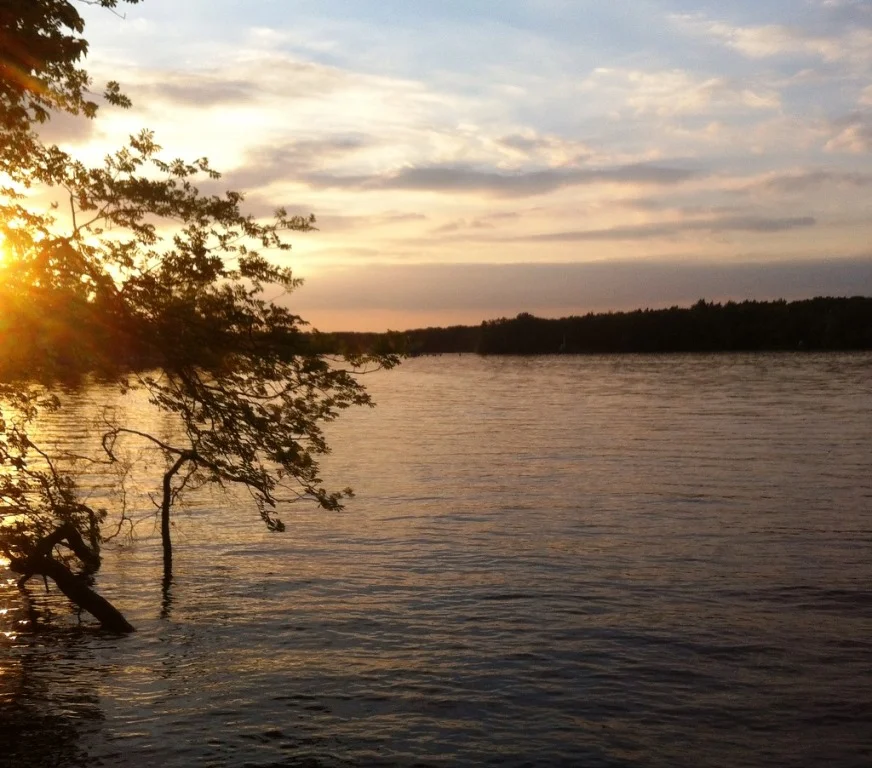
(Image: Langer See, Berlin-Grünau)

The next in our series of interviews with the contributors to Elsewhere brings us into conversation with Eve Richens. Eve not only contributed the fantastic piece Ghosts on the Beach about Arniston Bay, South Africa for Elswhere No. 01 but she also joined us on the makeshift stage at our launch party to read and talk about her writing. Originally from Suffolk, UK, Eve has lived in Berlin, Germany since 2013

What does home mean to you?

I am not too tied to the idea of home. I love where I live now, I would say home is where my bed linen is. I have always grown up with two homes so the idea of home was diluted for me. England doesn't feel like home though, it used to but now it feels like home when I step off the plane in Berlin.

Where is your favourite place?

My favourite place is probably Krumme Lanke (Berlin) right now, it's deep and cool and you can climb through the fence to get a quieter waterside spot. A close second is the British Museum. Or perhaps Grünau in Berlin… I like Grünau because it feels very alien to Berlin. It's a very fancy place full of big houses and feels a lot like middle class American suburbia. It's all quite creepy until you get to the lake. Also there are lots of accessible abandoned buildings to look at, it is close to where I live, and they have Mandarin Ducks there sometimes, which are my favourite type of duck.

What is beyond your front door?

Beyond my front door is Karl Marx Strasse and the Karl Marx shop which sells plastic things.

What place would you most like to visit?

I'd like to visit friends in Oregon now. I'd like to visit the Ocean anywhere.

What are you reading and watching right now?

I'm reading a lot of theory for essays, a lot of Bakhtin and a lot of Ted Berrigan poems. I'm always only really watching the Simpsons, I can't really watch things with people in, I can't suspend disbelief well. I'm also looking at the single giant tree in my Hof (courtyard) and the windows across the way where my neighbours are using bed sheets to block out the light and children are lining up looking out of the windows, the windows are full of children's faces right now because it's raining and sunny in 10 minute intervals.

You can read Eve’s writing in Elsewhere No.01 available from our online shop here.

The Library: Irish Journal, by Heinrich Böll

Review: Marcel Krueger

A lanky man in a raincoat and hat walks along the deck of the steamer bound for Dun Laoghaire. Irish families, travelling as cheaply as possible, have bedded down for the night, their possessions piled around them like tiny fortresses. The man overhears hushed conversations; between families, laundresses on their way home from London, priests. Sometimes he stops and leans against the railings, pretending to smoke but instead listening to the Irish complain about God and their fate. He is going to put them in a book.

Heinrich Böll (1917-1985) was always a political writer. A member of the famous German writers’ collective Gruppe 47, he started publishing novels, short stories and essays in 1949. Böll received the Nobel Prize for literature in 1972. His ideals were comparable to those of George Orwell: fiercely contesting totalitarianism, narrow-mindedness and prejudice. However, the further away from Germany he travelled, the more Böll the political novelist became Böll the explorer. And it was in this latter incarnation that he composed one of the classic works of German travel writing: his Irish Journal.

Böll and his family visited Ireland often, spending most of their summer holidays in the 1950s on Achill Island, Mayo. Appearing first as serial in Frankfurter Allgemeine newspaper, the collection was published in 1957 as Irisches Tagebuch, or ‘Irish Journal’. The journal is a series of sketches about life in Ireland, at that time a country of extreme poverty, strict Catholicism and torrential rainfall. As well as eavesdropping on conversations aboard the ferry from Holyhead, Böll strikes up conversations in pubs and, being German, marvels at how things are run without the slightest nod towards efficiency and yet still get done.

His portrait of Ireland is partly fictionalized, an idealistic rural alternative to life in industrialized Wirtschaftswunder West Germany. Böll was captivated by what he saw as a friendly, classless society living at a more leisurely pace. The contents of this short book, with an epilogue written 13 years after his first visit, is a reflection on the essence of the place that has, for some, become evergreen – in every the sense of the word. His words still reverberate with the many Germans who visit Ireland today:

“… here on this island, then, live the only people in Europe that never set out to conquer, although they were conquered several times, by Danes, Normans, Englishmen – all they sent out was priests, monks, missionaries who, by way of this strange detour via Ireland, brought the spirit of Thebaic asceticism to Europe.”

Maybe it is this idea of an innocent haven that has always drawn the visitors here. After all, Ireland was neutral during the Second World War; for the first German visitors after the war, the difference in landscape and mentality must have been striking. And maybe this fascination was somehow transported to Germany’s subconscious, and is what makes Ireland one of the favourite destinations for Germans even today.

Böll certainly plays with this perception of an innocent place steeped in mythology, and it seems to prevent him from engaging fully and critically with the Irish and their history. Some of his characters are almost stereotypically flat: the priest, the doctor’s wife, the drinker. Böll is fascinated by the poverty he sees, but to him that poverty is honourable, resulting as it does from overcrowding and a lack of resources, rather than from war and megalomania. Not once does he question the origin of this poverty, or dare to criticise the priests – he was a good Catholic himself. In his epilogue Böll even comments with horror on the arrival of the pill in Ireland. While admitting that it might liberate women and save the country from overpopulation, he writes “… this absolutely paralyzes me: the prospect that fewer children might be born in Ireland fills me with dismay”.

But this book, now 50 years old and smoothly translated by longstanding Böll translator Leila Vennewitz, was never meant to be a strict non-fiction travel report from an unbiased observer. Rather, it is a novelist’s way of both recording and making up his favourite country. Böll himself admits as much in his first sentence: ‘This Ireland exists: but whoever goes there and fails to find it has no claim on the author.” We have been warned.

This review originally appeared in our “zero edition” for the crowdfunding campaign.
Elsewhere No. 01 is out now - featuring writing from the Romney Marsh and Loch Fyne, Gyttorp and the Oderbruch, Bankstown and Nowa Huta, Arniston Bay and Prespa - get your copy via our online shop.

Postcard from... the Kickelhahn

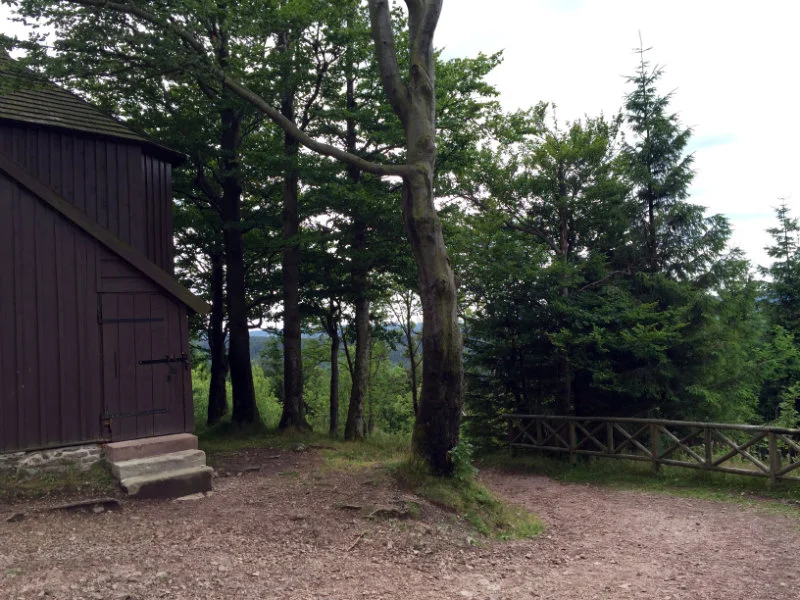
From Ilmenau the path starts steeply and does not level out until we have reached the summit. We walk through dense woods and then open space, a path lined with flowers and berry bushes and a view back across the rooftops of the town to the lake, the hardware stores and the GDR-era housing blocks at the outskirts. We keep walking – up, ever up – along stone-strewn paths and through more gloomy pine trees and then we are there. The top. A Byzantine-inspired brick tower and a view across the Thuringian forest that could inspire even the most mediocre poet…

...and of course, the greatest.

We walk along from the summit to a small wooden house with a similar view across the peaks and the valleys of the forest. In such a house, on this very spot, did Johann Wolfgang von Goethe spend the evening on the 6th September 1780 and was inspired to scrawl a poem into the wall. The hunters’ lodge burned down not long after, but the poem lived on… a Wanderer’s Nightsong for every walker of the woods:

Über allen Gipfeln
Ist Ruh,
In allen Wipfeln
Spürest du
Kaum einen Hauch;
Die Vögelein schweigen im Walde.
Warte nur, balde
Ruhest du auch.

Above all summits
it is calm.
In all the tree-tops
you feel
scarcely a breath;
The birds in the forest are silent,
just wait, soon
you will rest as well!

We stand at the top and look out across the peaks and the tree-tops. The wind blows. The buzzards soar. The sun breaks through the clouds. Just wait. Warte nur… Just wait.

The Library: 60 Degrees North, by Malachy Tallack

Review: Paul Scraton

What does home mean to you? This is a question that we ask all our contributors in the series of interviews on the Elsewhere blog, and it is a question that shapes an awful lot of writing on place. In 60 Degrees North, Malachy Tallack follows the sixtieth parallel from Shetland to, well, Shetland. Along the way he passes through Greenland, Canada, Alaska, Russia, Finland, Sweden and Norway, always following that invisible line, reflecting not only on what he discovers along the way but also on his own personal story, starting with the sudden death of his father, just at the moment he had moved to England to live with him, a moment when he thought he had left Shetland behind.

It is the loss of his father that is the starting point for Tallack’s changing relationship with Shetland and his eventual journey along the sixtieth parallel, and it is fair to say that loss is a central theme of this book. In Greenland he reflects on the loss of culture and tradition, and the complex issue surrounding increased opportunity via education for young people that, simultaneously, presents a threat to an old way of life. Another theme, also that he begins to discuss in Greenland but which follows throughout the book, is the question of our relationship to place and to land.

In Canada, he reflects on the people who live in the area around Fort Smith, one third of which are Dene – a group of northern First Nations, one third Metis – aboriginal people of mixed European and First Nations descent, and one third ‘white’. As in Greenland, Tallack leaves with a sense of a people for whom the connection to place is different to that in Europe, and one which is linked to existential factors such as how life is lived and how society is organised. In Greenland, all space is public because it is a society of hunters, not farmers. The notion of private property developed alongside agriculture, a process Tallack describes as a colonisation, an attempt to tame, to fence it off in order to harness the resources it offers. In Fort Smith, he finds a similar attitude at work:

“For the Dene, the land is not a resource, it is a presence; it is not something separate from their community, it is integral to it.”

This connection to land and place can be found all along the sixtieth parallel, perhaps because of the harsh reality of existence in the north. And Tallack leaves Canada with more questions than answers, for if “we” as Europeans have lost this connection to land and place, then can we ever truly be at home? This is one of many questions provoked by the journey around the sixtieth parallel, and it is no criticism of the book to say that Tallack does not have all the answers. Indeed, it is instead a strength of the book that it asks questions of its readers, and provokes a response that will be as individual as the circumstances of the person holding it in his or her hands.

Interestingly, one conclusion Tallack does come to as his journey progresses is that our attachment to place – and thus a feeling of being “at home” in a place – is not something innate, that we are born with or carried in our DNA. On reflecting on his own background and family history, Tallack is is clear:

“Certainly it means nothing when compared to the connections I have made in my own lifetime. For culture and history are not carried in the blood. Nor is identity. These things are not inherited, they exist only through acquaintance and familiarity. They exist in attachment.”

So although 60 Degrees North is a book about a journey, and a very personal journey at that, it is one which provokes in the reader their own internal discussion about place, attachment, and what it means to be home. For this reviewer, it meant putting the book down for a moment or two to be transported to a back garden in West Lancashire, a cliff top on Holy Island with a view across to Snowdonia, or walking the coastal path along the Baltic Sea in northern Germany. It asks big questions about humans and their connection to and impact on the land we live on, but it gets its power from the questions it asks of us as individuals and our own relationship to place. As a writer asking these questions, Malachy Tallack can only answer them for himself. For the rest of us, we have a lot to think about when we turn the final page.

Elsewhere No. 01 is out now - featuring writing from the Romney Marsh and Loch Fyne, Gyttorp and the Oderbruch, Bankstown and Nowa Huta, Arniston Bay and Prespa - get your copy via our online shop.


Sketch on the River... Bangkok

By Elsewhere’s Creative Director Julia Stone in Thailand:

I get on the river express boat at the northernmost and final stop, Nonthaburi pier. The boat is the fastest (and cheapest) way to get to China Town from where we live. There is still some time before it departs and the hard plastic seats that stick to your sweaty legs slowly fill up, with most people choosing to sit to the right of the center aisle, leaving the sunny half of the boat free. The back row is reserved for monks. The ride costs between 11 and 15 Baht depending on whether it is the no flag (stops at every pier) or orange flag (faster, leaves out the less important stops) boat and the money girl comes around shaking her tubular metal "till" to collect the fare from the new passengers at every stop. Other than her there is the captain and the "whistler" at the back of the boat where the passengers get on and off who whistles signals to the captain while he backs up the boat to the piers and who holds the boat and the pier together while the passengers get on and off (this all happens very fast, you have to be ready to jump off or else you miss your stop).

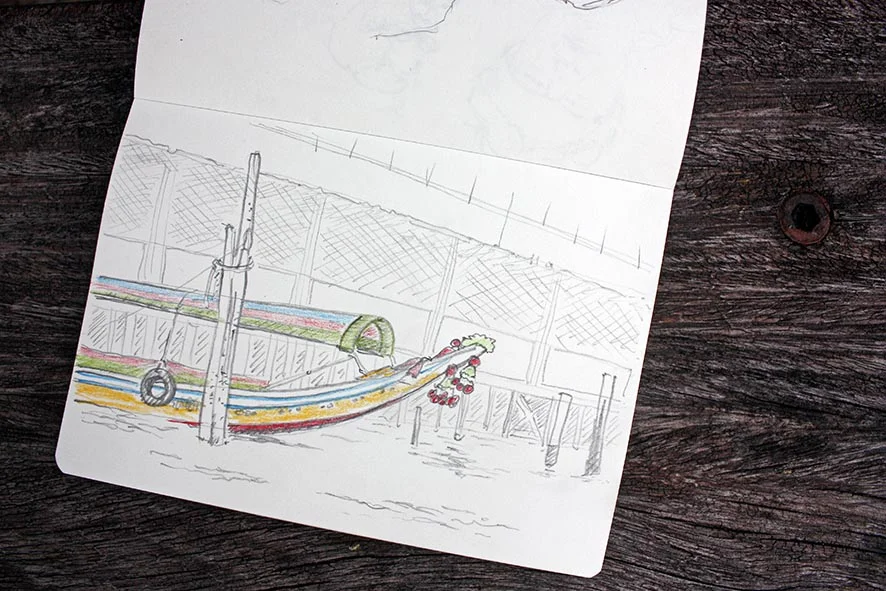
The boat is my favorite mode of transportation because I love to watch the scenery go by. Out where we live there are still lots of small houses built on stilts right on the edge of the Chaophraya, with some temples sprinkled in between them. A couple of stops on there are already more and more factories and condos, railway and car bridges passing overhead, and more people getting on and off the boat. Yet further south you pass one of the largest breweries, the place where the royal barges are kept, and Siriraj Hospital which is in itself the size of a small city. And then, all of a sudden, at one pier there are dozens of tourists waiting and we are at Banglampoo near the infamous Khao San road and just two stops from the Grand Palace. At this point the water is incredibly busy with ferries crossing from one side of to the other, as well as tourist boats, restaurant boats, hotel boats, and long-tail boats like the one in my sketch zipping to and fro, in addition to the other river expresses and the barges transporting construction material up and downstream. All the life of the river.

Elsewhere No.01, including more wonderful illustrations by Julia, is out now. Order your copy via our online shop.

Five Questions for... Julian Hoffman

The latest of our interviews with Elsewhere’s friends and contributors comes from Julian Hoffman, whose essay ‘A line of wild surprise’ appears in the first edition of the journal. If you want to read more from Julian, you can purchase Elsewhere No.01 via our online shop.  

1) What does home mean to you?

Home means many things to me: it’s a rented stone house in the valley where my wife and I live. It’s the Prespa Lakes region of northern Greece where that valley winds towards water. It’s also those smaller places that I’ve known for a long and intimate time here, like the shoreline forest of willow and silver birch on Great Prespa Lake that thrums with wild creatures. But home can also be a place I’ve only briefly known, such as the Keoladeo National Park in Rajasthan where I first discovered my enduring love of birds amidst a mysterious landscape of pools, lakes and meadows that kept shifting in and out of focus through a veil of mist.

What fascinates me about home is that to some degree we carry it with us. It’s a word we use to describe a feeling of personal belonging or equilibrium as much as a physical space. We talk of feeling at home somewhere, settled in unfamiliar surroundings as if it were actually a house we’d long inhabited. And what I find so compelling about the relationship between people and landscape, particularly at a time of enormous environmental degradation, is the possibility that we can be at home in more than one place. By forging connections to a range of places, perhaps we can better preserve and protect them within a wider landscape of home that we feel an attachment to. The American writer Sigurd Olson said that “awareness is becoming acquainted with environment wherever we are.” In that respect, I think home could be described as a quality of attention to the world around us.

2) Where is your favourite place?

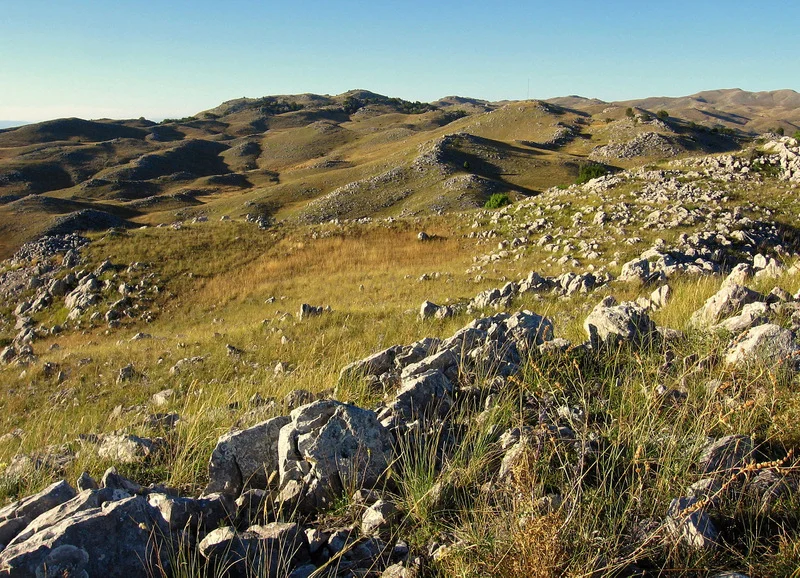
My favourite places vary because they’re contingent upon so many different things: weather, season, animal encounters, atmospheres and mood. I could never choose one over another. I love the Pennine moors the most, for example, when I walk them in mist and fog, the sheer, dense mystery of that enclosed yet open space. But the remarkable karst plateau that sits above Lesser Prespa Lake in Greece is especially wondrous to me in the long light of summer evenings, when the grasslands and stones begin to glow and the bright sparks of butterflies dance over what was once an ancient seabed. Then there’s the Hoo Peninsula at the edge of the Thames which moves me most when its big estuary skies swirl with salt, sun and cloud, when avocets lift from the sun-splashed grasses and ripple in the wind like flags.

Whenever I’m in these places, they always seem wonderful to me; it’s just that there’s a deeper, more complex attraction in those particular conditions. Place, I believe, is essentially about a relationship brokered between ourselves and a specific landscape, somewhere that’s been “claimed by feelings” and the “process of experiencing deeply” as the artist Alan Gussow puts it. Inevitably those relationships are influenced by our personal longings, fascinations and desires, which means that a place, any place, is remade, however subtly, the second we return to or remember it.

3) What is beyond your front door?

There are two extremely contrasting points of focus beyond the front door. The first is a steep rise of granite mountains that always draws my eye when I step outside, lifting from the edge of our village and marking the border between Greece and the Former Yugoslav Republic of Macedonia. But when my eyes lower from those sun-worn slopes I see our garden with the last of summer’s poppies splashed scarlet in sunlight. And over the garden wall are the tumbling ruins of an old stone house that’s gradually being engulfed by a tangle of wild clematis vines.

That house, like so many others in the valley, has most likely been abandoned since the Greek Civil War, when the population of this mountain village had around 3,000 inhabitants instead of the 150 it has today. Beyond that house are narrow lanes that converge on the village square, where you’ll find both an exquisite 1,000 year-old Byzantine church and a post office which has just had its concrete façade removed in order to restore the original stonework beneath. What the restoration work revealed, however, was a period in history as significant to this village as that ancient church: there’s an extraordinary red Communist star on the brickwork beside the front door that must have been painted there sometime during the late 1940s, when some of the final battles of the civil war unfolded in the Prespa basin as soldiers and refugees tried to escape the oncoming Royalist forces. The Prespa Lakes are home to a large colony of both Dalmatian and white pelicans, and sometimes when I see them circling high over the summer mountains I imagine how their ancestors must have been following those same ancient routes as the land beneath them erupted into violence.

4) What place would you most like to visit?

There are so many places I’d love to experience in this life, but of course there isn’t enough time to see them all, even if I could afford to! Which is part of the reason why I think landscapes can sometimes haunt us; they remind us, in a particular confluence of light, shape and season, that there are other places out there, as resonant and compelling as those we already know, but that will always remain out of reach to us. In one of her short stories, Alice Munro writes that “there are places that you long for that you might not ever see.” They exist as landscapes of the mind, though, which can be just as rich and sustaining in some respects.

But if I was to choose one place today that I would most like to visit it would be the Uyuni salt desert in Bolivia. Something about its blinding white clarity and skim of glimmering water fascinates me, both aesthetically and spiritually. It seems austere, with so little to find purchase on; and yet it glitters with a magical, baroque light. Few animals find solace in such salinity, which is why I’d love to see the flamingos that breed there in November bring their pink and carmine wash to that white and watery desert.

5) What are you reading?

I have a couple of things on the go at the moment. The first is The Sixth Extinction by Elizabeth Kolbert, a wonderfully written but sobering account of the great biological diminishing that our planet is suffering, largely as a result of human action. And it’s a list of lost species that grows ever longer through our inaction.

The other is a children’s book called The Candle Man, by Catherine Fisher. This was given to me a few weeks ago by a terrific environmental education officer in Wales called Kathy Barclay. I was with her on the Gwent Levels doing some research for a new book about threatened places and the resistance to their loss when she gave me the book to convey some sense of her own attachment to this remarkable, ancient landscape. And the book conjures the place wonderfully, the Severn Estuary constantly washing at its edges, and the reclaimed flatlands, shaped by Romans and walked across by monks attached to Tintern Abbey, riddled and crosshatched by reens, the Welsh word for the watery ditches that hold a bewildering and beautiful biodiversity. It’s essentially a children’s adventure tale, premised on the elemental tension between land and water in such a fragile, human-shaped environment, and reminds me that place is the foundation for our most potent stories.

Image: the Karst plateau, Prespa, Greece

Julian Hoffman was born in the north-east of England and grew up in Ontario, Canada. Since 2000 he has lived beside the Prespa Lakes in northern Greece. His book, The Small Heart of Things: Being at Home in a Beckoning World, was the winner of the 2012 AWP Nonfiction Award and won the 2014 National Outdoor Book Award for natural history literature.